
MundoDele Spanish Grammar
Direct and Indirect Speech in Spanish
Learn how direct and indirect speech work in Spanish sentence structure. This guide explains how to report statements, questions, commands and requests with decir que, preguntar si, question words, tense changes, pronoun changes and time expressions.
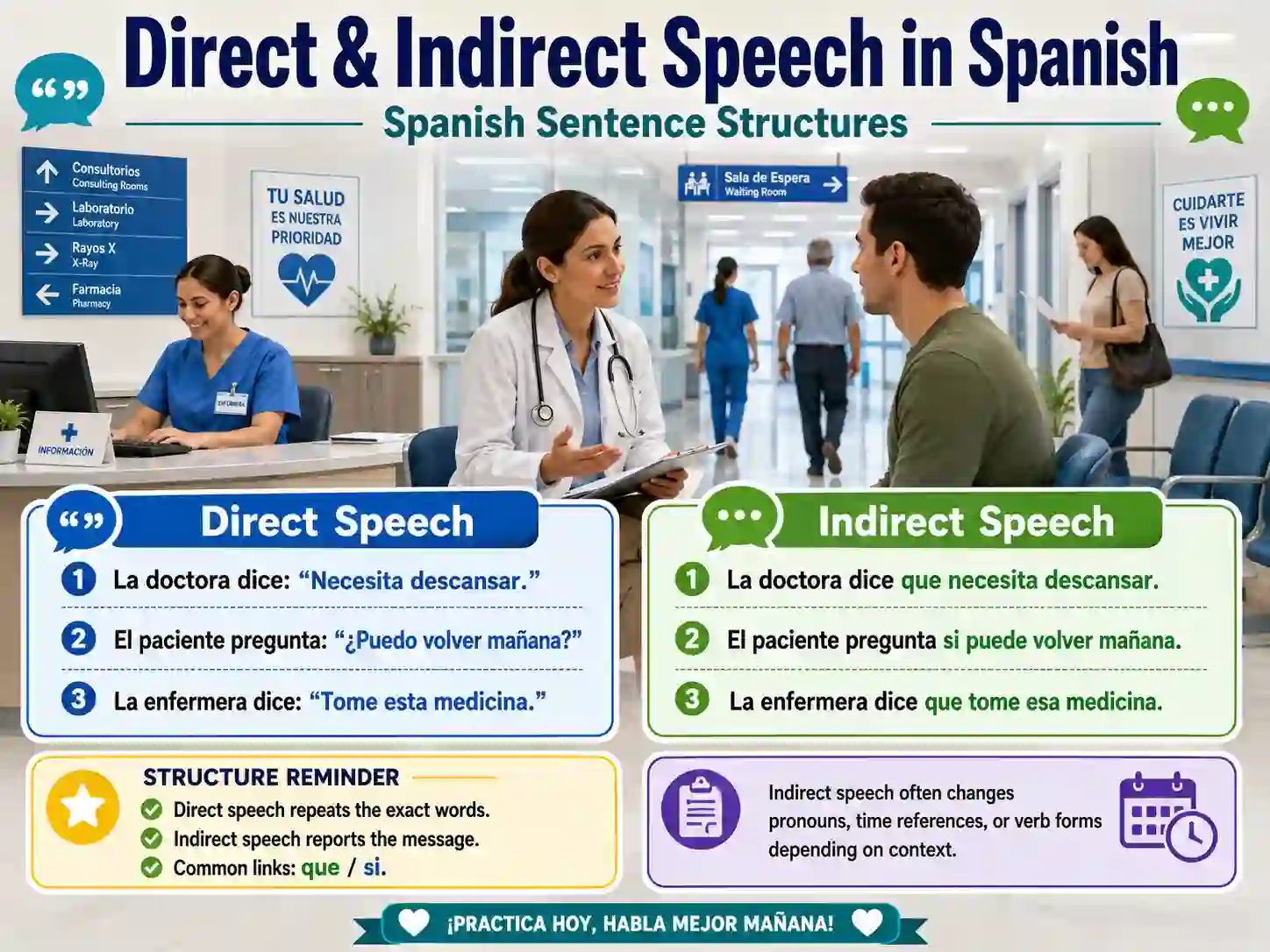
Why direct and indirect speech matters
Indirect speech helps you report conversations naturally
Direct and indirect speech are essential for telling stories, reporting conversations, writing summaries and explaining what someone said, asked or requested. The important part is not only the reporting verb, but the whole sentence structure.
Spanish adapts the original words to the new situation. That is why pronouns, verb tenses, time expressions and place expressions may change.
Dijo que estaba cansada. The reported statement uses que.
Preguntó si podía venir. The reported question uses si.
Me pidió que viniera. Reported requests often use the subjunctive.
Learning sequence
How to use this direct and indirect speech guide
Use this page as the main guide for Spanish direct and indirect speech. First compare exact quotation with reported speech. Then study reported statements, yes/no questions, information questions and commands.
Direct vs indirect
Learn the basic contrast between quoted words and reported meaning.
Reported statements
Use a reporting verb plus que.
Reported questions
Use si or keep the original question word.
Core idea
What is direct and indirect speech in Spanish?
Direct speech repeats the exact words someone said. Indirect speech reports the content of what was said, often with changes in tense, pronouns, time expressions and place expressions.
| Type | Spanish example | English meaning | Structure |
|---|---|---|---|
| Direct speech | Ana dijo: “Estoy cansada.” | Ana said: “I am tired.” | Exact quoted words. |
| Indirect speech | Ana dijo que estaba cansada. | Ana said that she was tired. | Reported statement with que. |
| Direct question | Pedro preguntó: “¿Puedes venir?” | Pedro asked: “Can you come?” | Exact quoted question. |
| Indirect question | Pedro preguntó si podía venir. | Pedro asked if I could come. | Reported yes/no question with si. |
Que
Indirect statements with que
Statements in indirect speech usually use a reporting verb plus que. The reported information becomes a subordinate clause.
| Direct speech | Indirect speech | Change | English meaning |
|---|---|---|---|
| “Estoy cansada.” | Ana dijo que estaba cansada. | estoy → estaba | Ana said that she was tired. |
| “Vivo en Madrid.” | Pedro dijo que vivía en Madrid. | vivo → vivía | Pedro said that he lived in Madrid. |
| “No tengo tiempo.” | Laura dijo que no tenía tiempo. | tengo → tenía | Laura said that she had no time. |
| “He terminado.” | Él dijo que había terminado. | he terminado → había terminado | He said that he had finished. |
Related page: Conjunctions with Que in Spanish.
Si
Indirect yes/no questions with si
Yes/no questions are reported with si, which means “if” or “whether” in this structure. The sentence no longer has the structure of a direct question.
| Direct question | Indirect question | English meaning | Connector |
|---|---|---|---|
| ¿Tienes tiempo? | Preguntó si tenía tiempo. | He/she asked if I had time. | si |
| ¿Puedes venir? | Preguntó si podía venir. | He/she asked if I could come. | si |
| ¿Has terminado? | Preguntó si había terminado. | He/she asked if I had finished. | si |
| ¿Vas a estudiar? | Preguntó si iba a estudiar. | He/she asked if I was going to study. | si |
Question words
Indirect information questions
Information questions keep their question word in indirect speech: qué, quién, cuándo, dónde, cómo, por qué or cuánto.
| Direct question | Indirect question | English meaning | Question word |
|---|---|---|---|
| ¿Dónde vives? | Preguntó dónde vivía. | He/she asked where I lived. | dónde |
| ¿Qué quieres? | Preguntó qué quería. | He/she asked what I wanted. | qué |
| ¿Cuándo llegas? | Preguntó cuándo llegaba. | He/she asked when I was arriving. | cuándo |
| ¿Cómo lo hiciste? | Preguntó cómo lo había hecho. | He/she asked how I had done it. | cómo |
| ¿Por qué estudias español? | Preguntó por qué estudiaba español. | He/she asked why I studied Spanish. | por qué |
Related page: Spanish Interrogative Pronouns.
Tense changes
Tense changes in Spanish indirect speech
When the reporting verb is in the past, Spanish often shifts the reported verb back in time. This is one of the most important parts of indirect speech.
| Direct speech tense | Direct speech | Indirect speech | Typical change |
|---|---|---|---|
| Present | “Estoy cansada.” | Dijo que estaba cansada. | Present → imperfect. |
| Preterite | “Llegué tarde.” | Dijo que había llegado tarde. | Preterite → pluperfect. |
| Present perfect | “He terminado.” | Dijo que había terminado. | Present perfect → pluperfect. |
| Future | “Iré mañana.” | Dijo que iría al día siguiente. | Future → conditional. |
| Near future | “Voy a estudiar.” | Dijo que iba a estudiar. | voy a → iba a. |
| Imperative | “Ven temprano.” | Me pidió que viniera temprano. | Command → imperfect subjunctive. |
Pronouns
Pronoun changes in indirect speech
Pronouns often change because the sentence is now reported from a different point of view. The exact change depends on who speaks, who reports and who is being addressed.
| Direct speech | Indirect speech | Change | English meaning |
|---|---|---|---|
| Ana dijo: “Estoy cansada.” | Ana dijo que estaba cansada. | yo becomes ella in meaning. | Ana said she was tired. |
| Pedro dijo: “Mi casa está cerca.” | Pedro dijo que su casa estaba cerca. | mi → su. | Pedro said his house was nearby. |
| Laura dijo: “Te llamo mañana.” | Laura dijo que me llamaría al día siguiente. | te can become me. | Laura said she would call me the next day. |
| Ellos dijeron: “Nuestro plan funciona.” | Ellos dijeron que su plan funcionaba. | nuestro → su. | They said their plan worked. |
Time and place
Time and place changes in indirect speech
Time and place expressions can change when the speech is reported later or from another place. These changes are not mechanical in every context, but they are common in standard indirect speech.
| Direct speech | Indirect speech | Example | English meaning |
|---|---|---|---|
| hoy | ese día | Dijo que trabajaba ese día. | He/she said that he/she was working that day. |
| mañana | al día siguiente | Dijo que vendría al día siguiente. | He/she said that he/she would come the next day. |
| ayer | el día anterior | Dijo que había llegado el día anterior. | He/she said that he/she had arrived the previous day. |
| aquí | allí | Dijo que vivía allí. | He/she said that he/she lived there. |
| este | ese / aquel | Dijo que ese libro era suyo. | He/she said that book was his/hers. |
Commands
Reporting commands and requests
Commands and requests are usually reported with verbs such as pedir, decir, ordenar, recomendar or aconsejar plus que and the subjunctive.
| Direct command | Indirect speech | English meaning | Structure |
|---|---|---|---|
| “Ven temprano.” | Me pidió que viniera temprano. | He/she asked me to come early. | pedir que + subjunctive |
| “No hables.” | Me dijo que no hablara. | He/she told me not to speak. | decir que + subjunctive |
| “Estudien más.” | El profesor recomendó que estudiaran más. | The teacher recommended that they study more. | recomendar que + subjunctive |
| “Esperen aquí.” | Les ordenó que esperaran allí. | He/she ordered them to wait there. | ordenar que + subjunctive |
Related page: Imperfect Subjunctive in Spanish.
Reporting verbs
Common reporting verbs in Spanish
Direct and indirect speech depend on reporting verbs. Different verbs show whether the speaker says, asks, answers, explains, denies, announces or requests something.
| Reporting verb | Meaning | Example | Typical structure |
|---|---|---|---|
| decir | to say / to tell | Dijo que estaba ocupado. | decir que |
| contar | to tell / to recount | Me contó que vivía en Sevilla. | contar que |
| preguntar | to ask | Preguntó si podía entrar. | preguntar si |
| responder | to answer | Respondió que no sabía. | responder que |
| explicar | to explain | Explicó que el sistema era nuevo. | explicar que |
| pedir | to ask / request | Pidió que esperáramos. | pedir que + subjunctive |
Detailed page: Reporting Verbs in Spanish.
Mood
Indicative or subjunctive in indirect speech?
Reported statements normally use the indicative when the content is presented as information. Reported commands, requests, recommendations and denials often use the subjunctive.
| Structure | Spanish example | Mood | Reason |
|---|---|---|---|
| decir que | Dijo que estaba cansado. | Indicative | Reported statement. |
| explicar que | Explicó que era necesario esperar. | Indicative | Reported explanation. |
| pedir que | Pidió que llegáramos temprano. | Subjunctive | Reported request. |
| recomendar que | Recomendó que estudiáramos más. | Subjunctive | Reported recommendation. |
| negar que | Negó que tuviera problemas. | Subjunctive | Reported denial. |
Related page: Indicative vs Subjunctive in Spanish.
Recommended order
Recommended learning order for direct and indirect speech
Direct vs indirect
Compare exact quotation with reported meaning.
Statements with que
Learn dijo que, explicó que and respondió que.
Questions with si
Use preguntó si for yes/no questions.
Question words
Keep qué, dónde, cuándo, cómo and por qué.
Tense changes
Learn how estoy becomes estaba and he terminado becomes había terminado.
Commands and requests
Use que and the subjunctive after reported commands and requests.
Practice
Practice exercises: direct and indirect speech in Spanish
Try to answer before opening the solutions. These exercises focus on que, si, question words, tense changes and reported commands.
Exercise 1: choose que or si
- Dijo ___ estaba cansada.
- Preguntó ___ podía venir.
- Explicó ___ el curso empezaba el lunes.
- Quería saber ___ había tiempo.
Show answers
1. que
2. si
3. que
4. si
Exercise 2: report the question
- ¿Dónde vives? → Preguntó...
- ¿Qué quieres? → Preguntó...
- ¿Cuándo llegas? → Preguntó...
- ¿Puedes venir? → Preguntó...
Show answers
1. Preguntó dónde vivía.
2. Preguntó qué quería.
3. Preguntó cuándo llegaba.
4. Preguntó si podía venir.
Exercise 3: change to indirect speech
- Ana dijo: “Estoy ocupada.”
- Pedro dijo: “He terminado.”
- Laura dijo: “Iré mañana.”
- El profesor dijo: “Estudien más.”
Show answers
1. Ana dijo que estaba ocupada.
2. Pedro dijo que había terminado.
3. Laura dijo que iría al día siguiente.
4. El profesor dijo que estudiaran más.
Typical mistakes
Typical mistakes with direct and indirect speech in Spanish
- Forgetting que in indirect statements: say dijo que estaba cansada, not dijo estaba cansada.
- Using que instead of si for yes/no questions: say preguntó si podía venir.
- Keeping direct-question structure in indirect questions: say preguntó dónde vivía.
- Forgetting tense changes after a past reporting verb: estoy often becomes estaba.
- Forgetting pronoun changes: mi casa can become su casa.
- Using indicative after reported requests: say pidió que viniera, not pidió que venía.
Where to go next
Where to go next
After direct and indirect speech, continue with reporting verbs, que and interrogative pronouns. These topics help you build sentences such as dijo que estaba cansada, preguntó si podía venir and preguntó dónde vivía.
Reporting Verbs
Learn the verbs that introduce reported speech and questions.
Conjunctions with Que
Learn how que connects reported statements.
Interrogative Pronouns
Review question words used in indirect questions.
Related guides
Continue with related Spanish grammar topics
These guides connect directly with direct and indirect speech: reporting verbs for speech structure, que for reported statements and question words for indirect questions.
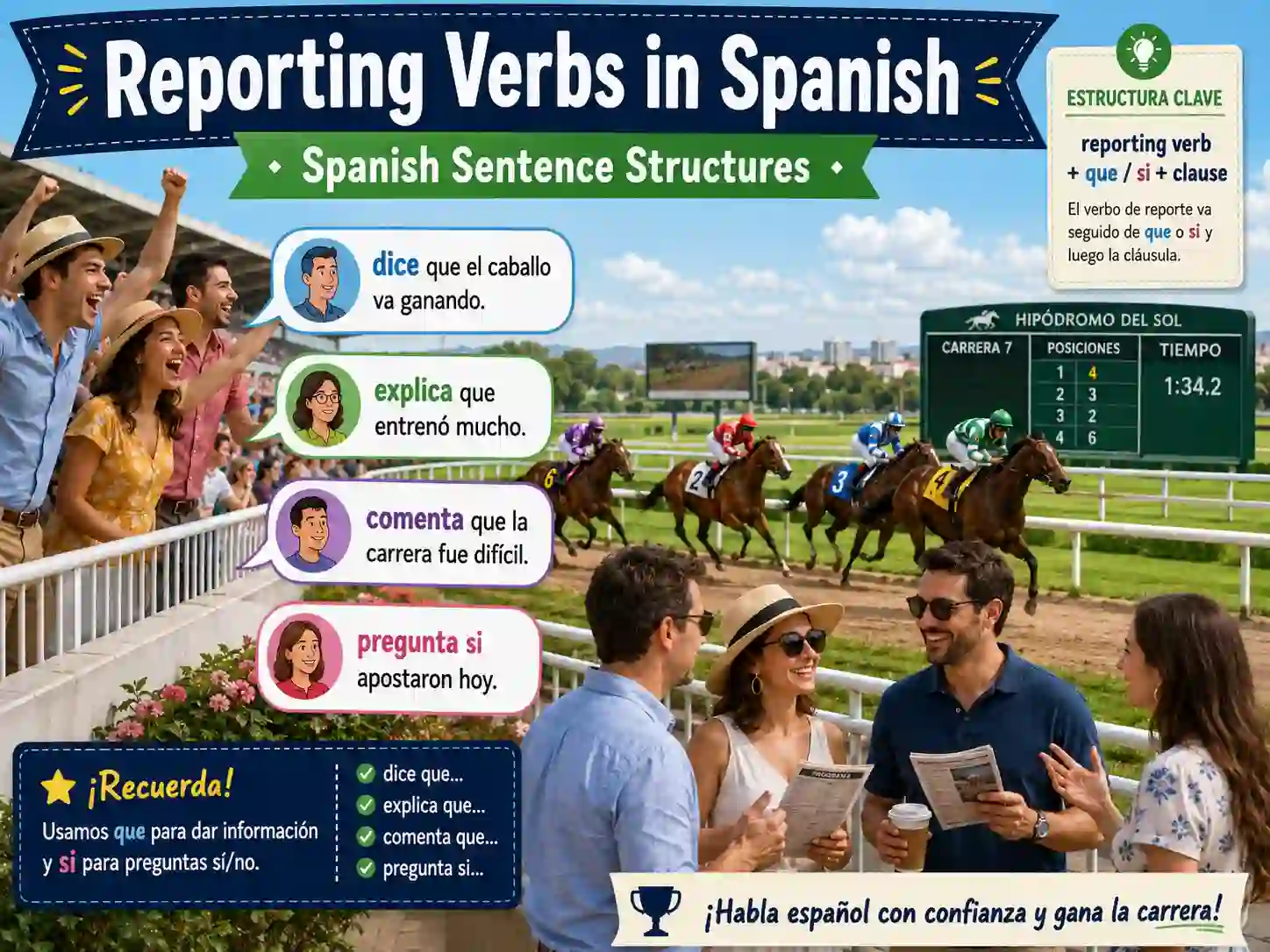
Reporting Verbs
Learn how decir, preguntar, responder and explicar introduce reported speech.
Open guide →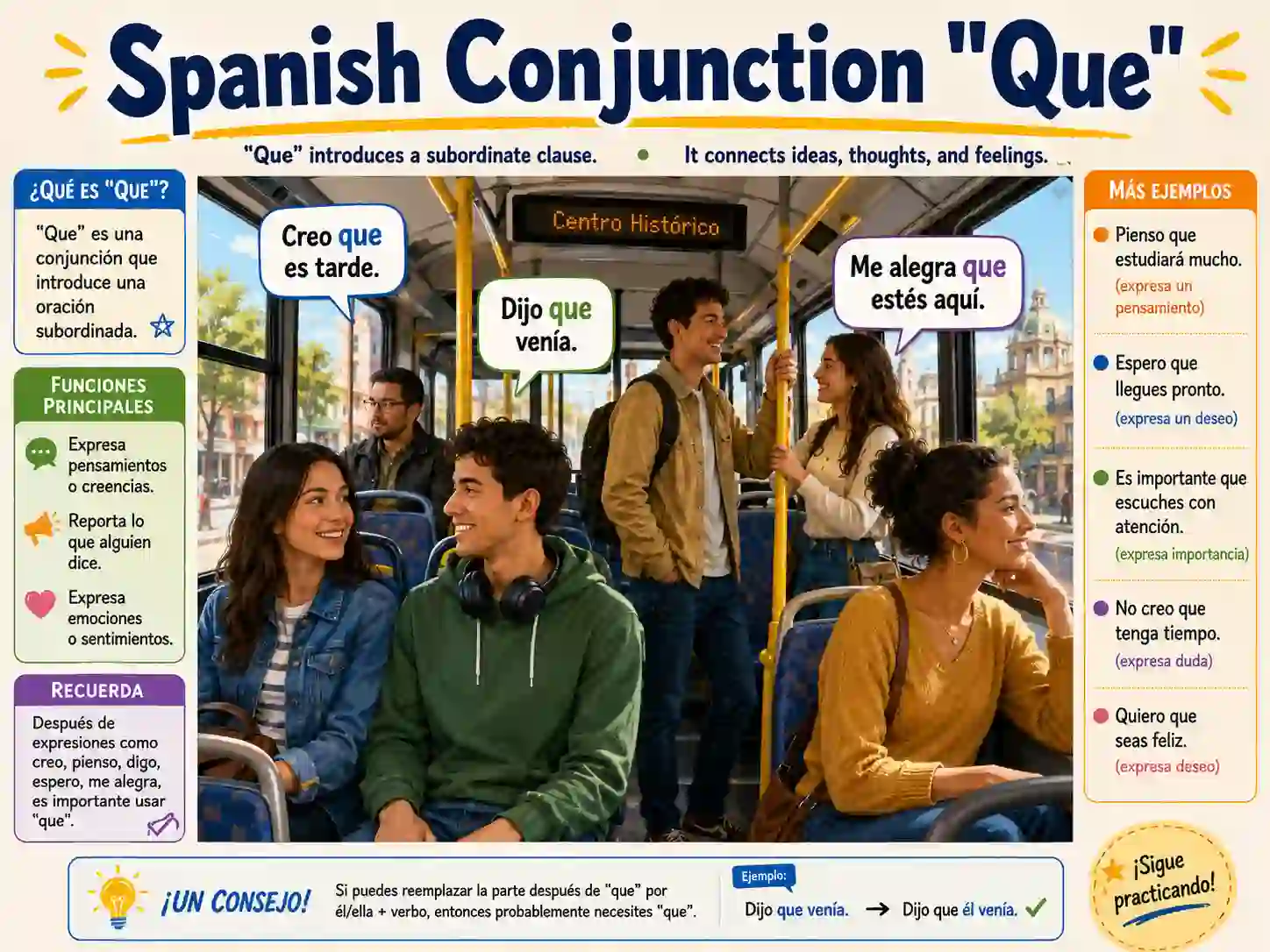
Conjunctions with Que
Learn how que connects reported statements and subordinate clauses in Spanish.
Open guide →
Interrogative Pronouns
Review qué, quién, cuándo, dónde, cómo and por qué.
Open guide →When you need help
Practise direct and indirect speech in real Spanish
Direct and indirect speech help you report conversations, questions, stories and instructions in Spanish. With MundoDele, you can learn the structure step by step through clear examples and connected grammar paths.
Spanish Tutoring
Useful if you need help with sentence structure, homework or weak points.
Private Spanish Lessons
Practise reported speech in conversation, writing and personal learning.
Intensive Spanish Course
Work through grammar, speaking and sentence structure in a focused format.
FAQ
FAQ: direct and indirect speech in Spanish
What is direct speech in Spanish?
Direct speech repeats the exact words someone said: Ana dijo: “Estoy cansada.”
What is indirect speech in Spanish?
Indirect speech reports what someone said without quoting the exact words: Ana dijo que estaba cansada.
How do you report a statement in Spanish?
Use a reporting verb plus que: dijo que estaba cansado, explicó que el curso empezaba el lunes.
How do you report a yes/no question in Spanish?
Use preguntar si: preguntó si podía venir, preguntó si había terminado.
How do you report an information question in Spanish?
Keep the question word: preguntó dónde vivía, preguntó qué quería, preguntó cuándo llegaba.
Do tenses change in Spanish indirect speech?
Often yes, especially after a past reporting verb. For example, estoy cansada can become dijo que estaba cansada.

About
About MundoDele
MundoDele connects online Spanish lessons, tutoring, intensive Spanish courses, DELE and SIELE preparation, Business Spanish, grammar resources and cultural context into one personal Spanish learning platform.
Grammar pages are designed to explain Spanish clearly, with practical examples, sentence logic and useful links to related learning support.