
MundoDele Spanish Grammar
Indicative vs Subjunctive in Spanish
Learn the difference between the Spanish indicative and subjunctive. This guide explains when Spanish presents something as fact, certainty or known information, and when it uses the subjunctive for wishes, doubts, emotions, uncertainty, purpose, hypothetical conditions and non-specific relative clauses.
Why this contrast matters
Spanish changes mood when the speaker changes perspective
The Spanish subjunctive is not only a list of endings. It is a way of showing how the speaker presents information. MundoDele explains the contrast through sentence meaning: fact, certainty, doubt, wish, emotion, purpose, hypothesis and non-specific reference.
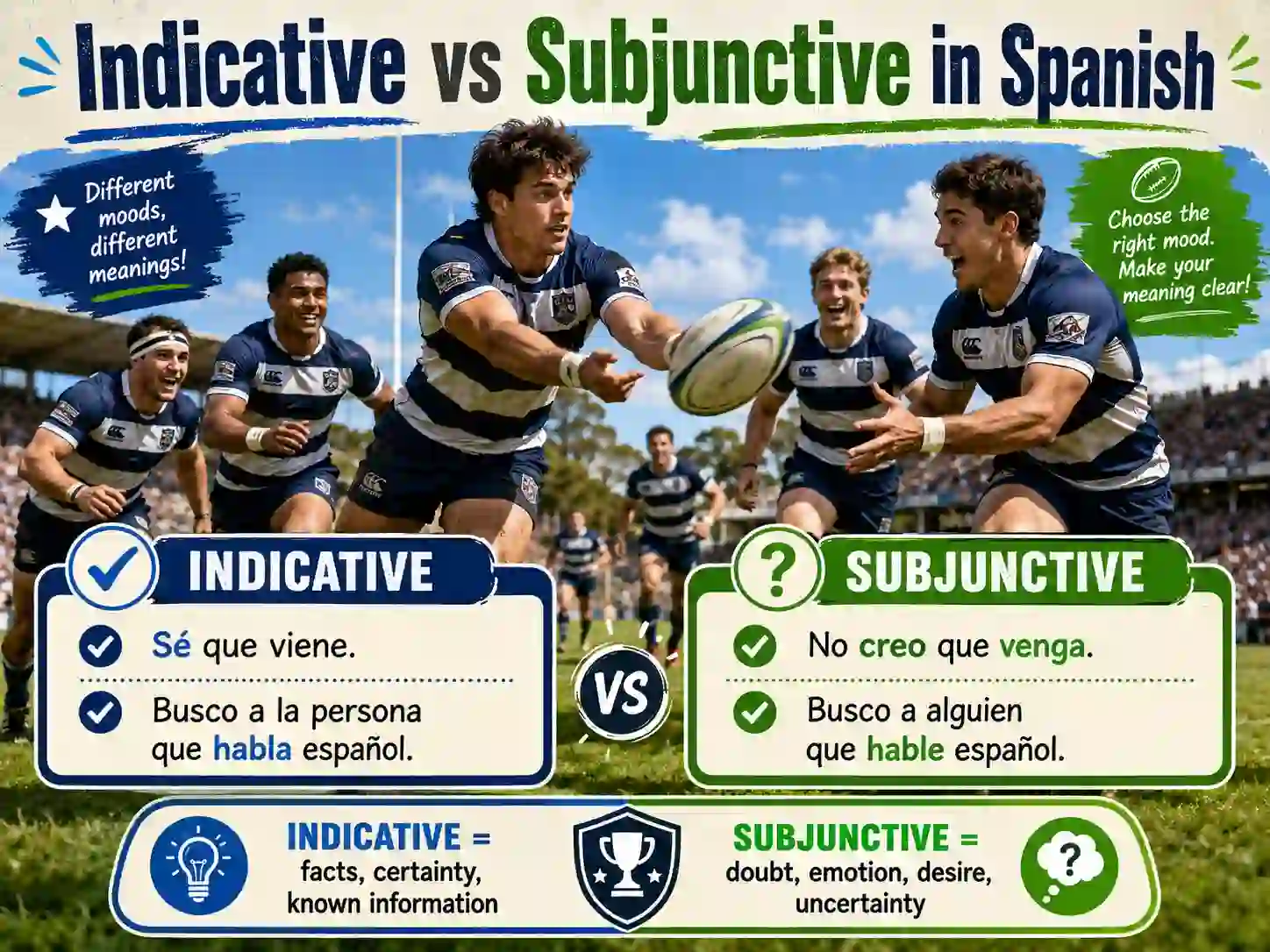
The central contrast is simple: creo que viene presents the action as believed information, while no creo que venga does not present it as accepted fact.
Sé que viene. The speaker presents the action as known or factual.
No creo que venga. The speaker does not present the action as accepted fact.
The same verb can change mood when the sentence meaning changes.
Learning sequence
How to use this indicative-subjunctive guide
Use this page as the central comparison guide for the Spanish subjunctive. First decide whether the sentence presents information as fact, certainty or known reality. Then check whether the sentence expresses wish, doubt, emotion, uncertainty, purpose, hypothesis or non-specific reference.
Recognise indicative meaning
Facts, knowledge, certainty, habitual actions and real conditions usually use the indicative.
Recognise subjunctive meaning
Wishes, doubts, emotions, purpose, uncertainty and non-specific reference often use the subjunctive.
Compare close pairs
Learn pairs such as creo que viene and no creo que venga.
Main contrast
The main difference between indicative and subjunctive
The indicative presents information as factual, known, certain or real. The subjunctive presents information as desired, doubted, uncertain, emotionally evaluated, hypothetical or not yet identified.
| Mood | Main idea | Spanish example | English meaning |
|---|---|---|---|
| Indicative | Fact or certainty | Sé que viene. | I know he/she is coming. |
| Indicative | Believed information | Creo que tienes razón. | I think you are right. |
| Subjunctive | Wish or influence | Quiero que vengas. | I want you to come. |
| Subjunctive | Doubt or denial | No creo que tengas razón. | I do not think you are right. |
| Subjunctive | Emotion or evaluation | Me alegra que estés aquí. | I am glad you are here. |
Indicative
When to use the indicative in Spanish
Use the indicative when the sentence presents something as information, fact, knowledge, certainty, habitual action or a real condition.
| Meaning | Common expression | Spanish example | Reason |
|---|---|---|---|
| Knowledge | sé que | Sé que tienes razón. | The speaker presents it as known. |
| Belief | creo que | Creo que viene. | The speaker presents it as believed information. |
| Certainty | es cierto que | Es cierto que trabaja mucho. | The statement is treated as certain. |
| Fact | es verdad que | Es verdad que vive aquí. | The statement is presented as true. |
| Real condition | si | Si tengo tiempo, voy. | The condition is real or possible. |
| Known person | conozco a alguien que | Conozco a alguien que habla español. | The person is known and specific. |
Subjunctive
When to use the subjunctive in Spanish
Use the subjunctive when the clause is not presented as plain factual information. It may be wanted, doubted, emotionally evaluated, uncertain, hypothetical, future-dependent or non-specific.
| Meaning | Common expression | Spanish example | Reason |
|---|---|---|---|
| Wish | querer que | Quiero que vengas. | The action is desired. |
| Doubt | dudar que | Dudo que sea verdad. | The statement is doubted. |
| Denial | no creer que | No creo que tengas razón. | The statement is not accepted as fact. |
| Emotion | me alegra que | Me alegra que estés aquí. | The speaker reacts emotionally. |
| Purpose | para que | Te ayudo para que apruebes. | The clause expresses purpose. |
| Unknown person | busco a alguien que | Busco a alguien que hable español. | The person is not identified yet. |
Key contrast
Creo que vs no creo que
This is one of the most important contrasts. Creo que usually takes the indicative because the speaker presents the statement as believed information. No creo que usually takes the subjunctive because the statement is denied or not accepted as fact.
| Expression | Spanish example | Mood | Explanation |
|---|---|---|---|
| creo que | Creo que Ana viene. | Indicative | The speaker thinks it is true. |
| no creo que | No creo que Ana venga. | Subjunctive | The speaker does not present it as true. |
| pienso que | Pienso que es importante. | Indicative | The opinion is presented as a statement. |
| no pienso que | No pienso que sea importante. | Subjunctive | Negative opinion or doubt. |
Certainty
Certainty vs uncertainty
Expressions of certainty usually take the indicative. Expressions of uncertainty, possibility or doubt usually take the subjunctive.
| Certainty: indicative | Uncertainty: subjunctive | Meaning difference |
|---|---|---|
| Es verdad que vive aquí. | No es verdad que viva aquí. | Confirmed fact vs denied fact. |
| Es cierto que trabaja mucho. | No es cierto que trabaje mucho. | Certainty vs denial or doubt. |
| Está claro que entiende. | No está claro que entienda. | Clear information vs uncertainty. |
| Sé que funciona. | No sé si funciona. | Knowledge vs uncertainty. With si, Spanish often uses the indicative. |
| Seguro que viene. | Es posible que venga. | Certainty vs possibility. |
Common triggers
Wishes, doubts and emotions
Wishes, doubts and emotional reactions are among the strongest reasons to use the Spanish subjunctive. They often follow the pattern: expression + que + subjunctive.
| Meaning | Expression | Spanish example | Subjunctive form |
|---|---|---|---|
| Wish | quiero que | Quiero que vengas. | vengas |
| Hope | espero que | Espero que todo salga bien. | salga |
| Doubt | dudo que | Dudo que sea verdad. | sea |
| Emotion | me alegra que | Me alegra que estés aquí. | estés |
| Regret | siento que | Siento que no puedas venir. | puedas |
Related page: Wishes, Doubts and Emotions in Spanish.
Reference
Known vs unknown people or things
In relative clauses, Spanish often chooses indicative or subjunctive according to whether the person or thing is known and specific.
| Indicative: known | Subjunctive: unknown or desired | Difference |
|---|---|---|
| Conozco a alguien que habla español. | Busco a alguien que hable español. | Known person vs person being searched for. |
| Tengo un libro que explica esto. | Necesito un libro que explique esto. | Known book vs required book. |
| Hay una tienda que vende pan sin gluten. | ¿Hay una tienda que venda pan sin gluten? | Known existence vs uncertain existence. |
| Vivo en un lugar que es tranquilo. | Quiero vivir en un lugar que sea tranquilo. | Known place vs desired place. |
Related page: Relative Clauses in Spanish Using the Subjunctive.
Conjunctions
Conjunctions: indicative or subjunctive?
Some Spanish conjunctions are usually followed by the indicative, some usually by the subjunctive, and some can take either mood depending on whether the action is factual, future, hypothetical or uncertain.
| Conjunction | Indicative example | Subjunctive example | Difference |
|---|---|---|---|
| cuando | Cuando llega, llama. | Cuando llegue, llamará. | Habitual fact vs future action. |
| aunque | Aunque llueve, salimos. | Aunque llueva, saldremos. | Factual obstacle vs possible obstacle. |
| si | Si tengo tiempo, voy. | Si tuviera tiempo, iría. | Real condition vs hypothetical condition. |
| para que | Usually not indicative in purpose clauses | Te ayudo para que apruebes. | Purpose normally takes subjunctive. |
| porque | No fui porque estaba enfermo. | Less common; special contexts only | Cause is normally presented as factual. |
If clauses
If clauses: si tengo vs si tuviera
Normal real si-clauses use the indicative. Hypothetical si-clauses use the imperfect subjunctive. This is a special and important part of the indicative-subjunctive contrast.
| Condition type | Spanish example | Mood pattern | Meaning |
|---|---|---|---|
| Real condition | Si tengo tiempo, voy. | Indicative | If I have time, I go / will go. |
| Real condition | Si llueve, nos quedamos en casa. | Indicative | If it rains, we stay at home. |
| Hypothetical condition | Si tuviera tiempo, iría. | Imperfect subjunctive + conditional | If I had time, I would go. |
| Unreal past condition | Si hubiera tenido tiempo, habría ido. | Pluperfect subjunctive + conditional perfect | If I had had time, I would have gone. |
Related page: If Clauses in Spanish Using the Subjunctive.
Same subject
Same subject: infinitive instead of subjunctive
When the subject is the same in both parts of the sentence, Spanish often uses the infinitive instead of que + subjunctive.
| Structure | Spanish example | English meaning | Reason |
|---|---|---|---|
| querer + infinitive | Quiero ir. | I want to go. | Same subject: I want, I go. |
| querer que + subjunctive | Quiero que vayas. | I want you to go. | Different subject: I want, you go. |
| para + infinitive | Estudio para aprobar. | I study in order to pass. | Same subject: I study, I pass. |
| para que + subjunctive | Te ayudo para que apruebes. | I help you so that you pass. | Different subject: I help, you pass. |
Useful forms
Useful subjunctive forms for comparison
These forms often appear in examples where Spanish contrasts the indicative and the subjunctive.
| Infinitive | Indicative example | Subjunctive example | Contrast |
|---|---|---|---|
| ser | Es verdad. | Dudo que sea verdad. | es vs sea. |
| estar | Estás aquí. | Me alegra que estés aquí. | estás vs estés. |
| tener | Tienes razón. | No creo que tengas razón. | tienes vs tengas. |
| venir | Viene mañana. | Quiero que venga mañana. | viene vs venga. |
| poder | Puede ayudar. | No hay nadie que pueda ayudar. | puede vs pueda. |
| hacer | Lo haces bien. | Prefiero que lo hagas tú. | haces vs hagas. |
Recommended order
Recommended learning order for indicative vs subjunctive
Learn the main contrast
Indicative presents information; subjunctive reacts, doubts, wants or imagines.
Learn close pairs
Practise creo que viene and no creo que venga.
Add common expressions
Use quiero que, dudo que, me alegra que and espero que.
Compare known and unknown references
Separate conozco a alguien que habla from busco a alguien que hable.
Learn if clauses
Compare si tengo, si tuviera and si hubiera tenido.
Check same or different subject
Use infinitive with the same subject and que + subjunctive with a different subject.
Practice
Practice exercises: indicative vs subjunctive
Try to answer before opening the solutions. These exercises focus on fact, certainty, doubt, wish, emotion and non-specific reference.
Exercise 1: choose the correct form
- Creo que Ana ___ mañana. venir
- No creo que Ana ___ mañana. venir
- Sé que tú ___ razón. tener
- Dudo que tú ___ razón. tener
Show answers
1. viene
2. venga
3. tienes
4. tengas
Exercise 2: identify the mood
- Quiero que vengas.
- Es cierto que trabaja mucho.
- Me alegra que estés aquí.
- Si tengo tiempo, voy.
Show answers
1. Subjunctive
2. Indicative
3. Subjunctive
4. Indicative
Exercise 3: indicative or subjunctive?
- Busco a alguien que ___ español. hablar
- Conozco a alguien que ___ español. hablar
- Cuando ___, te llamaré. llegar
- Cuando ___, siempre me llama. llegar
Show answers
1. hable
2. habla
3. llegue
4. llega
Typical mistakes
Typical mistakes with indicative and subjunctive
- Using the subjunctive after every que: que alone does not trigger the subjunctive.
- Forgetting the contrast between creo que and no creo que: creo que viene, but no creo que venga.
- Using present subjunctive after normal si clauses: say si tengo tiempo, not si tenga tiempo.
- Using indicative after wish expressions: say quiero que vengas, not quiero que vienes.
- Using subjunctive for a known person: say conozco a alguien que habla español when the person is known.
- Using indicative for a searched or unknown person: say busco a alguien que hable español.
- Learning only translations: English often looks the same, but Spanish changes mood according to how the speaker presents the clause.
Where to go next
Where to go next
After this comparison, continue with the present subjunctive and the trigger-based lessons. This helps you connect the meaning contrast with real verb forms.
Present Subjunctive
Learn the forms needed for quiero que venga, dudo que sea and busco alguien que hable.
Wishes, Doubts and Emotions
Practise the most common expression group for the subjunctive.
Relative Clauses
Learn known vs unknown references with indicative and subjunctive.
Related guides
Continue with related Spanish subjunctive topics
These guides connect directly with the indicative-subjunctive contrast: the full subjunctive overview, the present subjunctive forms and the imperfect subjunctive for hypothetical sentences.

Spanish Subjunctive
Review the full subjunctive system with forms, meanings and common sentence patterns.
Open guide →
Imperfect Subjunctive
Study tuviera, fuera, pudiera and hypothetical clauses.
Open guide →When you need help
Learn indicative and subjunctive with MundoDele
If the difference between indicative and subjunctive feels confusing, this lesson can help you practise facts, certainty, wishes, doubts, emotions, conditions, relative clauses and real Spanish sentence patterns in a clear and structured way.
Spanish Tutoring
Useful if you need help with subjunctive forms, sentence meaning or exercises.
Private Spanish Lessons
Practise indicative and subjunctive choices in conversation, writing and personal learning.
Intensive Spanish Course
Work through grammar, speaking and sentence structure in a focused format.
FAQ
FAQ: indicative vs subjunctive in Spanish
What is the difference between indicative and subjunctive in Spanish?
The indicative presents information as fact, certainty, knowledge or reality. The subjunctive presents information as wished for, doubted, uncertain, emotionally evaluated, hypothetical or non-specific.
When do you use the indicative in Spanish?
Use the indicative for facts, certainty, knowledge, believed information, habitual actions and real conditions: sé que tienes razón, creo que viene, si tengo tiempo.
When do you use the subjunctive in Spanish?
Use the subjunctive after many expressions of wish, doubt, emotion, uncertainty, purpose, hypothetical meaning and non-specific reference: quiero que vengas, dudo que sea verdad, busco a alguien que hable español.
Why is it creo que viene but no creo que venga?
Creo que viene uses the indicative because the speaker presents the action as believed information. No creo que venga uses the subjunctive because the speaker does not present it as accepted fact.
Does que always trigger the subjunctive?
No. Que alone does not trigger the subjunctive. The expression and meaning decide the mood: sé que viene, but quiero que venga.
Does si take the subjunctive in Spanish?
Normal real si-clauses use the indicative: si tengo tiempo. Hypothetical si-clauses use the imperfect subjunctive: si tuviera tiempo.

About
About MundoDele
MundoDele connects online Spanish lessons, tutoring, intensive Spanish courses, DELE and SIELE preparation, Business Spanish, grammar resources and cultural context into one personal Spanish learning platform.
Grammar pages are designed to explain Spanish clearly, with practical examples, sentence logic and useful links to related learning support.