
Spanish Articles, Nouns and Adjectives: Gender, Number & Agreement
Learn how Spanish articles, nouns and adjectives work together in full noun phrases — from el libro and la casa to las ciudades grandes and un problema importante.
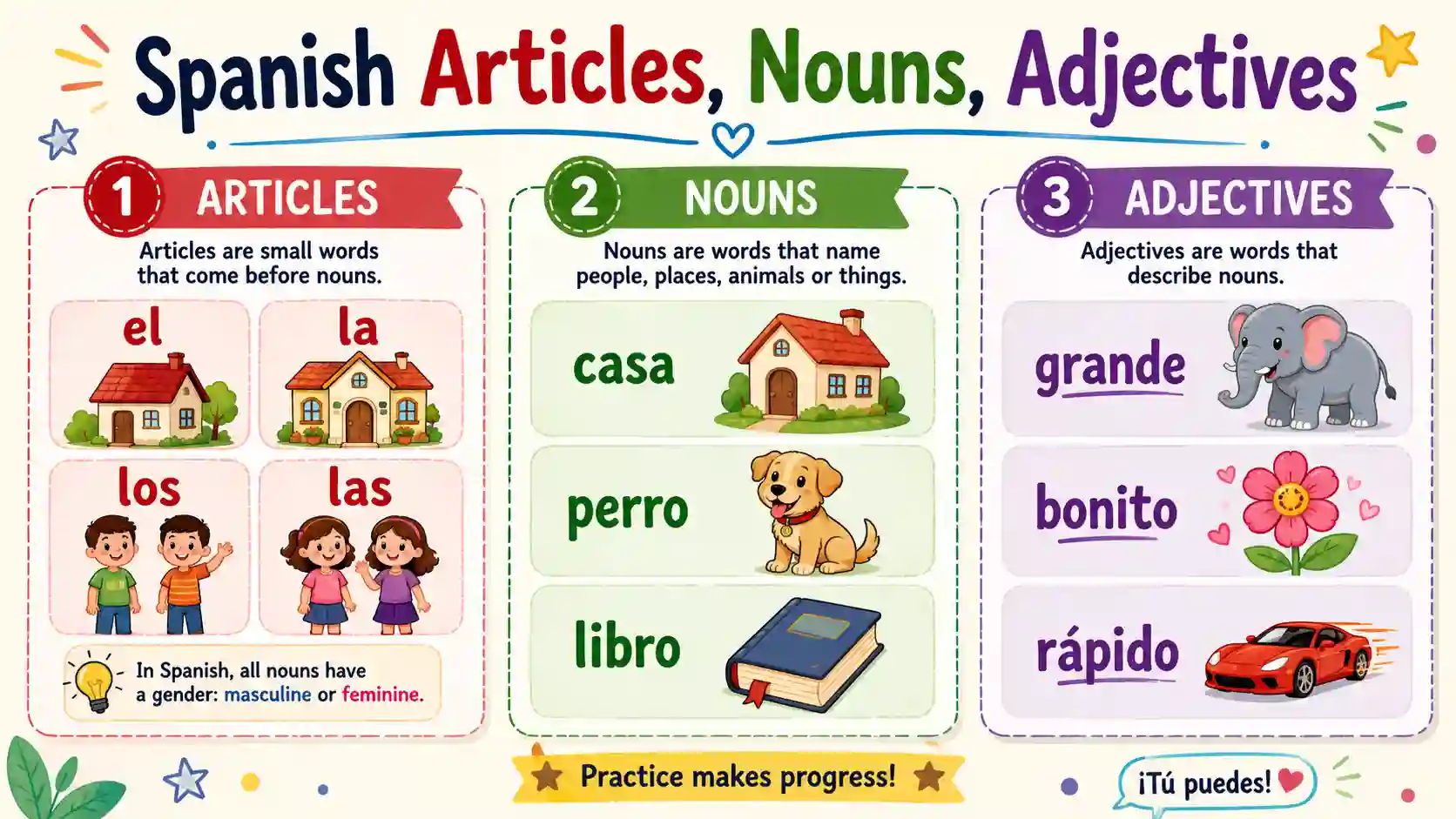
Why learn articles, nouns and adjectives together?
MundoDele teaches these topics as one connected system. A Spanish noun phrase is not built from isolated words: the article, noun and adjective must fit together, and small changes in gender, number or position can change the whole phrase.
How to use this section
Use this page as the central entry point for the grammar block after Spanish basics. Start with nouns, then articles, then adjectives, and finally comparison and superlatives.
Learn gender and plural forms: el libro, la ciudad, los problemas.
Choose definite or indefinite articles: el/la/los/las and un/una/unos/unas.
Make adjectives agree and understand position: una casa blanca, un viejo amigo.
The core system: gender, number and agreement
Gender
Nouns are usually masculine or feminine. Articles and adjectives follow that gender.
el libro nuevo · la casa nueva
Number
Nouns can be singular or plural. Articles and adjectives usually change too.
los libros nuevos · las casas nuevas
Position
Many adjectives come after the noun, but some appear before it and may change meaning.
una casa blanca · un viejo amigo
Topic overview
Spanish Nouns
Learn gender, plural forms and how nouns control article and adjective agreement.
Noun Gender
Understand patterns, exceptions and full phrase agreement with masculine and feminine nouns.
Plural Nouns
Learn -s, -es, z → c changes, accents and plural agreement.
Spanish Articles
Use definite and indefinite articles with correct gender and number.
Definite Articles
Learn el, la, los and las.
Indefinite Articles
Learn un, una, unos and unas.
Spanish Adjectives
Learn adjective agreement, position, intensifiers and meaning changes.
Comparatives
Compare nouns and qualities with más que, menos que and tan como.
Superlatives
Express “the most”, “the least” and strong adjective emphasis.
Typical mistakes in this grammar area
- Learning nouns without articles: memorize el libro or la ciudad, not only the noun.
- Changing only one word: in Spanish, article, noun and adjective often change together.
- Trusting endings blindly: el problema is masculine although it ends in -a.
- Using English adjective order automatically: Spanish often places adjectives after the noun.
- Forgetting meaning changes: un viejo amigo and un amigo viejo do not mean the same thing.
Where to go next
After this block, continue with determiners, pronouns and verbs. These areas build on noun gender, number and agreement.
Want personal guidance?
If gender, articles and adjective agreement feel confusing, individual guidance can help you build correct Spanish noun phrases and use them naturally in speaking and writing.
FAQ: Spanish articles, nouns and adjectives
Why should articles, nouns and adjectives be learned together?
Because Spanish noun phrases depend on agreement. The noun controls the article and often the adjective too.
What does agreement mean in Spanish?
Agreement means that articles and adjectives usually match the noun in gender and number.
What should I learn first: nouns, articles or adjectives?
Start with nouns and gender, then articles, then plural forms and adjectives.
Do adjectives always come after nouns in Spanish?
No. Many adjectives come after the noun, but some can come before it for emphasis, subjectivity or meaning change.
What comes after this grammar block?
After articles, nouns and adjectives, continue with determiners, pronouns and verbs.

MundoDele – Spanish learning for education, work and intercultural understanding
MundoDele connects online Spanish courses, DELE preparation, Business Spanish and cultural context into a personal Spanish learning platform.
Travel and culture content help you understand Spanish not as abstract grammar, but as language used in real situations, conversations and written communication.