
Spanish Prepositions
Learn Spanish prepositions with MundoDele. This grammar hub explains a, de, en, con, por, para, por vs para, prepositions of place, prepositions of time and Spanish prepositional phrases.
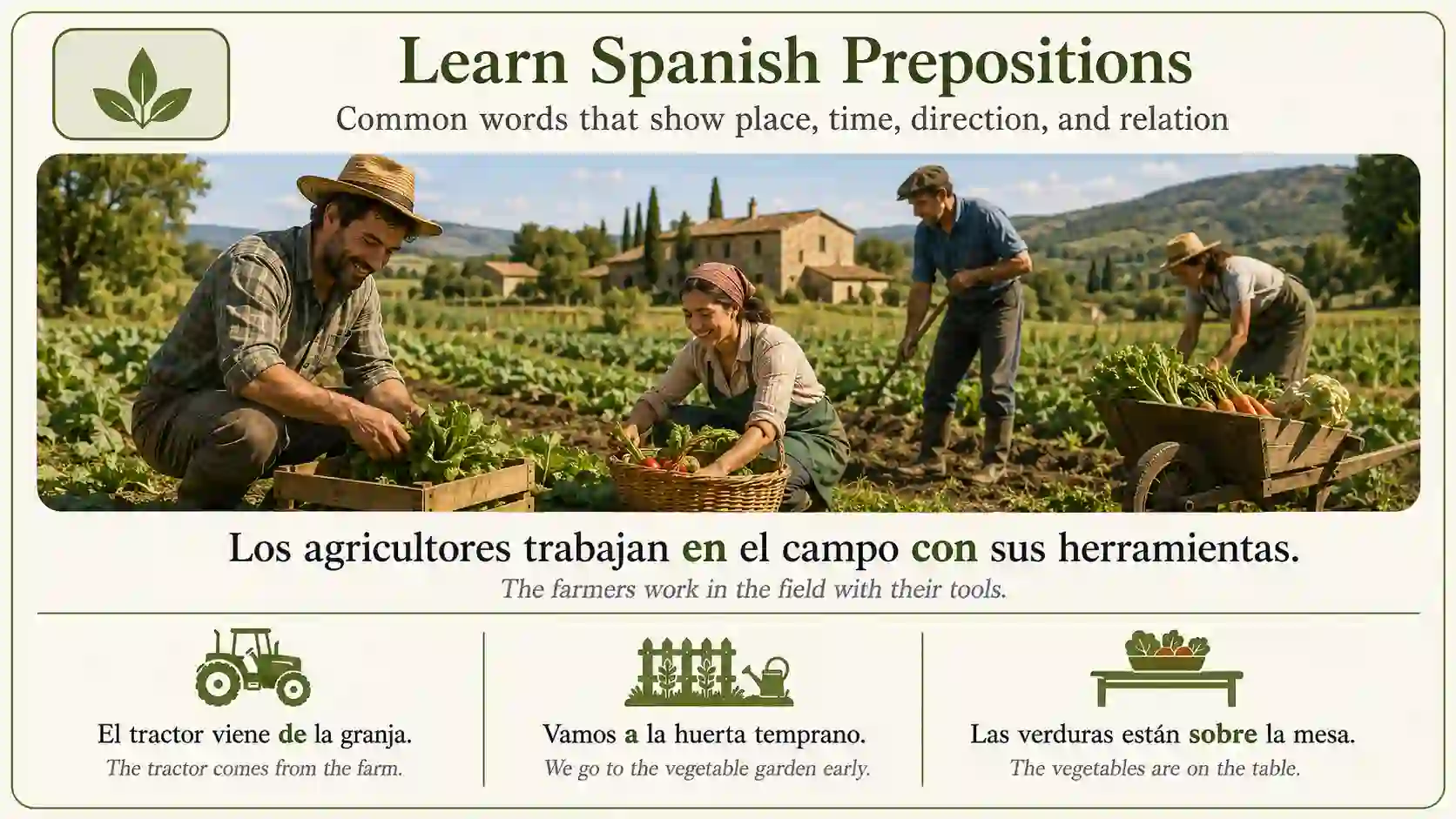
Why learn Spanish prepositions with MundoDele?
Spanish prepositions are small words, but they carry major meaning. They decide whether a sentence expresses location, movement, origin, purpose, possession, time or relationship.
MundoDele explains Spanish prepositions as sentence patterns, not as isolated translations. This is important because one English preposition can often become several different Spanish prepositions.
How to use this Spanish prepositions hub
Start with the six core prepositions: a, de, en, con, por and para. Then continue with the comparison pages and the thematic pages for place, time and full prepositional phrases.
Place and movement
Use prepositions to show where something is, where it goes or where it comes from.
Estoy en casa. Voy a casa. Vengo de casa.
Cause and purpose
Use por for many causes and reasons; use para for many purposes and goals.
No salimos por la lluvia. Estudio para aprender.
People and objects
Use prepositions to mark company, possession, recipients and personal objects.
Voy con Ana. Es el libro de Ana. Veo a Ana.
What are Spanish prepositions?
Spanish prepositions are words that connect nouns, pronouns, infinitives or phrases to the rest of the sentence. They help explain relationships such as location, direction, origin, possession, cause, purpose, time, means, company and topic.
| Preposition | Main meaning | Spanish example | English meaning |
|---|---|---|---|
| a | Direction, time, personal object | Voy a Madrid. Veo a Ana. | I am going to Madrid. I see Ana. |
| de | Origin, possession, material | Soy de México. Es el libro de Ana. | I am from Mexico. It is Ana’s book. |
| en | Location, time frame, transport | Estoy en casa. Viajo en enero. | I am at home. I travel in January. |
| con | Company, instrument, manner | Voy con Ana. Escribo con un lápiz. | I go with Ana. I write with a pencil. |
| por | Cause, route, exchange, duration | No salimos por la lluvia. | We did not go out because of the rain. |
| para | Purpose, recipient, deadline | Estudio para aprender. | I study in order to learn. |
Core Spanish prepositions
These are the core pages in the MundoDele Spanish prepositions cluster. Each page explains one preposition with rules, examples, typical mistakes and practice exercises.
A in Spanish
Learn a for movement, clock time, indirect objects, the personal a, ir a + infinitive and al.
De in Spanish
Learn de for origin, possession, material, topic, quantity, time ranges, fixed expressions and del.
En in Spanish
Learn en for location, surfaces, months, years, transport, states, activities and contrasts with a and de.
Con in Spanish
Learn con for company, tools, manner, ingredients, characteristics, fixed verbs, conmigo and contigo.
Por in Spanish
Learn por for cause, route, exchange, price, duration, means, passive agents and common expressions.
Para in Spanish
Learn para for purpose, intended use, recipient, destination, deadline, opinion and comparison with expectation.
Important preposition comparisons
Many mistakes happen because English uses one word where Spanish uses different prepositions. These comparison pages help learners choose the right preposition by sentence meaning.
Por vs Para
Compare cause, route, exchange and duration with purpose, recipient, destination and deadline.
Prepositions of Place
Learn location, direction, origin and position with en, a, de, cerca de and more.
Prepositions of Time
Learn a las ocho, en enero, por la mañana, para mañana and related time patterns.
Prepositional Phrases
Learn how Spanish prepositions combine with nouns, pronouns, infinitives and fixed expressions.
Prepositional Pronouns
Study forms such as mí, ti, él, ella, conmigo and contigo.
Spanish Grammar
Return to the full Spanish grammar hub and connect prepositions with verbs, pronouns, tenses and sentence structure.
Spanish prepositions by function
A good way to learn Spanish prepositions is to ask what the sentence needs: location, movement, origin, cause, purpose, time, company, material, recipient or topic.
| Function | Common preposition | Spanish example | Meaning |
|---|---|---|---|
| Location | en | Estoy en casa. | I am at home. |
| Destination | a | Voy a la escuela. | I am going to school. |
| Origin | de | Soy de Madrid. | I am from Madrid. |
| Company | con | Voy con Ana. | I am going with Ana. |
| Cause | por | No salimos por la lluvia. | We did not go out because of the rain. |
| Purpose | para | Estudio para aprender. | I study in order to learn. |
| Possession | de | El libro de Ana. | Ana’s book. |
| Recipient | a / para | Le doy el libro a Ana. Es para Ana. | Recipient or intended person. |
| Clock time | a | La clase empieza a las ocho. | The class starts at eight. |
| Month or year | en | Viajo en enero. | I travel in January. |
Place and time with Spanish prepositions
Place and time are two of the most important areas for prepositions. The same English word may require different Spanish prepositions depending on whether the sentence gives a location, direction, origin, time point or time period.
| Area | Spanish example | English meaning | Why this preposition? |
|---|---|---|---|
| Static location | Estoy en casa. | I am at home. | En gives location. |
| Movement to a place | Voy a casa. | I am going home. | A gives direction. |
| Coming from a place | Vengo de casa. | I am coming from home. | De gives origin. |
| Clock time | Empieza a las ocho. | It starts at eight. | A marks clock time. |
| Month | Viajo en enero. | I travel in January. | En marks a time frame. |
| Deadline | Lo necesito para mañana. | I need it by tomorrow. | Para marks a target time. |
Why por and para need special attention
Por and para are often difficult because both can sometimes be translated as “for”. The difference is not the English word, but the Spanish sentence logic.
| Meaning | Por | Para | Contrast |
|---|---|---|---|
| Cause vs purpose | No salimos por la lluvia. | Salimos para comprar pan. | Because of rain vs in order to buy bread. |
| Route vs destination | Caminamos por el parque. | Salimos para Madrid. | Through a place vs toward a destination. |
| Exchange vs recipient | Lo compré por diez euros. | Lo compré para Ana. | Price paid vs person who receives it. |
| Duration vs deadline | Estudié por dos horas. | El informe es para mañana. | Length of time vs target date. |
Detailed comparison: Por vs Para in Spanish.
Important contractions: al and del
Spanish has two mandatory contractions with common prepositions: a + el = al and de + el = del.
| Combination | Correct form | Spanish example | English meaning |
|---|---|---|---|
| a + el | al | Voy al mercado. | I am going to the market. |
| de + el | del | Vengo del mercado. | I am coming from the market. |
| a + la | a la | Voy a la escuela. | I am going to school. |
| de + la | de la | Vengo de la oficina. | I am coming from the office. |
Spanish prepositions and pronouns
After many prepositions, Spanish uses prepositional pronouns such as mí, ti, él and ella. With con, Spanish has special forms: conmigo, contigo and consigo.
| Meaning | Spanish form | Example | Comment |
|---|---|---|---|
| For me / to me | para mí / a mí | Para mí, es importante. | Prepositional pronoun. |
| With me | conmigo | Ven conmigo. | Special form with con. |
| With you | contigo | Quiero hablar contigo. | Special form with con. |
| With him | con él | Voy con él. | Regular prepositional pronoun. |
Related page: Spanish Prepositional Pronouns.
Practice exercises: Spanish prepositions
Try to answer before opening the solutions. These exercises review the most important prepositions in this cluster.
Exercise 1: choose a, de or en
- Estoy ___ casa.
- Voy ___ casa.
- Vengo ___ casa.
- Vivo ___ Madrid.
Show answers
1. en
2. a
3. de
4. en
Exercise 2: choose por or para
- Gracias ___ tu ayuda.
- Estudio ___ aprender español.
- Lo compré ___ diez euros.
- Necesito el informe ___ mañana.
Show answers
1. por
2. para
3. por
4. para
Exercise 3: identify the function
- Voy con Ana.
- El libro de Ana.
- Veo a Ana.
- Viajo en enero.
Show answers
1. Company
2. Possession
3. Personal a
4. Time frame
Typical mistakes with Spanish prepositions
- Translating English prepositions mechanically: English “for”, “in”, “on”, “at” and “to” do not map one-to-one into Spanish.
- Confusing a and en: use a for movement and en for location.
- Confusing de and en: use de for origin or material and en for location or time frame.
- Forgetting al and del: say al mercado and del mercado.
- Confusing por and para: use sentence meaning, not the English word “for”.
- Forgetting the personal a: say veo a Ana, not veo Ana.
- Using con mí or con ti: say conmigo and contigo.
Where to go next
If you are starting from this hub, the best next step is to study a, de and en first. Then continue with con, por, para and the comparison page por vs para.
Learn Spanish grammar with MundoDele
Spanish prepositions become easier when you learn them through sentence meaning: movement, location, origin, company, cause, purpose, time and relationship. MundoDele connects these patterns with clear examples, exercises and structured grammar paths.
FAQ: Spanish prepositions
What are Spanish prepositions?
Spanish prepositions are words that connect nouns, pronouns, infinitives or phrases to the rest of a sentence. They show relationships such as direction, origin, location, possession, cause, purpose, company, time and topic.
What are the most important Spanish prepositions?
The most important Spanish prepositions include a, de, en, con, por and para. Other common expressions include cerca de, delante de, después de and antes de.
What is the difference between a and en?
A usually expresses direction or destination: voy a casa. En usually expresses location: estoy en casa.
What is the difference between de and en?
De often expresses origin, possession or material: soy de México, mesa de madera. En often expresses location or time frame: vivo en México, en enero.
Why are por and para difficult?
Por and para are difficult because both can sometimes translate as “for” in English. Por often expresses cause, route, exchange or duration. Para often expresses purpose, recipient, destination or deadline.
What are al and del in Spanish?
Al is the contraction of a + el. Del is the contraction of de + el. For example: voy al mercado and vengo del mercado.

About MundoDele
MundoDele connects online Spanish courses, DELE preparation, Business Spanish and cultural context into a personal Spanish learning platform.
Grammar pages are designed to explain Spanish clearly, with practical examples, real sentence logic and connected learning paths.