
MundoDele Spanish Grammar
Spanish Tenses: Complete Guide and Overview
Learn the main Spanish tenses and how they fit together. This guide explains present tense, near future, future tense, conditional, preterite, imperfect, present perfect, pluperfect, future perfect, conditional perfect and compound tenses.
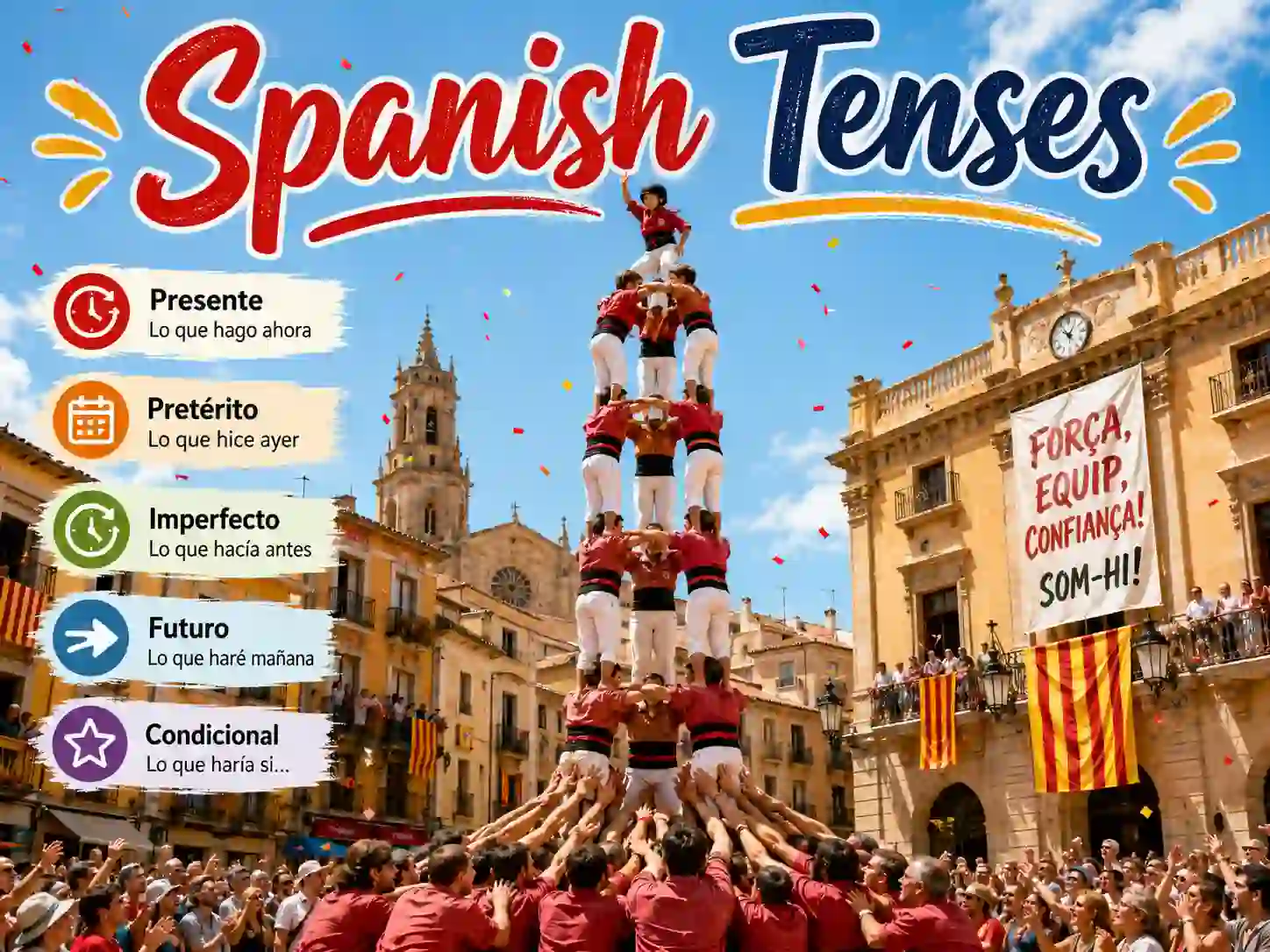
Why tense choice matters
Spanish tenses are not only about time
Spanish tenses show time, but they also show how the speaker presents the action: completed, repeated, ongoing, planned, hypothetical, connected to the present or placed before another action.
For example, comí, comía, he comido, había comido, comeré and comería all refer to “to eat”, but they do not describe the action in the same way.
Present, past, future and conditional forms place the action in a time frame.
Preterite and imperfect show whether a past action is completed, habitual or background.
Compound tenses with haber connect actions to another moment.
Learning sequence
How to use this Spanish tenses overview
Use this page as a map of the Spanish tense system. Start with the present tense. Then move to the main past tenses: preterite and imperfect. After that, study compound tenses with haber, then future and conditional forms.
1. Learn simple forms
Start with hablo, hablé, hablaba, hablaré and hablaría.
2. Add compound forms
Study he hablado, había hablado, habré hablado and habría hablado.
3. Compare meanings
Spanish often depends on contrast: hablé vs hablaba, or he comido vs comí.
Tense table
Spanish tenses at a glance
This table gives a practical overview of the main Spanish tenses, their forms and their typical meaning.
| Tense | Example | Basic meaning | Main use | Detail page |
|---|---|---|---|---|
| Present tense | hablo | I speak / I am speaking | Current actions, habits, facts and states | Present Tense |
| Near future | voy a hablar | I am going to speak | Plans, intention and near future actions | Near Future |
| Future tense | hablaré | I will speak | Future actions, predictions and promises | Future Tense |
| Conditional | hablaría | I would speak | Hypothetical actions, polite requests and possibilities | Conditional |
| Preterite | hablé | I spoke | Completed past actions and story events | Preterite |
| Imperfect | hablaba | I was speaking / I used to speak | Background, descriptions, habits and ongoing past | Imperfect |
| Present perfect | he hablado | I have spoken | Completed actions connected to the present | Present Perfect |
| Pluperfect | había hablado | I/he/she had spoken | Past-before-past meaning | Pluperfect |
| Future perfect | habré hablado | I will have spoken | Completed future action or future assumption | Future Perfect |
| Conditional perfect | habría hablado | I would have spoken | Hypothetical completed actions | Conditional Perfect |
Present-related forms
Present and present-related tenses
The present tense is the starting point for most learners. The near future and present perfect build from basic present-time logic.
Present Tense
Learn hablo, como, vivo, soy, estoy and voy.
Hablo español.
I speak Spanish.
Near Future
Use ir a + infinitive for plans and near future actions.
Voy a estudiar.
I am going to study.
Present Perfect
Use he + participle for present relevance and experience.
He terminado.
I have finished.
Past tenses
Past tenses in Spanish
Spanish past tenses are especially important because they separate completed events from background, habits, ongoing situations and actions completed before another past moment.
Preterite
Use the preterite for finished past actions and story events.
Ayer hablé con Ana.
Yesterday I spoke with Ana.
Irregular Preterite
Study forms such as tuve, hice, fui, dije and traje.
Tuve un problema.
I had a problem.
Imperfect
Use the imperfect for descriptions, background, routines and ongoing past actions.
Cuando era niño, leía mucho.
When I was a child, I read a lot.
Preterite vs Imperfect
Compare completed actions with background and habits.
Dormía cuando sonó el teléfono.
I was sleeping when the phone rang.
Present Perfect vs Preterite
Compare he comido with comí.
Hoy he comido. Ayer comí.
Today I have eaten. Yesterday I ate.
Pluperfect
Use había + participle for actions completed before another past moment.
Ya había salido.
He/she had already left.
Future and conditional
Future and conditional tenses
Future and conditional forms are used for predictions, plans, promises, assumptions, polite statements and hypothetical situations.
Future Tense
Use the future tense for predictions, promises and future actions.
Hablaré contigo mañana.
I will speak with you tomorrow.
Future Perfect
Use habré + participle for future completion or assumptions.
Habré terminado para las ocho.
I will have finished by eight.
Conditional
Use the conditional for hypothetical actions, polite requests and possibilities.
Me gustaría aprender español.
I would like to learn Spanish.
Conditional Perfect
Use habría + participle for completed hypothetical actions.
Habría llamado antes.
I would have called earlier.
Compound Tenses
Study the full haber + past participle system.
he hablado, había hablado, habré hablado
Spanish Verbs
Review regular, irregular, auxiliary, modal and reflexive verbs.
ser, estar, tener, ir, haber
Form logic
Simple tenses vs compound tenses
Spanish simple tenses use one conjugated verb form. Compound tenses use haber plus a past participle. This distinction is central for understanding forms such as hablo, hablé, he hablado and había hablado.
| Type | Spanish example | English meaning | Explanation |
|---|---|---|---|
| Simple present | hablo | I speak / I am speaking | One conjugated verb form. |
| Simple past | hablé | I spoke | One completed past verb form. |
| Compound present perfect | he hablado | I have spoken | haber + past participle. |
| Compound pluperfect | había hablado | I/he/she had spoken | Imperfect of haber + past participle. |
| Compound future perfect | habré hablado | I will have spoken | Future of haber + past participle. |
| Compound conditional perfect | habría hablado | I would have spoken | Conditional of haber + past participle. |
Decision guide
How to choose the right Spanish tense
Tense choice depends on time, completion, connection to the present and the speaker’s perspective. This table gives a practical learner-oriented decision guide.
| Meaning you need | Use this tense | Spanish example | Detail page |
|---|---|---|---|
| I do / I am doing | Present tense | Estudio español. | Present Tense |
| I am going to do | Near future | Voy a estudiar. | Near Future |
| I did | Preterite | Estudié ayer. | Preterite |
| I used to do / I was doing | Imperfect | Estudiaba todos los días. | Imperfect |
| I have done | Present perfect | He estudiado. | Present Perfect |
| I had done | Pluperfect | Había estudiado. | Pluperfect |
| I will do | Future tense | Estudiaré mañana. | Future Tense |
| I would do | Conditional | Estudiaría más. | Conditional |
Recommended order
Recommended learning path
A practical learning order is: present tense, near future, preterite, imperfect, preterite vs imperfect, present perfect, present perfect vs preterite, pluperfect, future, conditional and compound tenses.
Present Tense
Start with hablo, como, vivo, soy and estoy.
Preterite vs Imperfect
Learn the key contrast between completed events and background or habits.
Compound Tenses
Understand haber + past participle across the tense system.
When you need help
Use Spanish tenses in real sentences
If Spanish tenses feel confusing, individual guidance can help you practise present, past, future, conditional and compound forms in real sentence contexts: hablo, hablé, hablaba, he hablado, hablaré and hablaría.
Spanish Tutoring
Useful if you need help with tenses, homework, writing, school Spanish or weak points.
Private Spanish Lessons
Use Spanish tenses in conversation, writing, examples and personal practice.
DELE Exam Preparation
Review tense use for exam writing, speaking, reading and listening tasks.
FAQ
FAQ: Spanish tenses
What are the main Spanish tenses?
The main Spanish tenses include the present tense, near future, future tense, conditional, preterite, imperfect, present perfect, pluperfect, future perfect, conditional perfect and compound tenses.
What is the most important Spanish tense for beginners?
The present tense is usually the first essential Spanish tense because it is used for current actions, routines, habits, general truths and many everyday sentences.
What is the difference between preterite and imperfect?
The preterite presents a completed past action, such as hablé. The imperfect describes background, habits or ongoing past situations, such as hablaba.
What are compound tenses in Spanish?
Compound tenses use a form of haber plus the past participle. Examples include he hablado, había hablado, habré hablado and habría hablado.
What is the difference between present perfect and preterite?
The present perfect connects a completed action to the present, as in he comido. The preterite places a completed action in a finished past time, as in comí ayer.
How should I learn Spanish tenses?
Start with the present tense, then learn near future, preterite and imperfect. After that, compare preterite and imperfect, study present perfect, pluperfect, future, conditional and the compound tense system.
Can MundoDele help if Spanish tenses are confusing?
Yes. MundoDele grammar pages can be combined with Spanish tutoring or private lessons if you need personal explanation, correction or practice with Spanish tenses.

About
About MundoDele
MundoDele connects online Spanish lessons, tutoring, intensive Spanish courses, DELE and SIELE preparation, Business Spanish, grammar resources and cultural context into one personal Spanish learning platform.
Grammar pages are designed to explain Spanish clearly, with practical examples, sentence logic and useful links to related learning support.