
Spanish Conditional Tense: Would in Spanish
Learn how the Spanish conditional tense works with endings such as -ía, -ías, -íamos and -ían. This guide explains regular conditional forms, irregular stems, polite requests, hypothetical actions, future-in-the-past meanings and probability about the past.
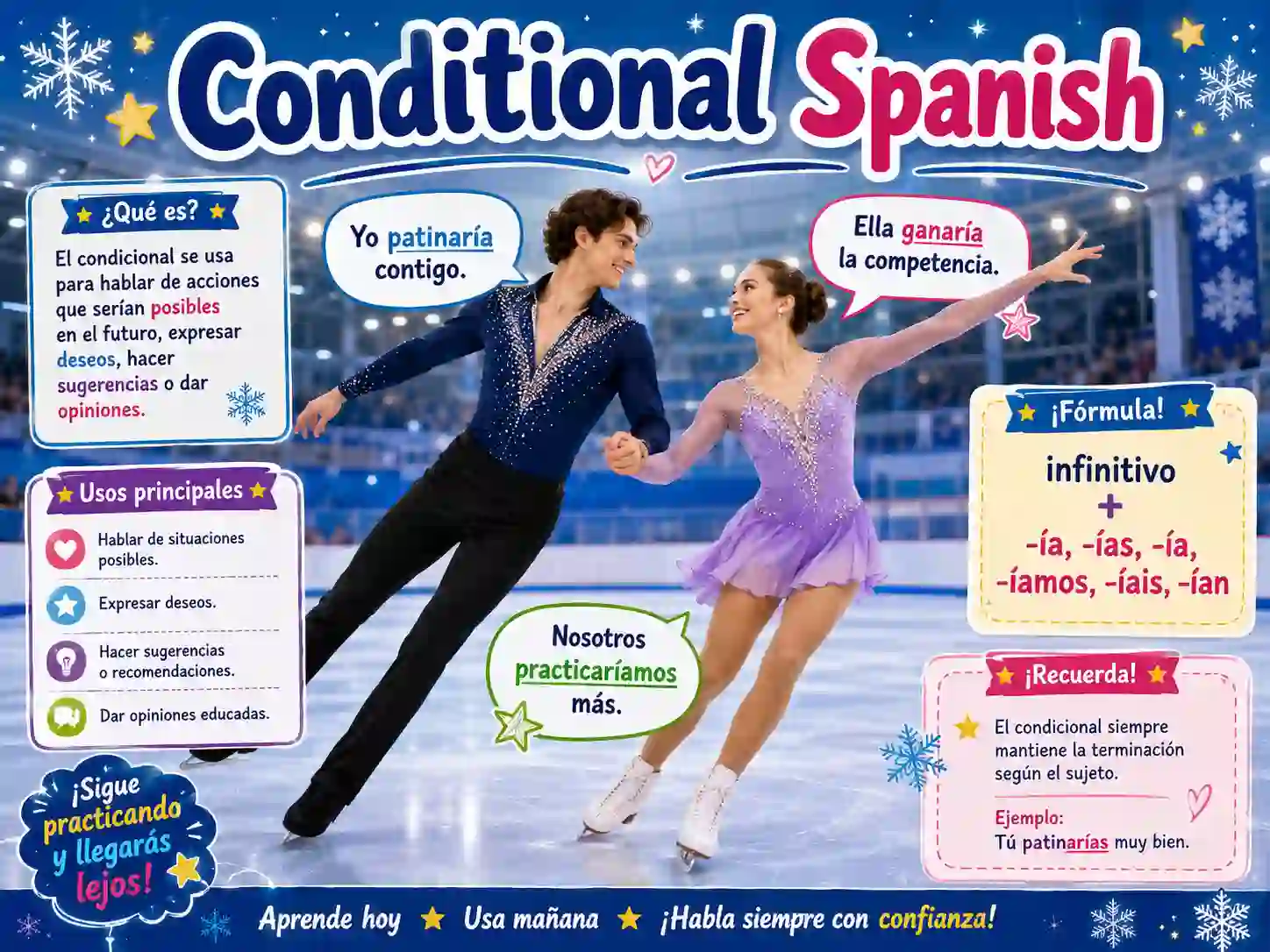
Why the Spanish conditional matters
The conditional is one of the most useful Spanish tenses because it lets you speak politely, imagine situations, express wishes and talk about actions that would happen under certain conditions. Common examples include me gustaría, podrías, deberíamos, sería mejor and yo lo haría.
How to use this page
Use this page after learning present, future and basic verb conjugation. The conditional is structurally simple because regular verbs keep the infinitive and use the same endings.
Use the full verb form: hablar, comer, vivir.
Add -ía, -ías, -ía, -íamos, -íais, -ían.
Some common verbs use special stems: tendría, podría, haría, diría, vendría.
The core idea: would + verb
Hypothetical action
The conditional often expresses what someone would do.
Yo viajaría a España.
I would travel to Spain.
Polite expression
The conditional makes requests, wishes and suggestions softer.
Me gustaría un café.
I would like a coffee.
Probability in the past
The conditional can express a guess about a past situation.
Serían las diez.
It was probably around ten.
Spanish conditional endings
| Subject | Ending | Hablar | Comer | Vivir |
|---|---|---|---|---|
| yo | -ía | hablaría | comería | viviría |
| tú | -ías | hablarías | comerías | vivirías |
| él / ella / usted | -ía | hablaría | comería | viviría |
| nosotros / nosotras | -íamos | hablaríamos | comeríamos | viviríamos |
| vosotros / vosotras | -íais | hablaríais | comeríais | viviríais |
| ellos / ellas / ustedes | -ían | hablarían | comerían | vivirían |
Regular conditional forms
Regular conditional forms are built from the infinitive. The same endings are used for -ar, -er and -ir verbs.
| Infinitive | Conditional form | Example sentence | English meaning |
|---|---|---|---|
| hablar | hablaría | Yo hablaría con ella. | I would speak with her. |
| comer | comerías | ¿Comerías aquí? | Would you eat here? |
| vivir | viviríamos | Viviríamos cerca del mar. | We would live near the sea. |
| estudiar | estudiarían | Ellos estudiarían más. | They would study more. |
Irregular conditional stems
Many common verbs use irregular stems in the conditional. The endings are still regular, but the stem changes.
| Infinitive | Irregular stem | Conditional example | English meaning |
|---|---|---|---|
| tener | tendr- | tendría | I/he/she would have. |
| venir | vendr- | vendrías | You would come. |
| salir | saldr- | saldría | I/he/she would leave. |
| poner | pondr- | pondríamos | We would put. |
| poder | podr- | podría | I/he/she could / would be able to. |
| saber | sabr- | sabrían | They would know. |
| querer | querr- | querría | I/he/she would want. |
| hacer | har- | haríamos | We would do / make. |
| decir | dir- | diría | I/he/she would say. |
| haber | habr- | habría | There would be / would have. |
These irregular stems are similar to the future tense stems: tendré / tendría, haré / haría, diré / diría.
Main uses of the Spanish conditional
The conditional is not only used for “would”. It also appears in polite requests, advice, reported future from a past viewpoint and probability about the past.
| Use | Spanish example | English meaning | Grammar logic |
|---|---|---|---|
| Hypothetical action | Yo viajaría más. | I would travel more. | Action imagined, not stated as real. |
| Polite request | ¿Podrías ayudarme? | Could you help me? | Softer than a direct command. |
| Wish or preference | Me gustaría aprender más. | I would like to learn more. | Common polite expression. |
| Advice | Yo hablaría con el profesor. | I would talk to the teacher. | Suggestion or recommendation. |
| Future in the past | Dijo que vendría mañana. | He/she said that he/she would come tomorrow. | A future action seen from a past moment. |
| Probability in the past | Serían las nueve. | It was probably around nine. | Guess or approximation about the past. |
Polite Spanish with the conditional
The conditional is very common in polite Spanish because it softens requests, wishes and suggestions.
| Direct form | Polite conditional form | English meaning |
|---|---|---|
| Quiero un café. | Me gustaría un café. | I would like a coffee. |
| Ayúdame. | ¿Podrías ayudarme? | Could you help me? |
| Necesito hablar contigo. | Necesitaría hablar contigo. | I would need to speak with you. |
| Es mejor hacerlo así. | Sería mejor hacerlo así. | It would be better to do it this way. |
Conditional with si-clauses
The conditional often appears as the result of a condition. In present or future hypothetical situations, Spanish often uses the imperfect subjunctive in the si-clause and the conditional in the result clause.
| Condition | Result | Full sentence | English meaning |
|---|---|---|---|
| Si tuviera tiempo | viajaría más | Si tuviera tiempo, viajaría más. | If I had time, I would travel more. |
| Si vivieras aquí | hablarías mejor español | Si vivieras aquí, hablarías mejor español. | If you lived here, you would speak better Spanish. |
| Si fuera posible | lo haríamos mañana | Si fuera posible, lo haríamos mañana. | If it were possible, we would do it tomorrow. |
For completed unreal past results, use the conditional perfect: Si hubiera tenido tiempo, habría viajado más.
Conditional vs future tense
The future and conditional are related because they often use the same irregular stems. The difference is meaning: the future says what will happen; the conditional says what would happen.
| Verb | Future | Conditional | Meaning contrast |
|---|---|---|---|
| hablar | hablaré | hablaría | I will speak / I would speak. |
| tener | tendré | tendría | I will have / I would have. |
| hacer | haré | haría | I will do / I would do. |
| decir | diré | diría | I will say / I would say. |
Conditional vs conditional perfect
The simple conditional refers to what would happen. The conditional perfect refers to what would have happened.
| Form | Structure | Example | English meaning |
|---|---|---|---|
| Conditional | infinitive or irregular stem + conditional ending | Yo viajaría. | I would travel. |
| Conditional perfect | habría + past participle | Yo habría viajado. | I would have travelled. |
| Conditional | future/hypothetical action | Lo haría mañana. | I would do it tomorrow. |
| Conditional perfect | completed unreal action | Lo habría hecho ayer. | I would have done it yesterday. |
Detail page: Spanish Conditional Perfect.
Common conditional modal verbs
Some of the most frequent conditional forms come from modal or semi-modal verbs.
| Verb | Conditional form | Example | English meaning |
|---|---|---|---|
| poder | podría | ¿Podrías repetirlo? | Could you repeat it? |
| querer | querría | Querría hablar con usted. | I would like to speak with you. |
| deber | debería | Deberías descansar. | You should rest. |
| gustar | me gustaría | Me gustaría aprender español. | I would like to learn Spanish. |
| tener que | tendría que | Tendríamos que salir temprano. | We would have to leave early. |
Related page: Spanish Modal Verbs.
Practice exercises: Spanish conditional
Try to answer before opening the solutions. These exercises focus on regular forms, irregular stems and conditional sentence use.
Exercise 1: form the regular conditional
- yo / hablar
- tú / comer
- ella / vivir
- nosotros / estudiar
Show answers
1. hablaría
2. comerías
3. viviría
4. estudiaríamos
Exercise 2: use irregular stems
- yo / tener
- tú / poder
- nosotros / hacer
- ellos / decir
Show answers
1. tendría
2. podrías
3. haríamos
4. dirían
Exercise 3: complete the sentence
- Si tuviera tiempo, ___ más. travel
- ¿___ ayudarme? poder, tú
- Yo ___ con el profesor. hablar
- Serían las ocho. meaning?
Show answers
1. viajaría
2. ¿Podrías ayudarme?
3. Yo hablaría con el profesor.
4. It was probably around eight o’clock.
When to use the Spanish conditional
Use it for hypothetical actions
Use the conditional when something would happen under certain conditions.
Yo lo haría.
Use it for polite requests and wishes
The conditional softens statements and sounds less direct.
Me gustaría un café.
Use it for guesses about the past
The conditional can express an approximate or probable past situation.
Serían las diez.
Related grammar topics
Conditional Perfect
Learn habría hablado, habría comido and habría vivido.
Spanish Tenses
Place the conditional inside the full Spanish tense system.
Future Tense
Compare future and conditional endings and irregular stems.
Conditional Sentences
Use the conditional in si-clauses and hypothetical structures.
Irregular Verbs
Study irregular stems such as tendr-, har-, dir- and podr-.
Modal Verbs
Practise podría, debería, querría and tendría que.
Typical mistakes with the Spanish conditional
- Dropping the infinitive too early: regular verbs keep the infinitive: hablaría, comería, viviría.
- Forgetting the accent: conditional endings need an accent on í: -ía, -ías, -íamos, -ían.
- Using future instead of conditional: hablaré means “I will speak”; hablaría means “I would speak”.
- Using regular stems for common irregular verbs: say tendría, haría, diría, podría.
- Confusing conditional and conditional perfect: lo haría means “I would do it”; lo habría hecho means “I would have done it”.
- Using the wrong form after si: in hypothetical si-clauses, Spanish often uses the imperfect subjunctive: si tuviera tiempo, viajaría.
Where to go next
After the simple conditional, continue with the conditional perfect, conditional sentences and irregular verb stems. These pages explain the difference between hablaría, habría hablado and si tuviera structures.
Want personal guidance?
If the Spanish conditional feels confusing, individual guidance can help you practise hablaría, comería, viviría, tendría, podría, haría, polite requests, hypothetical sentences and the difference between conditional and conditional perfect.
FAQ: Spanish conditional tense
What is the Spanish conditional tense?
The Spanish conditional tense usually expresses what would happen. Examples include hablaría, comería, viviríamos and harían.
How do you form the conditional in Spanish?
For regular verbs, add -ía, -ías, -ía, -íamos, -íais or -ían to the infinitive.
What does hablaría mean?
Hablaría means “I would speak”, “he would speak”, “she would speak” or “you formal would speak”, depending on context.
What are common irregular conditional forms?
Common irregular conditional forms include tendría, vendría, podría, sabría, haría, diría and habría.
What is the difference between conditional and conditional perfect?
The conditional expresses “would”: hablaría means “I would speak”. The conditional perfect expresses “would have”: habría hablado means “I would have spoken”.
Can the Spanish conditional express probability?
Yes. The conditional can express probability or approximation about the past. Serían las ocho can mean “It was probably around eight o’clock”.

MundoDele – Spanish learning for education, work and intercultural understanding
MundoDele connects online Spanish courses, DELE preparation, Business Spanish and cultural context into a personal Spanish learning platform.
Grammar pages are designed to explain Spanish clearly, with practical examples, real sentence logic and connected learning paths.