
Spanish Conjunctions with Que
Learn how que works in Spanish conjunctions and connector phrases. This guide explains simple que, compound conjunctions such as porque, aunque, para que, antes de que, después de que, hasta que, a menos que, con tal de que and the important difference between que and qué.
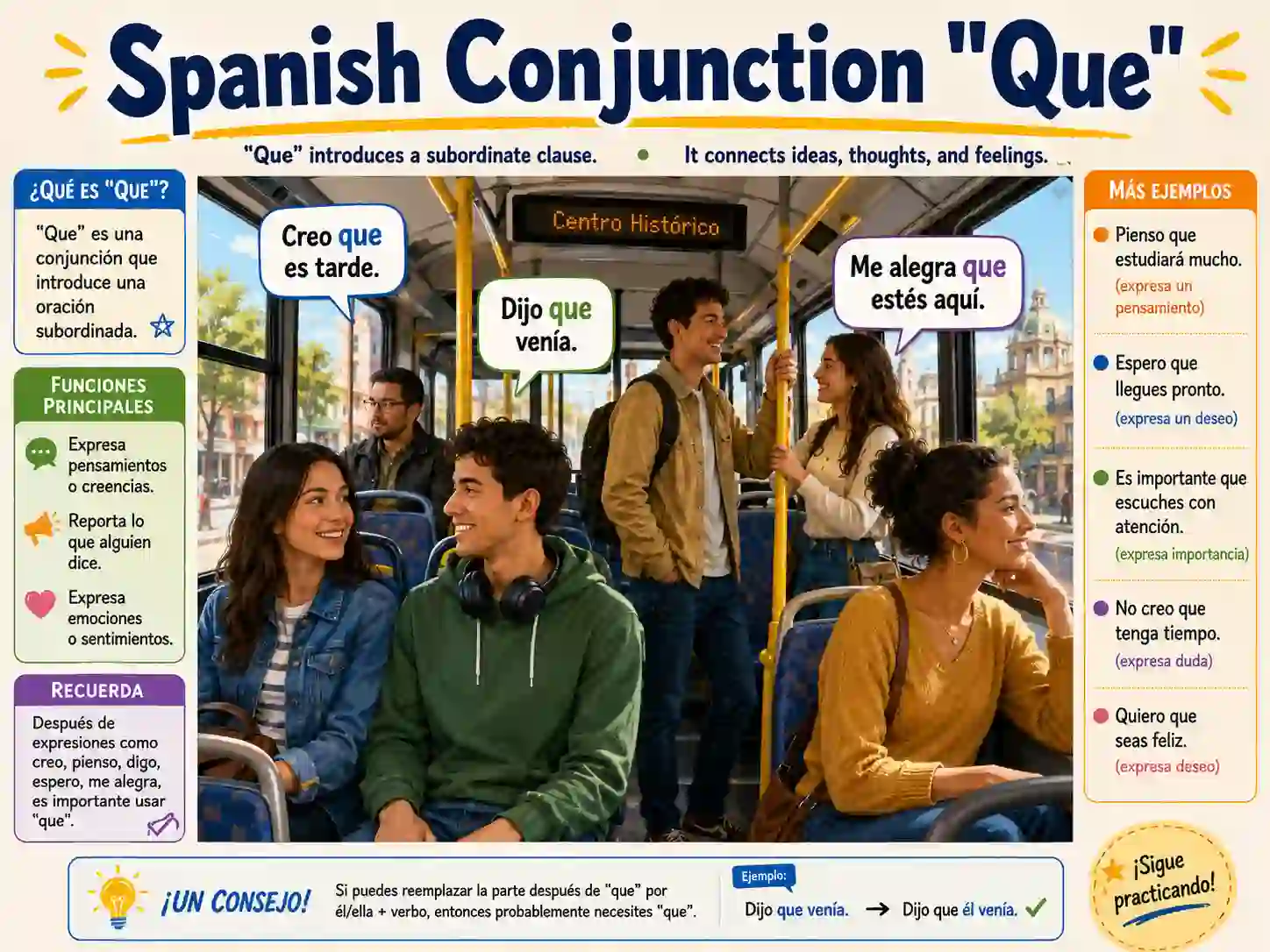
Why learn Spanish conjunctions with que with MundoDele?
Spanish que appears in many different structures, so it is easy to learn it mechanically without understanding its function. MundoDele explains que as a connector inside real sentence patterns: statement clauses, purpose clauses, time clauses, condition clauses, contrast clauses and cause-result structures.
The key idea is simple: que often opens the second part of a sentence. The meaning depends on the full connector around it: porque gives a reason, para que gives a purpose, a menos que gives an exception, and antes de que gives a time relationship.
How to use this page
Use this page after the general Spanish conjunctions overview. First learn what simple que does. Then study the compound connectors that contain que. The most important question is not only “what does que mean?”, but “what does the whole connector mean?”
Simple que
Que can introduce a subordinate clause after verbs of saying, thinking, knowing or feeling.
Creo que es importante.
I think that it is important.
Que inside connectors
Many Spanish conjunctions are built with que.
para que, aunque, antes de que, a menos que.
Mood depends on meaning
The verb after que can be indicative or subjunctive depending on the connector and sentence meaning.
Creo que viene.
Quiero que venga.
Simple que as a conjunction
Simple que often introduces a subordinate clause after a main verb. In English, it often corresponds to “that”, but English can sometimes omit “that”. Spanish usually keeps que.
| Spanish example | English meaning | Function of que |
|---|---|---|
| Creo que tienes razón. | I think that you are right. | Introduces what someone thinks. |
| Sé que es difícil. | I know that it is difficult. | Introduces what someone knows. |
| Dice que no puede venir. | He/she says that he/she cannot come. | Introduces reported information. |
| Es importante que estudies. | It is important that you study. | Introduces an evaluation or need. |
Que with indicative or subjunctive
After que, the verb can be indicative or subjunctive. The choice depends on the meaning of the main clause. Statements, certainty and information usually take indicative. Wishes, influence, emotion, doubt and necessity usually take subjunctive.
| Meaning | Spanish example | Verb mood | Reason |
|---|---|---|---|
| Certainty | Creo que viene. | Indicative | The speaker presents it as believed information. |
| Knowledge | Sé que tienes razón. | Indicative | The speaker presents it as known. |
| Wish | Quiero que vengas. | Subjunctive | The speaker wants another person to do something. |
| Doubt | Dudo que sea verdad. | Subjunctive | The statement is not presented as certain. |
| Necessity | Es necesario que estudies. | Subjunctive | The clause expresses what should happen. |
Common Spanish conjunctions with que
Many Spanish conjunctions and connector phrases contain que. The meaning comes from the whole expression, not from que alone.
| Connector | English meaning | Example | Type |
|---|---|---|---|
| porque | because | No fui porque estaba enfermo. | Causal |
| ya que | since / as | Ya que estás aquí, empezamos. | Causal |
| para que | so that / in order that | Te ayudo para que apruebes. | Final / purpose |
| aunque | although / even if | Aunque llueve, salimos. | Concessive |
| antes de que | before | Llámame antes de que salgas. | Temporal |
| después de que | after | Después de que llegue, cenaremos. | Temporal |
| hasta que | until | Esperaré hasta que termine. | Temporal |
| en caso de que | in case | Llama en caso de que necesites ayuda. | Conditional |
| a menos que | unless | No salimos a menos que deje de llover. | Conditional / exception |
| con tal de que | provided that / as long as | Acepto con tal de que vengas. | Conditional |
| de modo que | so that / so | Explícalo de modo que todos lo entiendan. | Purpose, manner or result |
| como si | as if | Habla como si supiera todo. | Modal comparison |
Que vs qué
Que without accent is used as a conjunction or relative word. Qué with accent is used in direct or indirect questions and exclamations.
| Form | Function | Spanish example | English meaning |
|---|---|---|---|
| que | Conjunction | Creo que viene. | I think that he/she is coming. |
| que | Relative word | El libro que compré es bueno. | The book that I bought is good. |
| qué | Question word | ¿Qué quieres? | What do you want? |
| qué | Exclamation | ¡Qué bonito! | How beautiful! / What a beautiful thing! |
Porque and aunque
Porque and aunque look like single words, but both contain que. Their meanings are different: porque gives a reason, while aunque introduces contrast or concession.
| Connector | Meaning | Example | Logic |
|---|---|---|---|
| porque | because | No fui porque estaba cansado. | Reason. |
| aunque | although / even if | Aunque estaba cansado, fui. | Contrast despite an obstacle. |
| aunque + indicative | although | Aunque llueve, salimos. | The obstacle is factual. |
| aunque + subjunctive | even if | Aunque llueva, saldremos. | The obstacle is possible or hypothetical. |
Para que and other purpose connectors
Purpose connectors with que explain what an action is for. They usually take the subjunctive when the purpose clause has a different subject.
| Connector | Spanish example | English meaning | Grammar point |
|---|---|---|---|
| para que | Te ayudo para que apruebes. | I help you so that you pass. | Purpose + subjunctive. |
| a fin de que | Lo explico a fin de que quede claro. | I explain it in order that it becomes clear. | Formal purpose. |
| con el fin de que | Repetimos la regla con el fin de que la recuerdes. | We repeat the rule so that you remember it. | Explicit aim. |
| con el objetivo de que | Hacemos ejercicios con el objetivo de que practiques. | We do exercises with the objective that you practise. | Formal learning or project goal. |
Related page: Final Conjunctions in Spanish.
Time connectors with que
Several temporal conjunctions contain que. They connect one action to another in time. Many of them take the subjunctive when the action is future or not yet completed.
| Connector | Spanish example | English meaning | Grammar point |
|---|---|---|---|
| antes de que | Llámame antes de que salgas. | Call me before you leave. | Usually subjunctive. |
| después de que | Después de que llegue, cenaremos. | After he/she arrives, we will have dinner. | Future time + subjunctive. |
| hasta que | Esperaré hasta que termine. | I will wait until he/she finishes. | Future or not-yet-completed action. |
| desde que | Vivo aquí desde que llegué. | I have lived here since I arrived. | Starting point in time. |
Related page: Temporal Conjunctions in Spanish.
Condition and exception connectors with que
Conditional connector phrases with que express requirements, exceptions or possible situations. Many of them take the subjunctive.
| Connector | Spanish example | English meaning | Grammar point |
|---|---|---|---|
| a menos que | No salimos a menos que deje de llover. | We are not going out unless it stops raining. | Exception + subjunctive. |
| salvo que | Iremos mañana salvo que haya problemas. | We will go tomorrow unless there are problems. | Exception + subjunctive. |
| en caso de que | Llama en caso de que necesites ayuda. | Call in case you need help. | Possible situation + subjunctive. |
| con tal de que | Acepto con tal de que vengas. | I accept provided that you come. | Requirement + subjunctive. |
| a condición de que | Te ayudo a condición de que seas puntual. | I help you on condition that you are punctual. | Formal condition + subjunctive. |
Related page: Conditional Conjunctions in Spanish.
De que, queísmo and dequeísmo
Some Spanish expressions require de que, while others require only que. Learners often make two opposite mistakes: adding de where it is not needed, or removing de where it is required.
| Pattern | Correct example | Common mistake | Explanation |
|---|---|---|---|
| creer que | Creo que tienes razón. | Creo de que tienes razón. | Creer does not take de. |
| pensar que | Pienso que es importante. | Pienso de que es importante. | Pensar does not take de. |
| alegrarse de que | Me alegro de que estés aquí. | Me alegro que estés aquí. | Alegrarse de keeps de. |
| darse cuenta de que | Me di cuenta de que era tarde. | Me di cuenta que era tarde. | Darse cuenta de keeps de. |
Que as conjunction vs que as relative pronoun
Que can be a conjunction or a relative pronoun. As a conjunction, it introduces a clause after a main expression. As a relative pronoun, it refers back to a noun.
| Use | Spanish example | English meaning | How to recognise it |
|---|---|---|---|
| Conjunction | Creo que viene. | I think that he/she is coming. | Que introduces what someone thinks. |
| Conjunction | Quiero que vengas. | I want you to come. | Que introduces the wanted action. |
| Relative pronoun | El libro que compré es bueno. | The book that I bought is good. | Que refers back to el libro. |
| Relative pronoun | La persona que llamó es Ana. | The person who called is Ana. | Que refers back to la persona. |
Related page: Spanish Relative Pronouns.
Practice exercises: Spanish conjunctions with que
Try to answer before opening the solutions. These exercises focus on que, qué, compound conjunctions with que and indicative vs subjunctive.
Exercise 1: que or qué?
- Creo ___ tienes razón.
- ¿___ quieres comer?
- Es importante ___ estudies.
- ¡___ bonito!
Show answers
1. que
2. qué
3. que
4. qué
Exercise 2: choose the connector
- No fui ___ estaba enfermo. = because
- Te ayudo ___ apruebes. = so that
- No salimos ___ deje de llover. = unless
- Llámame ___ salgas. = before
Show answers
1. porque
2. para que
3. a menos que
4. antes de que
Exercise 3: indicative or subjunctive?
- Creo que Ana ___. venir
- Quiero que Ana ___. venir
- Es necesario que tú ___. estudiar
- Sé que tú ___ razón. tener
Show answers
1. viene
2. venga
3. estudies
4. tienes
Typical mistakes with que in Spanish conjunctions
- Confusing que and qué: que connects; qué asks or exclaims.
- Translating English too directly: English can omit “that”, but Spanish often needs que: creo que...
- Using the wrong mood after que: compare creo que viene with quiero que venga.
- Ignoring the full connector: para que, porque, aunque and a menos que have different meanings.
- Using para que with an infinitive: say para aprobar or para que apruebes, not para que aprobar.
- Adding or removing de incorrectly: learn full expressions such as creer que and alegrarse de que.
Related grammar topics
Spanish Conjunctions
Learn how conjunctions connect cause, purpose, result, condition, contrast, time and manner.
Final Conjunctions
Study para que, a fin de que and purpose clauses.
Causal Conjunctions
Study porque, ya que, puesto que and dado que.
Conditional Conjunctions
Study a menos que, con tal de que and en caso de que.
Temporal Conjunctions
Study antes de que, después de que, hasta que and desde que.
Relative Pronouns
Compare conjunction que with relative pronoun que.
Where to go next
After Spanish conjunctions with que, continue with final, causal and temporal conjunctions. These pages show how que changes meaning inside specific connector phrases.
Learn Spanish grammar with MundoDele
If Spanish que feels confusing, this lesson can help you practise simple que, qué, porque, para que, aunque, antes de que, a menos que and real Spanish sentence patterns in a clear and structured way.
FAQ: Spanish conjunctions with que
What does que mean as a conjunction in Spanish?
Que often means “that” and introduces a subordinate clause, as in creo que tienes razón.
What is the difference between que and qué?
Que without accent connects clauses or works as a relative word. Qué with accent is used in questions and exclamations.
What are common Spanish conjunctions with que?
Common conjunctions with que include porque, aunque, para que, antes de que, después de que, hasta que, a menos que and con tal de que.
Does que take the subjunctive?
It depends on the expression before que. Creo que viene uses indicative, while quiero que venga uses subjunctive.
Is porque the same as por qué?
No. Porque means “because”. Por qué means “why?” and is used in questions.
What is the difference between que as a conjunction and que as a relative pronoun?
As a conjunction, que introduces a clause after a main expression: creo que viene. As a relative pronoun, it refers back to a noun: el libro que compré.

About MundoDele
MundoDele connects online Spanish courses, DELE preparation, Business Spanish and cultural context into a personal Spanish learning platform.
Grammar pages are designed to explain Spanish clearly, with practical examples, real sentence logic and connected learning paths.