
MundoDele Spanish Grammar
Reporting Verbs in Spanish: Decir, Preguntar and Indirect Speech
Learn how reporting verbs work in Spanish sentence structure. This guide explains verbs such as decir, contar, explicar, preguntar, responder, afirmar, negar and anunciar, and shows how they introduce reported speech with que, indirect questions with si, and tense changes in indirect speech.
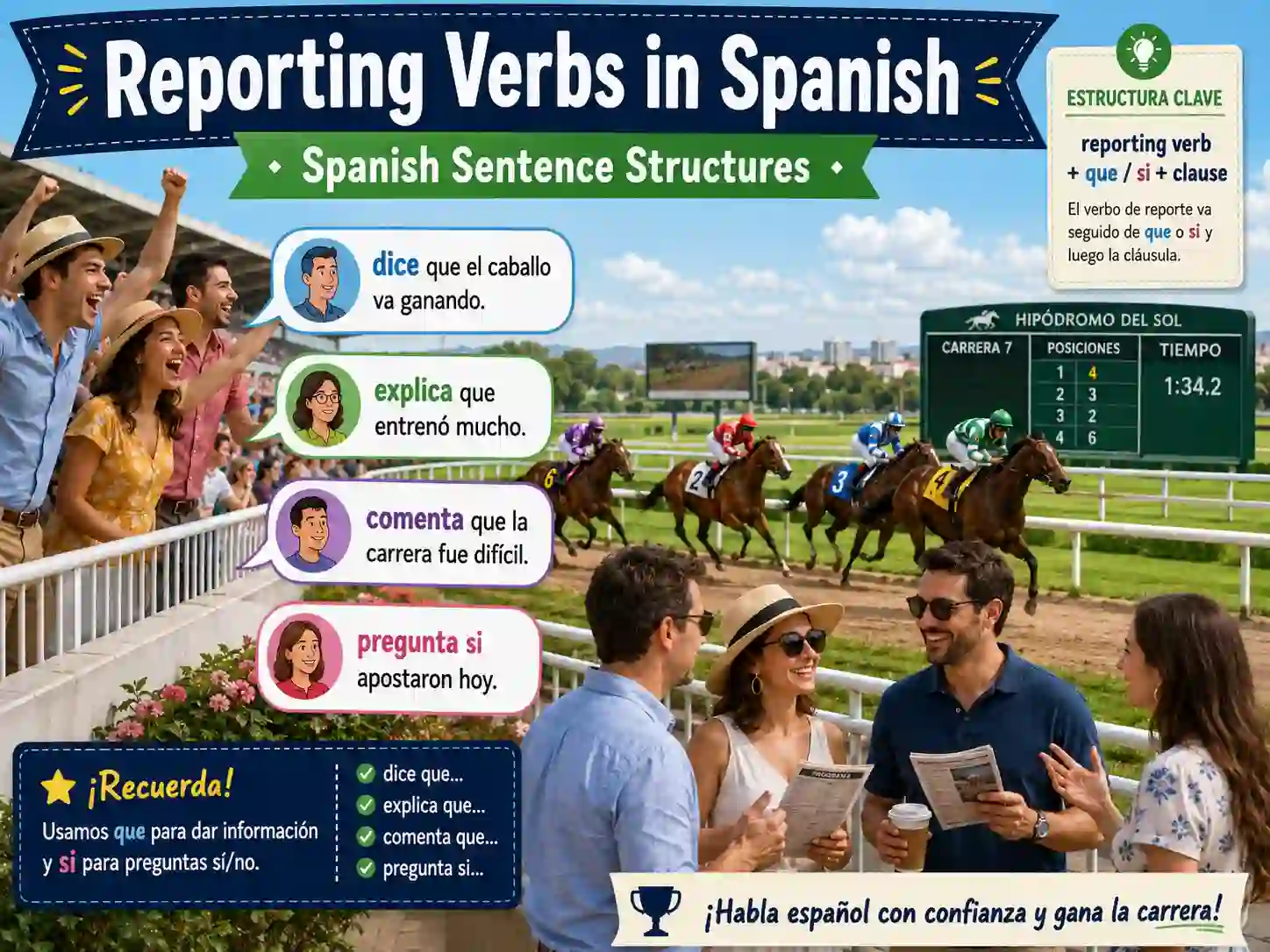
Why reporting verbs matter
Reporting verbs help you connect speech, questions and explanations
Reporting verbs are essential for telling stories, summarising conversations, writing formal texts and explaining what other people said or asked. They are not only vocabulary; they create sentence structures.
The key idea is simple: dice que viene reports a statement, pregunta si vienes reports a yes/no question, and pregunta cuándo vienes reports an information question.
Dice que está ocupado. The reported information follows que.
Preguntó si podía venir. The reported question uses si.
Preguntó dónde vivía. The question word stays in the sentence.
Learning sequence
How to use this Spanish reporting verbs guide
Use this page to understand how Spanish reports speech and questions. First learn the main reporting verbs. Then study the three core patterns: verb + que, preguntar si and preguntar + question word. Finally, compare direct and indirect speech.
Statements
Use reporting verbs such as decir, contar and explicar with que.
Yes/no questions
Use preguntar si to report a yes/no question.
Information questions
Keep the question word when reporting information questions.
Core idea
What are reporting verbs in Spanish?
Reporting verbs introduce what someone says, asks, tells, explains, answers or announces. They are used in direct speech and indirect speech. In sentence structure, they connect a main clause with reported information.
| Reporting verb | Basic meaning | Spanish example | English meaning |
|---|---|---|---|
| decir | to say / to tell | Dijo que estaba cansado. | He said he was tired. |
| contar | to tell / to recount | Me contó que vivía en Madrid. | He told me that he lived in Madrid. |
| explicar | to explain | Explicó que el sistema era nuevo. | He explained that the system was new. |
| preguntar | to ask | Preguntó si podía entrar. | He asked if he could enter. |
| responder | to answer | Respondió que no sabía. | He answered that he did not know. |
| anunciar | to announce | Anunciaron que abrirían una oficina. | They announced that they would open an office. |
Direct or indirect
Direct speech vs indirect speech
Direct speech repeats the exact words of a speaker. Indirect speech reports the meaning of what was said and often changes pronouns, time words and verb tenses.
| Direct speech | Indirect speech | Change |
|---|---|---|
| Ana dijo: “Estoy cansada.” | Ana dijo que estaba cansada. | estoy changes to estaba. |
| Pedro dijo: “Vivo aquí.” | Pedro dijo que vivía allí. | aquí can change to allí. |
| Laura dijo: “Voy mañana.” | Laura dijo que iba al día siguiente. | mañana changes to al día siguiente. |
| Él preguntó: “¿Puedes venir?” | Él preguntó si podía venir. | Question becomes indirect with si. |
Que
Reporting statements with que
Spanish usually uses que after reporting verbs when reporting a statement. This que connects the reporting verb to the reported clause.
| Reporting verb | Spanish example | English meaning | Structure |
|---|---|---|---|
| decir que | Dice que tiene tiempo. | He/she says that he/she has time. | decir + que + clause |
| contar que | Me contó que trabajaba allí. | He/she told me that he/she worked there. | contar + que + clause |
| explicar que | Explicó que el curso empezaba mañana. | He/she explained that the course started tomorrow. | explicar + que + clause |
| responder que | Respondió que no podía venir. | He/she answered that he/she could not come. | responder + que + clause |
| anunciar que | Anunciaron que iban a cambiar el horario. | They announced that they were going to change the schedule. | anunciar + que + clause |
Related page: Conjunctions with Que in Spanish.
Si
Reporting yes/no questions with si
When Spanish reports a yes/no question, it normally uses preguntar si. In this structure, si means “if” or “whether”.
| Direct question | Reported question | English meaning | Structure |
|---|---|---|---|
| ¿Tienes tiempo? | Preguntó si tenía tiempo. | He/she asked if I had time. | preguntar + si + clause |
| ¿Puedes venir? | Preguntó si podía venir. | He/she asked if I could come. | si + imperfect |
| ¿Has terminado? | Preguntó si había terminado. | He/she asked if I had finished. | si + pluperfect |
| ¿Vas a estudiar? | Preguntó si iba a estudiar. | He/she asked if I was going to study. | si + iba a + infinitive |
Question words
Reporting information questions
When Spanish reports an information question, the question word remains: qué, quién, cuándo, dónde, cómo, por qué or cuánto. The structure becomes a reported clause, not a direct question.
| Direct question | Reported question | English meaning | Question word |
|---|---|---|---|
| ¿Dónde vives? | Preguntó dónde vivía. | He/she asked where I lived. | dónde |
| ¿Qué quieres? | Preguntó qué quería. | He/she asked what I wanted. | qué |
| ¿Cuándo llegas? | Preguntó cuándo llegaba. | He/she asked when I was arriving. | cuándo |
| ¿Por qué estudias español? | Preguntó por qué estudiaba español. | He/she asked why I studied Spanish. | por qué |
| ¿Cómo lo hiciste? | Preguntó cómo lo había hecho. | He/she asked how I had done it. | cómo |
Related page: Spanish Interrogative Pronouns.
Verb groups
Common Spanish reporting verbs by meaning
Reporting verbs do not all have the same tone. Some are neutral, some explain, some deny, some announce and some introduce questions.
| Meaning group | Spanish verbs | Example | English meaning |
|---|---|---|---|
| Neutral reporting | decir, contar, comentar | Comentó que estaba ocupado. | He commented that he was busy. |
| Explanation | explicar, aclarar, señalar | Explicó que era necesario esperar. | He explained that it was necessary to wait. |
| Answering | responder, contestar | Respondió que no sabía. | He answered that he did not know. |
| Questions | preguntar, querer saber | Preguntó si podía entrar. | He asked if he could enter. |
| Confirmation | afirmar, confirmar, asegurar | Confirmó que el curso empezaba el lunes. | He confirmed that the course started on Monday. |
| Denial | negar, desmentir | Negó que tuviera problemas. | He denied that he had problems. |
| Announcement | anunciar, informar, comunicar | Anunciaron que abrirían una sede nueva. | They announced that they would open a new branch. |
Tense changes
Tense changes in Spanish indirect speech
When the reporting verb is in the past, the reported verb often moves one step back in time. This is especially common in indirect speech.
| Direct speech tense | Direct speech | Indirect speech | Change |
|---|---|---|---|
| Present | “Estoy cansado.” | Dijo que estaba cansado. | Present → imperfect. |
| Preterite | “Llegué tarde.” | Dijo que había llegado tarde. | Preterite → pluperfect. |
| Present perfect | “He terminado.” | Dijo que había terminado. | Present perfect → pluperfect. |
| Future | “Iré mañana.” | Dijo que iría al día siguiente. | Future → conditional. |
| Near future | “Voy a estudiar.” | Dijo que iba a estudiar. | voy a → iba a. |
| Imperative | “Ven aquí.” | Me dijo que viniera. | Command → imperfect subjunctive. |
Time and place
Changes in time and place words
In indirect speech, time and place expressions may change depending on the speaker’s perspective. These changes are especially common when reporting later.
| Direct speech | Indirect speech | Example | English meaning |
|---|---|---|---|
| hoy | ese día | Dijo que trabajaba ese día. | He said he was working that day. |
| mañana | al día siguiente | Dijo que vendría al día siguiente. | He said he would come the next day. |
| ayer | el día anterior | Dijo que había llegado el día anterior. | He said he had arrived the previous day. |
| aquí | allí | Dijo que vivía allí. | He said he lived there. |
| este | ese / aquel | Dijo que ese libro era suyo. | He said that book was his. |
Pronouns
Pronoun changes in reported speech
Pronouns often change when direct speech becomes indirect speech. The change depends on who is reporting and who the original speaker was.
| Direct speech | Indirect speech | Change | English meaning |
|---|---|---|---|
| Ana dijo: “Estoy cansada.” | Ana dijo que estaba cansada. | yo becomes ella in meaning. | Ana said she was tired. |
| Pedro dijo: “Mi casa está cerca.” | Pedro dijo que su casa estaba cerca. | mi becomes su. | Pedro said his house was nearby. |
| Laura dijo: “Te llamo mañana.” | Laura dijo que me llamaría al día siguiente. | te can become me. | Laura said she would call me the next day. |
| Ellos dijeron: “Nuestro plan funciona.” | Ellos dijeron que su plan funcionaba. | nuestro becomes su. | They said their plan worked. |
Mood
Reporting verbs with indicative or subjunctive
Many reporting verbs use the indicative when they report information as stated, confirmed or explained. Some verbs or negative reporting structures can trigger the subjunctive when the reported information is denied, doubted or not presented as fact.
| Structure | Spanish example | Mood | Why? |
|---|---|---|---|
| decir que | Dijo que estaba cansado. | Indicative | The content is reported as a statement. |
| explicar que | Explicó que el sistema era nuevo. | Indicative | The content is explained as information. |
| confirmar que | Confirmó que la reunión empezaba a las diez. | Indicative | The content is confirmed. |
| negar que | Negó que tuviera problemas. | Subjunctive | The content is denied. |
| no decir que | No dijo que fuera fácil. | Subjunctive possible | The statement is not asserted as fact. |
| pedir que | Pidió que llegáramos temprano. | Subjunctive | This reports a request, not a factual statement. |
Related page: Indicative vs Subjunctive in Spanish.
Commands
Reporting commands and requests
When reporting commands, requests or instructions, Spanish often uses verbs such as pedir, ordenar, decir, aconsejar or recomendar plus que and the subjunctive.
| Direct command | Reported command | English meaning | Structure |
|---|---|---|---|
| “Ven temprano.” | Me pidió que viniera temprano. | He/she asked me to come early. | pedir que + subjunctive |
| “No hables.” | Me dijo que no hablara. | He/she told me not to speak. | decir que + subjunctive |
| “Estudien más.” | El profesor recomendó que estudiaran más. | The teacher recommended that they study more. | recomendar que + subjunctive |
| “Esperen aquí.” | Les ordenó que esperaran allí. | He ordered them to wait there. | ordenar que + subjunctive |
Formal reporting
Formal reporting verbs in Spanish
Formal Spanish often uses reporting verbs in news, academic writing, business texts and official statements. These verbs help show whether information is claimed, confirmed, denied, announced or explained.
| Verb | Typical context | Spanish example | English meaning |
|---|---|---|---|
| afirmar | Statements, claims | El informe afirma que la demanda aumentó. | The report states that demand increased. |
| señalar | Analysis, reports | El estudio señala que existen diferencias regionales. | The study points out that regional differences exist. |
| indicar | Data, instructions | Los datos indican que el mercado creció. | The data indicate that the market grew. |
| confirmar | Confirmation | La empresa confirmó que abriría una nueva sede. | The company confirmed that it would open a new branch. |
| negar | Denial | El portavoz negó que hubiera problemas. | The spokesperson denied that there were problems. |
| anunciar | Public announcements | El gobierno anunció que cambiaría la norma. | The government announced that it would change the rule. |
Recommended order
Recommended learning order for reporting verbs
Main reporting verbs
Learn decir, contar, explicar, preguntar and responder.
Verb + que
Use que to report statements and explanations.
Preguntar si
Use si to report yes/no questions.
Question words
Use qué, dónde, cuándo, cómo and por qué in reported questions.
Tense changes
Learn how estoy becomes estaba and he terminado becomes había terminado.
Mood choice
Compare reported facts with requests, denials and commands.
Practice
Practice exercises: reporting verbs in Spanish
Try to answer before opening the solutions. These exercises focus on que, si, indirect questions and tense changes.
Exercise 1: choose que or si
- Dijo ___ estaba cansado.
- Preguntó ___ podía venir.
- Explicó ___ el curso empezaba el lunes.
- Quería saber ___ había tiempo.
Show answers
1. que
2. si
3. que
4. si
Exercise 2: report the question
- ¿Dónde vives? → Preguntó...
- ¿Qué quieres? → Preguntó...
- ¿Cuándo llegas? → Preguntó...
- ¿Puedes venir? → Preguntó...
Show answers
1. Preguntó dónde vivía.
2. Preguntó qué quería.
3. Preguntó cuándo llegaba.
4. Preguntó si podía venir.
Exercise 3: change to indirect speech
- Ana dijo: “Estoy ocupada.”
- Pedro dijo: “He terminado.”
- Laura dijo: “Iré mañana.”
- El profesor dijo: “Estudien más.”
Show answers
1. Ana dijo que estaba ocupada.
2. Pedro dijo que había terminado.
3. Laura dijo que iría al día siguiente.
4. El profesor dijo que estudiaran más.
Typical mistakes
Typical mistakes with Spanish reporting verbs
- Forgetting que after reporting statements: say dijo que estaba cansado, not dijo estaba cansado.
- Using que instead of si for yes/no questions: say preguntó si podía venir.
- Using direct-question word order in indirect questions: say preguntó dónde vivía.
- Forgetting tense shifts after a past reporting verb: estoy often becomes estaba; he terminado often becomes había terminado.
- Forgetting pronoun changes: mi casa can become su casa depending on who reports the speech.
- Using indicative after reported commands or requests: say pidió que viniera, not pidió que venía.
- Confusing decir and preguntar: decir reports statements; preguntar reports questions.
Where to go next
Where to go next
After reporting verbs, continue with que, interrogative pronouns and indicative vs subjunctive. These topics help you understand dijo que, preguntó si, preguntó dónde and pidió que viniera.
Conjunctions with Que
Learn how que connects Spanish clauses.
Interrogative Pronouns
Review the question words used in reported questions.
Indicative vs Subjunctive
Understand mood choice after reporting and request verbs.
Related guides
Continue with related Spanish grammar topics
These guides connect directly with reporting verbs: que for statements, question words for reported questions, and mood choice after reporting or request verbs.
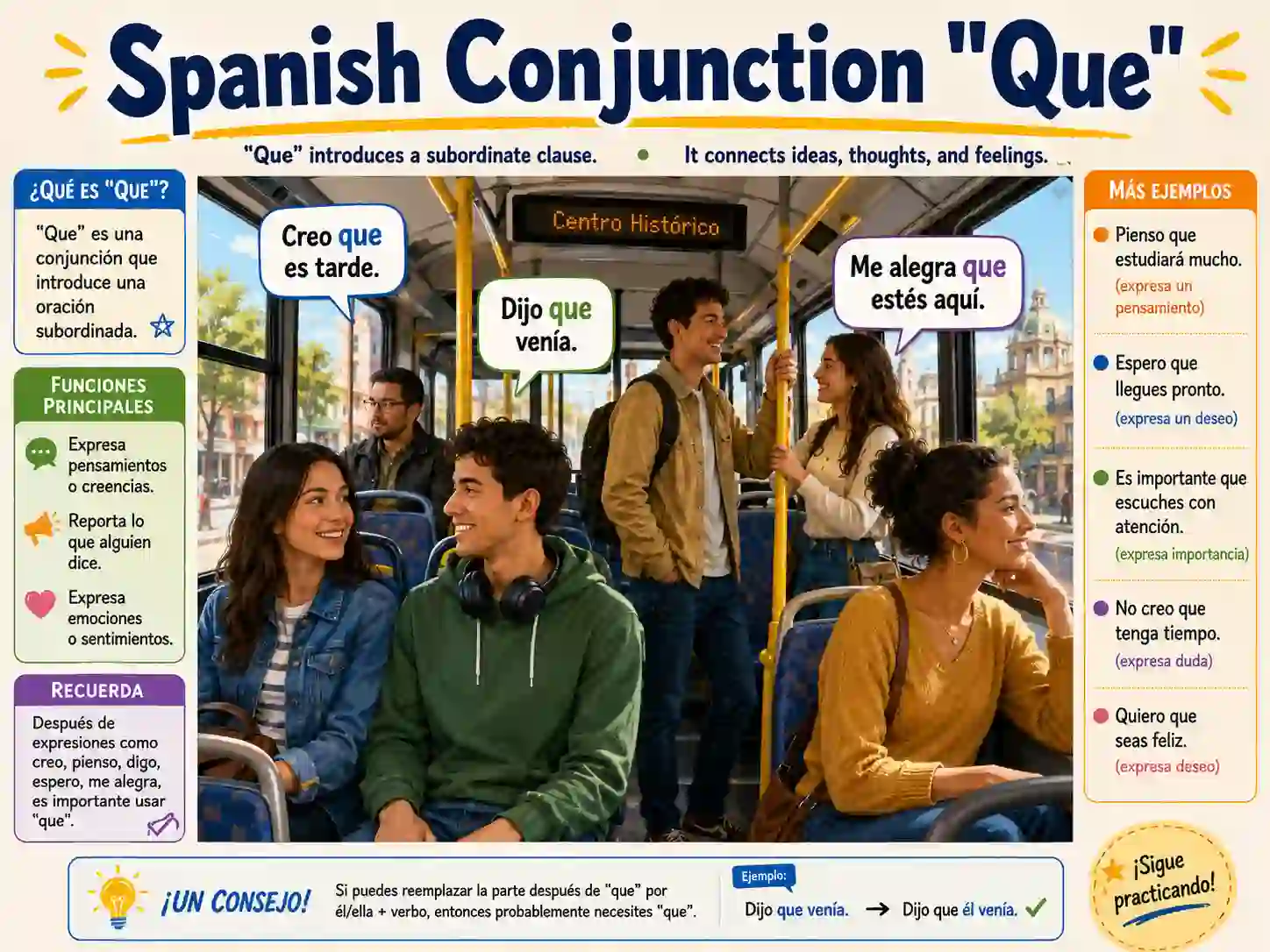
Conjunctions with Que
Learn how que connects reported statements and subordinate clauses in Spanish.
Open guide →
Interrogative Pronouns
Review qué, quién, cuándo, dónde, cómo and por qué.
Open guide →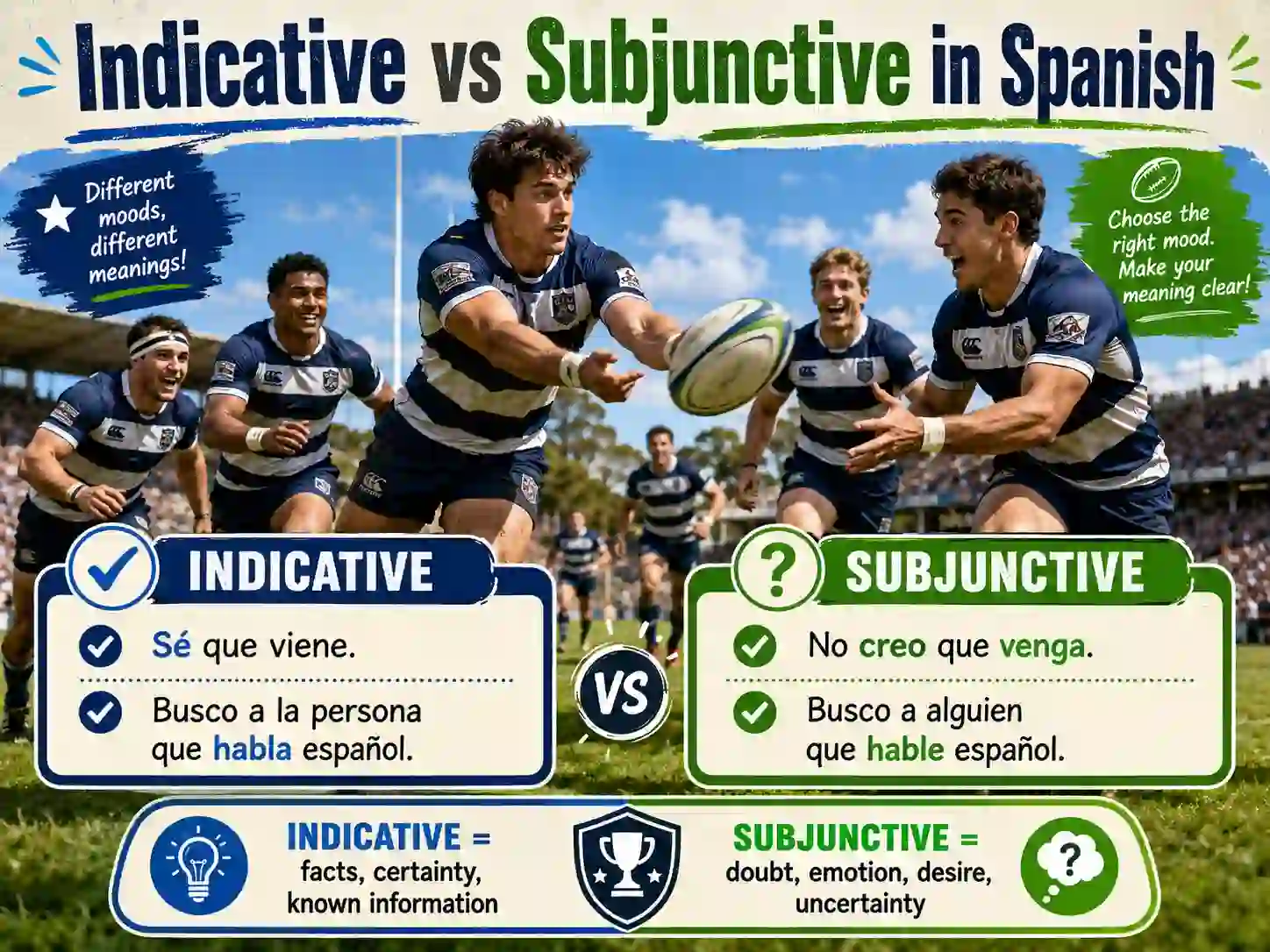
Indicative vs Subjunctive
Understand why dijo que estaba differs from pidió que viniera or negó que tuviera.
Open guide →When you need help
Practise reporting verbs in real Spanish
Reporting verbs help you move from short statements to connected Spanish discourse. With MundoDele, you can learn how to report statements, questions, answers, explanations and commands through clear sentence patterns and real examples.
Spanish Tutoring
Useful if you need help with sentence structure, homework or weak points.
Private Spanish Lessons
Practise reported speech in conversation, writing and personal learning.
Intensive Spanish Course
Work through grammar, speaking and sentence structure in a focused format.
FAQ
FAQ: reporting verbs in Spanish
What are reporting verbs in Spanish?
Reporting verbs introduce what someone says, asks, answers, explains or announces. Common examples are decir, contar, preguntar, responder, explicar and anunciar.
How do you report a statement in Spanish?
Spanish usually reports statements with a reporting verb plus que: dijo que estaba cansado, explicó que el curso empezaba el lunes.
How do you report a yes/no question in Spanish?
Use preguntar si: preguntó si podía venir, preguntó si había terminado.
How do you report an information question in Spanish?
Keep the question word: preguntó dónde vivía, preguntó qué quería, preguntó cuándo llegaba.
Do reporting verbs change the tense in Spanish?
Often yes, especially when the reporting verb is in the past. For example, estoy cansado can become dijo que estaba cansado.
Do reporting verbs use the subjunctive?
Many reporting verbs use the indicative when reporting information. But reported commands, requests, denials or non-asserted content may use the subjunctive: pidió que viniera, negó que tuviera problemas.

About
About MundoDele
MundoDele connects online Spanish lessons, tutoring, intensive Spanish courses, DELE and SIELE preparation, Business Spanish, grammar resources and cultural context into one personal Spanish learning platform.
Grammar pages are designed to explain Spanish clearly, with practical examples, sentence logic and useful links to related learning support.