
Spanish Determiners: Articles, Demonstratives, Possessives and More
Learn how Spanish determiners introduce, specify, point to, quantify or question nouns — from el libro, una casa and este problema to mi familia, algún día, muchas personas and ¿qué clase?.
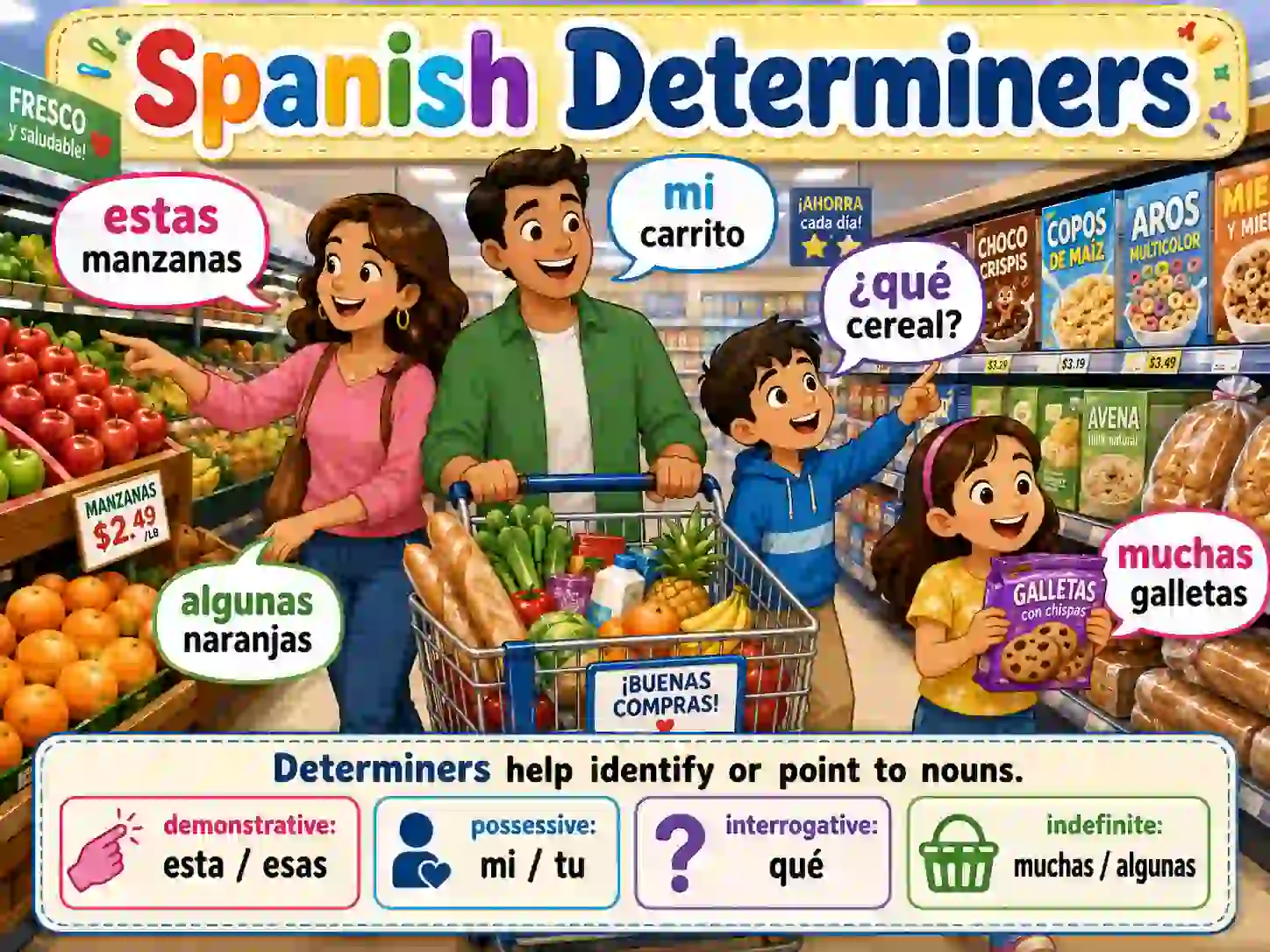
Why Spanish determiners matter
Determiners are central to Spanish noun phrases. They help you say whether a noun is definite or indefinite, near or far, possessed by someone, counted, questioned, general or specific. They also connect directly with Spanish gender and number: este libro, esta casa, estos libros, estas casas.
How to use this determiner guide
Use this page as the main hub for Spanish determiners. Start with articles and nouns, then move to demonstratives, possessives, indefinite determiners, quantifiers and question words.
Determiners normally come before a noun: el libro, mi casa, este problema.
Ask whether you need definiteness, possession, distance, quantity, indefiniteness or a question.
Many determiners agree with the noun: mucho trabajo, mucha agua, muchos libros, muchas personas.
The core system: determiner + noun
Determiners introduce nouns
They usually appear before a noun and help identify it.
el libro · una casa · este problema
Determiners often agree
Many determiners change for masculine, feminine, singular and plural nouns.
este libro · esta casa · estos libros · estas casas
Determiners are not pronouns
A determiner comes with a noun. A pronoun can stand alone and replace the noun phrase.
este libro vs este es mío
Spanish determiners at a glance
Spanish determiners form a connected system. Each group answers a different question about the noun.
| Determiner type | Main question | Examples | Typical meaning | Detail lesson |
|---|---|---|---|---|
| Articles | Is the noun definite or indefinite? | el, la, los, las, un, una | the, a, an, some | Spanish Articles |
| Demonstrative determiners | Which noun in relation to distance? | este, ese, aquel | this, that, these, those | Demonstrative Determiners |
| Possessive determiners | Whose noun? | mi, tu, su, nuestro | my, your, his, her, our | Possessive Determiners |
| Indefinite determiners | Is the noun non-specific? | algún, ningún, otro, cualquier | some, no, another, any | Indefinite Determiners |
| Quantifiers | How much or how many? | mucho, poco, todo, cada | much, many, little, all, each | Spanish Quantifiers |
| Interrogative determiners | What or how many? | qué, cuánto, cuánta, cuántos, cuántas | what, which, how much, how many | Interrogative Determiners |
| Relative determiners | Which noun inside a relative clause? | cuyo, cuya, cuyos, cuyas | whose, of which | Relative Determiners |
Articles as basic Spanish determiners
Articles are the most basic determiners in Spanish. Definite articles identify a known or specific noun. Indefinite articles introduce a non-specific noun.
el libro — the book
la casa — the house
los estudiantes — the students
las clases — the classes
un libro — a book
una casa — a house
Start here if you are new to Spanish noun phrases: Spanish Articles.
Demonstrative determiners: este, ese and aquel
Demonstrative determiners point to a noun by distance. Spanish has three main distance groups: este for near, ese for less near or near the listener, and aquel for far away.
este libro — this book
esta semana — this week
ese problema — that problem
aquellos años — those years long ago
Learn the full distance and agreement system here: Spanish Demonstrative Determiners.
Possessive determiners: mi, tu, su and nuestro
Possessive determiners show ownership, relationship or belonging. They agree with the possessed noun, not with the person who owns it.
mi libro — my book
mis libros — my books
tu casa — your house
su familia — his/her/your/their family
nuestra clase — our class
nuestros amigos — our friends
Study possession here: Spanish Possessive Determiners.
Indefinite determiners: algún, ningún, otro and cualquier
Indefinite determiners introduce nouns that are not fully specific. They are used for some, no, another, other, any or a certain noun.
algún día — some day / one day
alguna pregunta — some question / any question
ningún problema — no problem / not any problem
otro café — another coffee
cualquier persona — any person
Learn this group here: Spanish Indefinite Determiners.
Quantifiers: mucho, poco, todo and cada
Quantifiers express amount, number, totality or distribution. Many quantifiers agree with the noun in gender and number.
| Quantifier | Example | Meaning | Agreement note |
|---|---|---|---|
| mucho | mucho trabajo | a lot of work | masculine singular |
| mucha | mucha agua | a lot of water | feminine singular |
| muchos | muchos libros | many books | masculine plural |
| muchas | muchas personas | many people | feminine plural |
| cada | cada estudiante | each student | invariable, usually singular noun |
Learn quantity words here: Spanish Quantifiers.
Interrogative and relative determiners
Interrogative determiners are used in questions and exclamations before nouns. Relative determiners introduce nouns inside relative clauses.
| Type | Forms | Example | Meaning |
|---|---|---|---|
| Interrogative determiner | qué | ¿Qué libro lees? | What book are you reading? |
| Interrogative determiner | cuánto, cuánta, cuántos, cuántas | ¿Cuántas clases tienes? | How many classes do you have? |
| Relative determiner | cuyo, cuya, cuyos, cuyas | la autora cuyos libros leo | the author whose books I read |
| Relative quantity determiner | cuanto, cuanta, cuantos, cuantas | lee cuantos libros puede | he/she reads as many books as possible |
Study these separately: Interrogative Determiners and Relative Determiners.
Determiners vs pronouns
The same or similar forms can sometimes work as determiners or pronouns. A determiner comes before a noun. A pronoun stands alone and replaces the noun phrase.
| Determiner before a noun | Pronoun standing alone | Explanation |
|---|---|---|
| este libro | Este es mío. | Este determines libro in the first example and replaces it in the second. |
| algún problema | Alguno es difícil. | Algún appears before a noun; alguno stands alone. |
| muchos estudiantes | Muchos estudian español. | The noun is present in the first example and omitted in the second. |
| ¿Qué libro? | ¿Qué quieres? | Qué can determine a noun or stand alone as a pronoun. |
For pronoun use, continue here: Spanish Pronouns.
Recommended learning path for Spanish determiners
Spanish Articles
Start with el, la, los, las, un, una, unos, unas.
Spanish Nouns
Review gender and number because determiners usually depend on the noun.
Demonstrative Determiners
Learn how to point to nouns with este, ese and aquel.
Possessive Determiners
Learn possession with mi, tu, su, nuestro and related forms.
Indefinite Determiners
Learn non-specific reference with algún, ningún, otro and cualquier.
Spanish Quantifiers
Learn amount and number with mucho, poco, todo, cada and related forms.
Spanish determiner topics
Spanish Articles
Learn the article system before moving deeper into determiners.
Demonstrative Determiners
Use este, ese and aquel for distance and reference.
Possessive Determiners
Use mi, tu, su, nuestro and vuestro.
Indefinite Determiners
Use algún, ningún, otro, cierto and cualquier.
Spanish Quantifiers
Use mucho, poco, todo, cada, varios and related forms.
Interrogative Determiners
Use qué and cuánto forms before nouns in questions.
Relative Determiners
Learn formal forms such as cuyo, cuya, cuyos and cuyas.
Spanish Nouns
Review gender, number and noun phrase basics.
Spanish Adjectives
Compare determiner agreement with adjective agreement.
Typical mistakes with Spanish determiners
- Forgetting gender agreement: say esta casa, not este casa.
- Forgetting plural agreement: say mis libros, estos problemas, muchas personas.
- Using a pronoun before a noun: say este problema, not esto problema.
- Adding articles where they do not belong: say mi casa, not la mi casa; say cuyo hijo, not cuyo el hijo.
- Confusing determiner and pronoun use: algún libro has a noun; alguno can stand alone.
Where to go next
After this hub, start with articles if you are building the foundation. Then continue with demonstrative and possessive determiners before moving into indefinite forms and quantifiers.
Want personal guidance?
If Spanish determiners feel confusing, individual guidance can help you practise articles, gender agreement, demonstratives, possessives, quantifiers and noun phrases step by step.
FAQ: Spanish determiners
What are Spanish determiners?
Spanish determiners are words used before nouns to define, specify, point to, quantify, question or relate the noun. Examples include el, una, este, mi, algún, mucho, qué and cuyo.
What are the main types of Spanish determiners?
The main types are articles, demonstrative determiners, possessive determiners, indefinite determiners, quantifiers, interrogative determiners and relative determiners.
Do Spanish determiners agree with nouns?
Many Spanish determiners agree with nouns in gender and number, for example este libro, esta casa, estos libros and estas casas.
Are Spanish articles determiners?
Yes. Articles such as el, la, los, las, un, una, unos and unas are basic Spanish determiners.
What is the difference between a determiner and a pronoun?
A determiner comes before a noun, as in este libro. A pronoun stands alone and replaces the noun phrase, as in Este es mío.
Where should beginners start with Spanish determiners?
Beginners should start with articles and noun gender, then move to demonstrative determiners, possessive determiners, indefinite determiners and quantifiers.

MundoDele – Spanish learning for education, work and intercultural understanding
MundoDele connects online Spanish courses, DELE preparation, Business Spanish and cultural context into a personal Spanish learning platform.
Grammar pages are designed to explain Spanish clearly, with practical examples, real sentence logic and connected learning paths.