
MundoDele Spanish Grammar
Relative Clauses in Spanish: Que, Quien, Lo Que and Cuyo
Learn how Spanish relative clauses work inside sentence structure. This guide explains the basic pattern, the position of the relative clause, and the use of que, quien, el que, lo que, cuyo and donde.
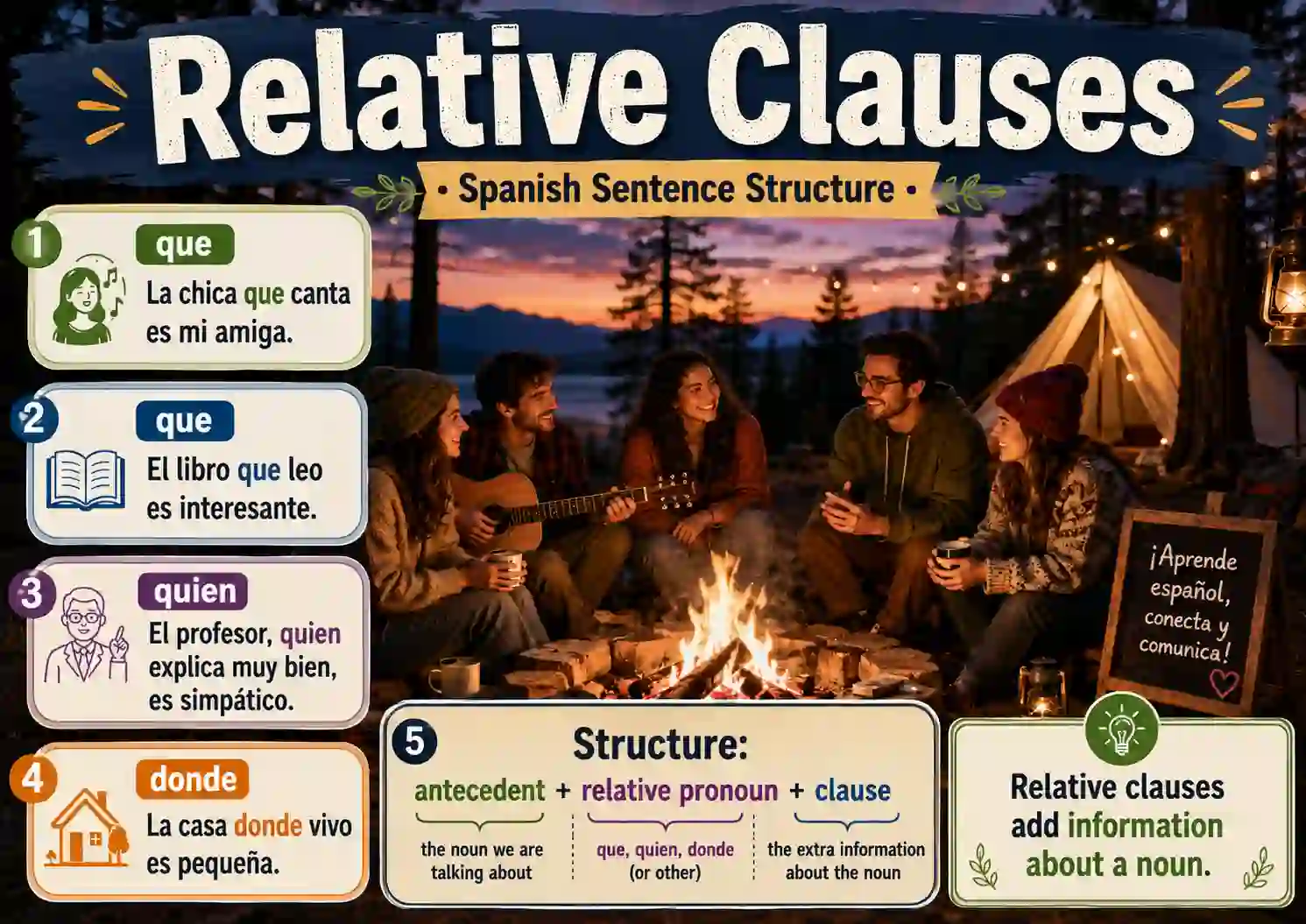
Why relative clauses matter
Relative clauses help you build longer, clearer Spanish sentences
Relative clauses allow you to add information without starting a new sentence. In el libro que compré ayer, the relative clause que compré ayer tells you which book is meant.
The most useful idea is simple: keep the relative clause close to the noun or idea it describes. Spanish becomes clearer when the listener immediately understands what que, quien, lo que or donde refers to.
El libro que leí. The clause describes a specific book.
La persona con quien hablé. The clause describes a person.
Lo que dices. The clause refers to an idea or statement.
Learning sequence
How to use this Spanish relative clauses guide
Use this page to understand relative clauses as part of Spanish sentence structure. First learn the basic pattern. Then compare restrictive and non-restrictive clauses, study the main relative pronouns, and finally practise prepositions and subjunctive contrasts.
The relative clause usually follows the noun or idea it describes: el hombre que vive aquí.
Use que for many people, things and ideas; use lo que for “what” or “the thing that”.
No commas identify the noun. Commas add extra information: los estudiantes que llegaron tarde vs los estudiantes, que llegaron tarde.
Core idea
What is a relative clause in Spanish?
A relative clause is a dependent clause that gives more information about a noun, pronoun or whole idea. The word or idea it refers to is the antecedent. In Spanish, the relative clause normally comes immediately after the antecedent.
| Spanish sentence | Antecedent | Relative clause | English meaning |
|---|---|---|---|
| El libro que compré es interesante. | el libro | que compré | The book that I bought is interesting. |
| La mujer que vive aquí es médica. | la mujer | que vive aquí | The woman who lives here is a doctor. |
| La ciudad donde nací es pequeña. | la ciudad | donde nací | The city where I was born is small. |
| Eso es lo que quiero. | lo / idea | que quiero | That is what I want. |
Relative clause table
Spanish relative clauses at a glance
This table shows the most common relative pronouns and the sentence situations where they appear.
| Form | Used for | Spanish example | Meaning | Related page |
|---|---|---|---|---|
| que | People, things, animals and ideas. | El libro que leí es bueno. | The book that I read is good. | Relative Pronouns |
| quien / quienes | People, especially after prepositions or in added information. | La persona con quien hablé fue amable. | The person I spoke with was kind. | Relative Pronouns |
| el que / la que / los que / las que | Clarified gender and number, often after prepositions. | La empresa para la que trabajo. | The company I work for. | Relative Pronouns |
| lo que | Ideas, statements or “what”. | No entiendo lo que dices. | I do not understand what you are saying. | Relative Pronouns |
| cuyo / cuya / cuyos / cuyas | Possession in written or formal Spanish. | El escritor cuyo libro ganó vive aquí. | The writer whose book won lives here. | Cuyo forms |
| donde | Places. | La ciudad donde nací es pequeña. | The city where I was born is small. | Donde forms |
Basic pattern
Basic Spanish relative clause pattern
The standard pattern is: noun or idea + relative pronoun + relative clause. The relative clause cannot usually stand alone because it depends on the antecedent.
| Pattern part | Spanish example | Function |
|---|---|---|
| Antecedent | la casa | The noun being described. |
| Relative pronoun | que | Connects the noun to the clause. |
| Relative clause | compramos | Gives more information about the noun. |
| Complete phrase | la casa que compramos | The house that we bought. |
La casa que compramos está cerca del centro.
The house that we bought is near the city centre.
Que
Que: the most common Spanish relative pronoun
Que is the most common relative pronoun in Spanish. It can refer to people, things, animals and ideas. In English it can often mean “that”, “which”, “who” or “whom”, depending on the sentence.
| Spanish example | Que refers to | English meaning | Structure |
|---|---|---|---|
| El libro que leí es bueno. | A thing | The book that I read is good. | noun + que + clause |
| La persona que llamó es mi jefe. | A person | The person who called is my boss. | noun + que + verb |
| El perro que vimos era enorme. | An animal | The dog that we saw was huge. | noun + que + clause |
| Lo que dices es importante. | An idea | What you say is important. | lo que + clause |
Other relative pronouns
Quien, el que, lo que, cuyo and donde
Spanish uses several relative forms when the sentence needs a more precise connection: a person after a preposition, a clarified gender or number, an idea, possession or place.
Quien and quienes
Use quien and quienes for people, especially after prepositions.
La persona con quien hablé.
El que forms
Use el que, la que, los que and las que when gender or number matters.
La empresa para la que trabajo.
Lo que
Use lo que for “what” or “the thing that”.
No entiendo lo que dices.
Cuyo forms
Use cuyo for possession. It agrees with the thing possessed.
El escritor cuyo libro ganó.
Donde
Use donde for places.
La ciudad donde nací.
Known or unknown?
Known antecedents often use indicative; unknown or desired antecedents often use subjunctive.
Busco a alguien que hable.
People
Quien and quienes: relative clauses about people
Quien and quienes refer to people. They are especially common after prepositions and in clauses that add extra information. In many simple identifying clauses, que is more common.
| Spanish example | Relative pronoun | English meaning | Note |
|---|---|---|---|
| Mi profesora, quien vive en Sevilla, habla muy claro. | quien | My teacher, who lives in Seville, speaks very clearly. | Extra information about a person. |
| Los estudiantes, quienes llegaron tarde, perdieron la explicación. | quienes | The students, who arrived late, missed the explanation. | Plural people. |
| La persona con quien hablé fue muy amable. | con quien | The person with whom I spoke was very kind. | After a preposition. |
| El hombre de quien te hablé está aquí. | de quien | The man I told you about is here. | Preposition + person. |
Related page: Spanish Relative Pronouns.
El que forms
El que, la que, los que and las que
El que, la que, los que and las que are often used after prepositions or when Spanish needs to clarify gender and number.
| Spanish example | Form | English meaning | Why this form? |
|---|---|---|---|
| El tema del que hablamos es difícil. | del que | The topic that we talked about is difficult. | Preposition + article + que. |
| La empresa para la que trabajo es grande. | para la que | The company I work for is large. | Refers to feminine singular noun. |
| Los documentos a los que me refiero están aquí. | a los que | The documents I am referring to are here. | Refers to masculine plural noun. |
| Las razones por las que lo hice son personales. | por las que | The reasons why I did it are personal. | Refers to feminine plural noun. |
Ideas
Lo que: referring to an idea
Lo que usually means “what” or “the thing that”. It does not refer to a specific masculine noun. It often refers to an idea, statement, situation or entire clause.
| Spanish example | English meaning | What lo que refers to |
|---|---|---|
| No entiendo lo que dices. | I do not understand what you are saying. | The content of what is said. |
| Lo que necesito es tiempo. | What I need is time. | The thing needed. |
| Eso es lo que me preocupa. | That is what worries me. | The situation or idea. |
| Lo que pasó ayer fue extraño. | What happened yesterday was strange. | The whole event. |
Possession
Cuyo, cuya, cuyos and cuyas: possession in relative clauses
Cuyo expresses possession and agrees with the thing possessed, not with the owner. It is more formal than many other relative structures, but it is important in written Spanish.
| Spanish example | Possessed noun | English meaning | Agreement |
|---|---|---|---|
| El escritor cuyo libro ganó el premio vive aquí. | libro | The writer whose book won the prize lives here. | cuyo agrees with masculine singular libro. |
| La mujer cuya hija estudia medicina es mi vecina. | hija | The woman whose daughter studies medicine is my neighbour. | cuya agrees with feminine singular hija. |
| Los países cuyos gobiernos firmaron el acuerdo participan. | gobiernos | The countries whose governments signed the agreement participate. | cuyos agrees with masculine plural gobiernos. |
| Las empresas cuyas oficinas están en Madrid crecieron. | oficinas | The companies whose offices are in Madrid grew. | cuyas agrees with feminine plural oficinas. |
Place
Donde: relative clauses about place
Donde introduces a relative clause about place. It often corresponds to “where” in English.
| Spanish example | Antecedent | English meaning | Structure |
|---|---|---|---|
| La ciudad donde nací está en el norte. | la ciudad | The city where I was born is in the north. | Place + donde + clause. |
| El restaurante donde cenamos era excelente. | el restaurante | The restaurant where we had dinner was excellent. | Place + donde + clause. |
| La casa donde vive es antigua. | la casa | The house where he/she lives is old. | Place + donde + clause. |
Commas
Restrictive and non-restrictive relative clauses
Spanish relative clauses can identify which person or thing you mean, or they can add extra information. This difference is shown with commas.
| Type | Spanish example | Meaning | Comma rule |
|---|---|---|---|
| Restrictive | Los estudiantes que llegaron tarde perdieron la explicación. | Only the students who arrived late missed it. | No commas. |
| Non-restrictive | Los estudiantes, que llegaron tarde, perdieron la explicación. | All the students arrived late and missed it. | Commas add extra information. |
| Restrictive | El libro que está sobre la mesa es mío. | The specific book on the table is mine. | No commas. |
| Non-restrictive | El libro, que está sobre la mesa, es mío. | The book is mine; it happens to be on the table. | Commas mark added information. |
Prepositions
Prepositions before relative pronouns
When a verb or expression requires a preposition, the preposition often appears before the relative pronoun in careful Spanish. This is common with del que, con quien, para la que, por los que and similar structures.
| Expression | Spanish example | English meaning | Structure |
|---|---|---|---|
| hablar de | El tema del que hablamos es importante. | The topic we talked about is important. | de + el que → del que |
| trabajar para | La empresa para la que trabajo es internacional. | The company I work for is international. | para + la que |
| referirse a | Los datos a los que me refiero están aquí. | The data I am referring to is here. | a + los que |
| contar con | La persona con quien cuento está ocupada. | The person I count on is busy. | con + quien |
| luchar por | Las razones por las que luchamos son claras. | The reasons we fight for are clear. | por + las que |
Related page: Prepositional Pronouns.
Mood choice
Relative clauses: indicative or subjunctive?
In Spanish relative clauses, the indicative is used when the person or thing is known, specific or real. The subjunctive is used when the person or thing is unknown, desired, non-specific or does not exist.
| Indicative: known or specific | Subjunctive: unknown or non-specific | Difference |
|---|---|---|
| Conozco a alguien que habla español. | Busco a alguien que hable español. | Known person vs person being searched for. |
| Tengo un libro que explica esto. | Necesito un libro que explique esto. | Known book vs desired book. |
| Hay una solución que funciona. | No hay una solución que funcione. | Existing solution vs no existing solution. |
| Vivo en una ciudad que tiene playa. | Quiero vivir en una ciudad que tenga playa. | Real city vs desired city. |
Continue here: Relative Clauses with Subjunctive and Indicative vs Subjunctive.
Position
Where does the relative clause go in a Spanish sentence?
A relative clause should normally be placed as close as possible to the word it describes. If the relative clause is too far away, the sentence can become unclear.
| Clear structure | Less clear structure | Why? |
|---|---|---|
| Vi al profesor que enseña español. | Vi al profesor ayer que enseña español. | The relative clause should stay close to profesor. |
| Compré el libro que me recomendaste. | Compré el libro ayer en la tienda que me recomendaste. | The second version could refer to the shop, not the book. |
| Conocí a una mujer que trabaja en Lima. | Conocí en Lima a una mujer que trabaja allí. | Both can work, but the first is simpler. |
Recommended order
Recommended learning order for Spanish relative clauses
Basic pattern
Learn the structure: noun or idea + relative pronoun + relative clause.
Que
Use que as the most common relative pronoun for people, things, animals and ideas.
Lo que
Separate que after a noun from lo que for “what” or an idea.
Prepositions
Learn del que, con quien, para la que and related structures.
Commas
Compare clauses that identify with clauses that add extra information.
Indicative or subjunctive
Learn the contrast between known and unknown antecedents.
Practice
Practice exercises: Spanish relative clauses
Try to answer before opening the solutions. These exercises focus on sentence structure, relative pronouns and clause position.
Exercise 1: identify the relative clause
- El libro que compré es interesante.
- La ciudad donde nací es pequeña.
- No entiendo lo que dices.
- La persona con quien hablé fue amable.
Show answers
1. que compré
2. donde nací
3. lo que dices
4. con quien hablé
Exercise 2: choose the relative pronoun
- El libro ___ leí es bueno.
- La ciudad ___ vivo es grande.
- No entiendo ___ dices.
- La persona con ___ hablé fue amable.
Show answers
1. que
2. donde
3. lo que
4. quien
Exercise 3: indicative or subjunctive?
- Conozco a alguien que ___ español. hablar
- Busco a alguien que ___ español. hablar
- Tengo un libro que ___ esto. explicar
- Necesito un libro que ___ esto. explicar
Show answers
1. habla
2. hable
3. explica
4. explique
Typical mistakes
Typical mistakes with Spanish relative clauses
- Placing the relative clause too far from the noun: keep the relative clause close to the word it describes.
- Using quien for things: quien refers to people, not objects.
- Confusing que and lo que: use que after a noun, but lo que for “what” or “the thing that”.
- Forgetting prepositions: Spanish often keeps the preposition before the relative pronoun: del que, con quien, para la que.
- Ignoring commas: commas can change whether the clause identifies or only adds information.
- Using indicative for unknown antecedents: say busco a alguien que hable, not busco a alguien que habla.
- Using cuyo without agreement: cuyo agrees with the possessed noun, not with the owner.
Where to go next
Where to go next
After learning relative clauses as sentence structure, continue with relative pronouns and the subjunctive contrast. This helps you separate el libro que leí, lo que quiero and busco a alguien que hable.
Relative Pronouns
Learn que, quien, el que, lo que, cuyo and donde.
Relative Clauses with Subjunctive
Compare known, specific, unknown, desired and non-existing antecedents.
Spanish Sentence Structures
Return to the sentence structure overview and continue with impersonal sentences or passive voice.
When you need help
Practise relative clauses in real Spanish sentences
Relative clauses help you move from short sentences to more precise Spanish. Individual practice can help you use que, lo que, quien, cuyo, commas and subjunctive contrasts with more confidence.
Spanish Tutoring
Useful if you need help with relative clauses, sentence structure, homework or weak points.
Private Spanish Lessons
Use relative clauses in conversation, writing, explanations and personal practice.
Spanish Grammar
Return to the main grammar overview and choose another topic.
FAQ
FAQ: Spanish relative clauses
What is a relative clause in Spanish?
A Spanish relative clause gives more information about a noun, pronoun or idea. In el libro que compré, the relative clause is que compré.
Where does a relative clause go in Spanish?
A relative clause usually comes directly after the word it describes: la persona que llamó, el libro que leí, la ciudad donde nací.
What is the most common Spanish relative pronoun?
The most common Spanish relative pronoun is que. It can refer to people, things, animals and ideas.
What is the difference between que and lo que?
Que usually connects to a specific noun, as in el libro que leí. Lo que refers to an idea or means “what”, as in lo que quiero.
When do Spanish relative clauses use commas?
Spanish uses commas when the relative clause adds extra information: Mi hermano, que vive en Madrid, viene mañana. Without commas, the clause identifies which person or thing is meant.
Do Spanish relative clauses use the subjunctive?
Yes. Spanish relative clauses use the subjunctive when the antecedent is unknown, desired, non-specific or non-existent: busco a alguien que hable español. Known or specific antecedents usually use the indicative: conozco a alguien que habla español.
How does cuyo work in Spanish relative clauses?
Cuyo expresses possession and agrees with the thing possessed, not with the owner: el escritor cuyo libro, la mujer cuya hija, los países cuyos gobiernos.

About
About MundoDele
MundoDele connects online Spanish lessons, tutoring, intensive Spanish courses, DELE and SIELE preparation, Business Spanish, grammar resources and cultural context into one personal Spanish learning platform.
Grammar pages are designed to explain Spanish clearly, with practical examples, sentence logic and useful links to related learning support.