
MundoDele Spanish Grammar
Spanish Adverbs: Types, Examples and Word Order
Learn how Spanish adverbs express time, place, manner, quantity, frequency, doubt, affirmation and negation. You will also learn how to form adverbs with -mente, where adverbs appear in sentences and how comparison works.
Definition
What are Spanish adverbs?
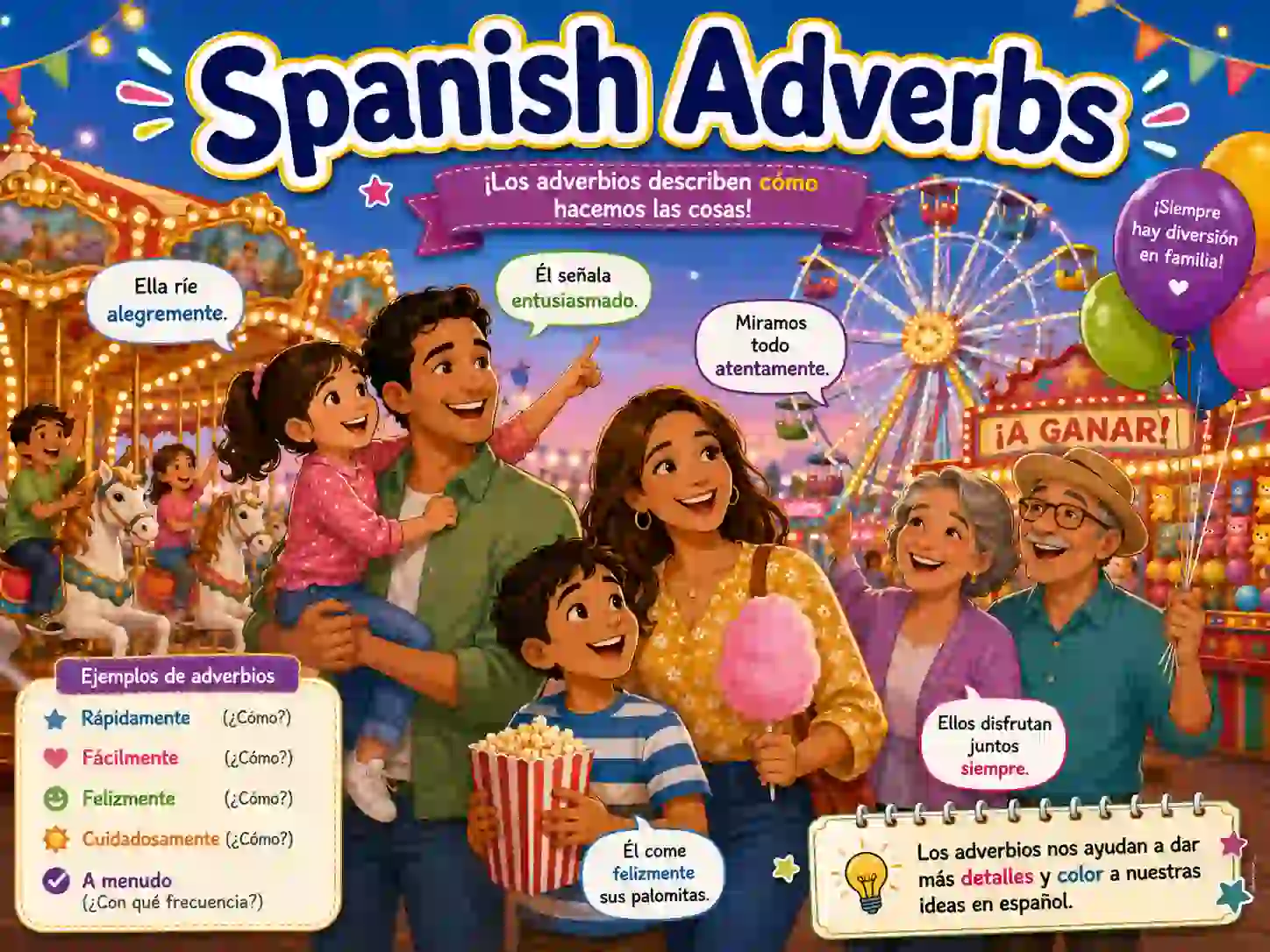
Spanish adverbs are words or expressions that modify a verb, adjective, another adverb or complete sentence. They explain when, where, how, how much, how often or how certainly something happens.
Habla claramente.
He or she speaks clearly.
Es muy difícil.
It is very difficult.
Probablemente llegará mañana.
He or she will probably arrive tomorrow.
Ella trabaja bien. and Ellos trabajan bien. use the same adverb form.
Spanish adverb lessons
Choose the lesson you need
Start with the meaning or grammar point you need. Each lesson contains explanations, examples, common mistakes and practice exercises.
Adverbs of Time
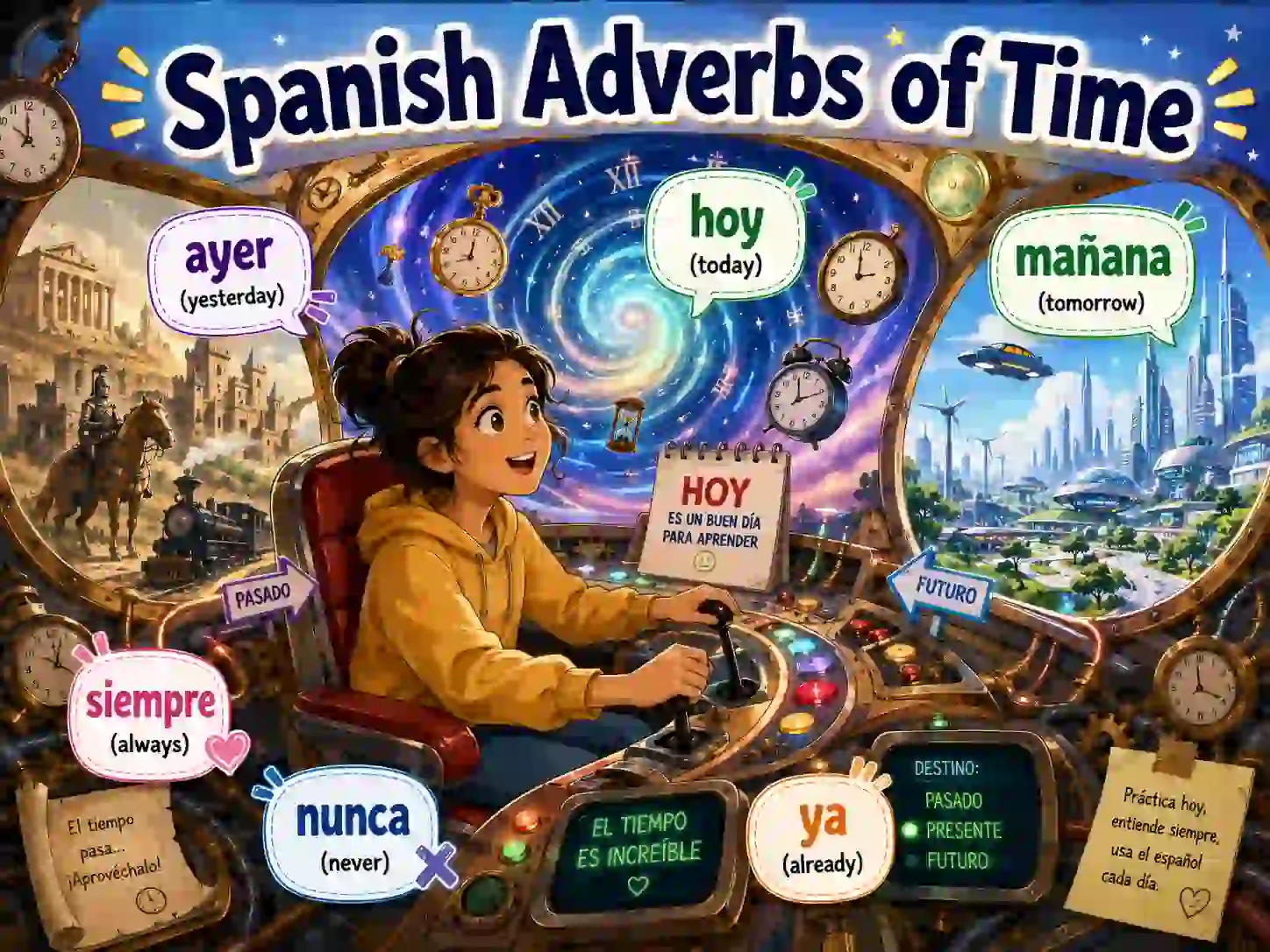
Learn hoy, ayer, mañana, ahora, ya, todavía, antes and después.
Open lesson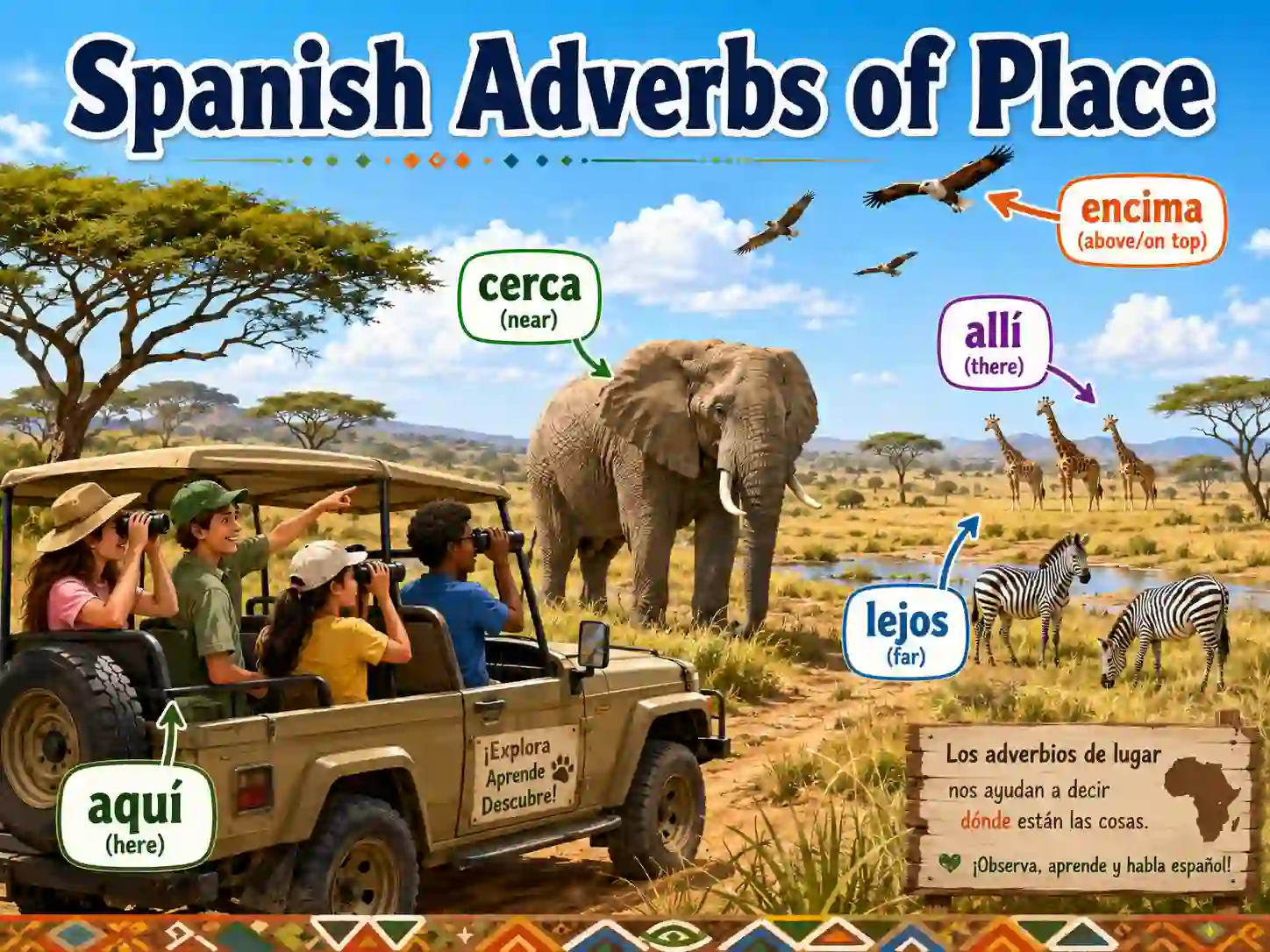
Adverbs of Place
Learn aquí, acá, ahí, allí, allá, cerca, lejos, dentro and fuera.
Open lesson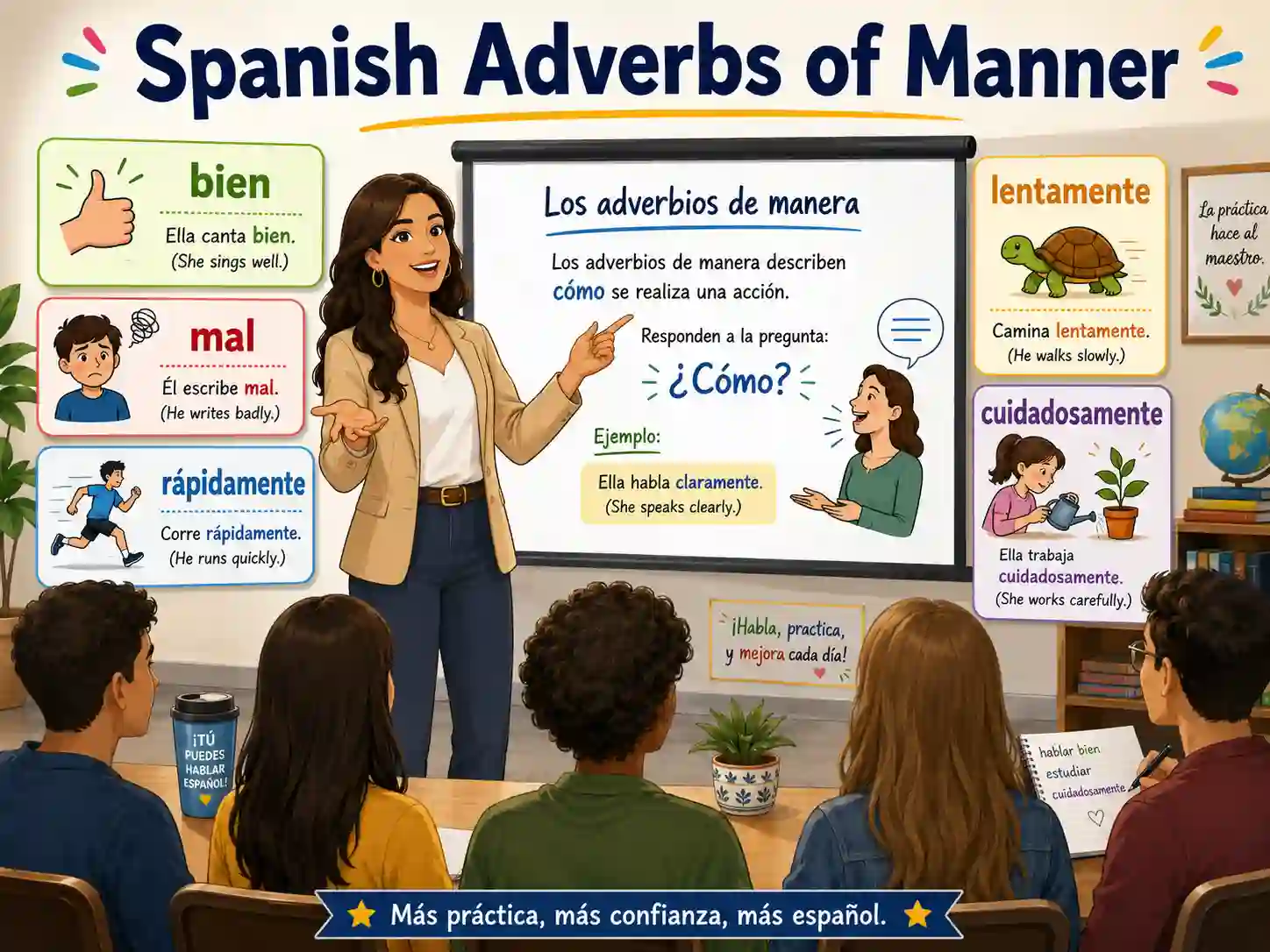
Adverbs of Manner
Learn bien, mal, así, despacio, rápido and claramente.
Open lesson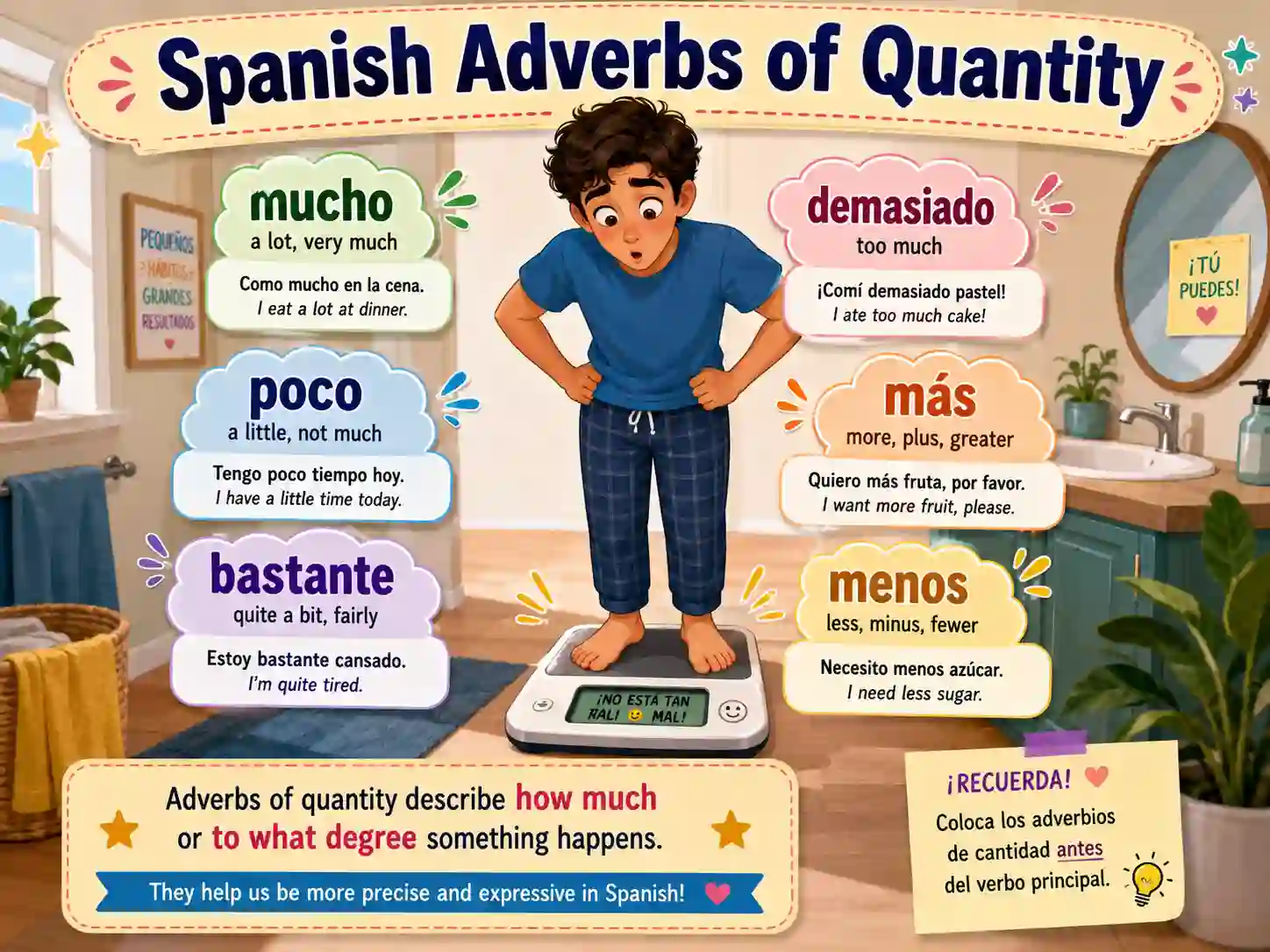
Adverbs of Quantity
Learn muy, mucho, poco, bastante, demasiado, más, menos and tan.
Open lesson
Adverbs of Frequency
Learn siempre, nunca, a veces, normalmente, frecuentemente and rara vez.
Open lesson
Adverbs of Doubt
Learn quizá, quizás, tal vez, probablemente, posiblemente and a lo mejor.
Open lesson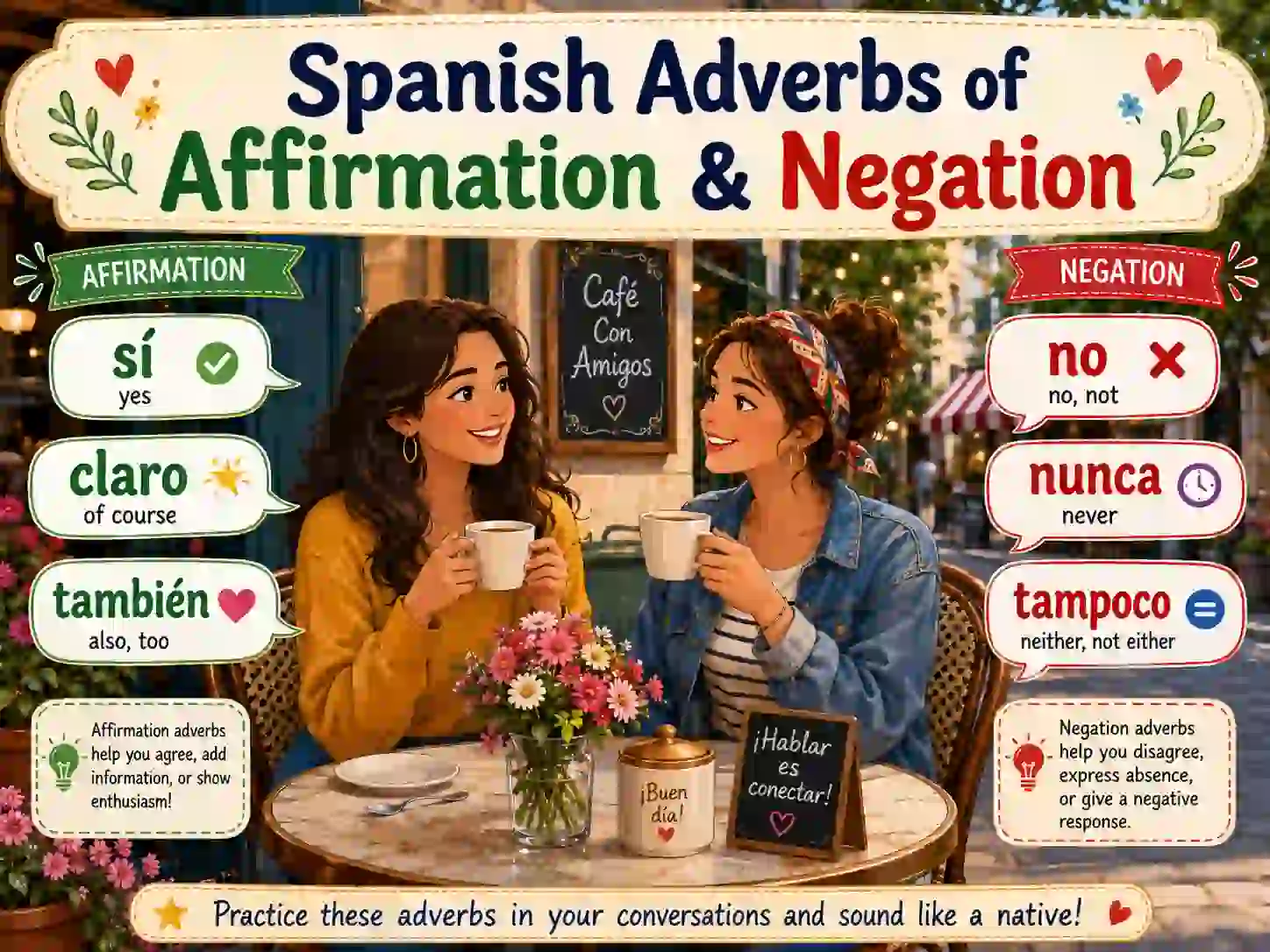
Affirmation and Negation
Learn sí, también, claro, no, nunca, jamás, tampoco and double negation.
Open lesson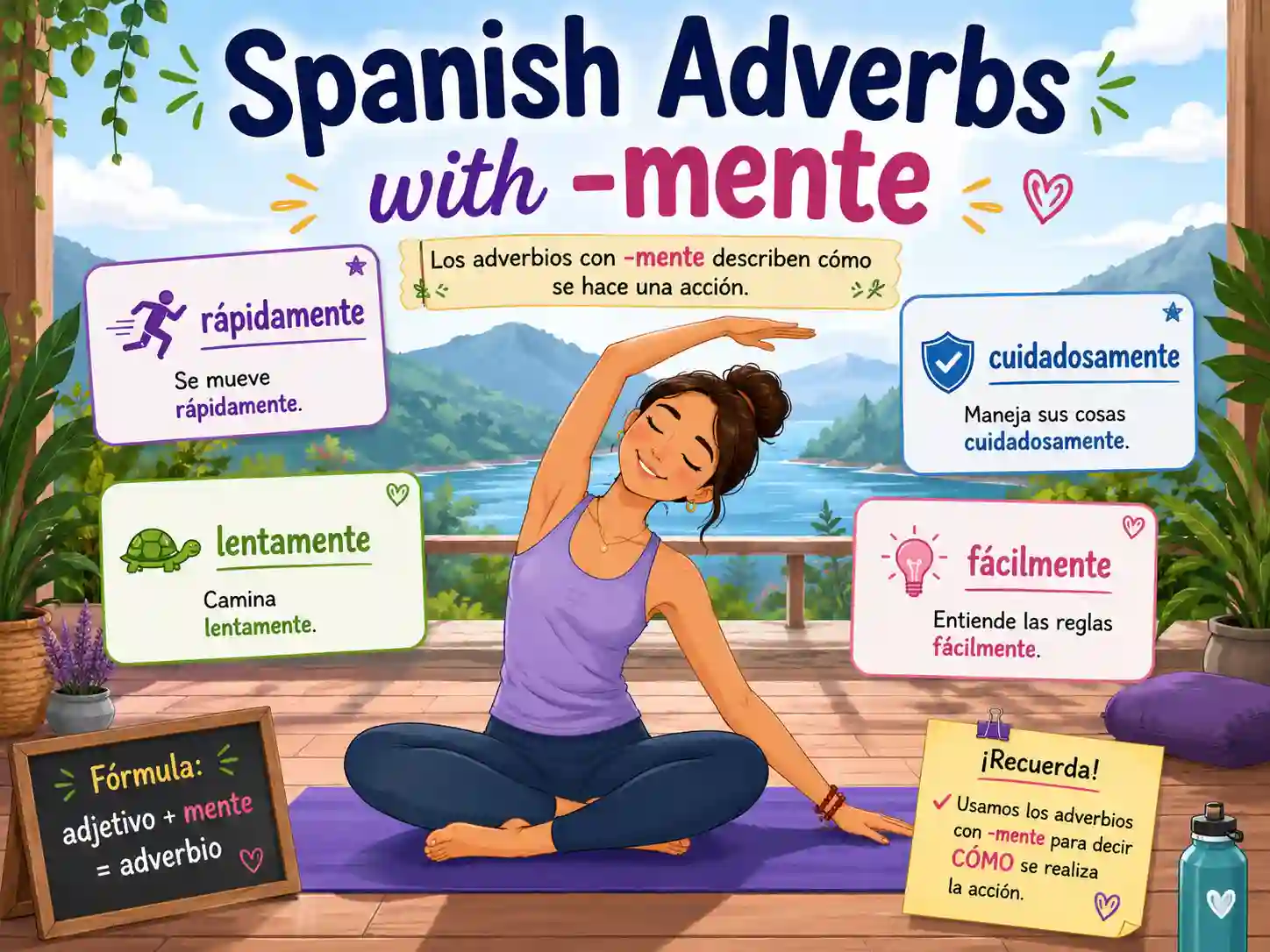
Adverbs with -mente
Learn how to form claramente, rápidamente, fácilmente, naturalmente and related forms.
Open lesson
Position of Adverbs
Learn where adverbs go with verbs, objects, adjectives, negation, frequency expressions and compound verb forms.
Open lesson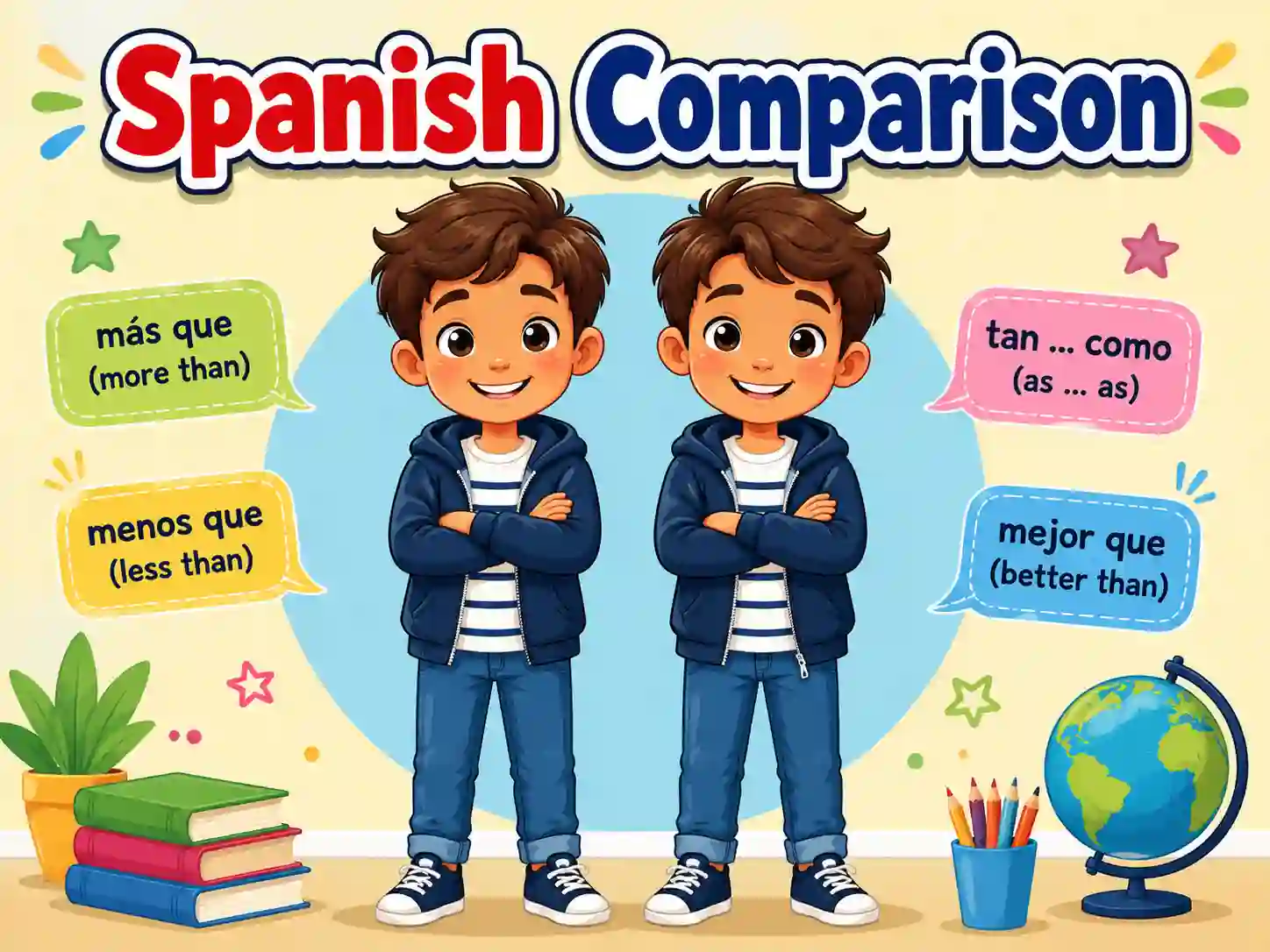
Spanish Comparison
Learn más que, menos que, tan como, tanto como, mejor, peor and superlatives.
Open lessonOverview
Spanish adverb types at a glance
The easiest way to identify an adverb type is to ask which information it adds.
| Type | Question | Common forms | Example | Lesson |
|---|---|---|---|---|
| Time | When? | hoy, ayer, mañana, ahora | Hoy estudio español. | Adverbs of Time |
| Place | Where? | aquí, ahí, allí, cerca, lejos | Vivo aquí. | Adverbs of Place |
| Manner | How? | bien, mal, así, despacio, claramente | Habla bien. | Adverbs of Manner |
| Quantity or degree | How much? | muy, mucho, poco, bastante | Trabaja mucho. | Adverbs of Quantity |
| Frequency | How often? | siempre, nunca, a veces, normalmente | Siempre estudio aquí. | Adverbs of Frequency |
| Doubt | How certain? | quizá, tal vez, probablemente | Quizá venga mañana. | Adverbs of Doubt |
| Affirmation | Is it confirmed? | sí, también, claro | Sí, también quiero ir. | Affirmation and Negation |
| Negation | Is it denied? | no, nunca, jamás, tampoco | No entiendo. | Affirmation and Negation |
Grammar function
What do Spanish adverbs modify?
A verb
The adverb describes an action or state.
Habla claramente.
Estudia mucho.
Vive aquí.
An adjective
A degree adverb changes the intensity of a quality.
muy interesante
bastante difícil
demasiado caro
Another adverb
One adverb can strengthen or limit another.
muy bien
bastante lejos
demasiado rápidamente
A complete sentence
Sentence adverbs express probability, evaluation or viewpoint.
Probablemente llegará.
Sinceramente, no lo sé.
A time frame
A time adverb can establish when the complete statement applies.
Hoy trabajo en casa.
Mañana tenemos clase.
A negative statement
No denies the action, state or verbal expression.
No entiendo.
No quiero salir.
Word order
Where do Spanish adverbs go?
Spanish does not use one fixed position for every adverb. Position depends on what the adverb modifies and which information the speaker wants to emphasise.
| Function | Common position | Example | Note |
|---|---|---|---|
| Manner | After the verb or object | Explica la regla claramente. | Describes how the action happens. |
| Degree | Before adjective or adverb | muy difícil · muy bien | Directly precedes the modified word. |
| Negation | Before the conjugated verb | No lo entiendo. | Pronouns remain next to the verb. |
| Time | Beginning or end | Hoy trabajo. · Trabajo hoy. | Position changes focus. |
| Frequency | Beginning, before verb or after phrase | Siempre estudio aquí. | Natural position varies by expression. |
| Sentence comment | Often at the beginning | Probablemente llegará tarde. | Comments on the whole statement. |
Say No entiendo, not Entiendo no. Say muy interesante, not interesante muy.
Detailed lesson: Position of Adverbs in Spanish .
Formation
Spanish adverbs with -mente
Many Spanish adverbs are formed by adding -mente to the feminine singular form of an adjective. Adjectives with one form keep that form.
| Adjective | Form used | Adverb | Meaning |
|---|---|---|---|
| claro | clara | claramente | clearly |
| rápido | rápida | rápidamente | quickly |
| lento | lenta | lentamente | slowly |
| fácil | fácil | fácilmente | easily |
| frecuente | frecuente | frecuentemente | frequently |
| natural | natural | naturalmente | naturally |
rápido → rápidamente and fácil → fácilmente.
Detailed lesson: Spanish Adverbs with -mente .
Common contrast
Muy and mucho
Muy and mucho both express degree, but they normally modify different kinds of words.
| Form | Function | Example | Meaning |
|---|---|---|---|
| muy | Before an adjective | Es muy difícil. | It is very difficult. |
| muy | Before an adverb | Habla muy bien. | He or she speaks very well. |
| mucho | With a verb | Trabaja mucho. | He or she works a lot. |
| mucho | Before a comparative | Es mucho mejor. | It is much better. |
Grammar contrast
Spanish adjective or adverb?
Adjectives describe nouns and normally agree with them. Adverbs describe actions, qualities, other adverbs or statements and normally remain unchanged.
| Adjective | Adverb | Difference |
|---|---|---|
| una buena respuesta | Responde bien. | Buena describes a noun; bien describes the action. |
| una mala idea | Escribe mal. | Mala describes a noun; mal describes how someone writes. |
| una respuesta rápida | Responde rápido. | Rápida agrees with the noun; adverbial rápido remains unchanged. |
| una explicación clara | Explica claramente. | Clara describes the explanation; claramente describes the action. |
Say Habla bien, not Habla bueno.
Comparison
Comparing actions with Spanish adverbs
| Pattern | Example | Meaning |
|---|---|---|
| más + adverb + que | Habla más claramente que yo. | He or she speaks more clearly than I do. |
| menos + adverb + que | Trabaja menos cuidadosamente que Ana. | He or she works less carefully than Ana. |
| tan + adverb + como | Explica tan bien como el profesor. | He or she explains as well as the teacher. |
| mejor que | Canta mejor que yo. | He or she sings better than I do. |
| peor que | Escribe peor que antes. | He or she writes worse than before. |
Detailed lesson: Spanish Comparison .
Exercises
Practice Spanish adverbs
Identify the adverb type
- Hoy trabajo en casa.
- Habla claramente.
- Vive lejos.
- Quizá venga mañana.
Show answers
1. Hoy: time.
2. Claramente: manner.
3. Lejos: place.
4. Quizá: doubt;
mañana: time.
Choose muy or mucho
- Es ___ difícil.
- Trabaja ___.
- Habla ___ bien.
- Es ___ mejor.
Show answers
1. muy
2. mucho
3. muy
4. mucho
Correct the sentence
- Habla bueno.
- Ellas trabajan rápidas.
- Entiendo no.
- Es mucho interesante.
Show answers
1. Habla bien.
2. Ellas trabajan rápido.
3. No entiendo.
4. Es muy interesante.
Common errors
Common mistakes with Spanish adverbs
- Adjective instead of adverb: say habla bien, not habla bueno.
- Agreement: adverbs normally remain unchanged: ellas trabajan rápido.
- Muy and mucho: say muy difícil but trabaja mucho.
- Negation: say No entiendo, not Entiendo no.
- Word order: position depends on the adverb’s function.
- -mente: not all Spanish adverbs end in -mente.
- Accent marks: write rápidamente and fácilmente.
Frequently asked questions
Questions about Spanish adverbs
What are Spanish adverbs?
Spanish adverbs modify verbs, adjectives, other adverbs or complete sentences. They can express time, place, manner, quantity, frequency, doubt, affirmation or negation.
Do Spanish adverbs change for gender or number?
They normally remain unchanged: ella habla bien and ellos hablan bien.
Where do Spanish adverbs go in a sentence?
Manner adverbs often follow the verb or object, degree adverbs normally precede adjectives and other adverbs, and no precedes the conjugated verb.
What is the difference between muy and mucho?
Muy normally modifies an adjective or adverb: muy difícil, muy bien. Mucho commonly modifies a verb: trabaja mucho.
How are Spanish adverbs with -mente formed?
Use the feminine singular form of the adjective and add -mente: claro → clara → claramente. Existing written accents remain.
What is the difference between an adjective and an adverb?
An adjective describes a noun and often agrees with it. An adverb modifies a verb, adjective, another adverb or complete sentence and normally remains unchanged.
Practice and support
Practise Spanish adverbs in complete sentences
Adverbs become easier when you practise their meaning, sentence position, -mente formation, comparison and the difference between adjectives and adverbs.
Spanish Tutoring
Work on adverb types, word order, sentence correction and individual grammar problems.
Private Spanish Lessons
Practise adverbs in speaking, writing and complete everyday sentences.
Intensive Spanish Course
Combine grammar with structured speaking, listening and sentence-building activities.

About MundoDele
Spanish learning for education, work and real communication
MundoDele connects online Spanish courses, DELE preparation, Business Spanish and cultural context into a personal Spanish learning platform.
The grammar guides explain Spanish with practical examples, clear comparisons and complete sentences.