
Spanish culture guide
Spanish and Latin American Traditions and Festivals
Explore how celebrations across Spain and Latin America connect faith, music, family memory, public rituals, symbols and language. This guide helps Spanish learners understand festivals as living cultural texts.
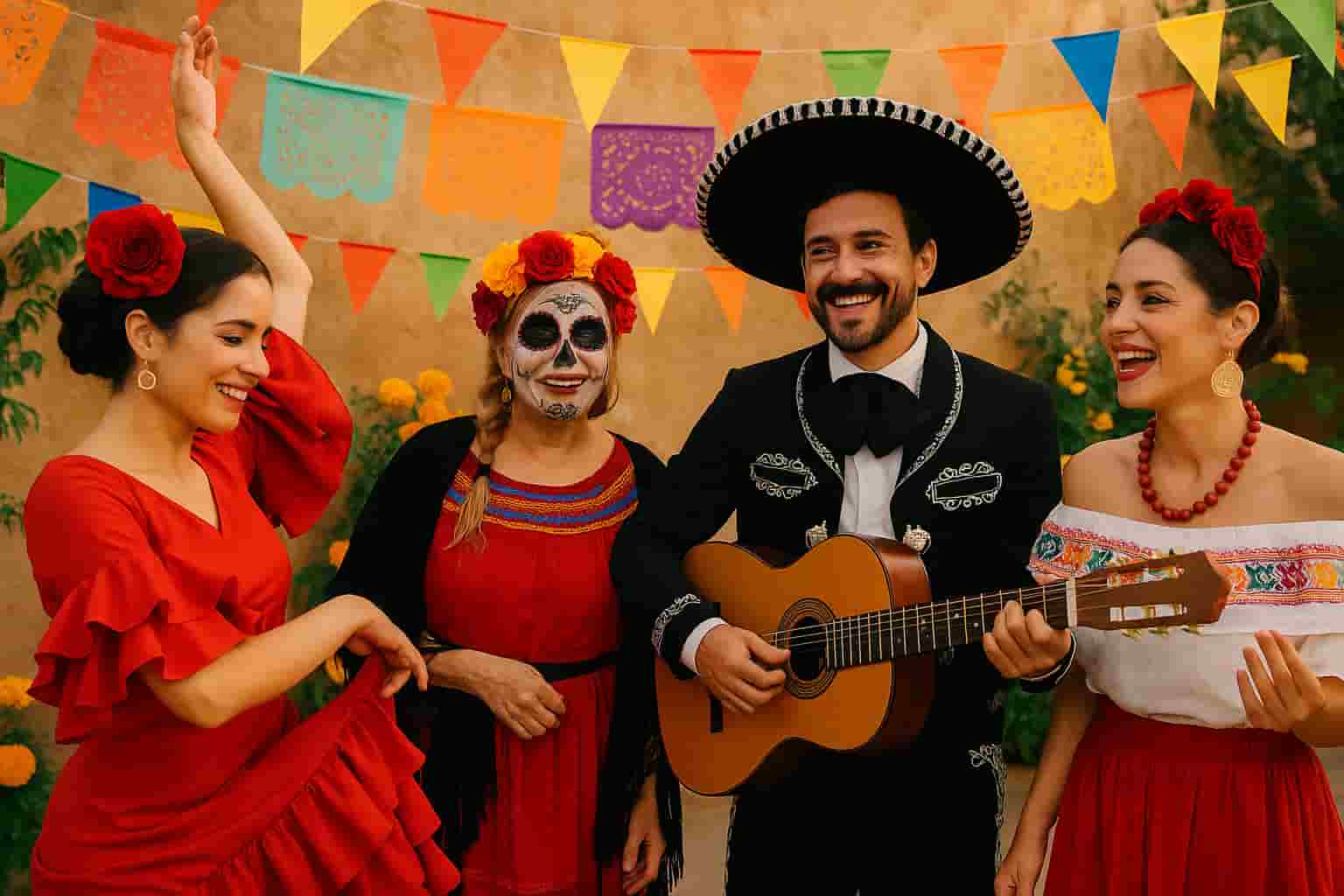
Quick culture guide
Why festivals matter for Spanish learners
Spanish and Latin American festivals are not only public events. They are cultural systems: people use them to remember the dead, mark seasonal change, express faith, celebrate identity, perform music, cook family recipes and teach younger generations what a community values.
For language learners, this is useful because vocabulary becomes easier when it is attached to a scene: a procession, an altar, a dance, a market, a song, a costume or a family ritual.
Words in real use
Festival phrases, greetings, chants and food words appear in real emotional situations.
Symbols and memory
Flowers, candles, masks, fire and music help explain shared meanings across generations.
Better lessons
Teachers can turn festivals into maps, roleplays, presentations, vocabulary work and comparisons.
Key themes
Key themes in Hispanic festivities
Behind every celebration lies a deeper story. Spanish and Latin American festivals are shaped by themes that cross borders while still remaining local, regional and personal.
Faith and devotion
From Catholic processions to syncretic rituals, faith plays a foundational role in celebrations such as Semana Santa or La Virgen de Guadalupe.
Music and dance
Music and dance are central: flamenco in Spain, cumbia in Colombia, carnival drums in Bolivia and Argentina, and many regional styles.
Actions with meaning
Festivals preserve ritual actions: offering food to the dead during Día de los Muertos, lighting bonfires for San Juan, or preparing family dishes.
Identity and resilience
Many celebrations express cultural survival. Andean, Afro-Latin and indigenous festivals often carry memories of resistance and community identity.
Generational memory
Traditions continue through families, kitchens, songs, costumes, stories, altars and local knowledge.
Local belonging
The same festival type can look different in Seville, Valencia, Cuzco, Mexico City or Barranquilla.
Must-know examples
5 must-know festivals in Spain and Latin America
These celebrations show how diverse Spanish-speaking cultures are: joyful, religious, satirical, ancestral, musical and deeply symbolic.
🎭 Carnival / Carnaval
Where: Brazil, Bolivia, Colombia, Spain and many other places.
Why it matters: parades, costumes and street dancing create a public moment of joy before Lent.
💀 Día de los Muertos
Where: Mexico.
Why it matters: families honor deceased loved ones with altars, food, candles and symbolic imagery.
🔥 Las Fallas
Where: Valencia, Spain.
Why it matters: giant satirical sculptures are built, displayed and burned in a dramatic public ritual.
🕊️ Semana Santa
Where: Spain, Guatemala, Peru and many other places.
Why it matters: processions, silence, incense, music and devotion mark Holy Week in public space.
☀️ Inti Raymi
Where: Peru, Ecuador, Bolivia.
Why it matters: the Inca sun festival connects seasonal cycles, indigenous heritage and public performance.
💃 Feria de Abril
Where: Seville, Spain.
Why it matters: flamenco dresses, casetas, horses and music turn spring celebration into local identity.
Interactive map
Map of major festivals in the Spanish-speaking world
Use the map to connect each celebration with its place. Click a button or a marker to see the festival, country and cultural meaning.
Symbols and meanings
Symbols that speak: what traditions tell us
Every festival is a coded language. Behind masks, colors, music and ritual objects lie meanings that reflect beliefs, values, collective memory and local identity.
💀 Calaveras
Skulls represent life beyond death. In Mexican festival culture they are often playful, colorful and connected to memory rather than fear.
🔥 Fire
Fire can symbolize purification, transformation and the public release of social satire.
🦙 Animals
Llamas, pumas and condors often connect earth, strength, sky and Andean cosmology.
🎭 Masks
Masks allow people to step outside daily identity, honor spirits, mock power or perform ancestral memory.
🎨 Festival colors
Red, white, purple, gold and black can carry meanings of life, purity, suffering, power, sun or mourning.
🔔 Bells, drums and chants
The soundscape of a festival marks sacred time, public space, celebration, mourning or collective energy.
Did you know?
In Mexican culture, marigolds are closely associated with Día de los Muertos. Their color and scent are used as part of the visual and ritual language of remembrance.
Living heritage
Traditions passed down through generations
Many Spanish and Latin American traditions have survived for centuries through families, communities and oral storytelling. These practices form a cultural backbone that links grandparents, parents and children through shared acts of memory.
🧵 Embroidered garments
Weaving patterns, clothing styles and decorative techniques can carry local identity and family knowledge.
🍲 Culinary rituals
Recipes for tamales, empanadas, mole or seasonal dishes often pass from one generation to the next.
📜 Oral storytelling
Legends, fables and local myths continue through family conversations, school activities and community memory.
These practices preserve the past and give new generations a way to reinterpret tradition. Learning Spanish helps learners connect with people, but also with the living heritage of entire regions.
Language in celebration
Key Spanish phrases for festivals
Spanish festivals are full of short expressions that learners can actually use: greetings, cheers, invitations, wishes and ritual phrases.
🎉 Celebration phrases
- ¡Feliz Carnaval! – Happy Carnival!
- ¡Que viva la fiesta! – Long live the party!
- ¡A bailar! – Let’s dance!
- ¡Viva San Fermín! – A famous cheer in Pamplona.
🕯️ Memory and ritual phrases
- ¡Feliz Día de los Muertos! – Happy Day of the Dead!
- una ofrenda – an offering / altar offering
- una procesión – a procession
- una tradición familiar – a family tradition
| Spanish word | English meaning | Useful context |
|---|---|---|
| la fiesta | festival / party | General word for celebration. |
| la procesión | procession | Common in Semana Santa and religious celebrations. |
| el desfile | parade | Useful for Carnival and public street festivals. |
| el disfraz | costume | Useful for Carnival and local celebrations. |
| la ofrenda | offering | Useful for Día de los Muertos and religious rituals. |
| la vela | candle | Useful for altars, processions and symbolic lighting. |
| el tambor | drum | Useful for music, rhythm and processions. |
| la tradición | tradition | Useful for cultural comparison and presentations. |
For teachers and learners
How to use festivals in Spanish lessons
Festivals work well in Spanish learning because they bring together vocabulary, geography, listening, speaking, comparison and cultural interpretation.
Map activity
Choose five festivals, locate them on a map and explain what each one celebrates.
Symbol analysis
Pick one symbol such as fire, masks, flowers or candles and explain its meaning in Spanish.
Roleplay
Students ask for directions, describe a parade, invite someone to dance or explain a family tradition.
Comparison task
Compare one Spanish or Latin American festival with a celebration from the learner’s country.
Vocabulary cluster
Create word groups for music, food, religion, costumes, public space and emotions.
Short presentation
Prepare a two-minute presentation about one festival, its place, symbols and key phrases.
Interactive quiz
Test your festival knowledge
Continue learning
More MundoDele guides for culture, travel and Spanish learning
Use these internal pages to connect traditions and festivals with Spanish culture, grammar, travel and structured lessons.
Explore more cultural topics from the Spanish-speaking world. Culture in Spain
Understand Spanish places, traditions and everyday cultural context. Spain Destinations
Connect cultural learning with travel routes and city guides. Learn Spanish
Start from the central MundoDele Spanish learning section. Spanish Grammar
Build the grammar foundation behind real cultural language. Private Spanish Lessons
Learn Spanish with individual support and real-life context. Intensive Spanish Course
Combine structured learning with culture and travel themes. Seville Travel Guide
Connect Semana Santa and Feria culture with a real Spanish city. Valencia Travel Guide
Connect Las Fallas with one of Spain’s major cultural destinations.
FAQ
FAQ: Spanish and Latin American traditions and festivals
Why are festivals useful for learning Spanish?
Festivals connect Spanish words with real cultural situations. Learners see how vocabulary, emotions, rituals, greetings, music and regional identity appear in authentic contexts.
Which Spanish-speaking festivals should learners know?
Useful examples include Semana Santa, Día de los Muertos, Las Fallas, Carnival, Inti Raymi, Feria de Abril and regional celebrations across Spain and Latin America.
What themes appear in many Hispanic festivals?
Common themes include religion, rhythm, ritual, memory, family, resistance, community identity, seasonal cycles and the relationship between local history and public celebration.
How can teachers use festivals in Spanish lessons?
Teachers can use festivals for vocabulary work, roleplays, cultural comparison, map activities, short presentations, symbol analysis, listening practice and creative writing tasks.
What Spanish phrases are useful for festivals?
Useful phrases include ¡Feliz Carnaval!, ¡Que viva la fiesta!, ¡A bailar!, ¡Feliz Día de los Muertos! and regional expressions connected to specific celebrations.