
MundoDele Spanish Grammar
Spanish Demonstrative Pronouns: Este, Ese, Aquel and Esto
Learn how Spanish demonstrative pronouns replace nouns and point to distance. This guide explains este, ese, aquel, their feminine and plural forms, and the neutral pronouns esto, eso and aquello.
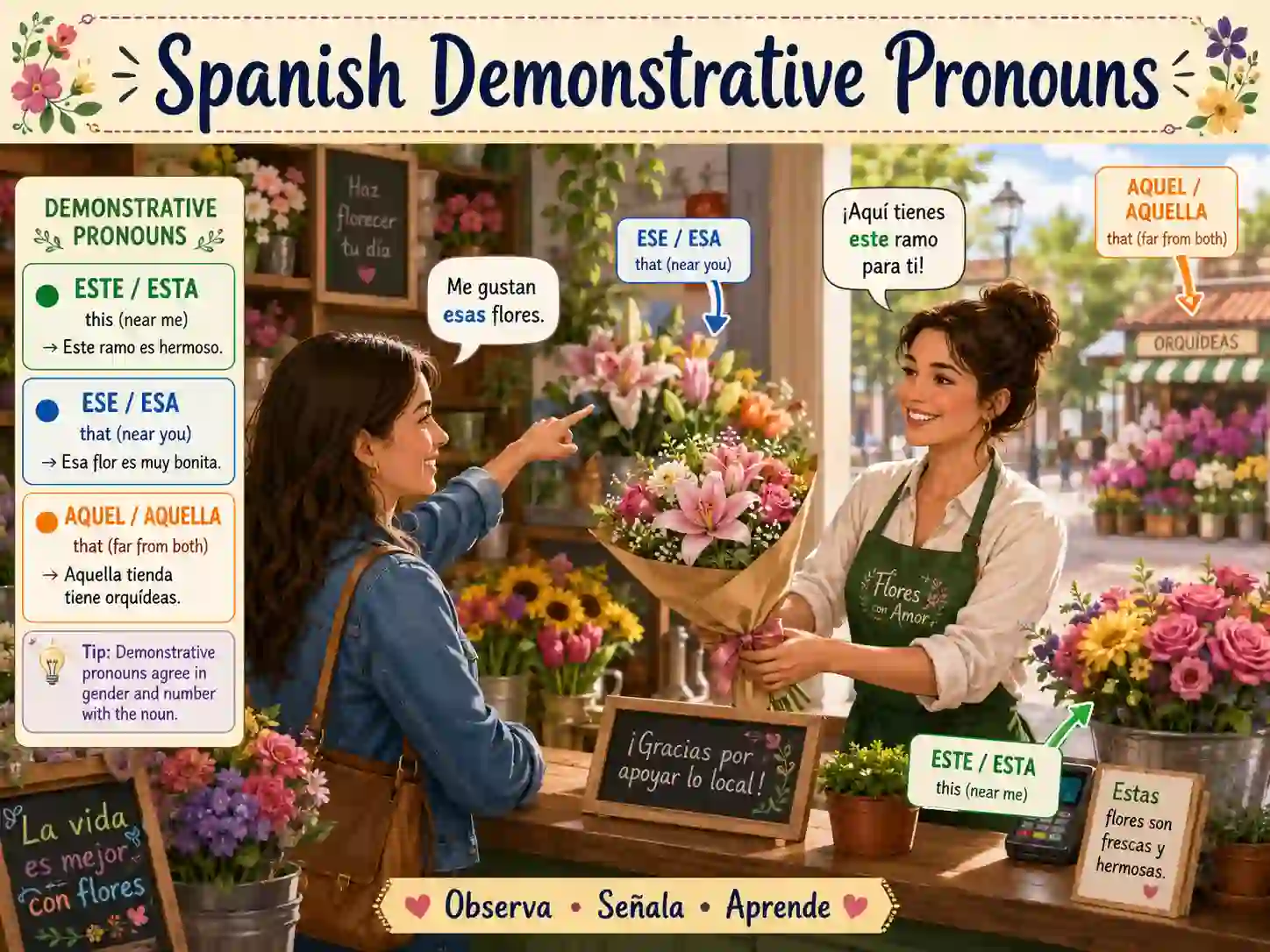
Definition
What are Spanish demonstrative pronouns?
Demonstrative pronouns replace a noun and identify its position, distance or relationship to the current conversation. They often correspond to “this one”, “that one”, “these ones” and “those ones”.
Este es mío.
This one is mine.
Esa es tuya.
That one is yours.
Aquellos son antiguos.
Those ones over there are old.
Spanish also has the neutral forms esto, eso and aquello. These forms refer to an idea, situation or unidentified thing rather than replacing a known masculine or feminine noun.
Pronoun table
Spanish demonstrative pronouns at a glance
| Distance | Masculine singular | Feminine singular | Masculine plural | Feminine plural | Neutral |
|---|---|---|---|---|---|
| Near the speaker | este | esta | estos | estas | esto |
| Farther away or near the listener | ese | esa | esos | esas | eso |
| Far from speaker and listener | aquel | aquella | aquellos | aquellas | aquello |
Three distances
Este, ese and aquel
Este, esta, estos, estas
Use these forms for something physically or mentally close to the speaker.
Este es mi cuaderno.
Estas son mis llaves.
Ese, esa, esos, esas
Use these forms for something farther from the speaker, near the listener or already mentioned.
Ese es tuyo.
Esas no me gustan.
Aquel, aquella, aquellos, aquellas
Use these forms for physical, temporal or emotional distance from both speaker and listener.
Aquel es muy antiguo.
Aquellas fueron difíciles.
| Situation | Pronoun | Spanish example | English meaning |
|---|---|---|---|
| A book in the speaker’s hand | este | Este es interesante. | This one is interesting. |
| A chair near the listener | esa | Esa es cómoda. | That one is comfortable. |
| A building far away | aquel | Aquel es antiguo. | That one over there is old. |
| A remembered period | aquellos | Aquellos fueron buenos años. | Those were good years. |
Gender and number
Agreement with the noun being replaced
Gendered demonstrative pronouns agree with the hidden or previously mentioned noun in gender and number.
| Known noun | Pronoun | Spanish example | Reason |
|---|---|---|---|
| el libro | este | Este es interesante. | Libro is masculine singular. |
| la casa | esta | Esta es grande. | Casa is feminine singular. |
| los documentos | estos | Estos son importantes. | Documentos is masculine plural. |
| las preguntas | estas | Estas son difíciles. | Preguntas is feminine plural. |
If the hidden noun is el libro, use este, ese or aquel. Use esto only when no specific gendered noun is being replaced.
Neutral forms
Esto, eso and aquello
Esto, eso and aquello refer to an idea, statement, situation or unidentified thing. They have no feminine or plural forms.
| Form | Reference | Spanish example | English meaning |
|---|---|---|---|
| esto | Current or nearby situation | Esto es importante. | This is important. |
| eso | Something just said or less immediate | Eso no es verdad. | That is not true. |
| aquello | Distant event, memory or situation | Aquello cambió mi vida. | That changed my life. |
¿Qué es esto?
Use esto when the object has not yet been identified.
Eso es correcto
Use eso to refer to something another person has just said.
Aquello fue difícil
Use aquello for a distant event or remembered situation.
Grammar contrast
Demonstrative pronouns vs demonstrative determiners
Demonstrative determiners accompany a noun. Demonstrative pronouns replace the noun.
| With a noun | Replacing the noun | English meaning | Difference |
|---|---|---|---|
| este libro | este | this book / this one | The noun appears only in the first structure. |
| esa casa | esa | that house / that one | Esa replaces casa. |
| aquellos árboles | aquellos | those trees / those ones over there | Aquellos replaces a masculine plural noun. |
| estas preguntas | estas | these questions / these ones | Estas replaces a feminine plural noun. |
Continue with: Spanish Demonstrative Determiners .
Modern spelling
Do Spanish demonstrative pronouns need accents?
Modern Spanish normally writes demonstrative pronouns without accent marks: este, ese, aquel, esta, esa and aquella.
| Modern form | Older form sometimes seen | Recommended learner form |
|---|---|---|
| este | éste | Este es mío. |
| ese | ése | Ese es tuyo. |
| aquel | aquél | Aquel es suyo. |
Always write esto, eso and aquello.
Comparisons
Demonstrative pronouns in comparisons
Demonstrative pronouns are especially useful when comparing several people or things without repeating the noun.
| Spanish example | English meaning |
|---|---|
| Este es más barato que ese. | This one is cheaper than that one. |
| Esta es mejor que aquella. | This one is better than that one over there. |
| Estos son más útiles que esos. | These ones are more useful than those ones. |
| Aquellas son más antiguas que estas. | Those ones over there are older than these ones. |
Mini practice
Practice Spanish demonstrative pronouns
Complete each exercise before opening the answer.
Exercise 1: choose the distance
- A book in your hand: ___ es mío.
- A chair near the listener: ___ es cómoda.
- A building far away: ___ es antiguo.
- Several houses far away: ___ son viejas.
Show answers
1. Este es mío.
2. Esa es cómoda.
3. Aquel es antiguo.
4. Aquellas son viejas.
Exercise 2: match gender and number
- el libro → ___
- la mochila → ___
- los documentos → ___
- las llaves → ___
Show answers
One possible set:
1. este
2. esta
3. estos
4. estas
Exercise 3: use a neutral form
- An unidentified object near you: ¿Qué es ___?
- A statement just made: ___ no es verdad.
- A distant memory: ___ fue difícil.
- A current situation: ___ es importante.
Show answers
1. ¿Qué es esto?
2. Eso no es verdad.
3. Aquello fue difícil.
4. Esto es importante.
Connected lessons
Continue with these Spanish pronoun pages
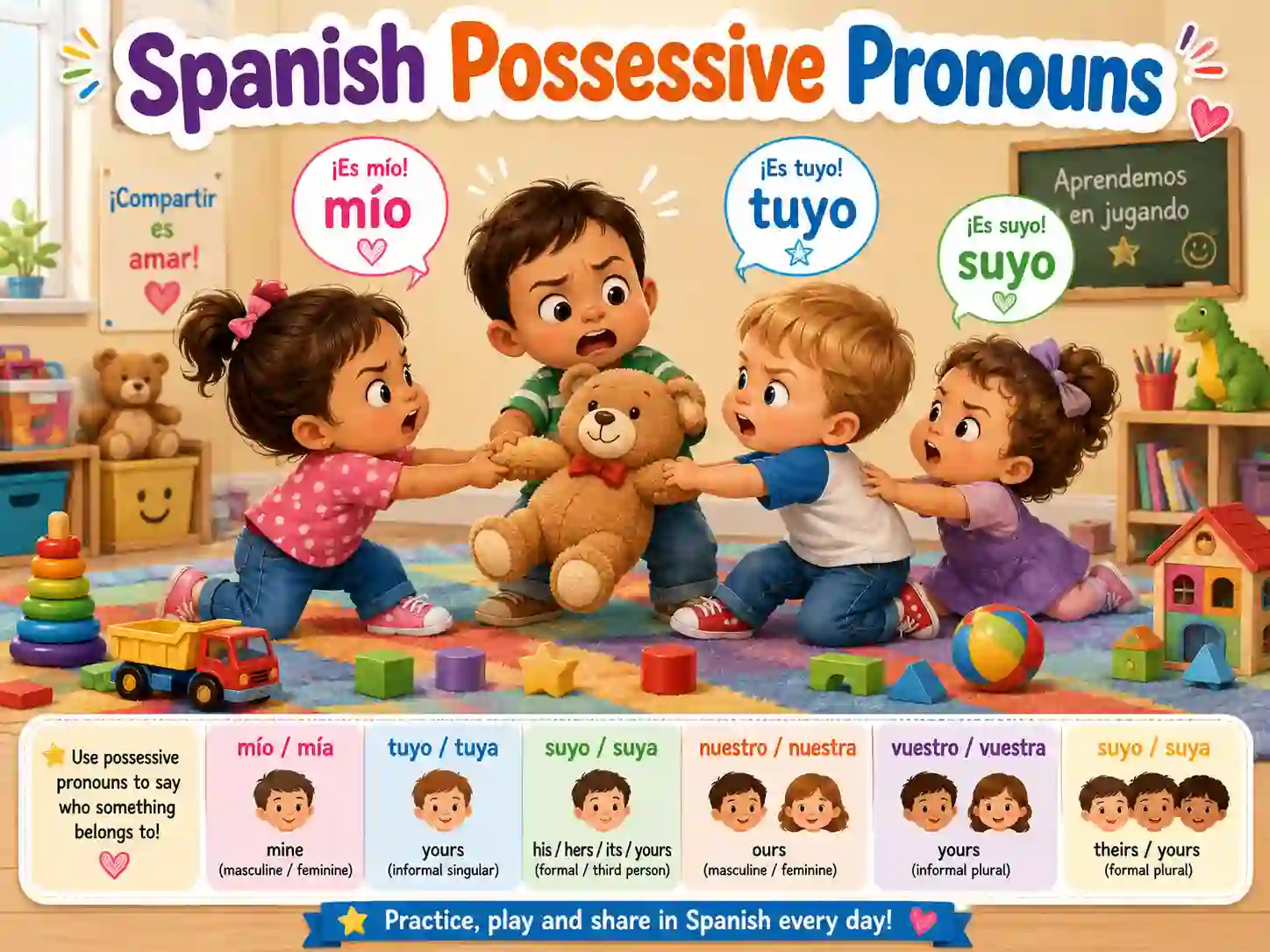
Spanish Possessive Pronouns
Combine demonstratives with possession: Este es mío, Esa es tuya and Aquellos son suyos.
Open lesson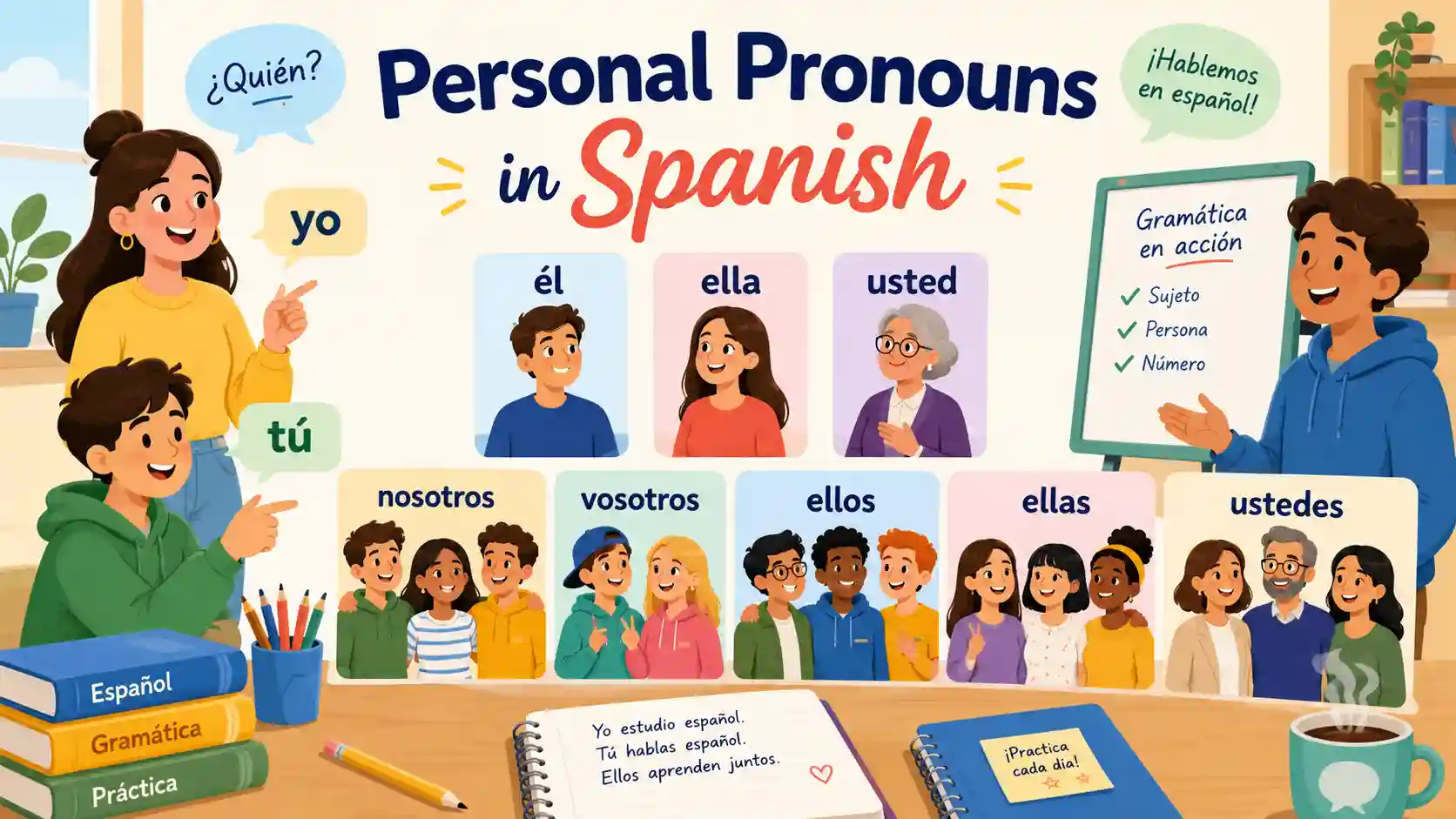
Spanish Personal Pronouns
Compare demonstratives with subject, object, reflexive and prepositional pronouns.
Open lesson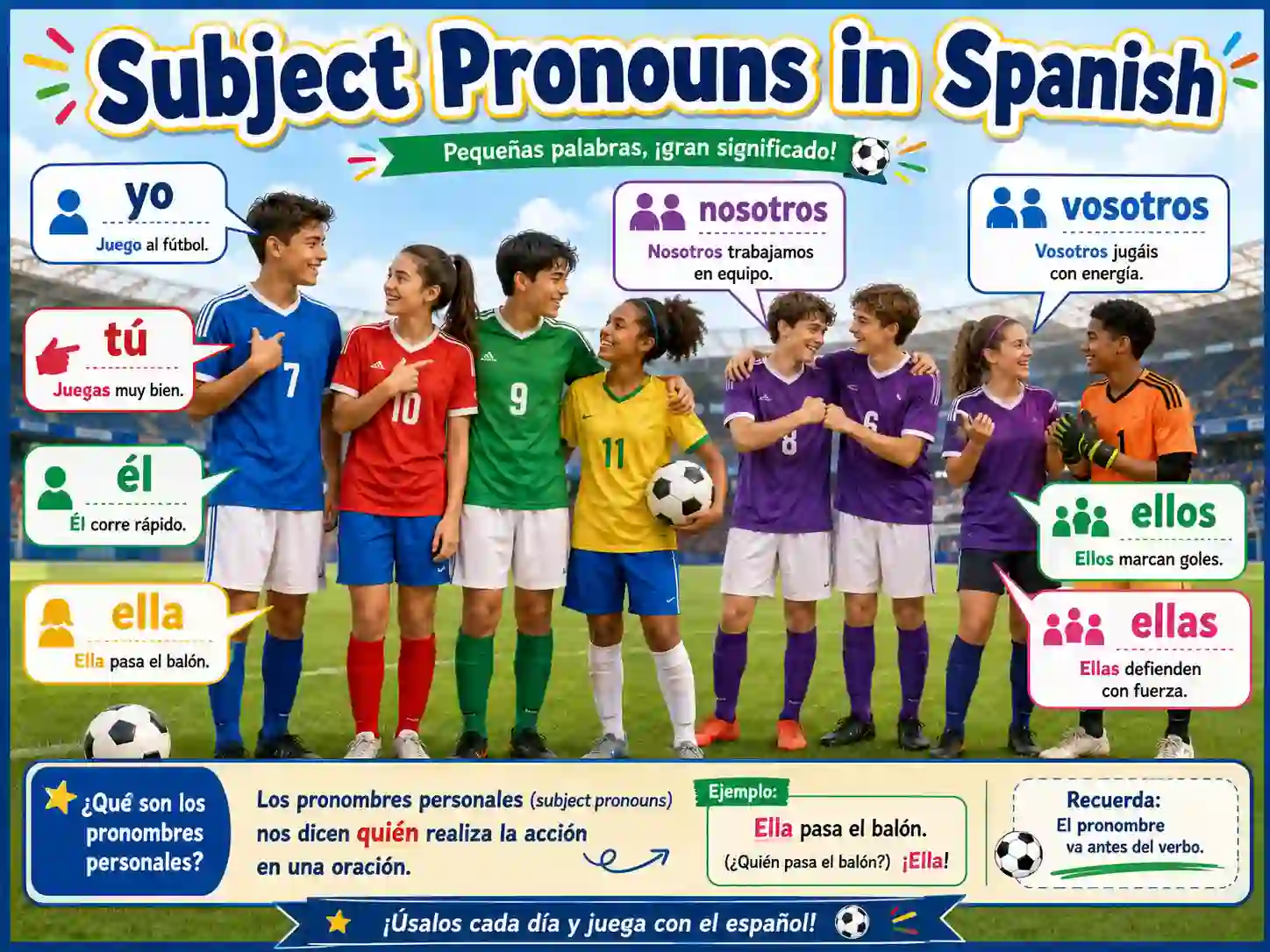
Spanish Subject Pronouns
Compare pronouns that identify people with demonstratives that identify distance.
Open lesson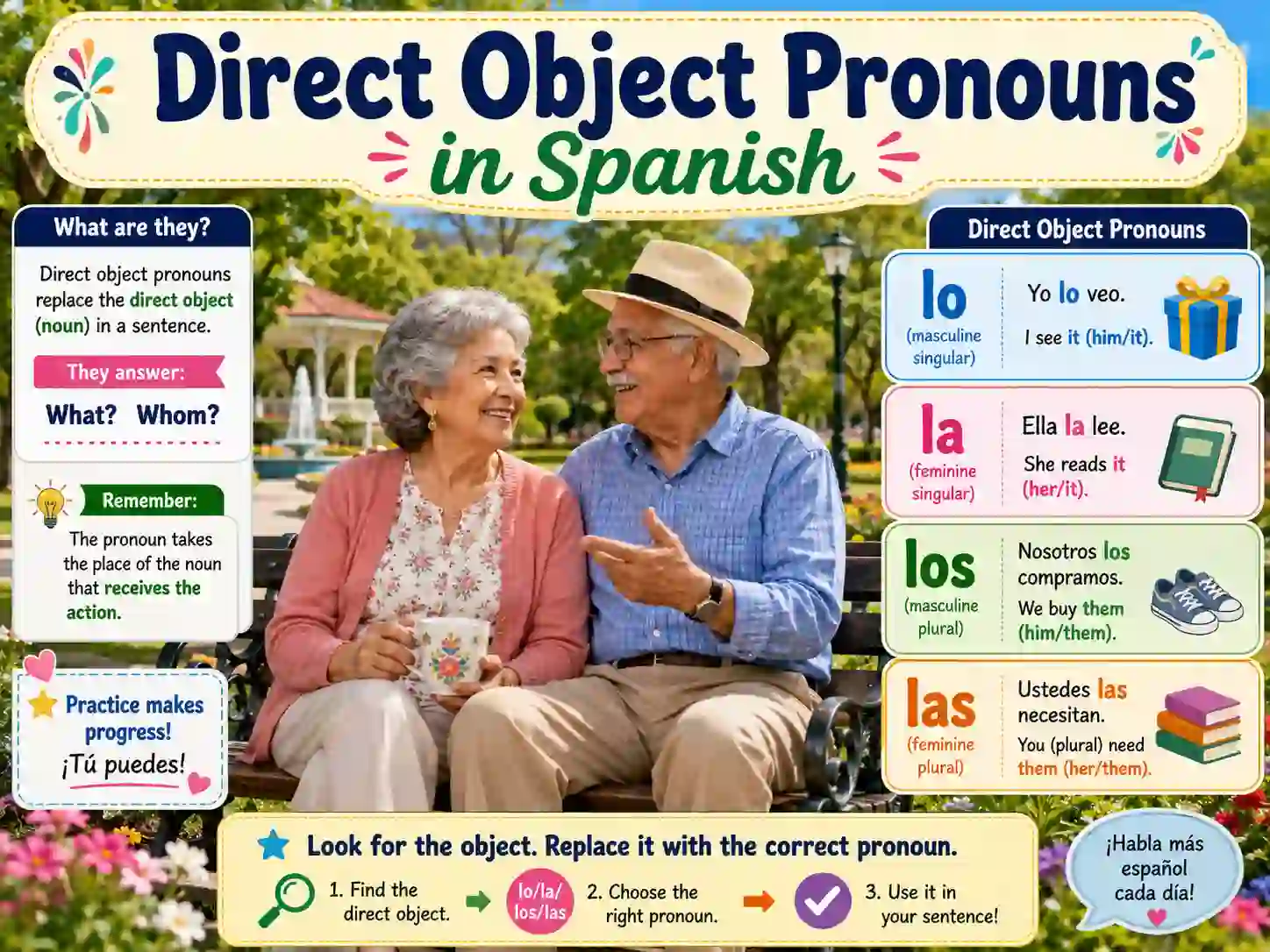
Spanish Direct Object Pronouns
Compare demonstratives such as este with direct-object forms such as lo and la.
Open lesson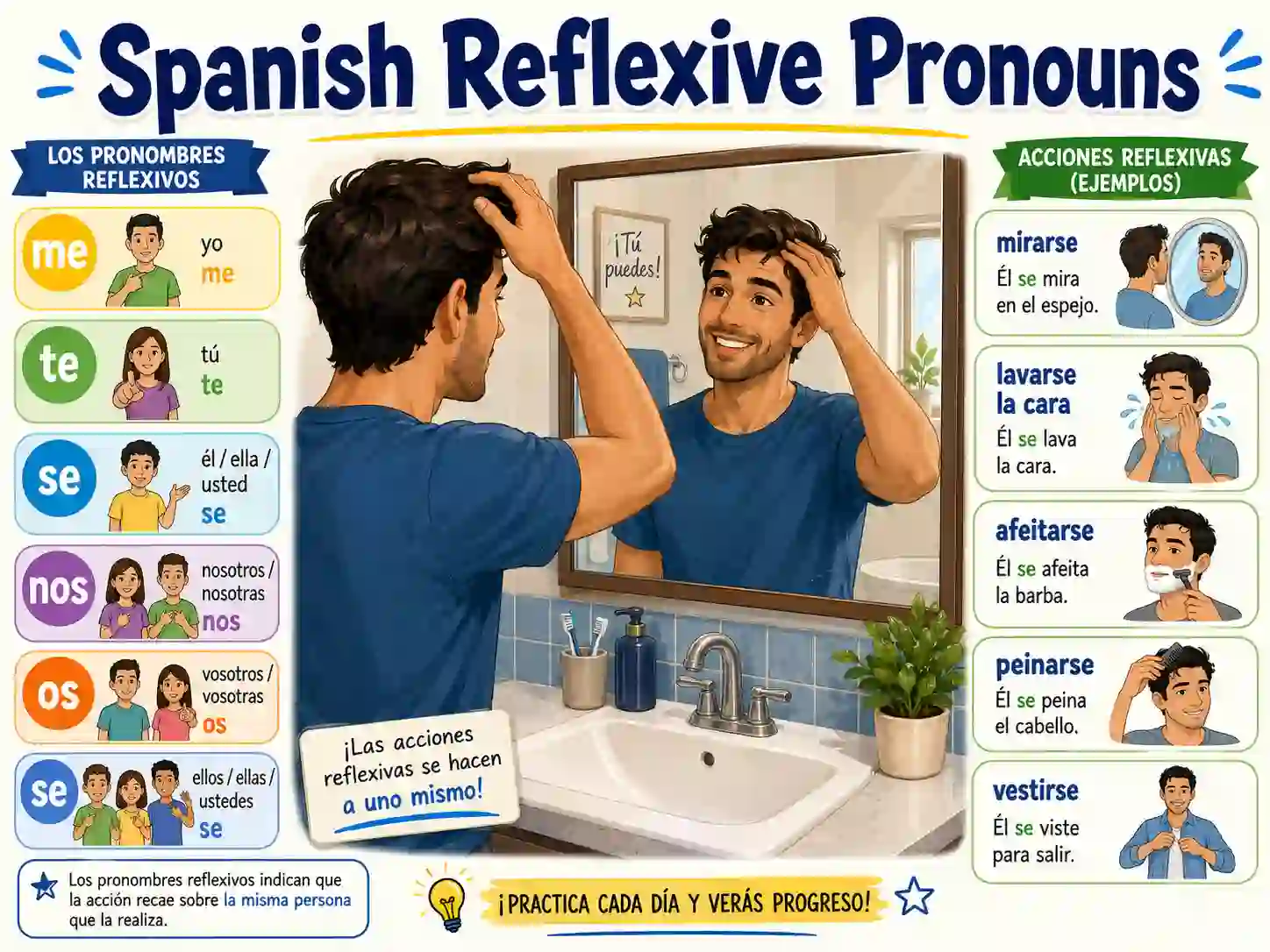
Spanish Reflexive Pronouns
Continue with reflexive forms such as me, te, se, nos and os.
Open lesson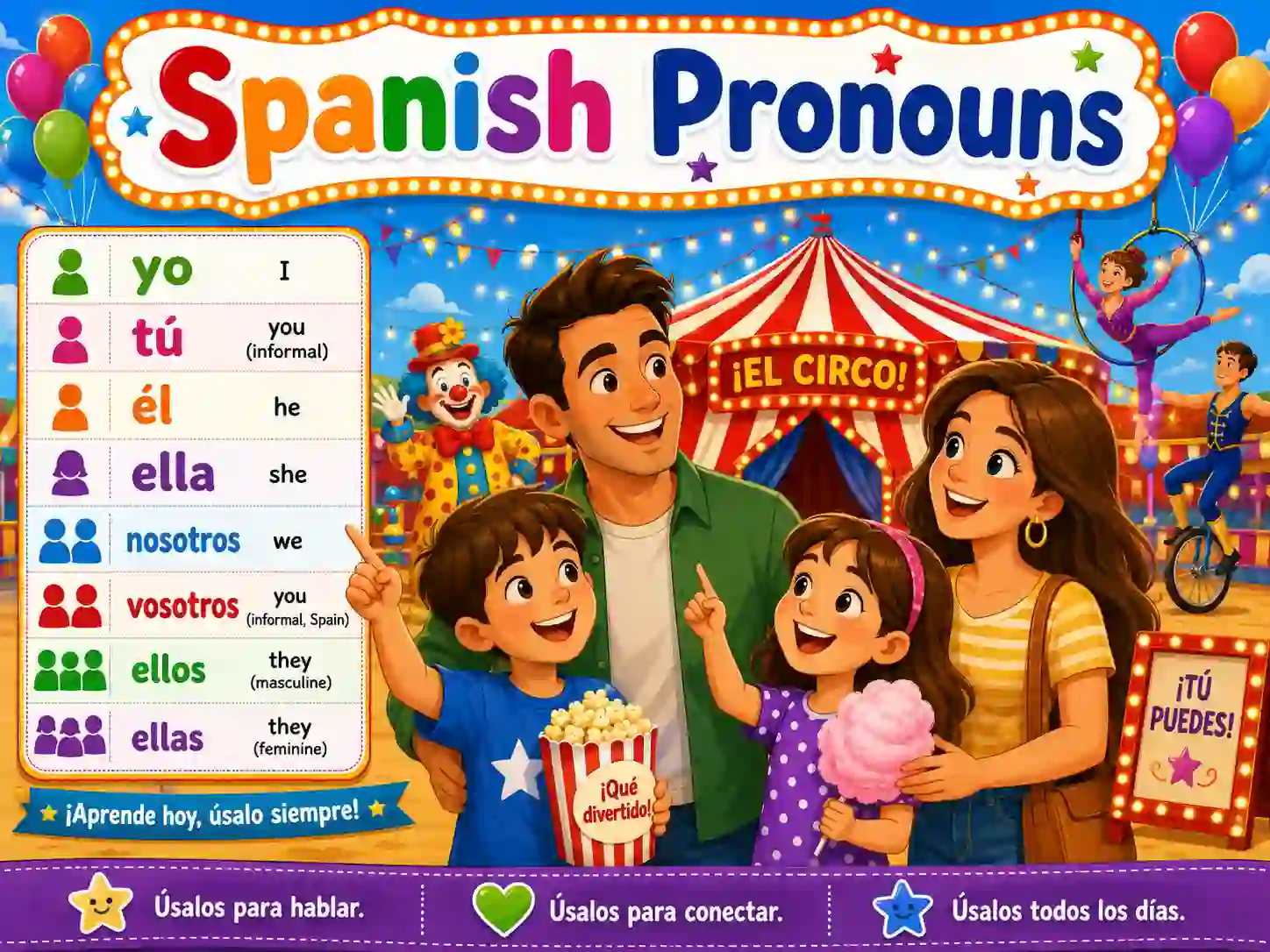
Spanish Pronouns
Return to the overview of personal, object, reflexive, possessive and demonstrative pronouns.
Open overviewCommon errors
Common mistakes with Spanish demonstrative pronouns
- Confusing pronouns and determiners: este libro means “this book”; este means “this one”.
- Forgetting gender agreement: use esta for a feminine noun such as casa.
- Forgetting plural agreement: use estos, estas, esos or esas for plural nouns.
- Using esto for a known noun: say esta when replacing la casa.
- Adding old accent marks: modern Spanish normally writes este, ese and aquel without accents.
- Overusing aquel: use it when the distance is physically, temporally or mentally greater.
Frequently asked questions
Questions about Spanish demonstrative pronouns
What are Spanish demonstrative pronouns?
They replace a noun and indicate distance. Forms include este, ese, aquel, their feminine and plural forms, and neutral esto, eso and aquello.
What is the difference between este, ese and aquel?
Este normally refers to something near the speaker. Ese refers to something farther away, near the listener or previously mentioned. Aquel indicates greater distance.
What is the difference between este and esto?
Este replaces a known masculine singular noun. Esto refers to an unidentified thing, idea or situation.
Do demonstrative pronouns need accents?
Modern Spanish normally writes them without accents: este, ese and aquel. Neutral esto, eso and aquello never take accents.
What is the difference between a pronoun and a determiner?
A demonstrative determiner accompanies a noun: este libro. A demonstrative pronoun replaces the noun: este.
Do demonstrative pronouns agree with the noun?
Yes. Gendered forms agree with the noun they replace: este, esta, estos and estas.
Practice and support
Practise demonstrative pronouns in complete sentences
Demonstrative pronouns become easier when you practise distance, gender, number, neutral forms and the difference between este libro, este and esto.
Spanish Tutoring
Work on demonstratives, agreement, sentence correction and individual grammar problems.
Private Spanish Lessons
Practise este, ese, aquel, esto, eso and aquello.
Spanish Grammar
Continue with pronouns, determiners, nouns, adjectives and sentence structures.

About MundoDele
Spanish learning connected with culture and real life
MundoDele combines clear Spanish grammar explanations with private lessons, tutoring, DELE and SIELE preparation, Business Spanish, cultural context and travel experiences from the Spanish-speaking world.
The grammar guides use practical examples, connected lessons and clear sentence logic to help international learners move from individual rules to confident Spanish use.