
MundoDele Spanish Grammar
Object Pronoun Doubling in Spanish: Rules and Examples
Learn why Spanish sometimes uses an object pronoun and the full object in the same sentence. This guide explains indirect-object doubling with le and les, fronted direct objects with lo, la, los and las, and structures such as a mí me gusta.
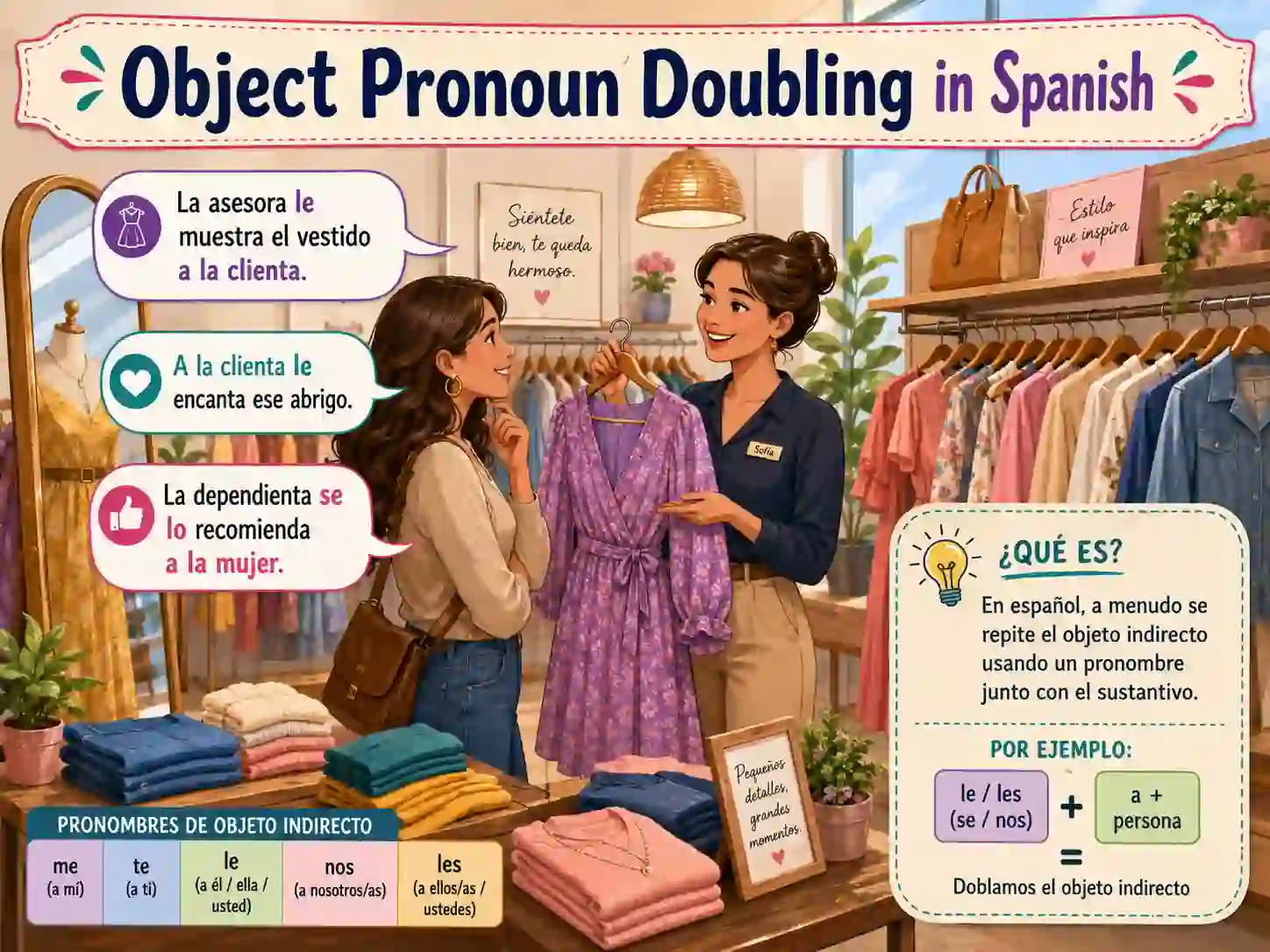
Definition
What is object pronoun doubling in Spanish?
Object pronoun doubling occurs when Spanish expresses the same direct or indirect object twice: once with a short object pronoun and once with a full noun or pronoun phrase.
English normally avoids this repetition, but Spanish uses it regularly for grammar, clarity, emphasis and topic structure.
Le escribí a Ana.
Le and a Ana identify the same recipient.
A Juan lo vi ayer.
A Juan and lo identify the same person.
A mí me gusta.
A mí emphasises the person represented by me.
Overview
Object pronoun doubling at a glance
| Structure | Spanish example | Doubled elements | English meaning | Main use |
|---|---|---|---|---|
| Indirect object doubling | Le di el libro a María. | le + a María | I gave the book to María. | Very common with recipients. |
| Plural indirect object | Les escribí a mis padres. | les + a mis padres | I wrote to my parents. | Clarifies a plural recipient. |
| Fronted direct object | A Juan lo vi ayer. | a Juan + lo | I saw Juan yesterday. | Juan is placed before the verb. |
| Feminine direct object | A Ana la conozco. | a Ana + la | I know Ana. | The pronoun agrees with Ana. |
| Emphatic indirect object | A mí me gusta el español. | a mí + me | I like Spanish. | Adds emphasis or contrast. |
| Clarifying third person | A ella le gusta leer. | a ella + le | She likes reading. | Clarifies who le refers to. |
Indirect objects
Indirect object doubling with le and les
Indirect-object doubling is extremely common in Spanish. The short pronoun le or les appears together with the full recipient introduced by a.
| Pronoun | Full indirect object | Spanish example | English meaning |
|---|---|---|---|
| le | a Ana | Le escribí a Ana. | I wrote to Ana. |
| le | a mi profesor | Le pregunté algo a mi profesor. | I asked my teacher something. |
| les | a mis padres | Les mandé un mensaje a mis padres. | I sent my parents a message. |
| les | a los estudiantes | Les expliqué la regla a los estudiantes. | I explained the rule to the students. |
The pronoun identifies who receives something
Le doy el libro a Ana.
The full phrase explains le or les
Le escribo a ella.
Use le for one and les for several
Les escribí a mis padres.
Direct objects
Direct object doubling with lo, la, los and las
Direct-object doubling is especially important when the direct object appears before the verb. Spanish normally repeats that fronted object with a matching direct-object pronoun.
| Fronted direct object | Pronoun | Spanish example | English meaning |
|---|---|---|---|
| a Juan | lo | A Juan lo vi ayer. | I saw Juan yesterday. |
| a Ana | la | A Ana la conozco bien. | I know Ana well. |
| a mis amigos | los | A mis amigos los invité. | I invited my friends. |
| a mis hermanas | las | A mis hermanas las llamé. | I called my sisters. |
Word order
Fronted objects, emphasis and topic structure
Spanish can move an object to the beginning of a sentence to make it the topic or create contrast. The object pronoun then remains next to the verb.
| Neutral word order | Fronted object | Main effect |
|---|---|---|
| Vi a Juan ayer. | A Juan lo vi ayer. | Juan becomes the topic or contrast. |
| Conozco a Ana. | A Ana la conozco. | Ana is highlighted. |
| Le escribí a mi padre. | A mi padre le escribí ayer. | The recipient is placed first. |
| Les expliqué la regla a los alumnos. | A los alumnos les expliqué la regla. | The students become the topic. |
Gustar-type verbs
A mí me gusta and other emphatic structures
Verbs such as gustar, encantar, interesar, importar, doler and molestar use indirect-object pronouns. An additional a-phrase can add emphasis, contrast or clarification.
| Emphatic phrase | Pronoun | Spanish example | English meaning |
|---|---|---|---|
| a mí | me | A mí me gusta el español. | I like Spanish. |
| a ti | te | A ti te interesa la historia. | You are interested in history. |
| a ella | le | A ella le encanta viajar. | She loves travelling. |
| a nosotros | nos | A nosotros nos importa mucho. | It matters a lot to us. |
| a ellos | les | A ellos les interesa el tema. | They are interested in the topic. |
Correct: A mí me gusta.
Incorrect: A mí gusta.
Understanding the structure
The different functions of Spanish a-phrases
A phrase beginning with a can be a personal direct object, an indirect object or an emphatic clarification. The preposition alone does not identify the function.
| A-phrase | Function | Spanish example | Pronoun |
|---|---|---|---|
| a Juan | Personal direct object | A Juan lo vi. | lo |
| a Ana | Indirect-object recipient | Le di el libro a Ana. | le |
| a mí | Emphatic indirect object | A mí me gusta. | me |
| a ellos | Clarifying indirect object | A ellos les interesa el tema. | les |
Ask whom or what
¿A quién vi? A Juan → Lo vi.
Ask to whom or for whom
¿A quién escribí? A Juan → Le escribí.
Use the full phrase for contrast
A mí me gusta, pero a ella no.
Singular and plural
Le and les must match the recipient
Use le for one recipient and les for more than one recipient.
| Pronoun | Recipient | Spanish example | English meaning |
|---|---|---|---|
| le | a Ana | Le escribí a Ana. | I wrote to Ana. |
| les | a Ana y a Luis | Les escribí a Ana y a Luis. | I wrote to Ana and Luis. |
| les | a mis clientes | Les di la información a mis clientes. | I gave my clients the information. |
Object function
Direct vs indirect object doubling
The same person can be direct or indirect depending on the verb. The correct pronoun therefore depends on the object’s function.
| Sentence | Object type | Pronoun | Question |
|---|---|---|---|
| A Juan lo vi. | Direct object | lo | Whom did I see? |
| A María la llamé. | Direct object | la | Whom did I call? |
| A Juan le escribí. | Indirect object | le | To whom did I write? |
| A mis padres les mandé fotos. | Indirect object | les | To whom did I send photos? |
Word position
Where does the doubled pronoun go?
The short object pronoun follows the normal Spanish pronoun-position rules. The presence of the full object does not change its placement.
| Verb form | Pronoun position | Spanish example | English meaning |
|---|---|---|---|
| Conjugated verb | Before the verb | Le escribí a Ana. | I wrote to Ana. |
| Infinitive | Attached or before the conjugated verb |
Voy a escribirle a Ana. Le voy a escribir a Ana. |
I am going to write to Ana. |
| Gerund | Attached or before the conjugated verb |
Estoy escribiéndole a Ana. Le estoy escribiendo a Ana. |
I am writing to Ana. |
| Affirmative command | Attached | Escríbele a Ana. | Write to Ana. |
| Negative command | Before the verb | No le escribas a Ana. | Do not write to Ana. |
Continue with: Spanish Pronoun Position .
Regional variation
A short note on leísmo
In parts of Spain, le may replace lo for a masculine human direct object. This regional pattern is known as leísmo.
Use lo for a masculine direct object, la for a feminine direct object, and le for an indirect object.
A Juan lo vi. — direct object.
A Juan le escribí. — indirect object.
Mini practice
Practice object pronoun doubling
Complete each exercise before opening the answer.
Exercise 1: add le or les
- ___ escribí a Ana.
- ___ mandé fotos a mis padres.
- ___ expliqué la regla al alumno.
- ___ di la información a los clientes.
Show answers
1. Le escribí a Ana.
2. Les mandé fotos a mis padres.
3. Le expliqué la regla al alumno.
4. Les di la información a los clientes.
Exercise 2: front the direct object
- Vi a Juan ayer.
- Conozco a Ana bien.
- Invité a mis amigos.
- Llamé a mis hermanas.
Show answers
1. A Juan lo vi ayer.
2. A Ana la conozco bien.
3. A mis amigos los invité.
4. A mis hermanas las llamé.
Exercise 3: add emphasis
- Me gusta el español. — add a mí
- Te interesa la historia. — add a ti
- Le encanta viajar. — add a ella
- Nos importa mucho. — add a nosotros
Show answers
1. A mí me gusta el español.
2. A ti te interesa la historia.
3. A ella le encanta viajar.
4. A nosotros nos importa mucho.
Connected lessons
Continue with these Spanish pronoun pages
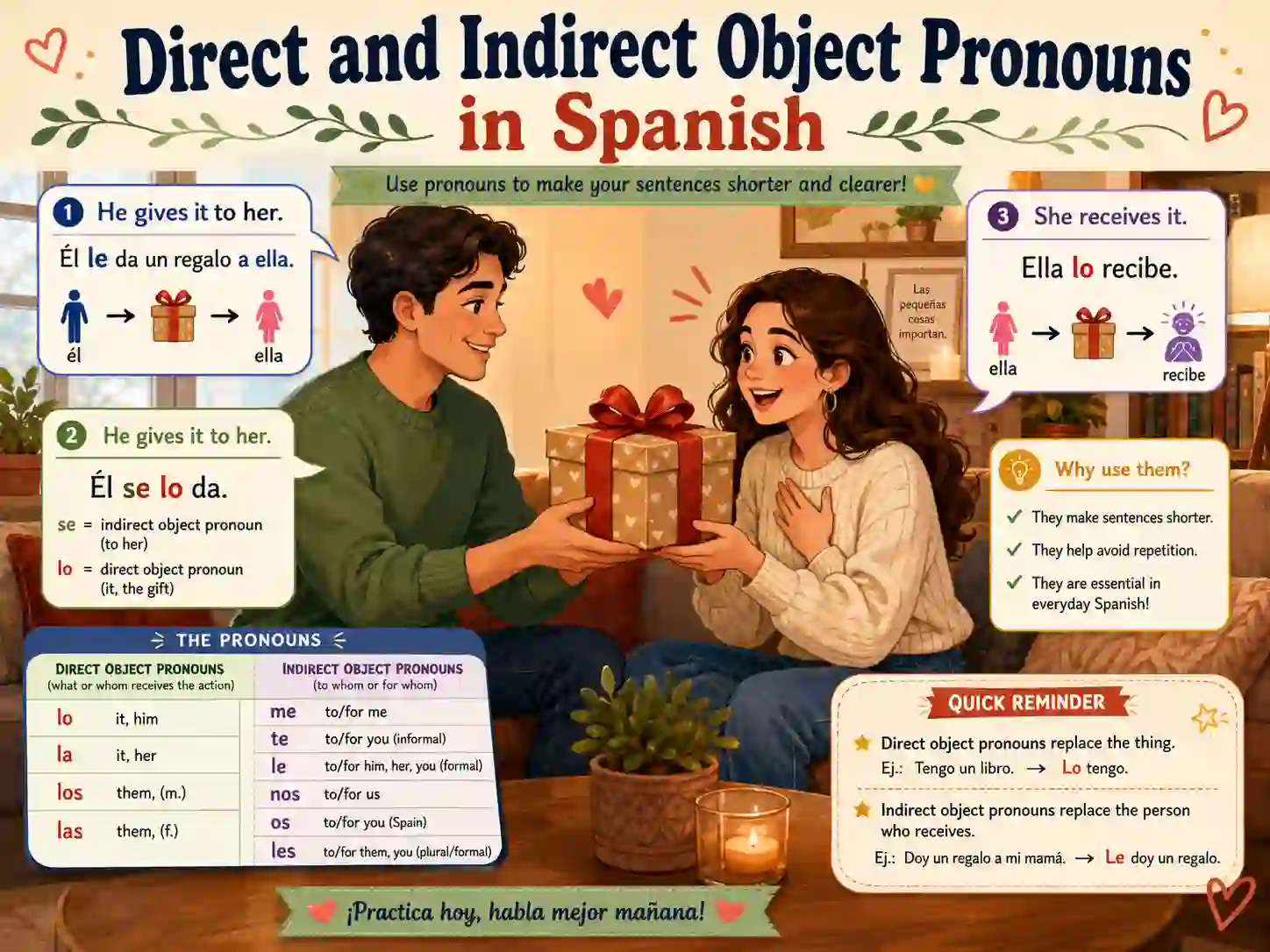
Direct and Indirect Object Pronouns
Compare direct and indirect objects before studying how Spanish doubles them.
Open lesson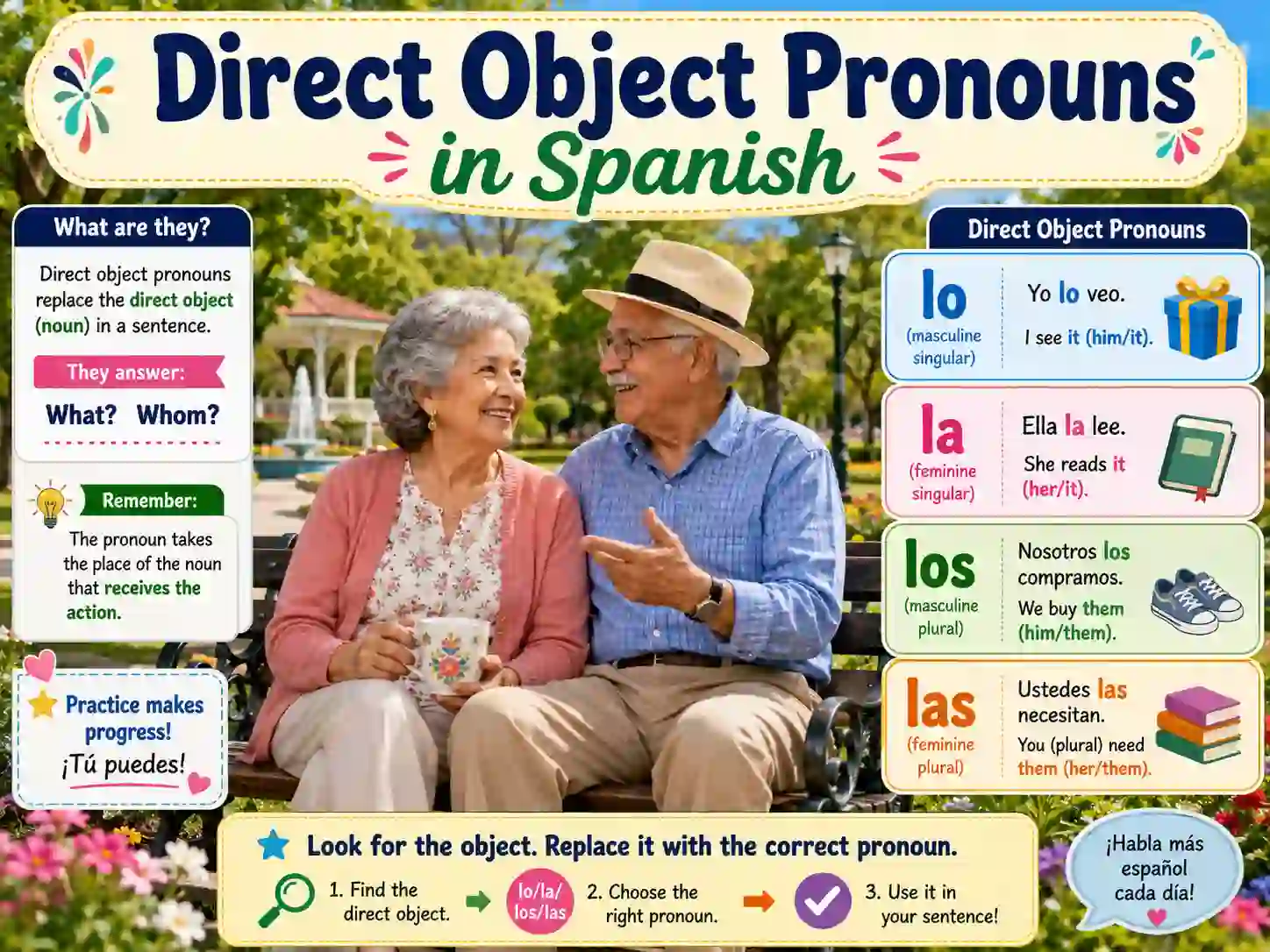
Spanish Direct Object Pronouns
Learn lo, la, los and las before using fronted direct objects.
Open lesson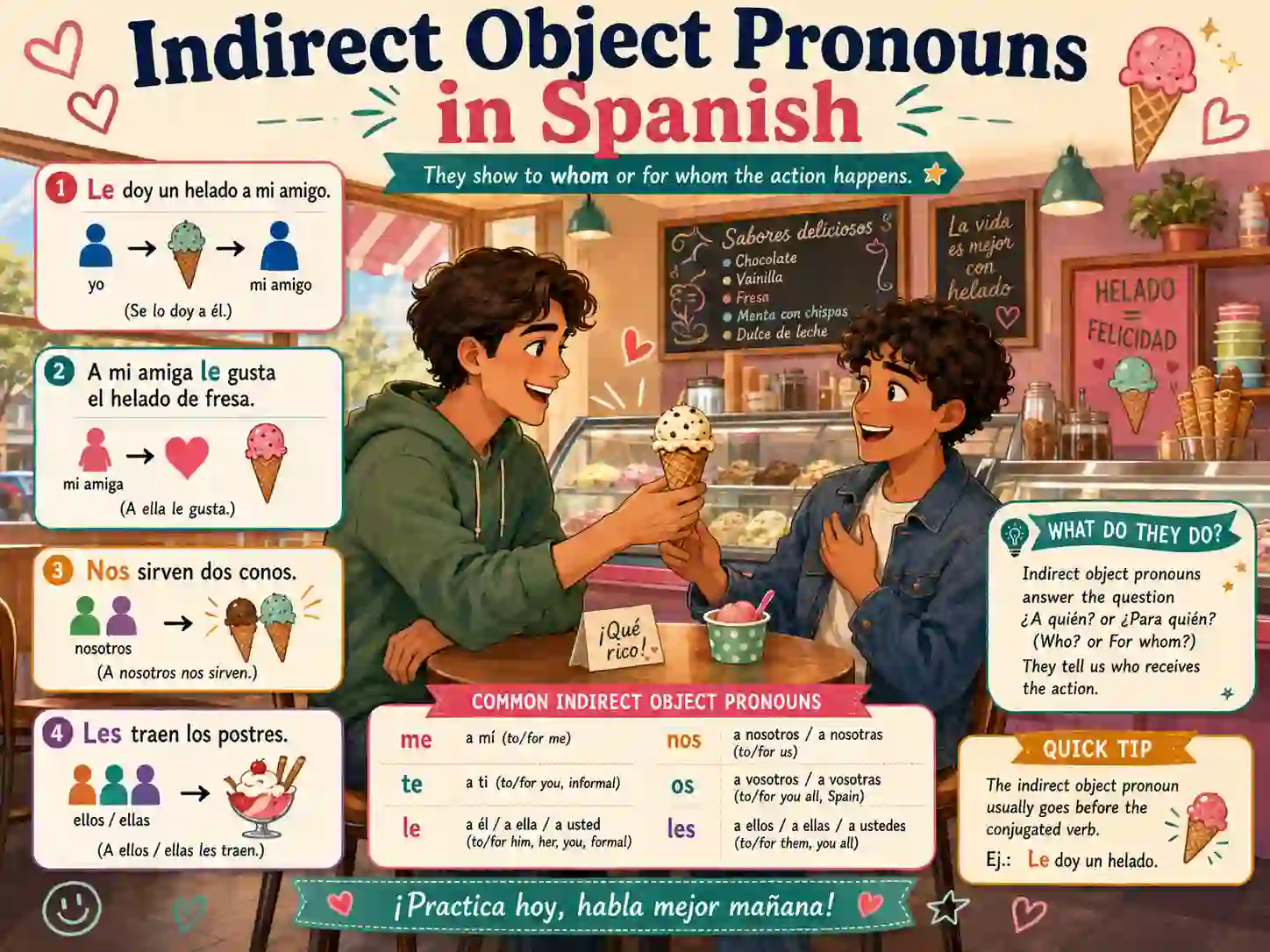
Spanish Indirect Object Pronouns
Study le, les, gustar structures and recipient phrases.
Open lesson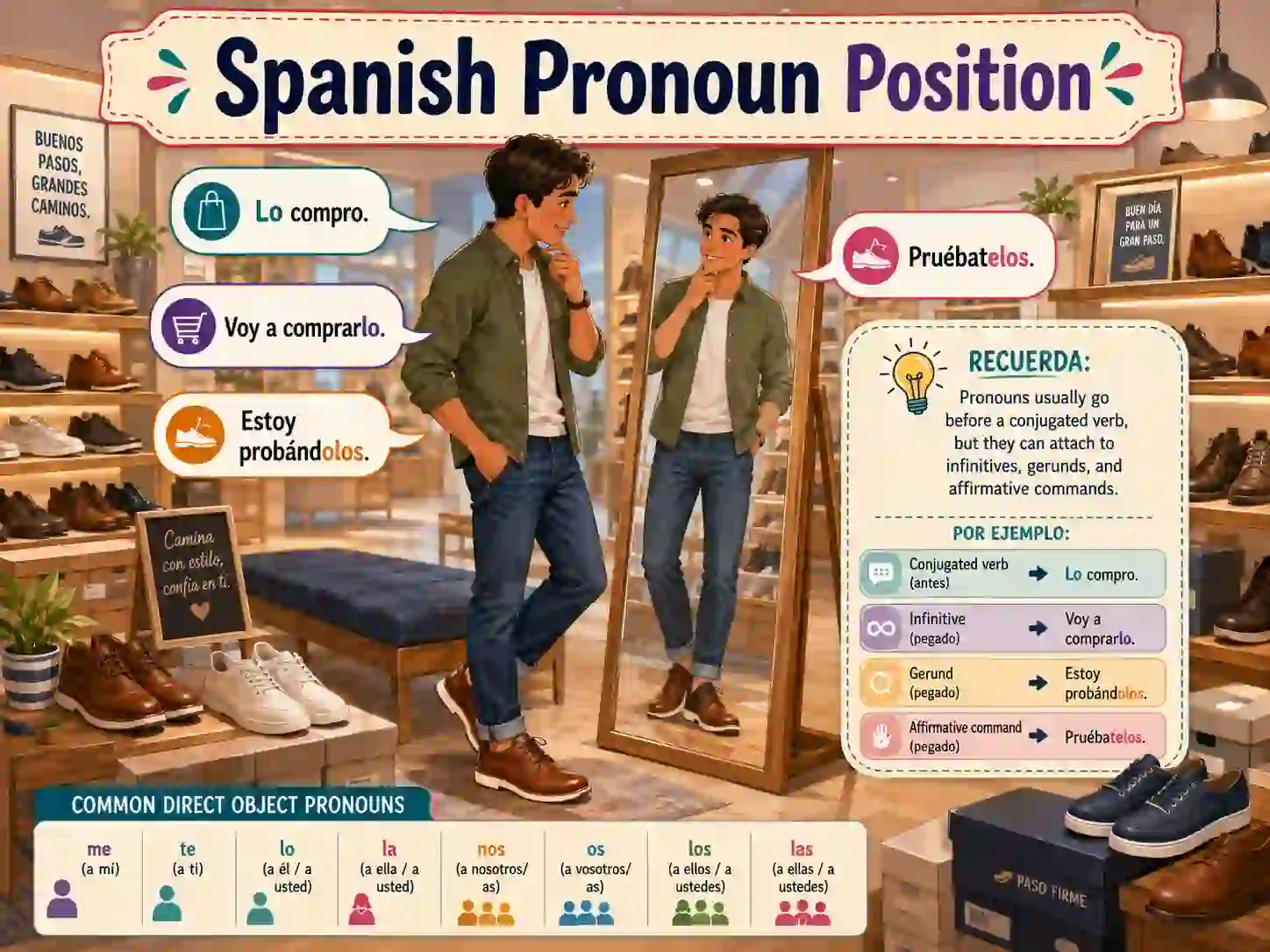
Spanish Pronoun Position
Learn where doubled pronouns go with conjugated verbs, infinitives, gerunds and commands.
Open lesson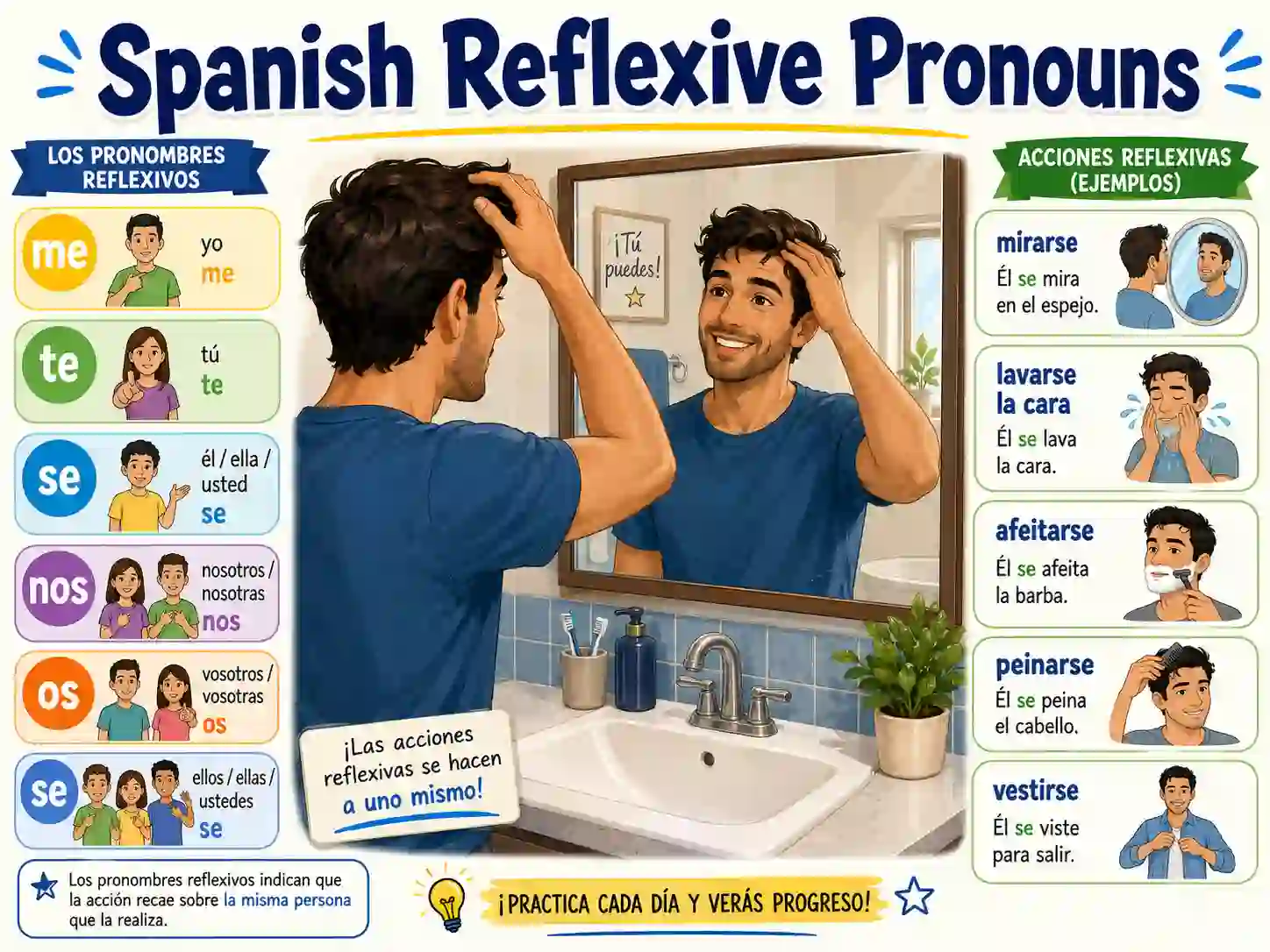
Spanish Reflexive Pronouns
Distinguish object-pronoun doubling from reflexive uses of me, te and se.
Open lesson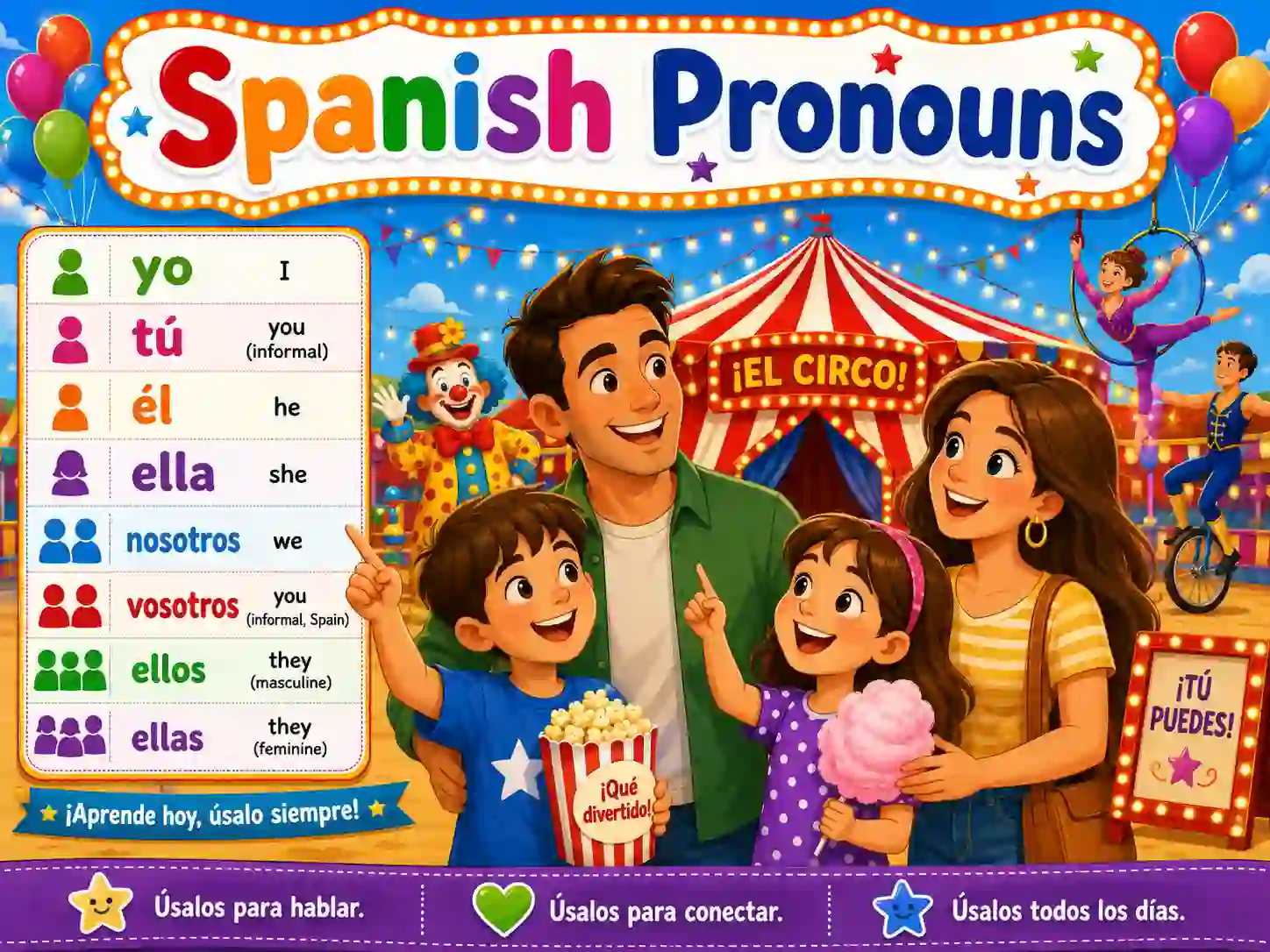
Spanish Pronouns
Return to the complete overview of subject, object, reflexive and other Spanish pronouns.
Open overviewCommon errors
Common mistakes with object pronoun doubling
- Thinking the pronoun and full object refer to different people: in Le escribí a Ana, both refer to Ana.
- Using le for every human object: direct objects normally use lo, la, los or las.
- Forgetting agreement with fronted direct objects: say A Ana la vi and A mis amigos los vi.
- Using le for several recipients: say Les escribí a mis padres.
- Dropping the short pronoun with gustar: say A mí me gusta, not A mí gusta.
- Choosing the pronoun only from the preposition a: compare A Juan lo vi with A Juan le escribí.
Frequently asked questions
Questions about object pronoun doubling
What is object pronoun doubling in Spanish?
It occurs when Spanish uses an object pronoun together with the full object, as in Le escribí a Ana or A Juan lo vi.
Is object pronoun doubling common?
Yes. It is especially common with indirect objects, fronted direct objects and gustar-type verbs.
Why does Spanish say le escribí a Ana?
Spanish commonly repeats an indirect object with le or les. Both le and a Ana identify the recipient.
Why does Spanish say a Juan lo vi?
Juan is a direct object placed before the verb. Spanish repeats that fronted object with the matching direct-object pronoun lo.
Why does Spanish say a mí me gusta?
Me is the required indirect-object pronoun. The phrase a mí adds emphasis or contrast.
Should I use le or les with plural recipients?
Use le for one recipient and les for several recipients.
Practice and support
Practise object pronoun doubling in real sentences
Pronoun doubling becomes easier when you practise direct and indirect objects, fronted phrases, gustar-type verbs, agreement and pronoun position in complete sentences.
Spanish Tutoring
Work on object pronouns, sentence correction and individual grammar problems.
Private Spanish Lessons
Practise le escribí a Ana, a Juan lo vi and a mí me gusta.
Spanish Grammar
Continue with pronouns, verbs, word order and sentence structures.

About MundoDele
Spanish learning connected with culture and real life
MundoDele combines clear Spanish grammar explanations with private lessons, tutoring, DELE and SIELE preparation, Business Spanish, cultural context and travel experiences from the Spanish-speaking world.
The grammar guides use practical examples, connected lessons and clear sentence logic to help international learners move from individual rules to confident Spanish use.