
MundoDele Spanish Grammar
Spanish Indefinite Pronouns: Algo, Alguien, Nadie and Nada
Learn how Spanish refers to unspecified people, things, quantities and groups. This guide explains algo, alguien, nada, nadie, alguno, ninguno, cualquiera and related forms, including personal a, agreement and Spanish negative sentence structure.
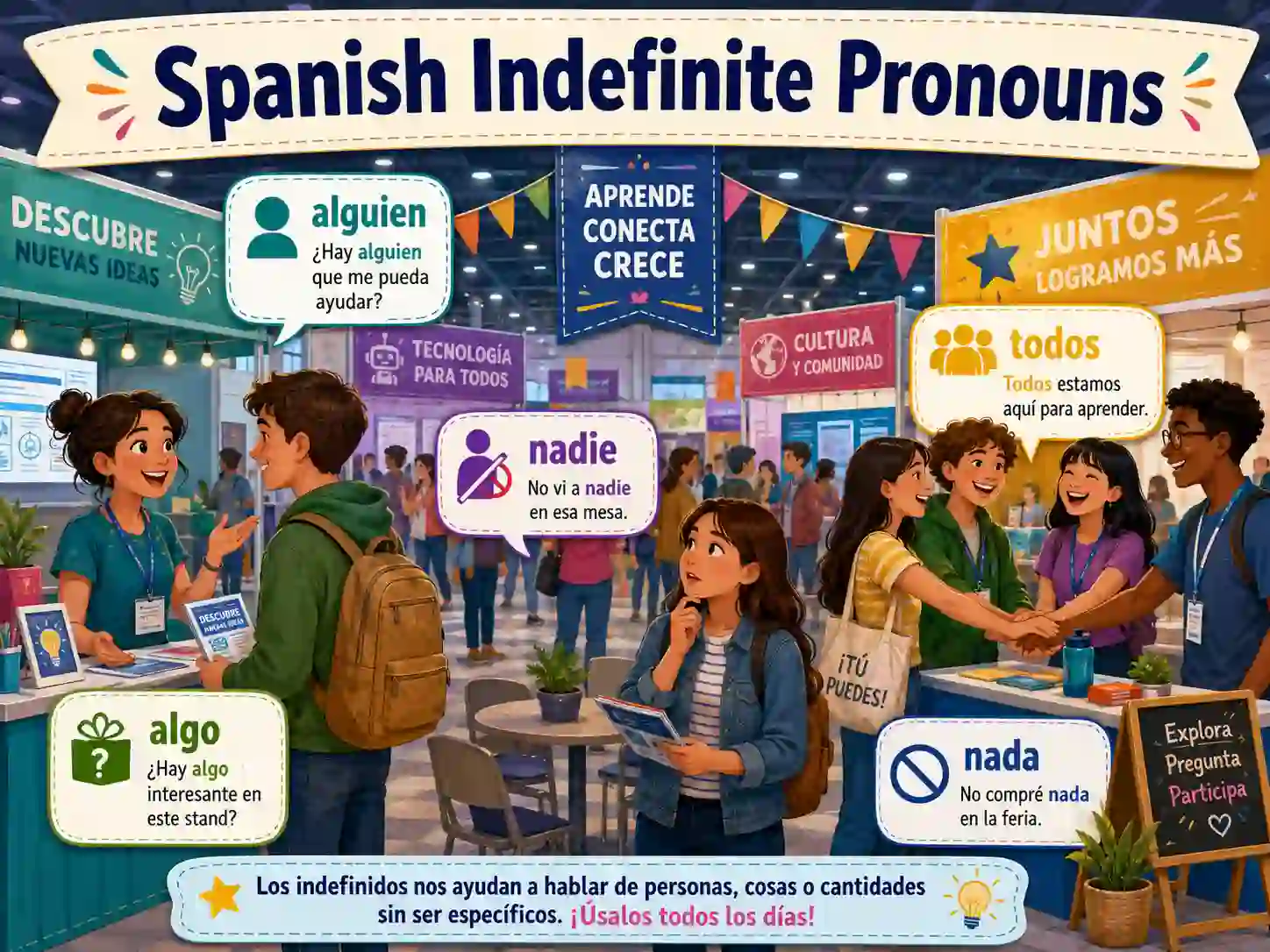
Definition
What are Spanish indefinite pronouns?
Indefinite pronouns refer to people, things, quantities or groups without identifying them precisely. They replace a noun or refer to something that remains unknown, general or unspecified.
Necesito algo.
I need something.
Alguien llama.
Someone is calling.
No veo nada.
I do not see anything.
Some indefinite forms are always pronouns, while others can also function as determiners before a noun.
Pronoun table
Spanish indefinite pronouns at a glance
| Pronoun | Main meaning | Spanish example | English meaning | Grammar note |
|---|---|---|---|---|
| algo | something | Necesito algo. | I need something. | Invariable; refers to things, ideas or information. |
| nada | nothing; anything after negation | No veo nada. | I do not see anything. | Invariable negative form. |
| alguien | someone; anyone in questions | Alguien llama. | Someone is calling. | Invariable; refers to people. |
| nadie | nobody; anybody after negation | No conozco a nadie. | I do not know anyone. | Invariable; refers to people. |
| alguno / alguna | one, some, any | ¿Tienes alguno? | Do you have one or any? | Agrees with the understood noun. |
| algunos / algunas | some, some of them | Algunos llegaron tarde. | Some arrived late. | Plural forms. |
| ninguno / ninguna | none, not one | No tengo ninguno. | I do not have any. | Negative counterpart of alguno. |
| cualquiera | anyone, any one | Cualquiera puede hacerlo. | Anyone can do it. | Unrestricted or unspecified choice. |
| todo | everything | Todo está listo. | Everything is ready. | Neutral singular reference. |
| todos / todas | everyone, all of them | Todos llegaron. | Everyone arrived. | Agrees with the group. |
| otro / otra | another one | Quiero otro. | I want another one. | Agrees with the noun replaced. |
| varios / varias | several | Varias respondieron. | Several answered. | Plural reference. |
Core pairs
Algo and nada vs alguien and nadie
Algo
Refers to an unspecified thing, idea or piece of information.
Quiero algo.
I want something.
Alguien
Refers to an unspecified or unknown person.
Alguien está en la puerta.
Someone is at the door.
Nada and nadie
Use nada for things and nadie for people.
No veo nada.
No veo a nadie.
| Reference | Affirmative or open form | Negative form | Examples |
|---|---|---|---|
| Thing, idea or information | algo | nada |
¿Necesitas algo? No necesito nada. |
| Person | alguien | nadie |
¿Conoces a alguien? No conozco a nadie. |
Things and ideas
Algo and nada
Algo refers to an unspecified thing, idea, event or piece of information. Nada is the corresponding negative form.
| Spanish sentence | English meaning | Use |
|---|---|---|
| Quiero algo. | I want something. | Unspecified thing. |
| ¿Necesitas algo? | Do you need anything? | Open question. |
| No quiero nada. | I do not want anything. | Negative concord after the verb. |
| Nada funciona. | Nothing works. | Negative word before the verb. |
| Algo ha cambiado. | Something has changed. | Unspecified event or situation. |
People
Alguien, nadie and the personal a
Alguien and nadie refer to people. They are grammatically singular and do not change according to gender.
| Spanish sentence | English meaning | Grammar point |
|---|---|---|
| Alguien llama. | Someone is calling. | Alguien is the subject. |
| ¿Conoces a alguien? | Do you know anyone? | Personal a before a person as object. |
| Nadie responde. | Nobody answers. | No additional no before the verb. |
| No conozco a nadie. | I do not know anyone. | Negative word follows the verb. |
| Busco a alguien que hable español. | I am looking for someone who speaks Spanish. | Unspecified person with a relative clause. |
Veo a alguien and
No veo a nadie.
Do not use personal a with things:
Veo algo and No veo nada.
One, some or none
Alguno, alguna, ninguno and ninguna
These pronouns replace a known or understood noun and agree with it in gender. The plural forms algunos and algunas mean “some” or “some of them”.
| Form | Reference | Spanish example | English meaning |
|---|---|---|---|
| alguno | Masculine singular | ¿Tienes alguno? | Do you have one or any? |
| alguna | Feminine singular | Necesito alguna. | I need one or some. |
| algunos | Masculine or mixed plural | Algunos llegaron tarde. | Some arrived late. |
| algunas | Feminine plural | Algunas son difíciles. | Some are difficult. |
| ninguno | Masculine singular or neutral group reference | No tengo ninguno. | I do not have any. |
| ninguna | Feminine singular | No necesito ninguna. | I do not need any. |
Before a masculine singular noun: algún libro and ningún libro
Plural ningunos and ningunas exist, but they are much less common and occur mainly with nouns normally used in the plural or in emphatic contexts.
Unrestricted choice
Cualquiera and cualquier
Cualquiera means “anyone”, “any one” or “whichever one”. It expresses an unrestricted or non-specific choice.
| Structure | Spanish example | English meaning |
|---|---|---|
| Pronoun as subject | Cualquiera puede aprender. | Anyone can learn. |
| Pronoun as object | Elige cualquiera. | Choose any one. |
| Pronoun with de | Cualquiera de estos sirve. | Any of these works. |
| Before a singular noun | Cualquier opción sirve. | Any option works. |
Use cualquiera when it stands alone. Use cualquier before a singular noun: cualquier persona and cualquier problema.
Additional forms
Todo, otro, varios and uno as pronouns
Todo
Todo está bien.
Everything is fine.
Todos and todas
Todos entienden.
Everyone understands.
Otro and otra
Quiero otro.
I want another one.
Varios and varias
Varias llegaron tarde.
Several arrived late.
Uno and una
Uno nunca sabe.
You never know.
Uno de
Uno de ellos llamó.
One of them called.
Spanish negation
Negative concord: no veo nada
Spanish commonly uses more than one negative element in the same clause. This pattern is called negative concord. The negative words reinforce the same negation rather than cancelling each other.
| Negative word before the verb | Negative word after the verb | English meaning |
|---|---|---|
| Nadie responde. | No responde nadie. | Nobody answers. |
| Nada funciona. | No funciona nada. | Nothing works. |
| Ninguno sirve. | No sirve ninguno. | None of them works. |
| Nadie lo sabe. | No lo sabe nadie. | Nobody knows it. |
negative word before the verb: Nadie viene
negative word after the verb: No viene nadie
Study the complete system on the Spanish Negation page.
Grammar function
Indefinite pronouns vs indefinite determiners
A pronoun replaces a noun. A determiner appears before a noun and introduces it.
| Pronoun use | Determiner use | Difference |
|---|---|---|
| Necesito alguno. | Necesito algún libro. | Alguno replaces the noun; algún introduces it. |
| No tengo ninguno. | No tengo ningún problema. | Ninguno stands alone; ningún appears before a noun. |
| Cualquiera sirve. | Cualquier opción sirve. | Cualquiera stands alone; cualquier introduces a noun. |
| Quiero otro. | Quiero otro café. | Otro can replace or accompany a noun. |
| Todos llegaron. | Todos los estudiantes llegaron. | The noun is understood in the pronoun structure. |
Continue with: Spanish Indefinite Determiners .
Adjective patterns
Algo and nada with adjectives
When algo or nada refers to an unspecified thing, a following adjective normally appears in the masculine singular form.
| Structure | Spanish example | English meaning |
|---|---|---|
| Something + adjective | Quiero algo dulce. | I want something sweet. |
| Something + adjective | Pasó algo extraño. | Something strange happened. |
| Nothing + adjective | No ocurrió nada grave. | Nothing serious happened. |
| Nothing + adjective | No hay nada nuevo. | There is nothing new. |
Quiero algo dulce means “I want something sweet”.
Es algo difícil can mean “It is somewhat difficult”.
In the second sentence, algo expresses degree.
Mini practice
Practice Spanish indefinite pronouns
Complete each exercise before opening the answer.
Exercise 1: person or thing?
- Necesito ___. — something
- ___ llama. — someone
- No veo ___. — anything
- No conozco a ___. — anyone
Show answers
1. Necesito algo.
2. Alguien llama.
3. No veo nada.
4. No conozco a nadie.
Exercise 2: pronoun or determiner?
- Necesito ___ libro.
- ¿Tienes ___?
- No tengo ___ problema.
- No tengo ___.
Show answers
1. Necesito algún libro.
2. ¿Tienes alguno?
3. No tengo ningún problema.
4. No tengo ninguno.
Exercise 3: correct the negation
- Veo nada.
- Conozco a nadie.
- No nadie viene.
- No funciona ninguno.
Show answers
1. No veo nada.
2. No conozco a nadie.
3. Nadie viene.
4. No funciona ninguno. — already correct.
Connected lessons
Continue with these Spanish pronoun pages
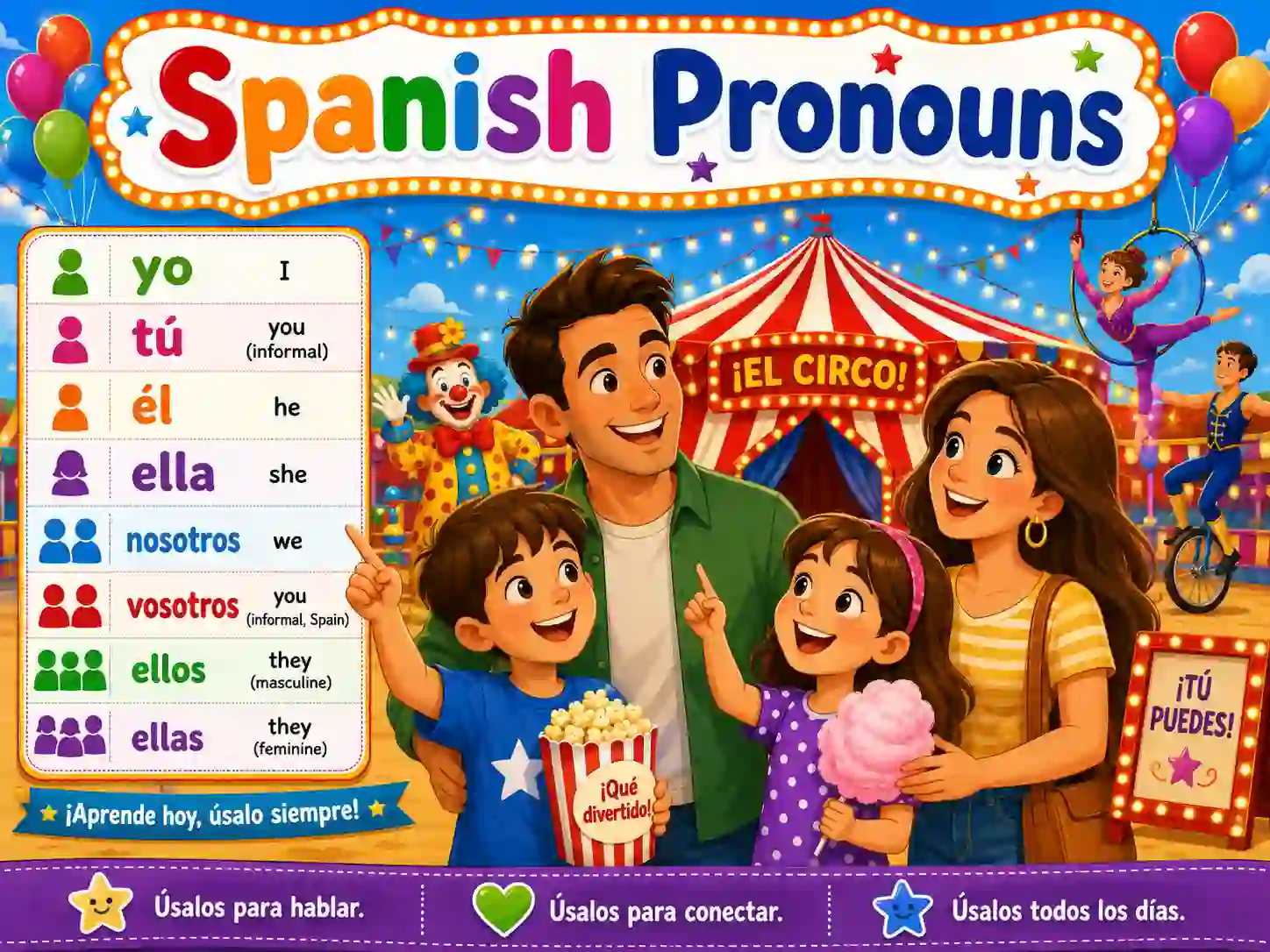
Spanish Pronouns
Return to the complete overview of personal, object, reflexive, possessive and indefinite pronouns.
Open overview
Spanish Interrogative Pronouns
Compare questions and indefinite answers: ¿Quién? — alguien or nadie.
Open lesson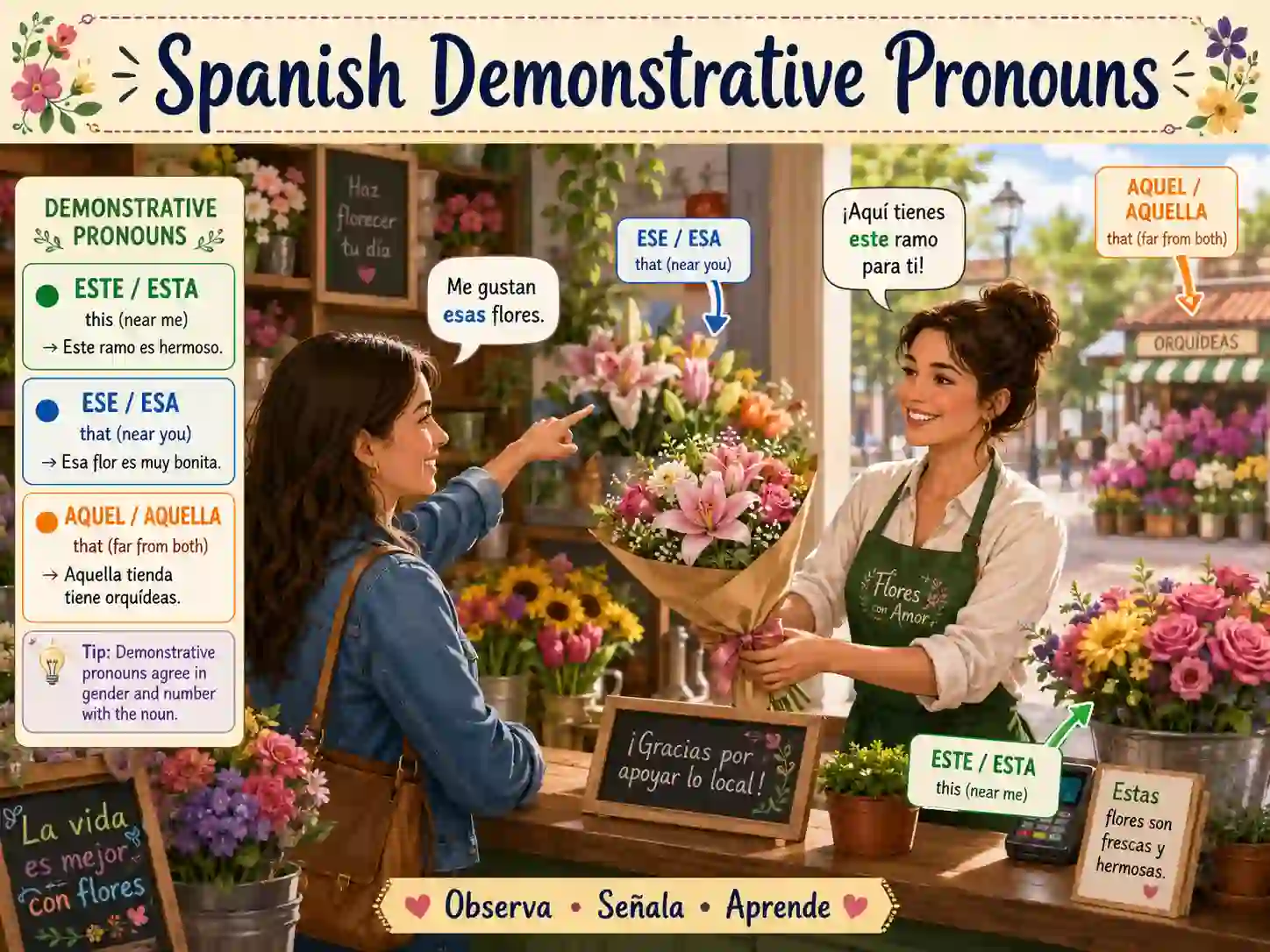
Spanish Demonstrative Pronouns
Compare unspecified algo with specific demonstratives such as esto, eso and aquello.
Open lessonCommon errors
Common mistakes with Spanish indefinite pronouns
- Confusing people and things: use alguien and nadie for people; use algo and nada for things or ideas.
- Forgetting personal a: say Veo a alguien and No veo a nadie.
- Omitting no before a following negative word: say No veo nada, not Veo nada in a normal negative statement.
- Adding no when the negative word comes first: say Nadie viene, not normally No nadie viene.
- Using algún as a standalone pronoun: use alguno alone and algún before a masculine singular noun.
- Using ningún as a standalone pronoun: use ninguno alone and ningún before a masculine singular noun.
- Making alguien or nadie plural: both forms are invariable and normally take a singular verb.
- Confusing cualquiera and cualquier: use cualquiera alone and cualquier before a singular noun.
Frequently asked questions
Questions about Spanish indefinite pronouns
What are Spanish indefinite pronouns?
They refer to unspecified people, things, quantities or groups. Examples include algo, alguien, nada, nadie, alguno, ninguno and cualquiera.
What is the difference between algo and alguien?
Algo refers to a thing, idea or piece of information. Alguien refers to a person.
What is the difference between nada and nadie?
Nada refers to things or ideas. Nadie refers to people.
Why does Spanish say no veo nada?
Spanish uses negative concord. When nada, nadie or ninguno appears after the verb, no normally appears before the verb.
What is the difference between alguno and algún?
Alguno can stand alone: ¿Tienes alguno? Algún appears before a masculine singular noun: ¿Tienes algún libro?
Do alguien and nadie use the personal a?
Yes, when they are direct objects referring to people: Veo a alguien and No veo a nadie.
Practice and support
Practise indefinite pronouns in complete sentences
These forms become easier when you practise the contrast between people and things, personal a, gender agreement and Spanish negative concord.
Spanish Tutoring
Work on indefinite pronouns, negation, sentence correction and individual grammar problems.
Private Spanish Lessons
Practise algo, alguien, nada, nadie, alguno and ninguno.
Intensive Spanish Course
Combine grammar practice with structured speaking, listening and sentence-building activities.

About MundoDele
Spanish learning for education, work and real communication
MundoDele combines clear Spanish grammar explanations with private lessons, tutoring, DELE preparation, Business Spanish and cultural context from the Spanish-speaking world.
The grammar guides use practical examples, connected lessons and clear sentence logic to help learners move from individual rules to confident Spanish use.