
Spanish Demonstrative Determiners: Este, Ese and Aquel
Learn how Spanish demonstrative determiners point to people, objects, places and ideas — from este libro, esa casa and aquellos días to the full distance system of este, ese and aquel.
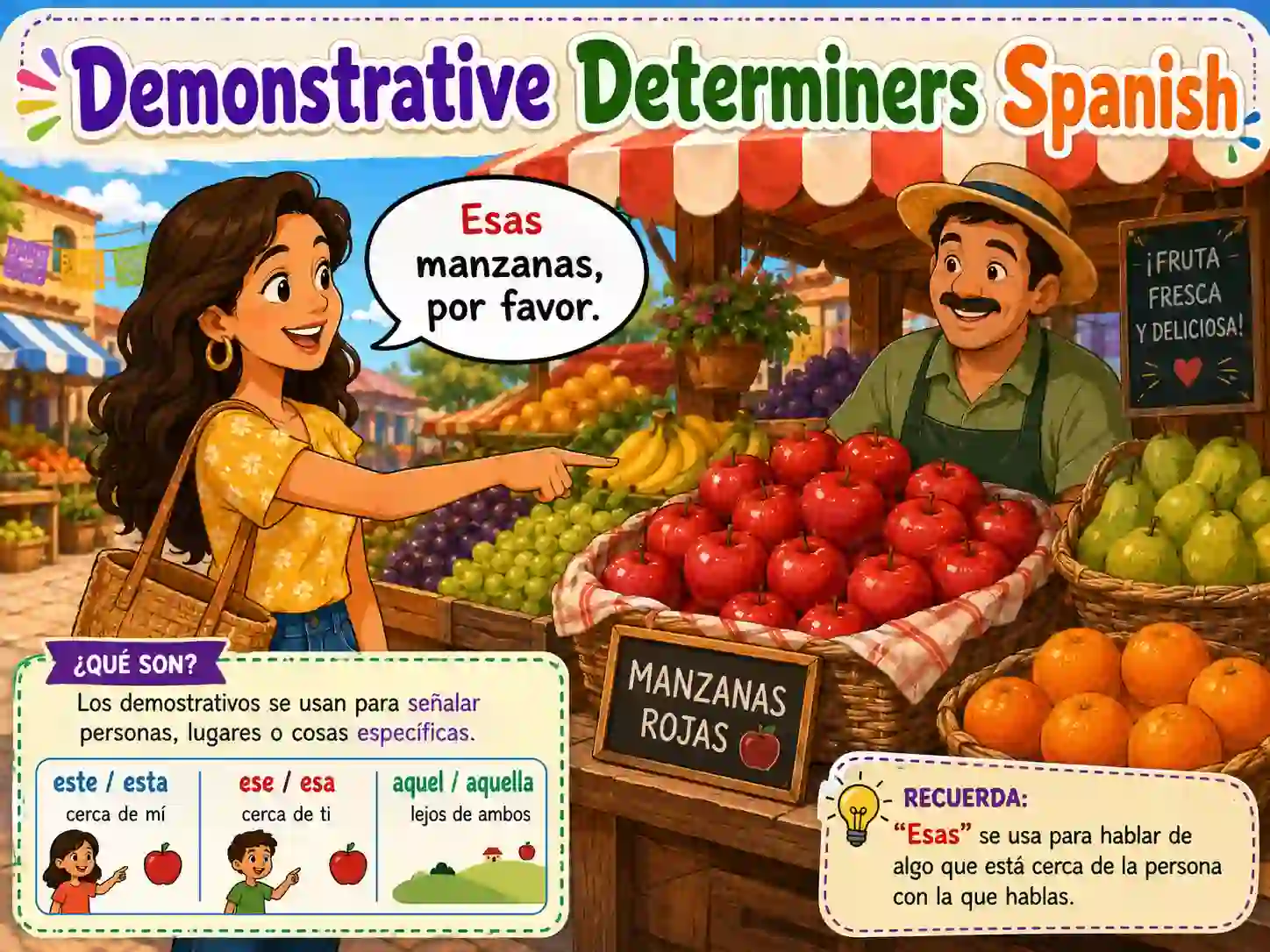
Why Spanish demonstrative determiners matter
Demonstrative determiners are essential for pointing to specific nouns in conversation and writing. They help you say which book, which house, which day, which person or which idea you mean. The main challenge is that Spanish has a three-way distance system: este for near, ese for less near, and aquel for far away.
How to use this page
Use this page after articles, nouns and adjective agreement. First learn the three distance groups, then practise gender and plural agreement before nouns.
Use este for near, ese for less near or near the listener, and aquel for far away.
Look at gender and number: libro, casa, libros, casas.
Say este libro, esta casa, estos libros, estas casas.
The core system: this, that and that over there
Este group
Use este forms for something close to the speaker in space, time or context.
este libro · esta semana · estos días
Ese group
Use ese forms for something less near, near the listener or already mentioned.
ese libro · esa pregunta · esos ejemplos
Aquel group
Use aquel forms for something far away in space, time or memory.
aquel pueblo · aquella época · aquellos años
Spanish demonstrative determiners at a glance
Demonstrative determiners come before nouns and agree with the noun in gender and number.
| Distance | Masculine singular | Feminine singular | Masculine plural | Feminine plural | Example meaning |
|---|---|---|---|---|---|
| Near speaker | este | esta | estos | estas | this / these |
| Less near / near listener | ese | esa | esos | esas | that / those |
| Far away | aquel | aquella | aquellos | aquellas | that over there / those over there |
Este, esta, estos and estas
Use the este group for people, things, times or ideas that are close to the speaker. This closeness can be physical, temporal or contextual.
| Form | Used before | Example | English meaning |
|---|---|---|---|
| este | masculine singular noun | este libro | this book |
| esta | feminine singular noun | esta clase | this class |
| estos | masculine plural noun | estos estudiantes | these students |
| estas | feminine plural noun | estas preguntas | these questions |
Este libro es interesante. — This book is interesting.
Esta semana estudio mucho. — This week I study a lot.
Estos ejemplos son claros. — These examples are clear.
Estas clases son útiles. — These classes are useful.
Ese, esa, esos and esas
Use the ese group for something less close to the speaker. It can refer to something near the listener, something already mentioned, or something psychologically more distant.
| Form | Used before | Example | English meaning |
|---|---|---|---|
| ese | masculine singular noun | ese libro | that book |
| esa | feminine singular noun | esa casa | that house |
| esos | masculine plural noun | esos días | those days |
| esas | feminine plural noun | esas personas | those people |
Ese problema es importante. — That problem is important.
Esa idea no es nueva. — That idea is not new.
Esos libros son tuyos. — Those books are yours.
Esas palabras son difíciles. — Those words are difficult.
Aquel, aquella, aquellos and aquellas
Use the aquel group for something far away from both the speaker and the listener. It is also common for distant time, memory, history or contrast.
| Form | Used before | Example | English meaning |
|---|---|---|---|
| aquel | masculine singular noun | aquel pueblo | that village over there / that distant village |
| aquella | feminine singular noun | aquella época | that period back then |
| aquellos | masculine plural noun | aquellos años | those years back then |
| aquellas | feminine plural noun | aquellas montañas | those mountains over there |
Aquel edificio es muy antiguo. — That building over there is very old.
Aquella ciudad cambió mucho. — That city changed a lot.
Aquellos años fueron difíciles. — Those years were difficult.
Aquellas casas pertenecen a mi familia. — Those houses over there belong to my family.
Agreement with nouns
Demonstrative determiners agree with the noun they introduce. The form changes according to gender and number.
este libro — masculine singular
esta casa — feminine singular
estos libros — masculine plural
estas casas — feminine plural
aquel problema — masculine singular
aquellas preguntas — feminine plural
The distance meaning and the noun agreement must both be correct. First choose este, ese or aquel, then adjust the ending to the noun.
Distance in space, time and context
Demonstrative determiners can refer to physical distance, time distance or contextual distance. This is why este, ese and aquel are not only about physical location.
| Distance type | Este group | Ese group | Aquel group |
|---|---|---|---|
| Physical space | este libro here | ese libro there / near you | aquel libro over there |
| Time | esta semana this week | ese día that day | aquellos años those years long ago |
| Context | esta idea this idea now | ese argumento that argument mentioned | aquella teoría that distant theory |
Demonstrative determiners vs demonstrative pronouns
Demonstrative determiners come before nouns. Demonstrative pronouns stand alone and replace the noun. This distinction is important because esto, eso and aquello are neuter pronouns, not determiners before nouns.
| Function | Example | Explanation |
|---|---|---|
| Demonstrative determiner | este libro | Este comes before the noun libro. |
| Demonstrative pronoun | Este es interesante. | Este stands alone and replaces a masculine noun. |
| Demonstrative determiner | esa casa | Esa comes before the noun casa. |
| Demonstrative pronoun | Esa es grande. | Esa stands alone and replaces a feminine noun. |
| Neuter demonstrative pronoun | Esto es importante. | Esto stands alone; it is not used before a noun. |
Learn pronoun use separately here: Spanish Demonstrative Pronouns.
Este vs esto, ese vs eso, aquel vs aquello
Este, ese and aquel can be masculine demonstrative determiners before masculine nouns. Esto, eso and aquello are neuter pronouns and do not come before nouns.
| Correct determiner before noun | Correct pronoun alone | Incorrect before noun |
|---|---|---|
| este problema | Esto es un problema. | esto problema |
| ese tema | Eso es interesante. | eso tema |
| aquel recuerdo | Aquello fue difícil. | aquello recuerdo |
Accent marks with demonstratives
Demonstrative determiners such as este libro, esa casa and aquellos años are written without accent marks. In modern standard teaching, demonstrative forms are generally written without accents, especially when they are determiners before nouns.
este libro, not éste libro
esa casa, not ésa casa
aquellos días, not aquéllos días
For learners, the practical rule is simple: do not add accent marks to demonstrative determiners before nouns.
When to use Spanish demonstrative determiners
Use este forms
Use these for things close to you now.
este libro · esta clase · estos ejemplos
Use ese forms
Use these for things near the listener, less near, or already mentioned.
ese problema · esa idea · esas preguntas
Use aquel forms
Use these for distant places, memories, periods or contrasts.
aquel año · aquella época · aquellos lugares
Related grammar topics
Spanish Determiners
Understand how determiners introduce, specify, quantify or question nouns.
Spanish Nouns
Review gender and number because demonstrative determiners agree with nouns.
Spanish Adjectives
Compare demonstrative agreement with adjective agreement in noun phrases.
Demonstrative Pronouns
Learn how este, ese, aquel, esto, eso and aquello work when they stand alone.
Spanish Articles
Compare demonstratives with articles such as el, la, un and una.
Possessive Determiners
Compare pointing to a noun with showing ownership: este libro vs mi libro.
Typical mistakes with Spanish demonstrative determiners
- Forgetting agreement: say esta casa, not este casa.
- Using neuter pronouns before nouns: say este problema, not esto problema.
- Confusing ese and aquel: use aquel for stronger distance in space, time or memory.
- Adding accent marks before nouns: write este libro, esa casa, aquellos años without accents.
- Using only English “that” logic: Spanish separates ese and aquel, while English often uses “that” for both.
Where to go next
After demonstrative determiners, continue with demonstrative pronouns, nouns and adjectives. These topics explain the difference between pointing before a noun and replacing the noun completely.
Want personal guidance?
If Spanish demonstratives feel confusing, individual guidance can help you practise este, ese, aquel, gender agreement, plural forms and the difference between determiners and pronouns.
FAQ: Spanish demonstrative determiners
What are Spanish demonstrative determiners?
Spanish demonstrative determiners are words used before nouns to mean “this”, “that”, “these” or “those”. Examples include este libro, esa casa and aquellos años.
What is the difference between este, ese and aquel?
Este refers to something near the speaker, ese to something less near or near the listener, and aquel to something far away in space, time or context.
Do Spanish demonstrative determiners agree with nouns?
Yes. They agree with the noun in gender and number: este libro, esta casa, estos libros, estas casas.
What is the difference between este and esto?
Este can be a masculine demonstrative determiner before a noun: este problema. Esto is a neuter pronoun and stands alone: Esto es importante.
Do demonstrative determiners have accents in Spanish?
No. Demonstrative determiners before nouns are written without accent marks: este libro, esa casa, aquellos días.
Are demonstrative determiners the same as demonstrative pronouns?
No. Demonstrative determiners come before nouns, as in este libro. Demonstrative pronouns stand alone and replace the noun, as in Este es mío.

MundoDele – Spanish learning for education, work and intercultural understanding
MundoDele connects online Spanish courses, DELE preparation, Business Spanish and cultural context into a personal Spanish learning platform.
Grammar pages are designed to explain Spanish clearly, with practical examples, real sentence logic and connected learning paths.