
MundoDele Spanish Grammar
Spanish Direct Object Pronouns: Lo, La, Los and Las
Learn how Spanish direct object pronouns replace the person or thing directly affected by a verb. This guide explains me, te, lo, la, nos, os, los and las, including gender, number, the personal a, word position and double-object combinations.
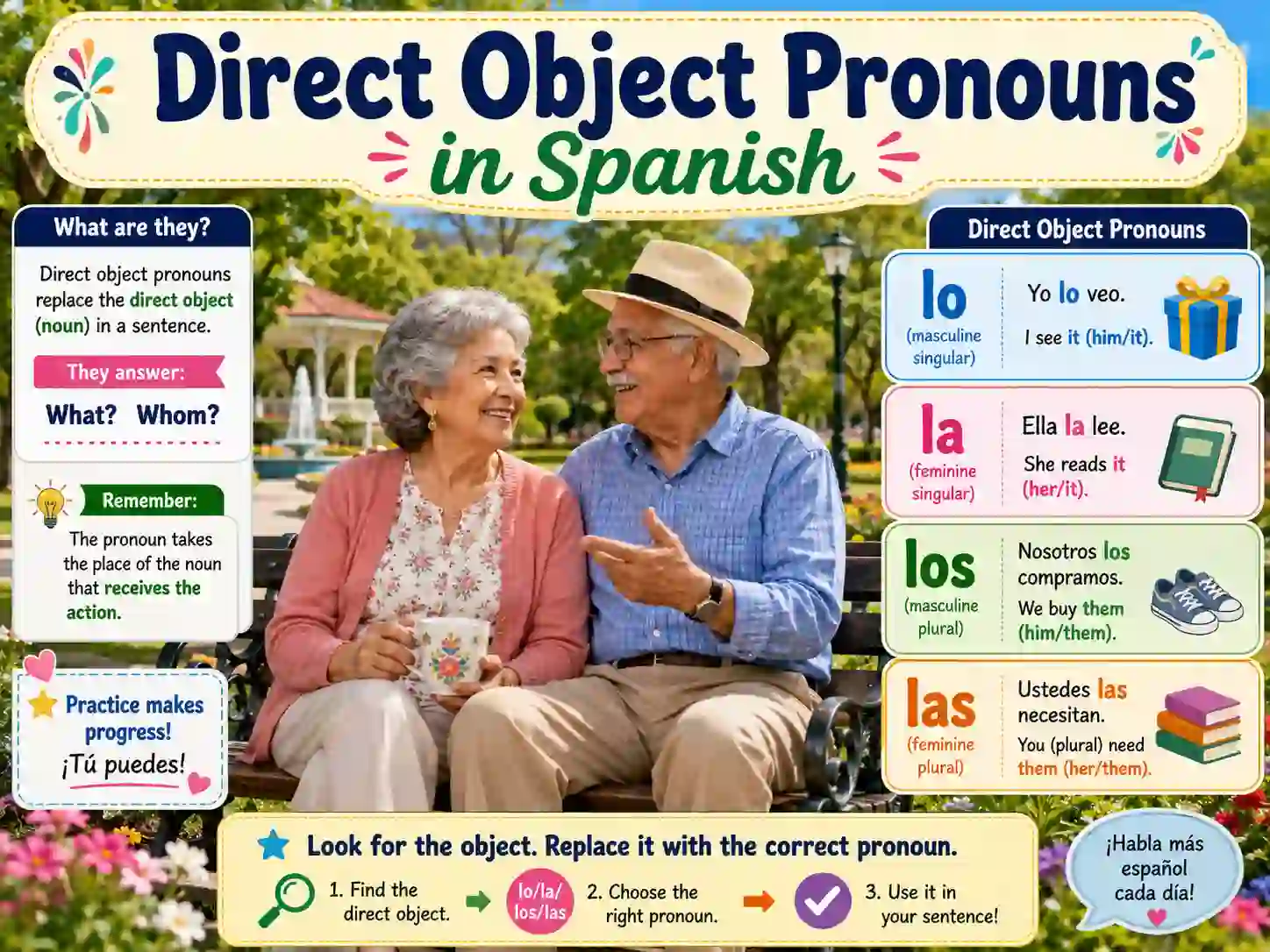
Definition
What is a direct object in Spanish?
A direct object is the person, thing or idea that receives the action of the verb directly. It normally answers what? or whom?.
In Compro el libro, the book is the thing being bought. In Conozco a Ana, Ana is the person known. Both are direct objects.
Compro el libro → Lo compro.
What do I buy? The book.
Conozco a Ana → La conozco.
Whom do I know? Ana.
No lo entiendo.
Lo can refer to an idea or statement.
Pronoun table
Spanish direct object pronouns at a glance
The pronoun is chosen according to the person, gender and number of the direct object.
| Meaning | Pronoun | Spanish example | English meaning | Grammar note |
|---|---|---|---|---|
| me | me | Me ves. | You see me. | First-person singular. |
| you | te | Te llamo. | I call you. | Informal singular. |
| him or masculine object | lo | Lo veo. | I see him or it. | Masculine singular. |
| her or feminine object | la | La conozco. | I know her or it. | Feminine singular. |
| us | nos | Nos ayudan. | They help us. | First-person plural. |
| you all in Spain | os | Os veo. | I see you all. | Mainly used in Spain. |
| them, masculine or mixed | los | Los compro. | I buy them. | Masculine or mixed plural. |
| them, feminine | las | Las leo. | I read them. | Feminine plural. |
Identify the object
How to find the direct object
Begin with the verb and ask what or whom receives the action directly.
Find the verb
Identify the action in the sentence.
María compra el libro.
Ask what or whom
The answer normally identifies the direct object.
What does María buy? El libro.
Choose the pronoun
Match the noun’s gender and number.
El libro → lo → María lo compra.
| Sentence | Question | Direct object | Pronoun sentence |
|---|---|---|---|
| Veo el coche. | What do I see? | el coche | Lo veo. |
| Compro la entrada. | What do I buy? | la entrada | La compro. |
| Leo los libros. | What do I read? | los libros | Los leo. |
| Conozco a María. | Whom do I know? | a María | La conozco. |
Gender and number
Lo, la, los and las
Third-person direct object pronouns agree with the noun they replace. Use singular or plural and masculine or feminine according to the original object.
| Noun replaced | Pronoun | Complete sentence | Pronoun sentence |
|---|---|---|---|
| el libro | lo | Leo el libro. | Lo leo. |
| la carta | la | Leo la carta. | La leo. |
| los libros | los | Compro los libros. | Los compro. |
| las cartas | las | Escribo las cartas. | Las escribo. |
Other direct-object forms
Me, te, nos and os as direct object pronouns
These forms do not show grammatical gender. Their function depends on the verb and sentence structure.
Me ves
The speaker is the person directly seen.
¿Me escuchas?
Te llamo
The listener is the person directly called.
Te conozco.
Nos ayudan · Os invito
These forms represent plural direct objects.
Nos conocen bien.
People as direct objects
Direct object pronouns and the personal a
Spanish normally uses the personal a before a specific person who functions as a direct object. The pronoun itself does not include the preposition.
| Full person object | Pronoun sentence | English meaning | Grammar point |
|---|---|---|---|
| Veo a Juan. | Lo veo. | I see Juan or him. | A Juan is a direct object. |
| Conozco a Ana. | La conozco. | I know Ana or her. | La replaces a Ana. |
| Invito a mis amigos. | Los invito. | I invite my friends or them. | Masculine or mixed plural. |
| Llamo a mis hermanas. | Las llamo. | I call my sisters or them. | Feminine plural. |
Compare Veo a Juan → Lo veo with Escribo a Juan → Le escribo. The verb determines the object’s function.
Word position
Where do direct object pronouns go?
Direct object pronouns normally go before a conjugated verb. They can attach to infinitives, gerunds and affirmative commands.
| Verb form | Pronoun position | Spanish example | English meaning |
|---|---|---|---|
| Conjugated verb | Before the verb | Lo veo. | I see it or him. |
| Compound tense | Before the auxiliary | Lo he visto. | I have seen it or him. |
| Infinitive | Before the conjugated verb or attached | Lo quiero ver. / Quiero verlo. | I want to see it or him. |
| Gerund | Before the conjugated verb or attached | Lo estoy viendo. / Estoy viéndolo. | I am seeing it or him. |
| Affirmative command | Attached to the command | Míralo. | Look at it or him. |
| Negative command | Before the verb | No lo mires. | Do not look at it or him. |
Continue with the complete guide: Spanish Pronoun Position .
Object contrast
Direct vs indirect object pronouns
The same person can be direct or indirect depending on the verb. Do not choose the pronoun only because a person appears after the preposition a.
| Sentence | Object function | Pronoun | Pronoun sentence |
|---|---|---|---|
| Veo a Juan. | Direct object | lo | Lo veo. |
| Escribo a Juan. | Indirect object | le | Le escribo. |
| Doy el libro a Ana. |
el libro direct; a Ana indirect |
lo + le | Se lo doy. |
| Mando las cartas a mis padres. |
las cartas direct; a mis padres indirect |
las + les | Se las mando. |
Two object pronouns
Direct object pronouns with indirect object pronouns
When both object pronouns appear, the indirect object pronoun comes first and the direct object pronoun comes second.
Indirect before direct
Te lo explico.
Change to se
Le doy el libro → Se lo doy.
The direct pronoun keeps its form
Se la mando · Se los compro.
| Full sentence | Two pronouns | English meaning |
|---|---|---|
| Doy el libro a Ana. | Se lo doy. | I give it to her. |
| Mando la carta a Luis. | Se la mando. | I send it to him. |
| Compro los billetes para ti. | Te los compro. | I buy them for you. |
| Explicamos las reglas a ellos. | Se las explicamos. | We explain them to them. |
Additional use
Lo for ideas, facts and situations
Lo can refer to a complete idea, fact, statement or situation rather than to one masculine noun.
No lo entiendo
I do not understand it or what was said.
Lo sé
I know it or I know that fact.
No lo creo
I do not believe it or that claim.
Regional variation
A short note on leísmo
In parts of Spain, le may be used for a masculine human direct object. This regional pattern is known as leísmo.
Use lo for a masculine direct object, la for a feminine direct object and le for an indirect object.
A Juan lo vi — direct object.
A Juan le escribí — indirect object.
Mini practice
Practice Spanish direct object pronouns
Answer each exercise before opening the solution.
Exercise 1: choose lo, la, los or las
- Veo el coche.
- Compro la entrada.
- Leo los libros.
- Escribo las cartas.
Show answers
1. Lo veo.
2. La compro.
3. Los leo.
4. Las escribo.
Exercise 2: replace the person
- Veo a Ana.
- Conozco a Juan.
- Invito a mis amigos.
- Llamo a mis hermanas.
Show answers
1. La veo.
2. Lo conozco.
3. Los invito.
4. Las llamo.
Exercise 3: choose the position
- Quiero ver el libro.
- Estoy leyendo la carta.
- Compra los billetes.
- No mires la foto.
Show answers
1. Quiero verlo or
Lo quiero ver.
2. Estoy leyéndola or
La estoy leyendo.
3. Cómpralos.
4. No la mires.
Connected lessons
Continue with these Spanish pronoun pages
These lessons connect direct objects with indirect objects, double-pronoun order, placement rules and the wider pronoun system.
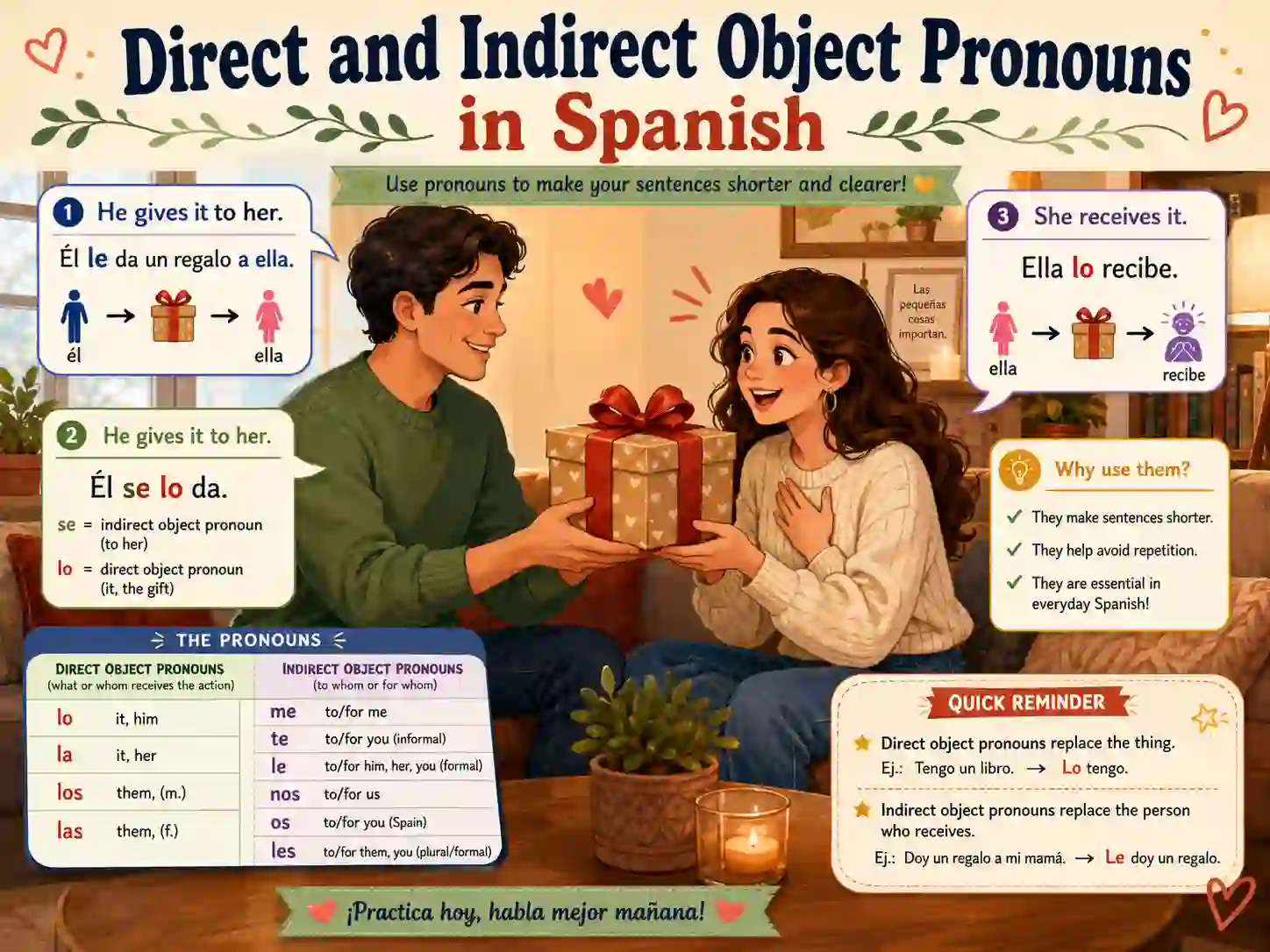
Direct and Indirect Object Pronouns
Compare direct and indirect objects and learn combinations such as me lo and se la.
Open lesson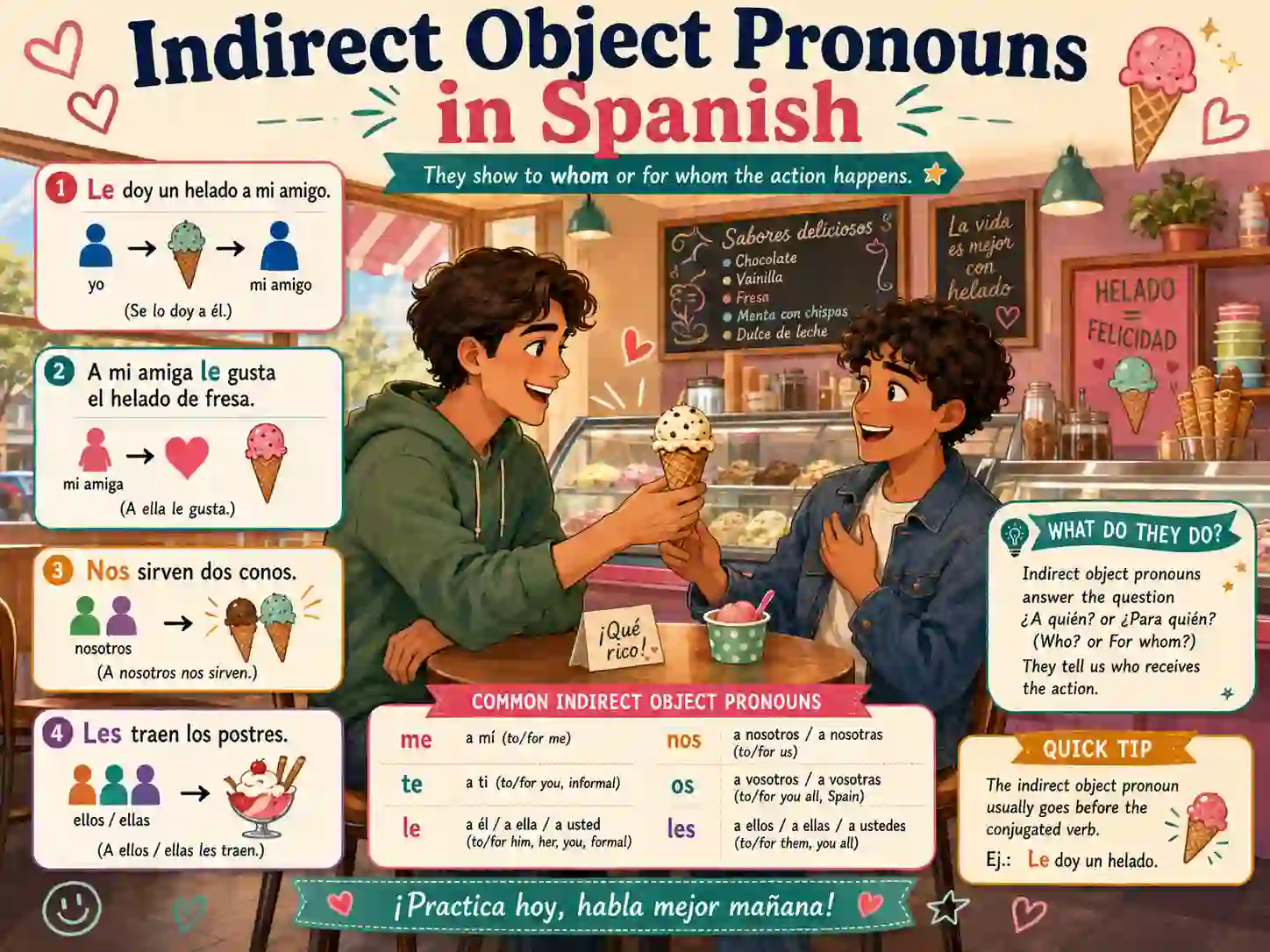
Spanish Indirect Object Pronouns
Compare direct lo and la with indirect le and les.
Open lesson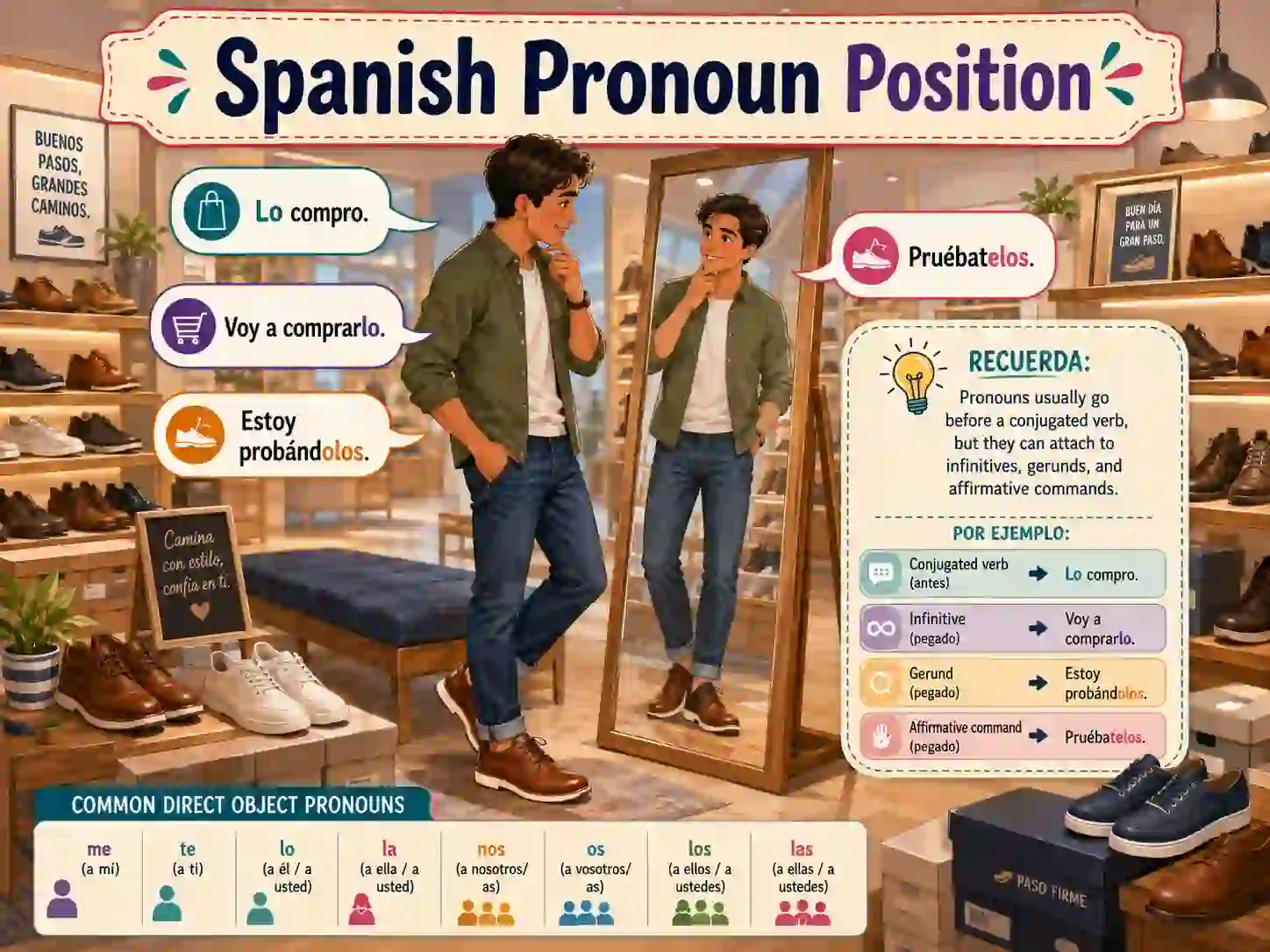
Spanish Pronoun Position
Learn where object pronouns go with conjugated verbs, infinitives, gerunds and commands.
Open lesson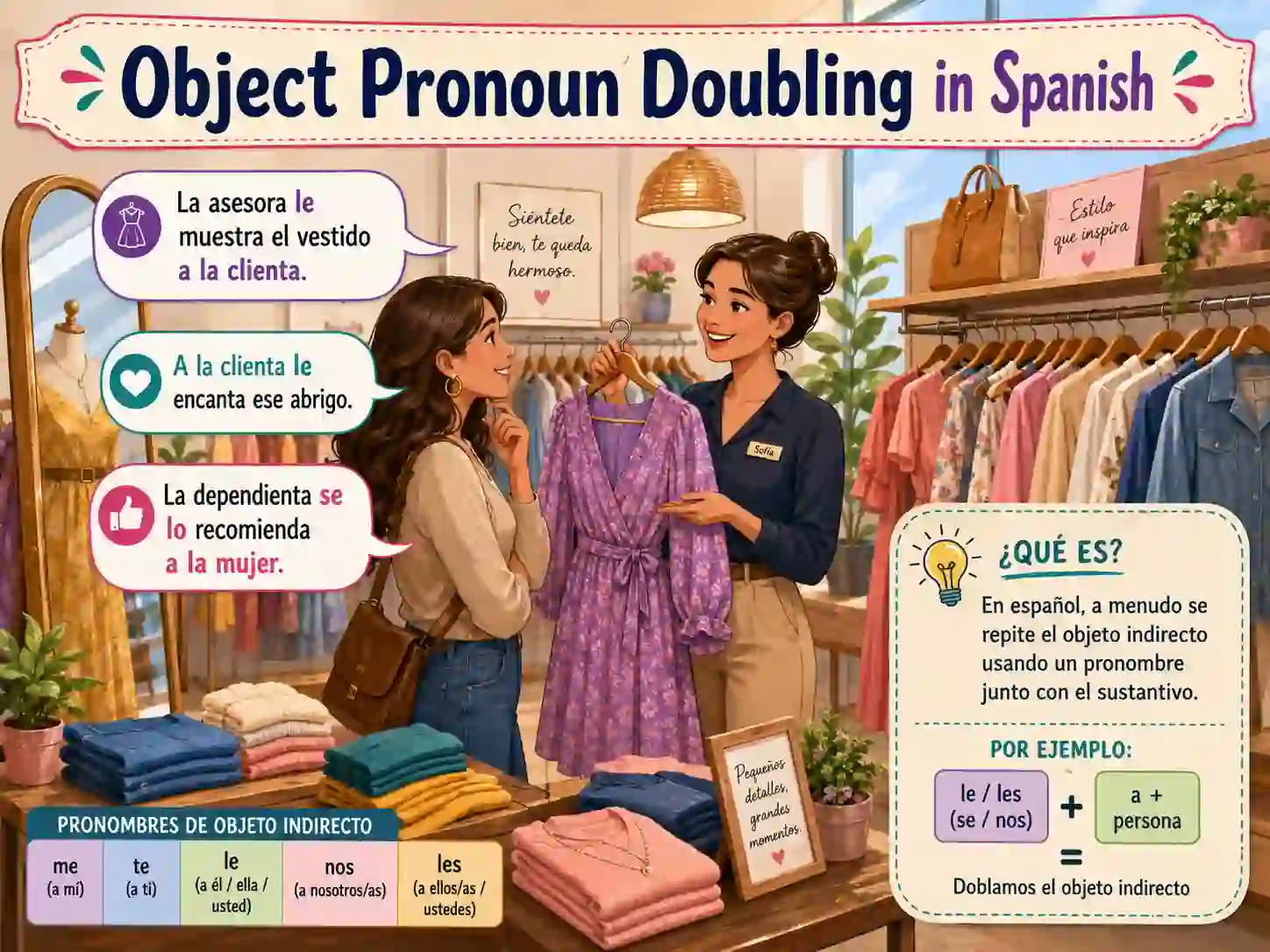
Object Pronoun Doubling
Understand structures such as A Juan lo vi and A Ana la conozco.
Open lesson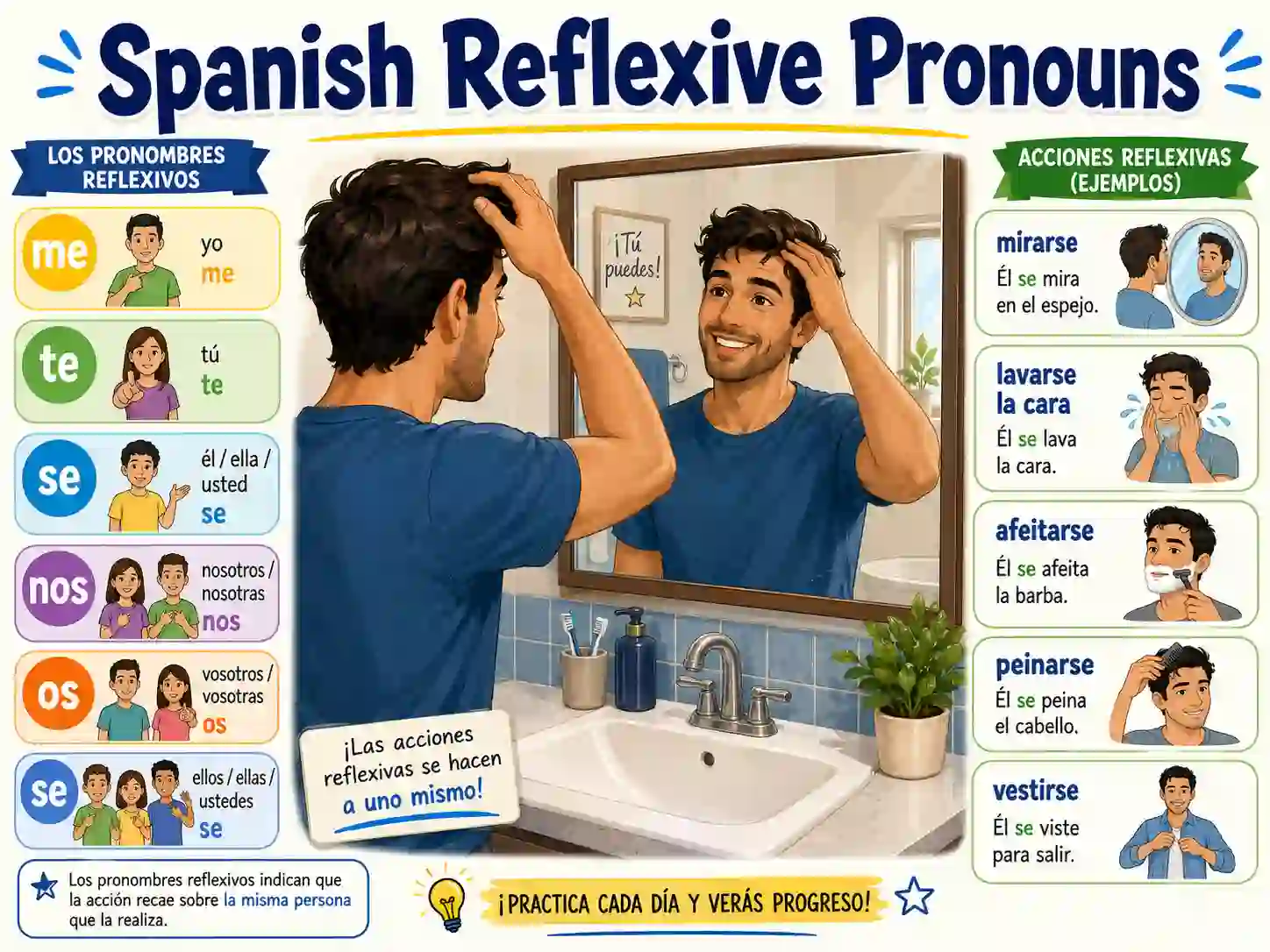
Spanish Reflexive Pronouns
Compare direct-object me, te and nos with reflexive uses.
Open lesson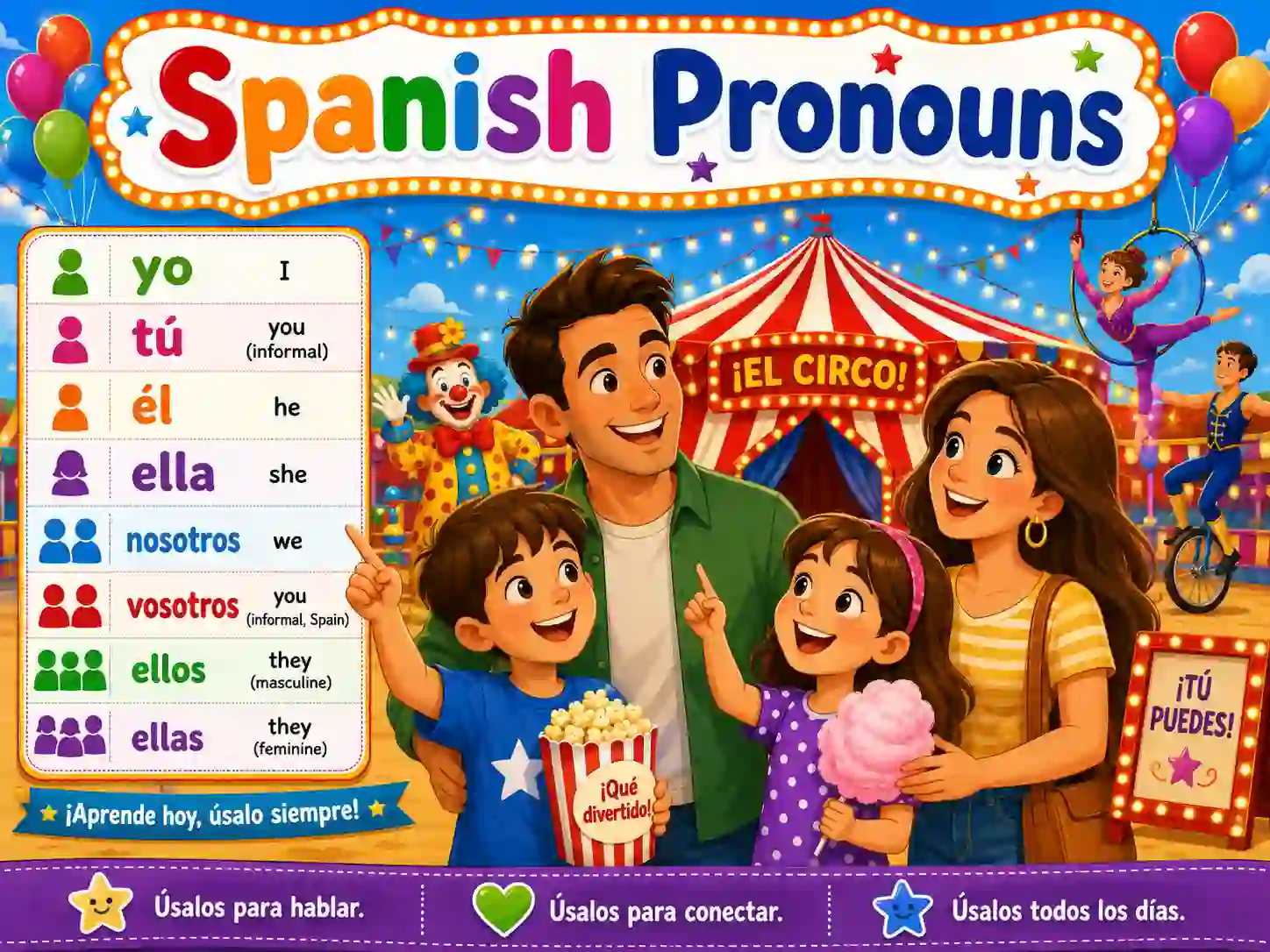
Spanish Pronouns
Return to the complete overview of subject, object, reflexive, possessive and relative pronouns.
Open overviewCommon errors
Common mistakes with direct object pronouns
- Using le for every person: the basic learner system uses lo for a masculine direct object and la for a feminine direct object.
- Forgetting gender and number: el libro becomes lo, while las cartas becomes las.
- Thinking personal a marks an indirect object: Veo a Ana is direct: La veo.
- Putting the pronoun after a conjugated verb: say Lo veo, not Veo lo.
- Keeping personal a with the pronoun: say La veo, not A la veo.
- Using lo for every object: use la, los or las when the original noun requires them.
Frequently asked questions
Questions about Spanish direct object pronouns
What are Spanish direct object pronouns?
They replace the person or thing directly affected by a verb. The forms are me, te, lo, la, nos, os, los and las.
What is the difference between lo and la?
Lo normally replaces a masculine singular direct object. La replaces a feminine singular direct object.
What is the difference between los and las?
Los replaces masculine or mixed plural objects. Las replaces feminine plural objects.
Where do direct object pronouns go?
They normally go before a conjugated verb. They attach to infinitives, gerunds and affirmative commands.
Is a Juan in veo a Juan a direct object?
Yes. The personal a marks Juan as a specific person, but Juan remains the direct object: Lo veo.
What is the difference between lo veo and le escribo?
Lo veo is direct because someone is seen directly. Le escribo is indirect because someone receives the communication.
Practice and support
Practise direct object pronouns in complete sentences
Direct object pronouns become easier when you practise object recognition, gender, number, the personal a, pronoun position and direct-versus-indirect contrasts in context.
Spanish Tutoring
Work on pronouns, homework, sentence correction and individual grammar problems.
Private Spanish Lessons
Practise lo veo, la conozco, se lo doy and natural sentence patterns.
Spanish Grammar
Continue with verbs, tenses, pronouns, prepositions and sentence structures.

About MundoDele
Spanish learning connected with culture and real life
MundoDele combines clear Spanish grammar explanations with private lessons, tutoring, DELE and SIELE preparation, Business Spanish, cultural context and travel experiences from the Spanish-speaking world.
The grammar guides use practical examples, connected lessons and clear sentence logic to help international learners move from individual rules to confident Spanish use.