
MundoDele Spanish Grammar
Spanish Subject Pronouns: Yo, Tú, Vos, Él and Ella
Learn how Spanish subject pronouns identify the person or thing doing the action. This guide explains yo, tú, vos, él, ella, usted, nosotros, vosotros, ellos and ustedes, including regional usage and when Spanish leaves the pronoun out.
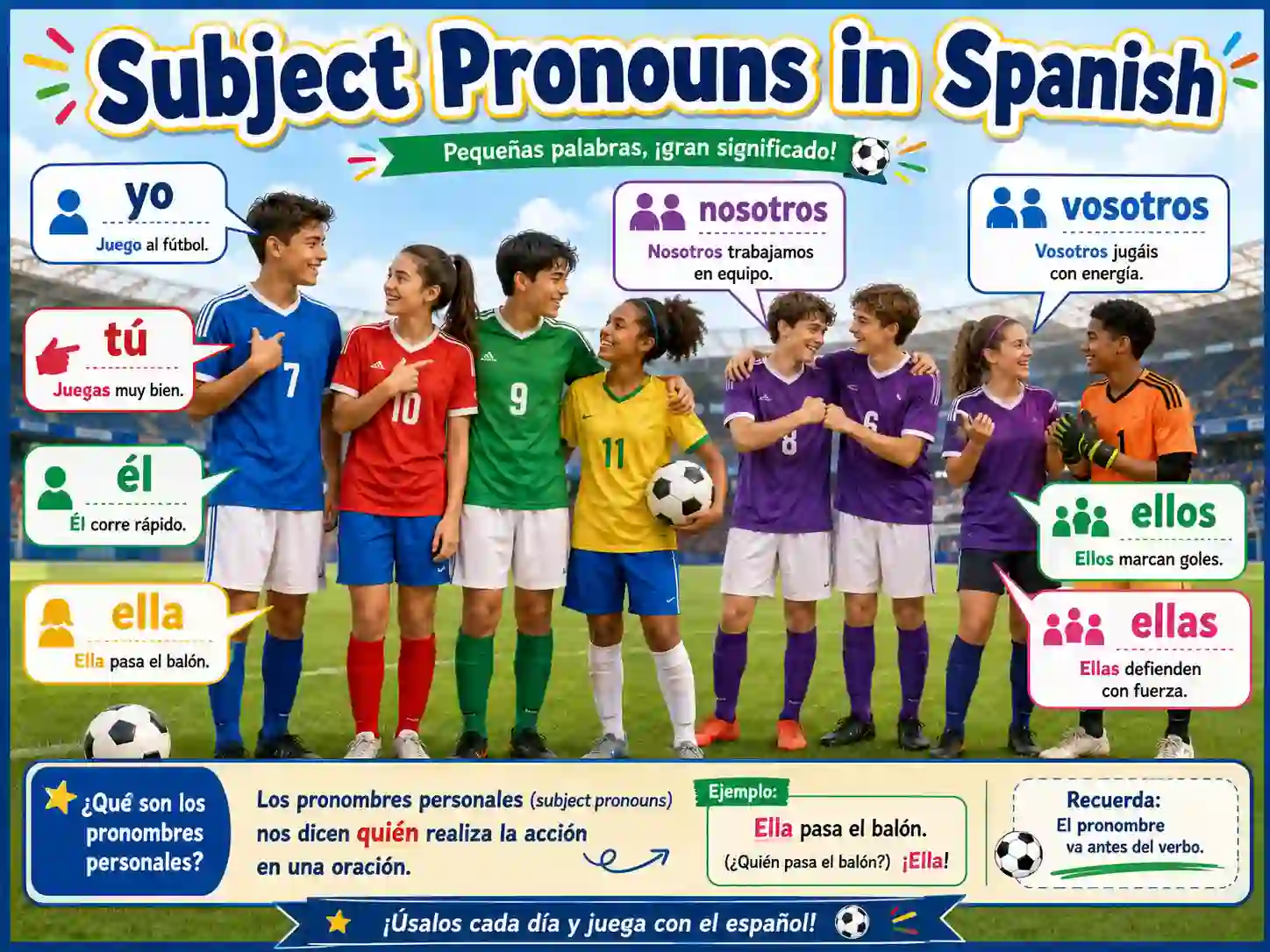
Definition
What are Spanish subject pronouns?
A Spanish subject pronoun identifies the person or thing that performs the action of the verb. In Ella trabaja, ella is the subject pronoun because she is the person performing the action.
Subject pronouns are closely connected to verb conjugation. The ending of a Spanish verb normally changes according to the subject: yo hablo, tú hablas, ella habla, nosotros hablamos.
Yo estudio español.
The speaker performs the action.
Nosotros hablamos.
The subject determines the conjugated form.
Hablo español.
The pronoun can disappear when the subject is clear.
Core system
The core idea: subject pronoun + conjugated verb
The pronoun identifies the subject
Use the pronoun to show whether the speaker, listener or another person performs the action.
Yo estudio. Tú trabajas. Ella vive aquí.
The verb changes with the subject
Spanish conjugation links each subject form to a corresponding verb ending.
hablo · hablas · habla · hablamos
The pronoun is often omitted
When the subject is obvious, Spanish usually relies on the verb ending instead of repeating the pronoun.
Vivimos en Argentina.
Subject pronoun table
Spanish subject pronouns at a glance
The table shows the complete subject-pronoun system, including regional and formal forms of “you”.
| Spanish pronoun | English meaning | Example | Use note |
|---|---|---|---|
| yo | I | Yo hablo español. | Often omitted: Hablo español. |
| tú | you, informal singular | Tú estudias mucho. | Common informal singular form in many regions. |
| vos | you, informal singular | Vos estudiás mucho. | Common in Argentina, Uruguay and other regions. |
| él | he | Él trabaja aquí. | The accent distinguishes él from article el. |
| ella | she | Ella vive en Madrid. | Third-person singular feminine. |
| usted | you, formal singular | Usted habla muy bien. | Uses a third-person singular verb form. |
| nosotros / nosotras | we | Nosotros aprendemos español. | Use nosotras for an all-female group. |
| vosotros / vosotras | you all, informal | Vosotros habláis español. | Mainly used in Spain. |
| ellos / ellas | they | Ellos trabajan juntos. | Use ellas for an all-female group. |
| ustedes | you all | Ustedes hablan español. | Normal plural “you” throughout Latin America. |
Pronoun omission
Why Spanish often leaves subject pronouns out
Spanish verb endings usually contain enough information to identify the subject. This allows Spanish to omit subject pronouns in many neutral sentences.
| With pronoun | Natural form without pronoun | English meaning | Signal in the verb |
|---|---|---|---|
| Yo hablo español. | Hablo español. | I speak Spanish. | The ending -o identifies first-person singular. |
| Tú estudias mucho. | Estudias mucho. | You study a lot. | The ending -as identifies the informal singular form. |
| Nosotros vivimos aquí. | Vivimos aquí. | We live here. | The ending -mos identifies first-person plural. |
| Ellos trabajan hoy. | Trabajan hoy. | They work today. | The plural ending identifies a third-person plural subject. |
Omit the pronoun
Leave the pronoun out when the verb ending and context make the subject obvious.
Trabajo en casa.
Include the pronoun
Use the pronoun when two people or groups are contrasted.
Yo trabajo, pero ella estudia.
Name the unclear subject
Third-person verb forms can refer to several people, so a pronoun may be necessary for clarity.
Él vive aquí.
Singular you
Tú, vos and usted: three forms of “you”
Spanish distinguishes informal, regional and formal forms of singular “you”. The correct choice depends on region, relationship and social context.
| Pronoun | Meaning | Example | Main use |
|---|---|---|---|
| tú | informal singular you | Tú hablas español. | Friends, relatives, classmates and informal situations. |
| vos | regional informal singular you | Vos hablás español. | Normal in Argentina, Uruguay and several other regions. |
| usted | formal singular you | Usted habla español. | Respect, distance and professional or formal contexts. |
Plural forms
Nosotros, vosotros, ellos and ustedes
Spanish plural subject pronouns show person, region and, in some forms, the gender composition of the group.
| Pronoun | Meaning | Example | Use note |
|---|---|---|---|
| nosotros | we, male or mixed group | Nosotros vivimos aquí. | Includes the speaker. |
| nosotras | we, all-female group | Nosotras vivimos aquí. | All members of the group are female. |
| vosotros / vosotras | you all, informal | Vosotros habláis español. | Mainly Spain. |
| ustedes | you all | Ustedes hablan español. | Standard plural “you” in Latin America. |
| ellos | they, male or mixed group | Ellos trabajan juntos. | Third-person plural. |
| ellas | they, all-female group | Ellas trabajan juntas. | All members of the group are female. |
Written accents
Tú vs tu and él vs el
Written accents distinguish subject pronouns from other short words with a different grammatical function.
tú means “you”
Tú tienes razón.
tu means “your”
Tu libro está aquí.
él vs el
Él lee el libro.
Verb connection
Subject pronouns and Spanish verb conjugation
Every subject form connects to a corresponding verb form. The present tense of hablar shows the basic pattern.
| Subject | Hablar form | English idea | Grammar note |
|---|---|---|---|
| yo | hablo | I speak | First-person singular. |
| tú | hablas | you speak | Informal singular form. |
| vos | hablás | you speak | Voseo present-tense form. |
| él / ella / usted | habla | he, she or you speak(s) | Third-person singular. |
| nosotros / nosotras | hablamos | we speak | First-person plural. |
| vosotros / vosotras | habláis | you all speak | Mainly Spain. |
| ellos / ellas / ustedes | hablan | they or you all speak | Third-person plural. |
Continue with the full conjugation lesson: Regular Verbs in Spanish .
Real use
When should you use Spanish subject pronouns?
Compare two people
Use subject pronouns when two subjects perform different actions.
Yo estudio, pero tú trabajas.
Focus strongly on the subject
Include the pronoun when the identity of the person is the main point.
Yo no quiero eso.
Avoid ambiguity
Use él, ella or usted when the verb form alone is unclear.
Ella vive en Valencia.
Make respectful address clear
Usted can make a formal or professional relationship explicit.
Usted tiene razón.
Use the locally normal form
In Argentina and other voseo regions, vos is the normal informal subject pronoun.
Vos tenés razón.
Leave the pronoun out
In ordinary speech, omit the pronoun when the subject is already obvious.
Estudiamos español.
Mini practice
Practice Spanish subject pronouns
Answer each exercise before opening the solution.
Exercise 1: choose the pronoun
- ___ hablo español. — I
- ___ trabaja aquí. — she
- ___ vivimos en Argentina. — we
- ___ hablan español. — you all in Latin America
Show answers
1. Yo hablo español.
2. Ella trabaja aquí.
3. Nosotros / Nosotras vivimos en Argentina.
4. Ustedes hablan español.
Exercise 2: tú, vos or usted?
- ___ hablás muy bien.
- ___ habla muy bien. — formal
- ___ hablas muy bien. — informal tú
- ___ tenés razón.
Show answers
1. Vos hablás muy bien.
2. Usted habla muy bien.
3. Tú hablas muy bien.
4. Vos tenés razón.
Exercise 3: omit or keep?
- Yo estudio español.
- Nosotros vivimos aquí.
- Yo quiero café, pero ella quiere té.
- Usted trabaja aquí. — formal clarification
Show answers
1. Estudio español.
2. Vivimos aquí.
3. Keep both pronouns because they express contrast.
4. Keep usted because it clarifies formal address.
Connected lessons
Continue with these Spanish grammar pages
These pages connect subject pronouns with the wider personal-pronoun system, object forms, prepositional forms and verb conjugation.
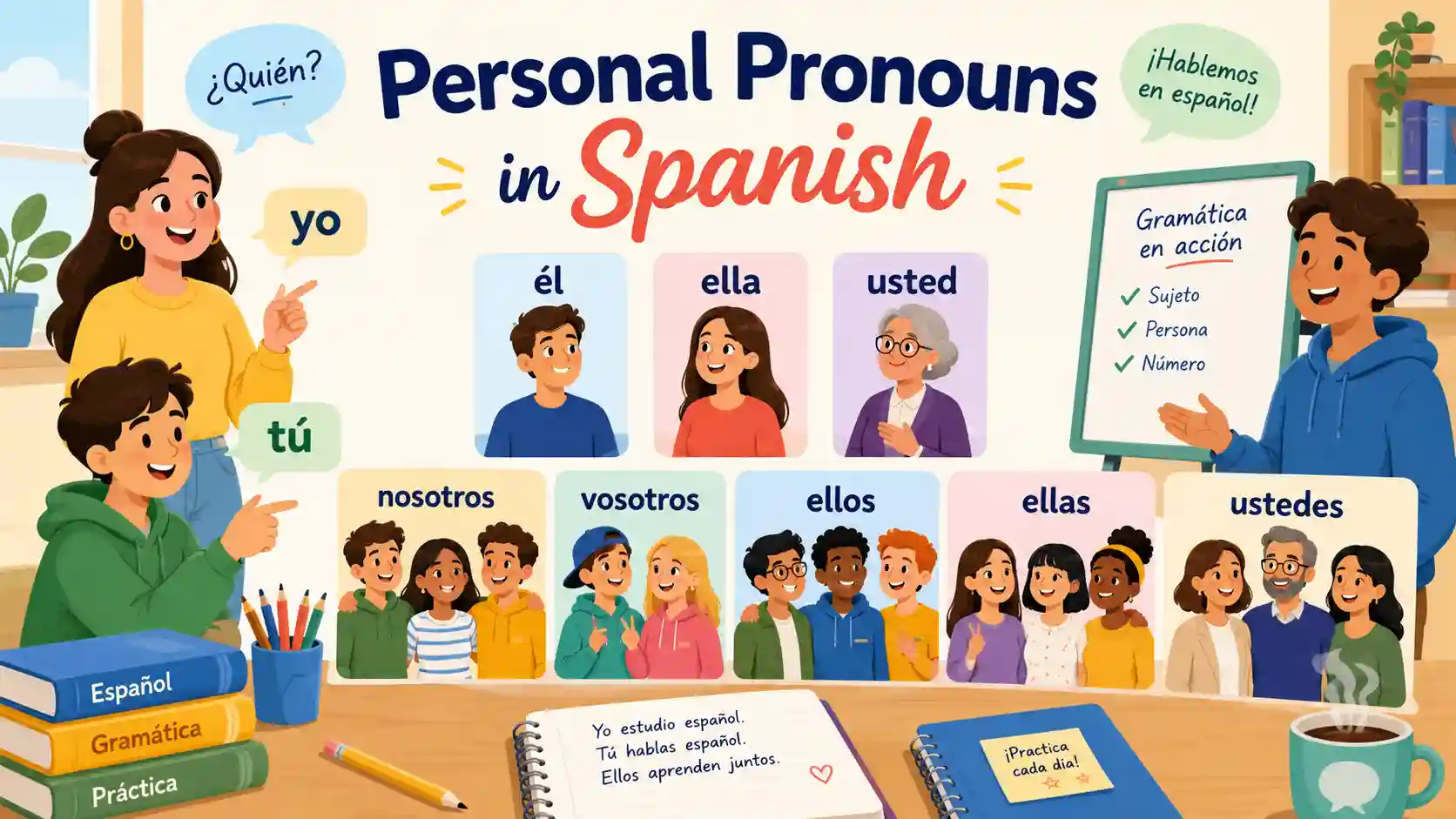
Personal Pronouns in Spanish
Compare subject forms with object and prepositional forms such as yo → me → mí.
Open lesson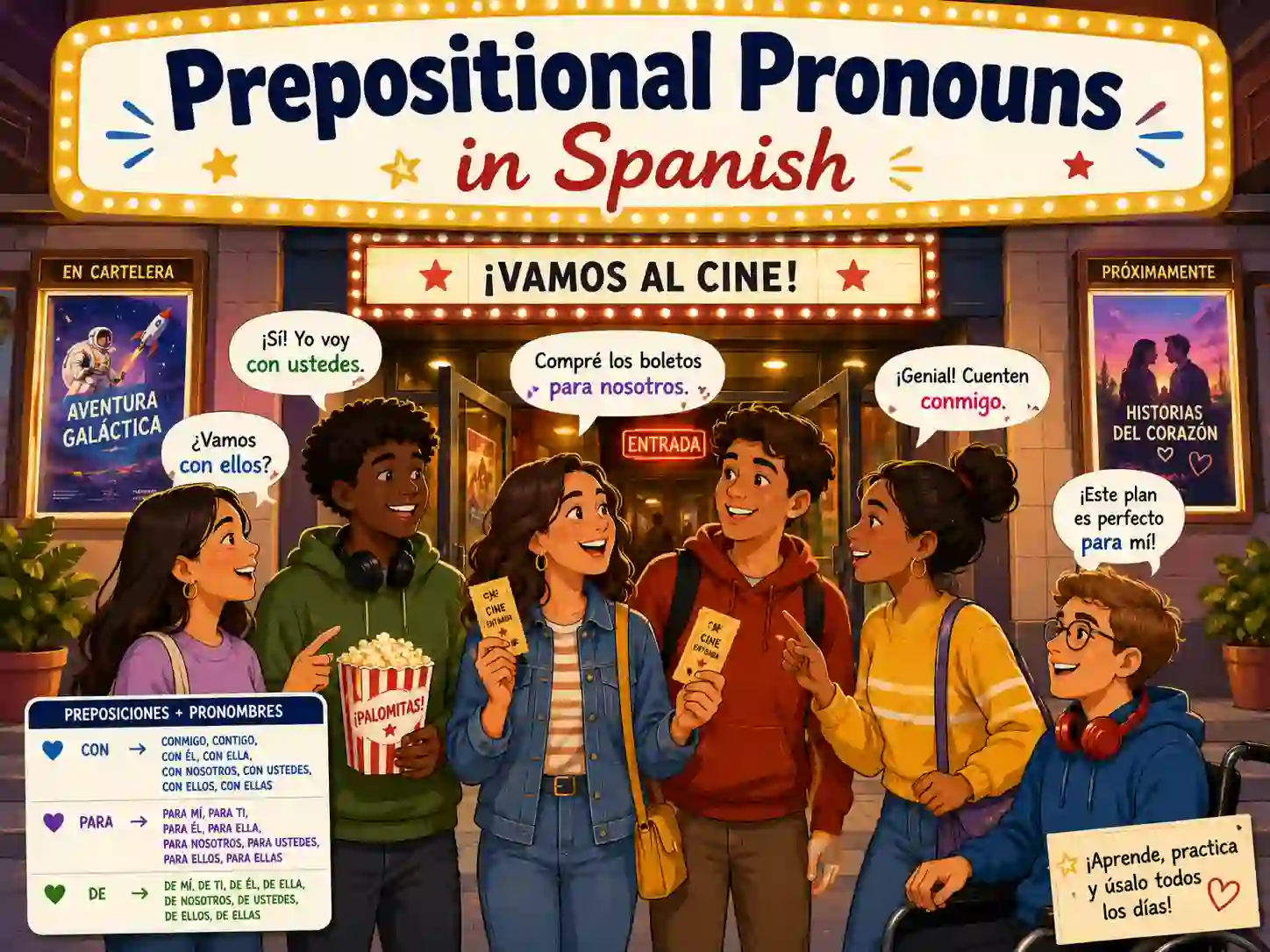
Spanish Prepositional Pronouns
Learn why yo changes to mí and tú changes to ti.
Open lesson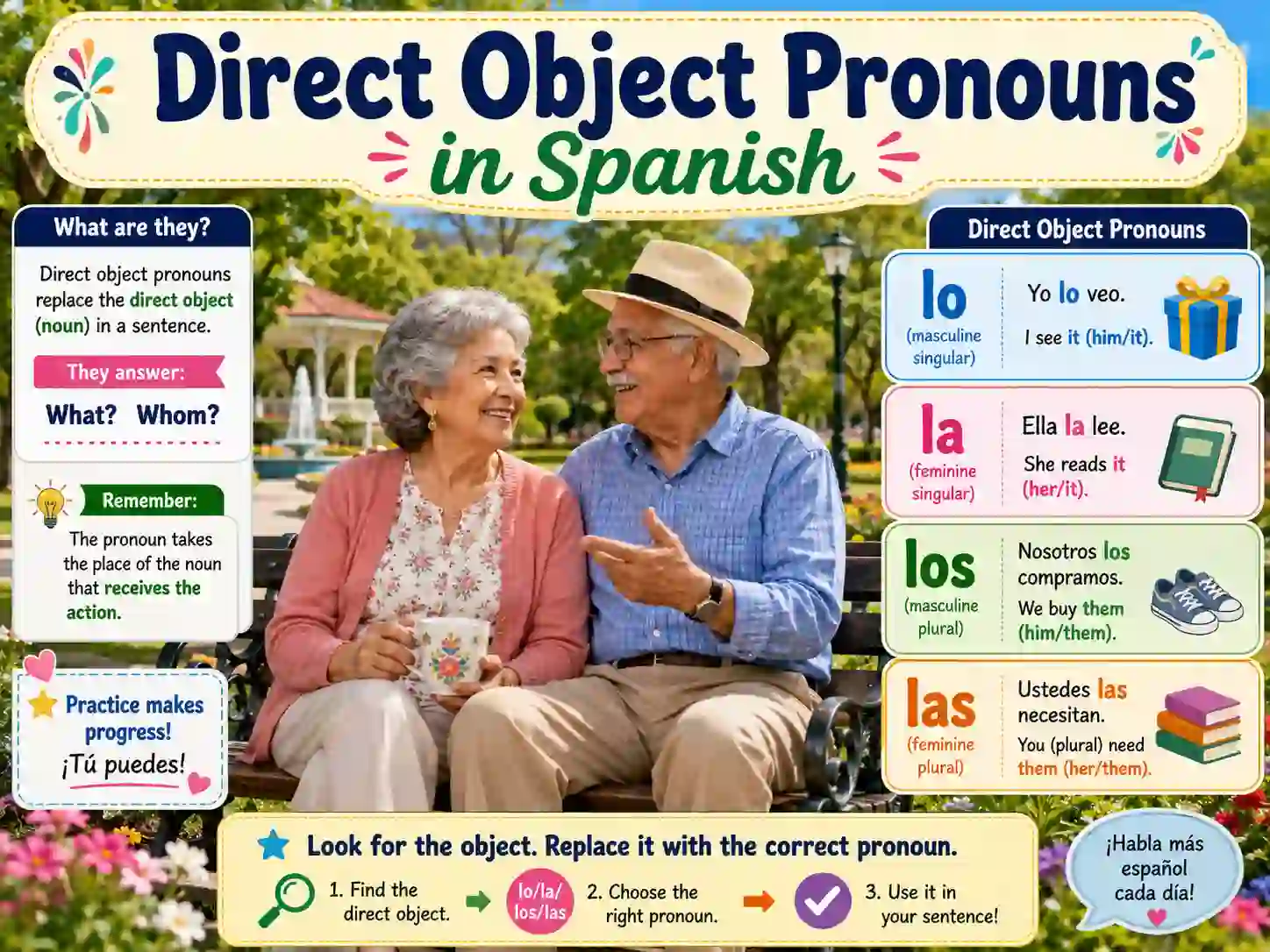
Spanish Direct Object Pronouns
Compare the subject with the person or thing directly affected by the verb.
Open lesson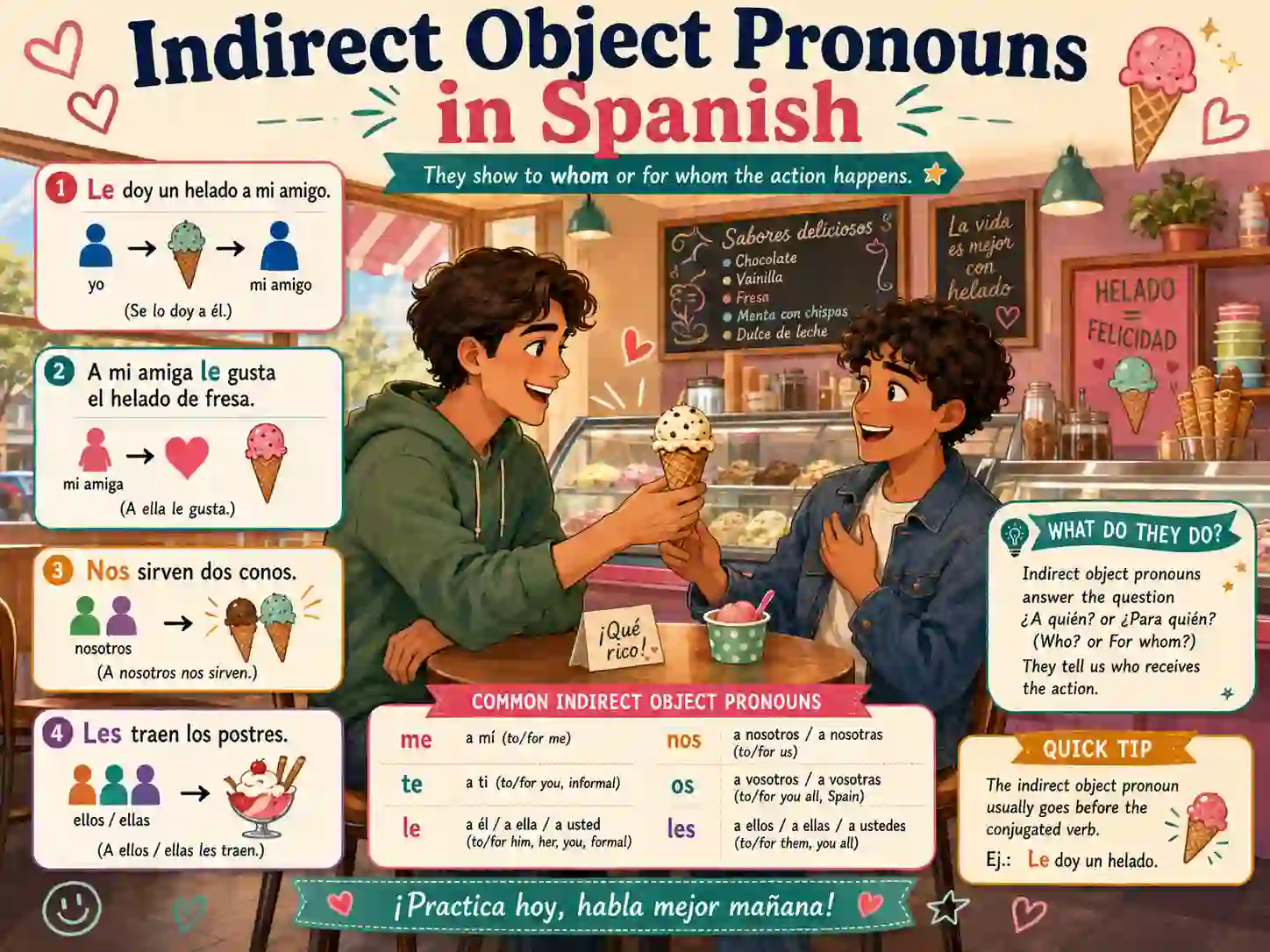
Spanish Indirect Object Pronouns
Learn how Spanish identifies the person who receives, benefits from or is affected by an action.
Open lesson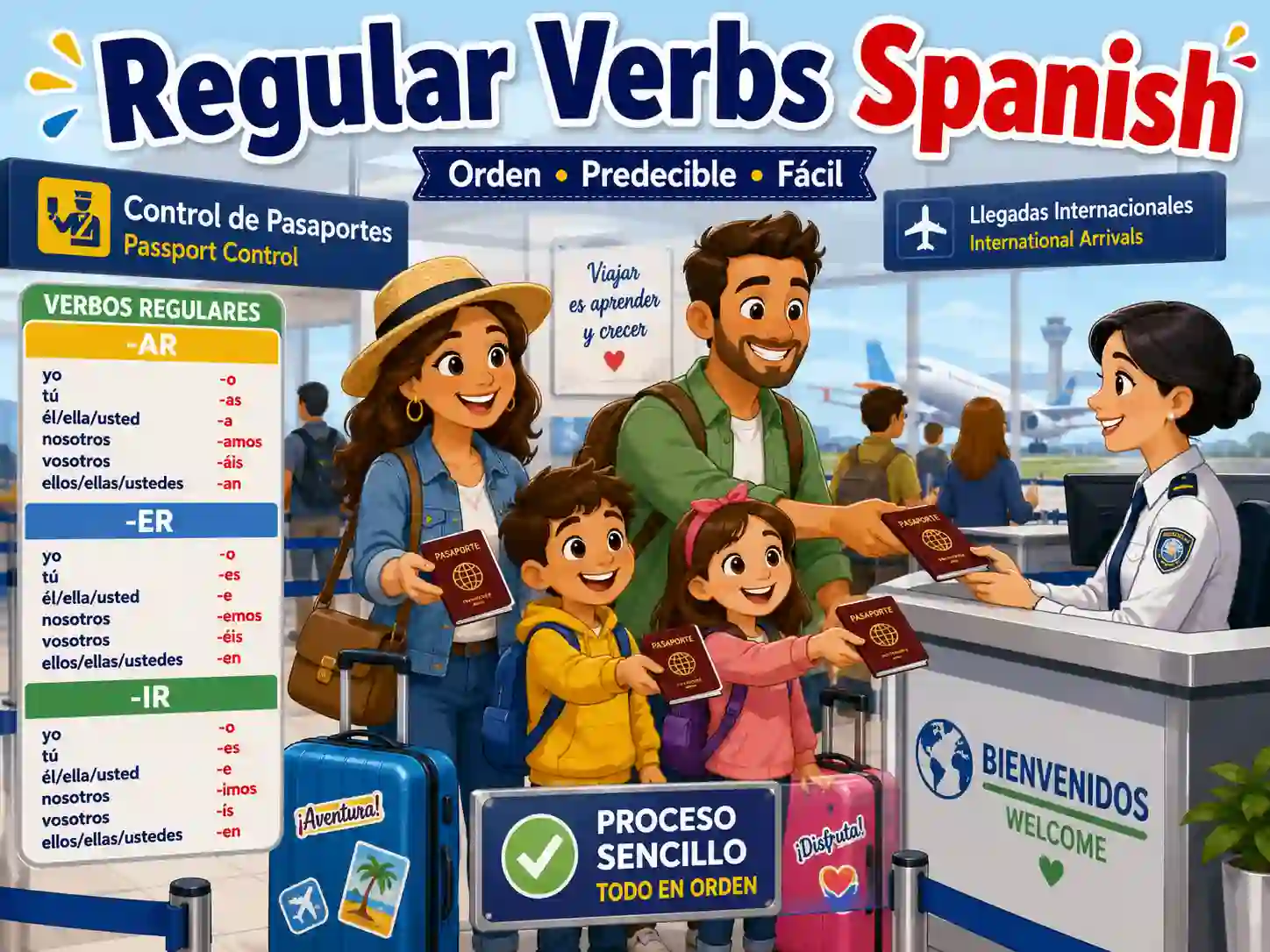
Regular Verbs in Spanish
Connect subject pronouns to predictable -ar, -er and -ir conjugation patterns.
Open lesson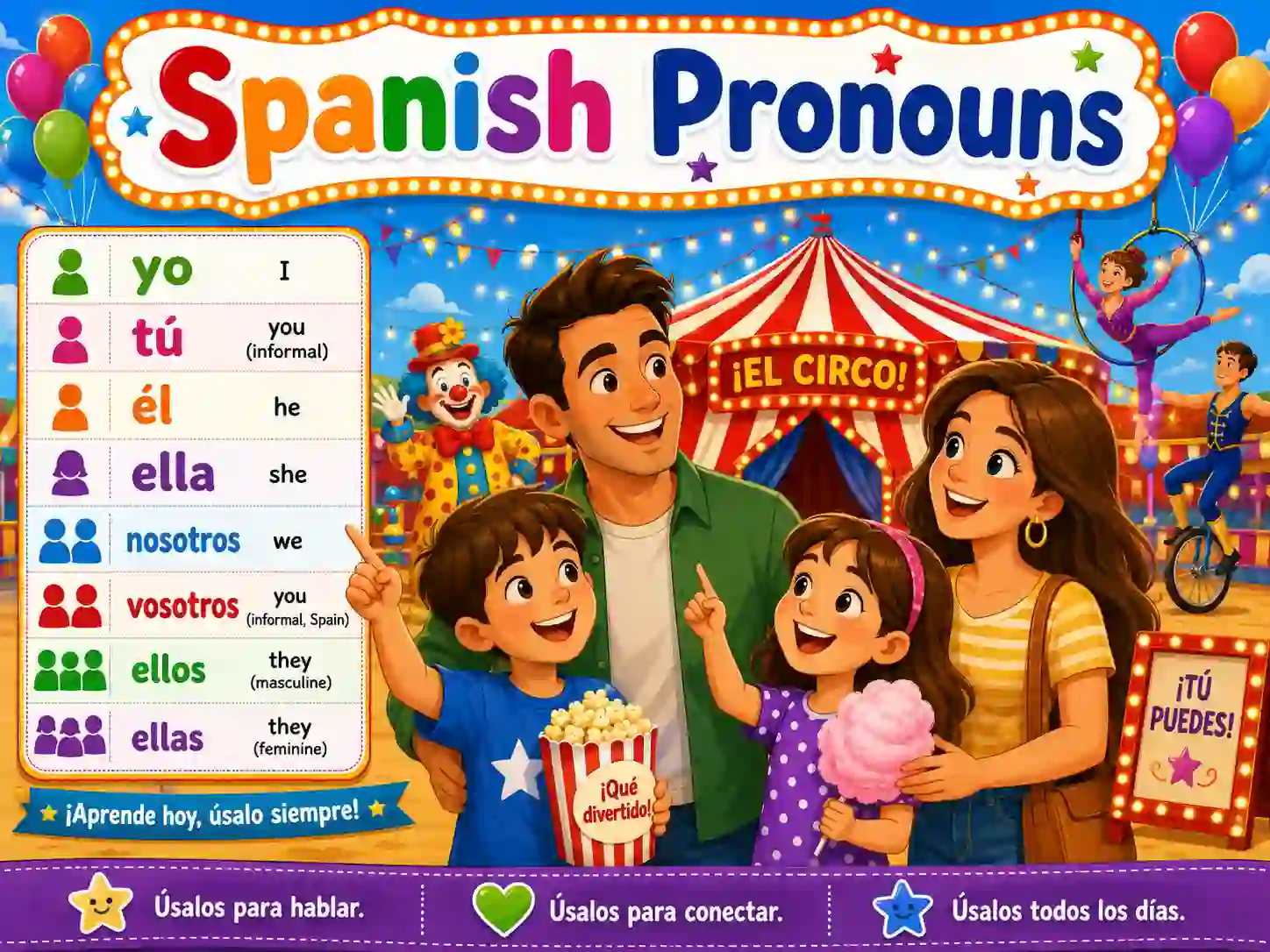
Spanish Pronouns
Return to the complete overview of subject, object, reflexive, possessive and relative pronouns.
Open overviewCommon errors
Common mistakes with Spanish subject pronouns
- Repeating the pronoun too often: Spanish normally omits it when the subject is already clear.
- Confusing tú and tu: tú means “you”; tu means “your”.
- Confusing él and el: él means “he”; el means “the”.
- Using the wrong verb with usted: say usted habla, not usted hablas.
- Ignoring regional use: vos is normal in Argentina and other regions; vosotros is mainly used in Spain.
- Using subject forms after prepositions: say para mí and de ti, not para yo or de tú.
Frequently asked questions
Questions about Spanish subject pronouns
What are Spanish subject pronouns?
Spanish subject pronouns identify who performs the action of the verb. They include yo, tú, vos, él, ella, usted, nosotros, vosotros, ellos and ustedes.
Why does Spanish often omit subject pronouns?
Spanish verb endings usually identify the subject. Hablo español already means “I speak Spanish”, so yo is not normally necessary.
What is the difference between tú, vos and usted?
Tú and vos are informal singular forms used in different regions. Usted is formal and uses a third-person verb form.
What is the difference between vosotros and ustedes?
Vosotros is mainly the informal plural “you” in Spain. Ustedes is the normal plural “you” throughout Latin America.
What is the difference between él and el?
Él with an accent means “he”. El without an accent is the article “the”.
When should I use a Spanish subject pronoun?
Use the pronoun for contrast, emphasis, clarification, formal address or when the subject would otherwise be unclear.
Practice and support
Practise subject pronouns with real verb forms
Subject pronouns become useful when they are connected to complete sentences, regional forms and real conjugation patterns. Personal correction can help with pronoun omission, voseo, formal address and verb agreement.
Spanish Tutoring
Work on subject pronouns, verb forms, homework and individual grammar problems.
Private Spanish Lessons
Practise pronouns, conjugation and natural sentence patterns in personalised lessons.
Spanish Grammar
Continue with verbs, tenses, pronouns, prepositions and sentence structures.

About MundoDele
Spanish learning connected with culture and real life
MundoDele combines clear Spanish grammar explanations with private lessons, tutoring, DELE and SIELE preparation, Business Spanish, cultural context and travel experiences from the Spanish-speaking world.
The grammar guides use practical examples, connected lessons and clear sentence logic to help international learners move from individual rules to confident Spanish use.