
MundoDele Spanish Grammar
Spanish Adverbs with -mente: Formation, Accents and Examples
Learn how Spanish forms adverbs such as claramente, lentamente, rápidamente, fácilmente, naturalmente and cuidadosamente.
Definition
What are Spanish adverbs with -mente?
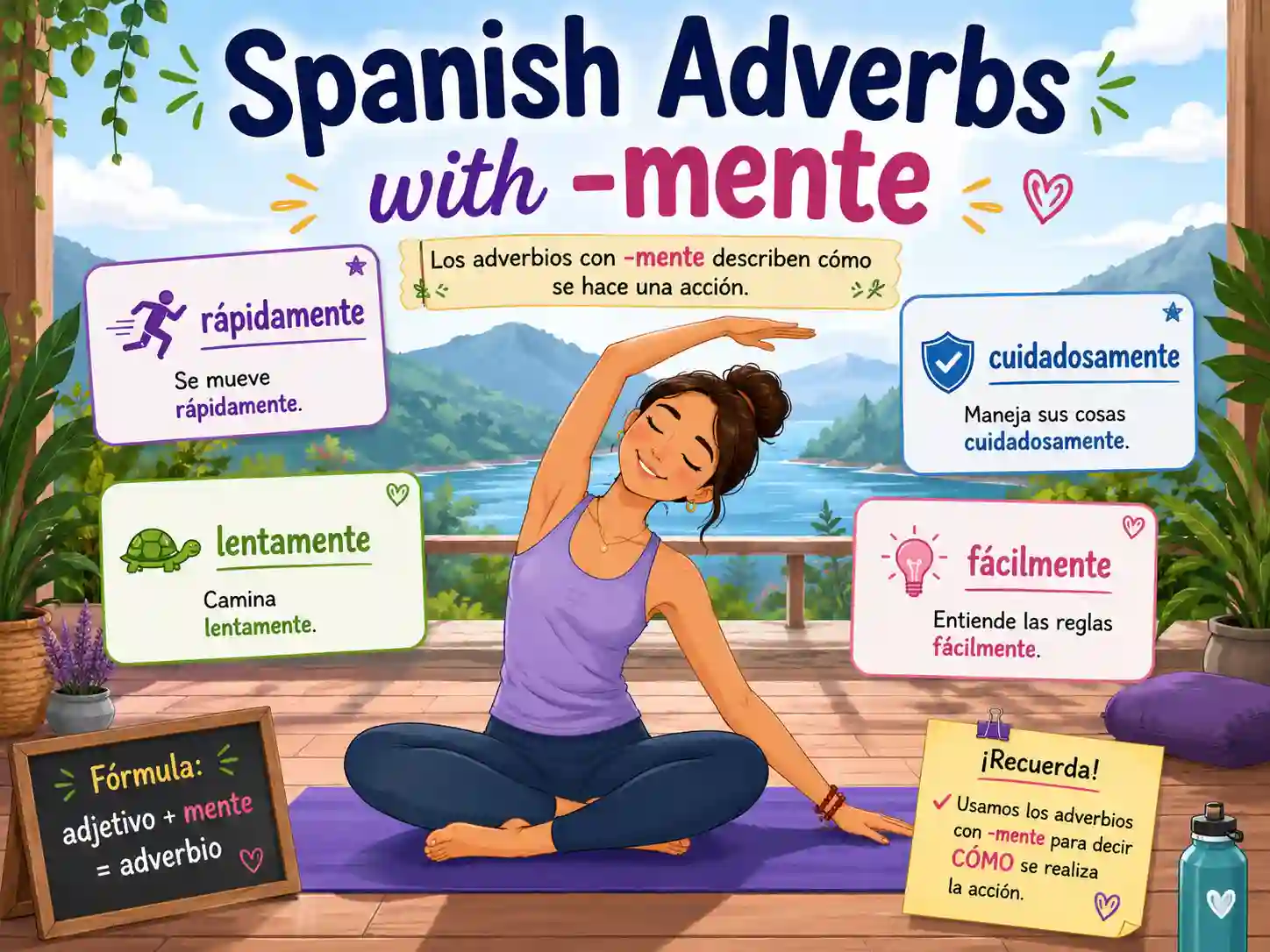
Many Spanish adverbs are formed by adding -mente to an adjective. They often describe how an action happens, but some comment on frequency, probability, viewpoint or the complete sentence.
Habla claramente.
He or she speaks clearly.
Viaja frecuentemente.
He or she travels frequently.
Probablemente llegará tarde.
He or she will probably arrive late.
English often uses the ending “-ly” for a similar purpose, but the correspondence is not exact in every case.
Overview
Spanish adverbs with -mente at a glance
| Adjective | Form used | Adverb | Meaning | Example |
|---|---|---|---|---|
| claro | clara | claramente | clearly | Habla claramente. |
| rápido | rápida | rápidamente | quickly | Respondió rápidamente. |
| lento | lenta | lentamente | slowly | Camina lentamente. |
| cuidadoso | cuidadosa | cuidadosamente | carefully | Lee cuidadosamente. |
| fácil | fácil | fácilmente | easily | Lo entiende fácilmente. |
| frecuente | frecuente | frecuentemente | frequently | Viaja frecuentemente. |
| natural | natural | naturalmente | naturally | Naturalmente, hay excepciones. |
| probable | probable | probablemente | probably | Probablemente vendrá. |
Formation
How to form Spanish adverbs with -mente
Use the feminine form
Change final -o to -a, then add -mente.
claro → clara → claramente
rápido → rápida → rápidamente
lento → lenta → lentamente
Add -mente directly
Adjectives ending in forms such as -e, -l or -z often have the same form for both genders.
frecuente → frecuentemente
natural → naturalmente
feliz → felizmente
The adverb is invariable
The final adverb does not agree with the subject or noun.
Ella habla claramente.
Ellos hablan claramente.
| Adjective type | Step 1 | Step 2 | Final adverb |
|---|---|---|---|
| perfecto | Use feminine singular | perfecta + mente | perfectamente |
| directo | Use feminine singular | directa + mente | directamente |
| honesto | Use feminine singular | honesta + mente | honestamente |
| amable | Keep the one-form adjective | amable + mente | amablemente |
| especial | Keep the one-form adjective | especial + mente | especialmente |
| feliz | Keep the one-form adjective | feliz + mente | felizmente |
Correct:
claro → clara → claramente.
Incorrect:
claromente.
Spelling and pronunciation
Accent marks in Spanish -mente adverbs
When the original adjective has a written accent, the resulting adverb keeps that accent. Adding -mente does not remove it.
| Adjective | Adverb | Meaning | Spelling note |
|---|---|---|---|
| rápido | rápidamente | quickly | The accent on á remains. |
| fácil | fácilmente | easily | The accent on á remains. |
| difícil | difícilmente | hardly, with difficulty | The accent on í remains. |
| común | comúnmente | commonly | The accent on ú remains. |
| último | últimamente | lately | The accent on ú remains. |
Adverbs ending in -mente preserve the stress of the original adjective and also have stress on men in -mente. This helps explain why the adjective’s written accent is retained.
Grammar contrast
Adjective or adverb?
An adjective describes a noun and may change for gender and number. An adverb describes an action, quality, another adverb or complete statement and remains unchanged.
| Adjective phrase | Adverb sentence | Difference |
|---|---|---|
| una explicación clara | Explica claramente. | Clara describes the explanation; claramente describes how someone explains. |
| una respuesta rápida | Responde rápidamente. | Rápida describes the answer; rápidamente describes the action. |
| una decisión cuidadosa | Actúa cuidadosamente. | Cuidadosa describes the decision; cuidadosamente describes how someone acts. |
| un cambio frecuente | Cambia frecuentemente. | Frecuente describes the change; frecuentemente describes how often it changes. |
Review: Spanish Adjectives .
Word order
Where do Spanish -mente adverbs go?
The natural position depends on what the adverb modifies. Manner adverbs often follow the verb or verb phrase. Sentence adverbs often appear at the beginning.
| Function | Position | Spanish example | English meaning |
|---|---|---|---|
| Manner | After the verb | Habla claramente. | He or she speaks clearly. |
| Manner | After the verb phrase | Ha respondido correctamente. | He or she has answered correctly. |
| Sentence comment | Beginning | Naturalmente, hay excepciones. | Naturally, there are exceptions. |
| Probability | Beginning or before verb phrase | Probablemente llegará mañana. | He or she will probably arrive tomorrow. |
| Frequency | Beginning or near the verb | Normalmente trabajo en casa. | I normally work at home. |
| Emphasis | Before the element modified | Es especialmente importante. | It is especially important. |
Probablemente, llegará mañana comments on the complete statement. Other placements may highlight a particular part of the sentence.
Continue with: Position of Adverbs in Spanish .
Coordination
Two or more -mente adverbs together
When two or more adverbs ending in -mente are connected with y or another conjunction, Spanish often adds -mente only to the final item.
| Full repeated form | Common coordinated form | English meaning |
|---|---|---|
| claramente y lentamente | clara y lentamente | clearly and slowly |
| rápidamente y correctamente | rápida y correctamente | quickly and correctly |
| seriosamente y cuidadosamente | seria y cuidadosamente | seriously and carefully |
| tranquilamente pero firmemente | tranquila pero firmemente | calmly but firmly |
In Habla clara y lentamente, clara functions as part of the coordinated adverbial expression. It does not describe a feminine noun.
Important exceptions
Not every Spanish adverb ends in -mente
Many of the most frequent Spanish adverbs are independent words rather than adjective forms ending in -mente.
| Type | Examples | Meaning |
|---|---|---|
| Manner | bien, mal | well, badly |
| Quantity and degree | muy, mucho, poco, bastante | very, much, little, quite |
| Time | hoy, ayer, mañana, ahora | today, yesterday, tomorrow, now |
| Place | aquí, ahí, allí, cerca, lejos | here, there, nearby, far away |
| Frequency | siempre, nunca, a veces | always, never, sometimes |
Habla bien. — He or she speaks well.
Trabaja mal. — He or she works badly.
Forms such as buenamente and malamente exist in particular contexts, but they are not the general equivalents of “well” and “badly”.
Natural alternatives
Short adverbs and phrases instead of -mente
Spanish often allows a shorter adverb or a phrase with con, de manera or de forma. These alternatives can make speech and writing sound less repetitive.
| -mente adverb | Possible alternative | Example |
|---|---|---|
| cuidadosamente | con cuidado | Lee con cuidado. |
| claramente | con claridad | Explica con claridad. |
| rápidamente | rápido | Responde rápido. |
| lentamente | despacio | Habla despacio. |
| amablemente | de manera amable | Respondió de manera amable. |
| directamente | de forma directa | Contestó de forma directa. |
Actúa cuidadosamente and Actúa con cuidado both mean “He or she acts carefully”. The second form may sound lighter in some contexts.
Meaning and usage
Some -mente adverbs have specialised meanings
The meaning of an adverb cannot always be calculated by translating the adjective and adding “-ly”. Some forms have developed conventional meanings.
| Adverb | Common meaning | Example | Important note |
|---|---|---|---|
| actualmente | currently | Actualmente vive en Madrid. | It does not normally mean “actually”. |
| eventualmente | possibly or occasionally, depending on region | Eventualmente podría cambiar. | It is not always equivalent to English “eventually”. |
| difícilmente | hardly, unlikely to | Difícilmente llegará a tiempo. | Often expresses low probability. |
| últimamente | lately | Últimamente trabajo mucho. | Refers to the recent period. |
| finalmente | finally, in the end | Finalmente aceptó. | Often marks the final result. |
Comparison
Comparing actions with -mente adverbs
Adverbs with -mente can appear in comparison structures with más, menos and tan.
| Pattern | Spanish example | English meaning |
|---|---|---|
| más + adverb + que | Habla más claramente que antes. | He or she speaks more clearly than before. |
| menos + adverb + que | Trabaja menos cuidadosamente que Ana. | He or she works less carefully than Ana. |
| tan + adverb + como | Explica tan lentamente como el profesor. | He or she explains as slowly as the teacher. |
| mucho más + adverb | Ahora responde mucho más rápidamente. | Now he or she answers much more quickly. |
Continue with: Spanish Comparison .
Useful vocabulary
Common Spanish adverbs ending in -mente
| Spanish adverb | English meaning | Example sentence |
|---|---|---|
| absolutamente | absolutely | Es absolutamente necesario. |
| amablemente | kindly | Respondió amablemente. |
| claramente | clearly | Explica claramente. |
| correctamente | correctly | Escribió correctamente. |
| cuidadosamente | carefully | Revisa el documento cuidadosamente. |
| especialmente | especially | Es especialmente importante. |
| fácilmente | easily | Lo aprende fácilmente. |
| frecuentemente | frequently | Viaja frecuentemente. |
| lentamente | slowly | Habla lentamente. |
| normalmente | normally | Normalmente trabajo en casa. |
| probablemente | probably | Probablemente llegará tarde. |
| rápidamente | quickly | Contestó rápidamente. |
| recientemente | recently | Se mudó recientemente. |
| realmente | really | Es realmente interesante. |
| simplemente | simply | Simplemente no lo sé. |
Exercises
Practice Spanish adverbs with -mente
Form the adverb
- claro
- rápido
- fácil
- natural
- cuidadoso
Show answers
1. claramente
2. rápidamente
3. fácilmente
4. naturalmente
5. cuidadosamente
Choose adjective or adverb
-
Es una explicación ___.
clara / claramente -
Explica ___.
clara / claramente -
Es una respuesta ___.
rápida / rápidamente -
Respondió ___.
rápida / rápidamente
Show answers
1. clara
2. claramente
3. rápida
4. rápidamente
Add the accent where necessary
- rapidamente
- facilmente
- naturalmente
- dificilmente
- comunmente
Show answers
1. rápidamente
2. fácilmente
3. naturalmente
4. difícilmente
5. comúnmente
Coordinate the adverbs
- claramente y lentamente
- rápidamente y correctamente
- seriosamente y cuidadosamente
- tranquilamente pero firmemente
Show answers
1. clara y lentamente
2. rápida y correctamente
3. seria y cuidadosamente
4. tranquila pero firmemente
Correct the mistake
- Habla claromente.
- Ellas hablan claramentes.
- Respondió rapidamente.
- Es una explicación claramente.
Show answers
1. Habla claramente.
2. Ellas hablan claramente.
3. Respondió rápidamente.
4. Es una explicación clara.
Replace the adverb with a phrase
- Actúa cuidadosamente.
- Explica claramente.
- Respondió amablemente.
- Contestó directamente.
Show possible answers
1. Actúa con cuidado.
2. Explica con claridad.
3. Respondió de manera amable.
4. Contestó de forma directa.
Continue learning
Related Spanish grammar lessons
Spanish Adverbs
Review adverbs of time, place, manner, quantity, frequency, doubt, affirmation and negation.
Open lesson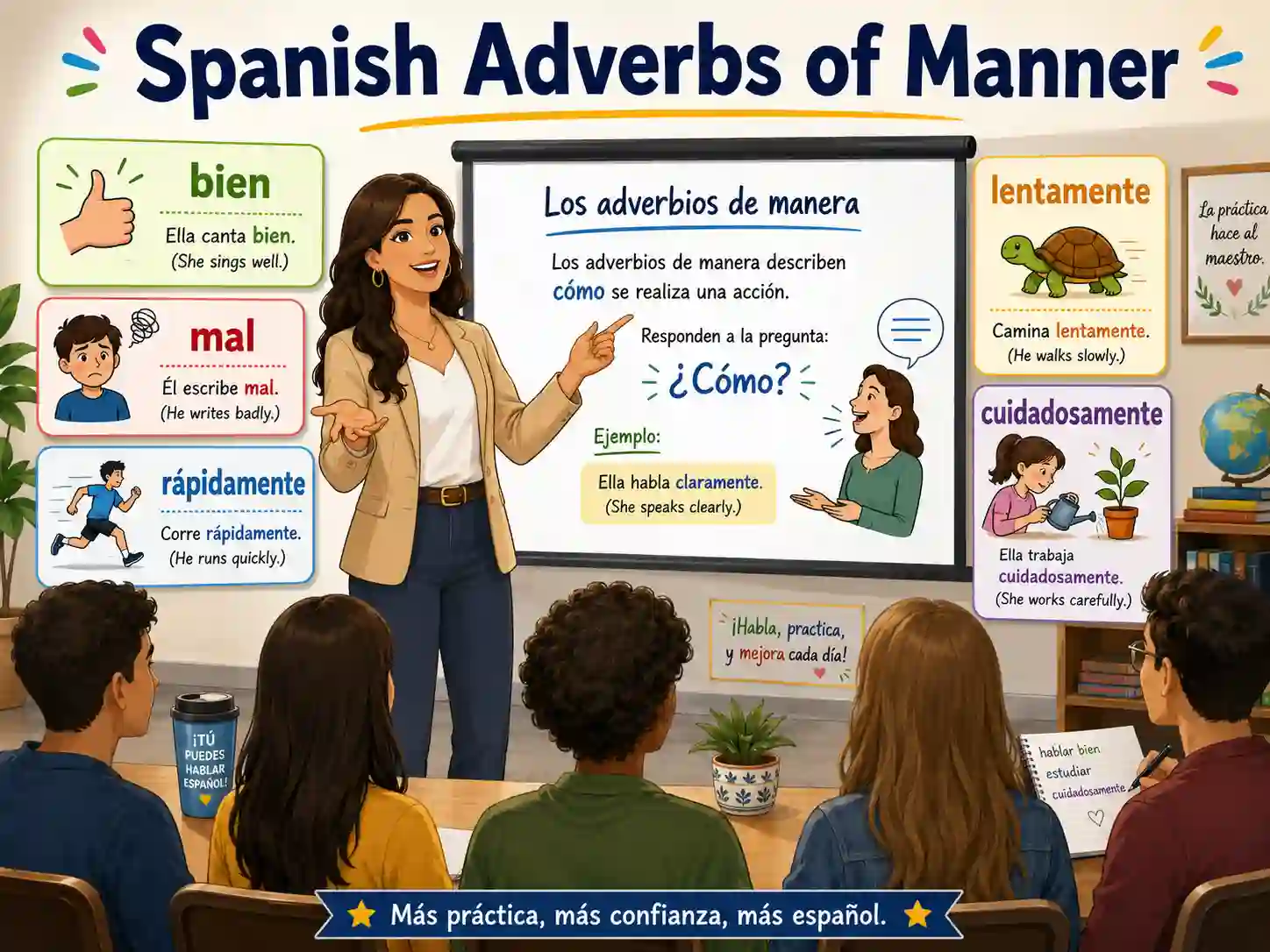
Adverbs of Manner
Learn how Spanish describes the way an action is performed with short forms, phrases and -mente adverbs.
Open lesson
Position of Adverbs
Learn where manner, frequency, quantity and sentence adverbs appear.
Open lesson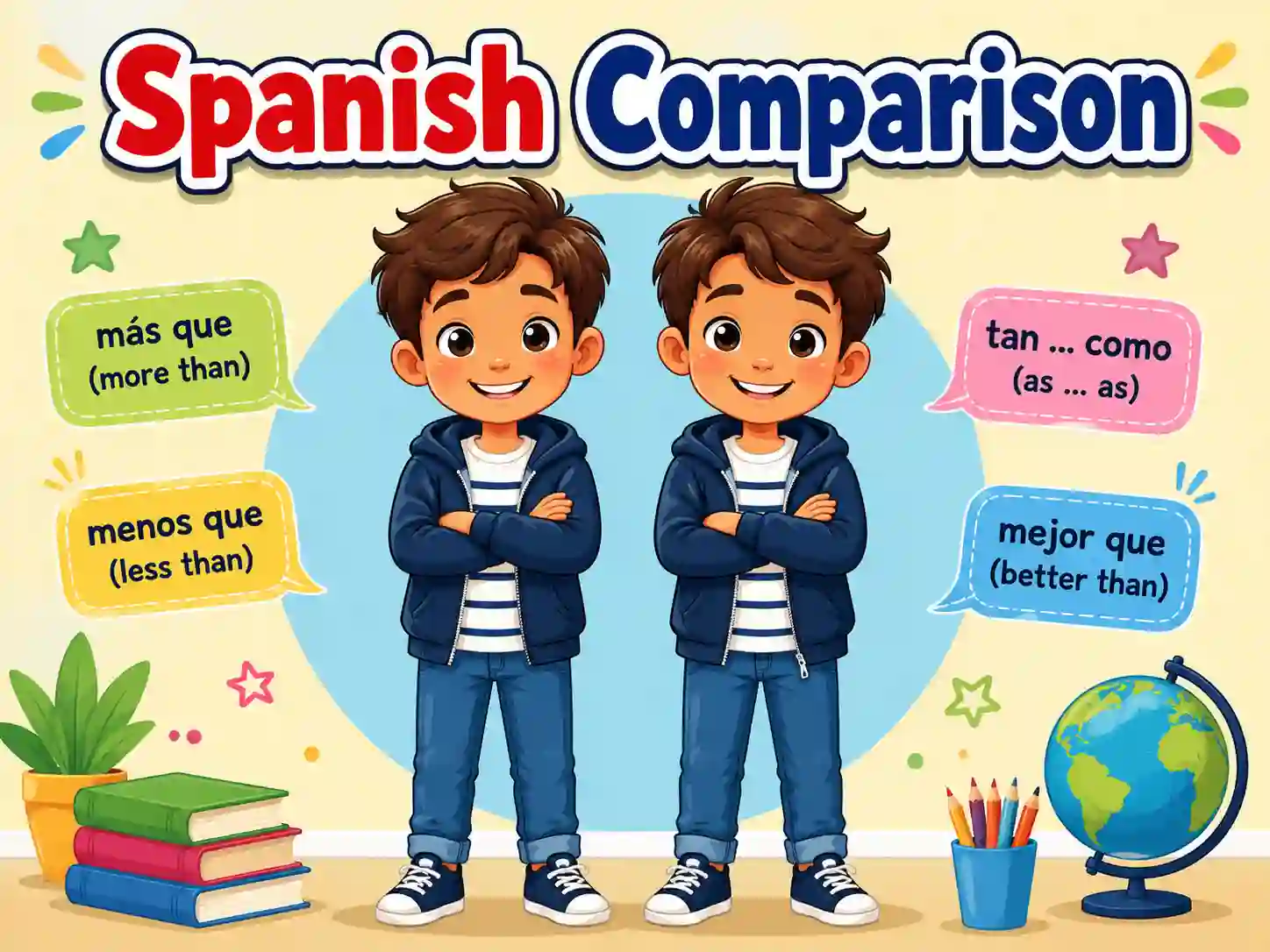
Spanish Comparison
Practise más claramente que, menos rápidamente que and tan cuidadosamente como.
Open lessonCommon errors
Common mistakes with Spanish -mente adverbs
- Using the masculine adjective form: say claramente, not claromente.
- Forgetting a written accent: write rápidamente, fácilmente and difícilmente.
- Making the adverb agree: use claramente with masculine, feminine, singular and plural subjects.
- Using an adverb to describe a noun: say una explicación clara, not una explicación claramente.
- Assuming every adjective forms a common adverb: use bien for “well” and mal for “badly”.
- Repeating -mente unnecessarily: coordinated forms such as clara y lentamente are common.
- Overusing long forms: natural Spanish often alternates cuidadosamente with con cuidado.
- Translating false friends literally: actualmente means “currently”, not normally “actually”.
Frequently asked questions
Questions about Spanish adverbs with -mente
How do you form Spanish adverbs with -mente?
Use the feminine singular form of the adjective and add -mente: claro → clara → claramente. With one-form adjectives, add it directly: fácil → fácilmente.
Do -mente adverbs change for gender or number?
No. Once formed, they remain unchanged: ella habla claramente and ellos hablan claramente.
Do -mente adverbs keep accent marks?
Yes. If the adjective has a written accent, the adverb keeps it: rápido → rápidamente and fácil → fácilmente.
Where do -mente adverbs go in Spanish?
Manner adverbs commonly follow the verb: Habla claramente. Sentence adverbs may appear at the beginning: Probablemente llegará mañana.
How do you use two -mente adverbs together?
Spanish often places -mente only on the final adverb: clara y lentamente.
Do all adjectives form natural -mente adverbs?
No. Some meanings use an established short adverb. Bueno normally corresponds to bien, and malo normally corresponds to mal.
Practice and support
Practise Spanish adverbs in complete sentences
Adverbs with -mente become easier when you practise their formation, spelling, word order and contrast with adjectives.
Spanish Tutoring
Work on adjective forms, adverb formation, accents and sentence position.
Private Spanish Lessons
Practise natural adverb use through conversation, writing and personalised exercises.
Intensive Spanish Course
Combine grammar with structured speaking, listening and sentence-building activities.

About MundoDele
Spanish learning for education, work and real communication
MundoDele connects online Spanish courses, DELE preparation, Business Spanish and cultural context into a personal Spanish learning platform.
The grammar guides explain Spanish with practical examples, clear comparisons and complete sentences.