
MundoDele Spanish Grammar
Position of Adverbs in Spanish: Word Order and Examples
Learn where Spanish adverbs appear with verbs, objects, adjectives, other adverbs, negation, frequency expressions, time phrases and complete sentences.

Basic principle
What determines the position of a Spanish adverb?
Spanish does not use one universal position for every adverb. The natural position depends on what the adverb modifies and which information the speaker wants to highlight.
Habla claramente.
The adverb describes how someone speaks.
Es muy interesante.
The adverb changes the degree of the adjective.
Probablemente llegará mañana.
The adverb comments on the complete statement.
Overview
Position of Spanish adverbs at a glance
| Function | Usual position | Spanish example | English meaning |
|---|---|---|---|
| Manner | After the verb or its object | Habla claramente. | He or she speaks clearly. |
| Manner with an object | Often after the object | Explica la regla claramente. | He or she explains the rule clearly. |
| Degree before adjective | Immediately before the adjective | muy importante | very important |
| Degree before adverb | Immediately before the other adverb | muy bien | very well |
| Negation | Before the conjugated verb | No entiendo. | I do not understand. |
| Frequency | Beginning, before verb or after phrase | Siempre estudio aquí. | I always study here. |
| Time | Often beginning or end | Hoy trabajo. / Trabajo hoy. | I work today. |
| Place | Often after the verb phrase or at beginning | Trabajo aquí. | I work here. |
| Sentence comment | Often beginning | Probablemente llegará tarde. | He or she will probably arrive late. |
Verbs and objects
Manner adverbs after verbs and objects
Adverbs of manner explain how an action happens. Without a direct object, they commonly follow the verb. When the verb has a short direct object, the adverb often follows the complete verb-and-object group.
| Structure | Spanish example | English meaning |
|---|---|---|
| verb + adverb | Habla lentamente. | He or she speaks slowly. |
| verb + adverb | Respondió claramente. | He or she answered clearly. |
| verb + object + adverb | Explica la regla claramente. | He or she explains the rule clearly. |
| verb + object + adverb | Lee el documento cuidadosamente. | He or she reads the document carefully. |
| verb phrase + adverb | Ha respondido correctamente. | He or she has answered correctly. |
The neutral order is usually Explica la regla claramente, rather than placing the manner adverb between the verb and its object.
Spanish word order is flexible. An adverb can move when the speaker deliberately highlights how the action is performed, but the verb–object–adverb pattern is a safe neutral choice.
Degree and intensity
Adverbs before adjectives and other adverbs
Degree adverbs such as muy, bastante, demasiado, poco, tan, más and menos normally appear directly before the word they modify.
Before an adjective
muy importante — very important
bastante difícil — quite difficult
demasiado caro — too expensive
poco claro — not very clear
Before another adverb
muy bien — very well
bastante rápido — quite quickly
demasiado tarde — too late
más claramente — more clearly
| Phrase | Complete sentence | Meaning |
|---|---|---|
| muy interesante | El libro es muy interesante. | The book is very interesting. |
| bastante difícil | El ejercicio es bastante difícil. | The exercise is quite difficult. |
| muy bien | Habla español muy bien. | He or she speaks Spanish very well. |
| demasiado lentamente | Habla demasiado lentamente. | He or she speaks too slowly. |
| tan claramente como | Explica tan claramente como Ana. | He or she explains as clearly as Ana. |
Correct: muy interesante.
Incorrect in neutral Spanish:
interesante muy.
Negation
Position of no and other negative words
The basic negative word no normally comes before the conjugated verb. Object and reflexive pronouns remain between no and the verb.
| Structure | Spanish example | English meaning |
|---|---|---|
| no + verb | No entiendo. | I do not understand. |
| no + object pronoun + verb | No lo entiendo. | I do not understand it. |
| no + reflexive pronoun + verb | No me acuerdo. | I do not remember. |
| no + auxiliary + participle | No he terminado. | I have not finished. |
| nunca + verb | Nunca trabajo los domingos. | I never work on Sundays. |
| no + verb + nunca | No trabajo nunca los domingos. | I never work on Sundays. |
| ya no + verb | Ya no vivo allí. | I no longer live there. |
before the verb: Nunca voy
after the verb: No voy nunca
Correct: No entiendo.
Incorrect: Entiendo no.
Frequency
Position of siempre, nunca, normalmente and a veces
Frequency adverbs are relatively flexible. Their position depends on the individual expression, the length of the sentence and the information being emphasised.
| Position | Spanish example | Typical effect |
|---|---|---|
| Beginning | Normalmente trabajo en casa. | Frames the complete statement. |
| Before the conjugated verb | Siempre estudio por la mañana. | Common and neutral with siempre. |
| After the verb phrase | Trabajo en casa normalmente. | Possible, often with end focus. |
| Beginning with a phrase | A veces trabajo los sábados. | Very common position for a veces. |
| Before the verb | Nunca llego tarde. | No additional no is needed. |
| After the verb with no | No llego tarde nunca. | Possible with negative reinforcement. |
A veces trabajo los sábados is generally more neutral than placing a veces at the very end of a long sentence. Position affects rhythm and focus even when the basic meaning remains similar.
Time and place
Time and place adverbs at the beginning or end
Time and place expressions commonly appear at the beginning or end of a sentence. Beginning position establishes the setting. End position often presents the information more neutrally.
Beginning position
The adverb becomes the starting point or topic.
Hoy trabajo desde casa.
Mañana viajamos a Madrid.
Aquí vivimos tranquilos.
End position
The sentence begins with the action or subject.
Trabajo desde casa hoy.
Viajamos a Madrid mañana.
Vivimos tranquilos aquí.
| Type | Beginning | End |
|---|---|---|
| Time | Hoy estudio español. | Estudio español hoy. |
| Time | Después hablamos. | Hablamos después. |
| Place | Aquí trabajo mejor. | Trabajo mejor aquí. |
| Place | Allí vive mi hermana. | Mi hermana vive allí. |
The difference is often information structure: beginning position sets the scene, while end position supplies the time or place after the main action.
Complete sentence
Sentence adverbs and commas
Some adverbs express probability, evaluation, viewpoint or the speaker’s attitude toward the complete sentence. They commonly appear at the beginning.
| Sentence adverb | Example | Function |
|---|---|---|
| probablemente | Probablemente llegará mañana. | Expresses probability. |
| desgraciadamente | Desgraciadamente, no tenemos tiempo. | Evaluates the situation negatively. |
| naturalmente | Naturalmente, hay excepciones. | Presents the statement as expected. |
| generalmente | Generalmente, estudiamos por la mañana. | Frames the statement as a general tendency. |
| sinceramente | Sinceramente, no lo sé. | Expresses the speaker’s viewpoint. |
Introductory comments such as Desgraciadamente, ... and Sinceramente, ... are commonly followed by a comma.
A closely integrated probability adverb such as Probablemente llegará mañana does not always require one.
Verb phrases
Adverbs with compound and progressive verb forms
With compound forms such as haber + participle and progressive forms such as estar + gerund, learners should normally keep the verb unit together.
| Verb form | Spanish example | English meaning |
|---|---|---|
| ya + haber + participle | Ya he terminado. | I have already finished. |
| haber + participle + ya | He terminado ya. | I have finished already. |
| no + haber + participle | No he entendido bien. | I have not understood well. |
| ahora + estar + gerund | Ahora estoy trabajando. | Now I am working. |
| estar + gerund + ahora | Estoy trabajando ahora. | I am working now. |
| verb phrase + manner adverb | Ha explicado la situación claramente. | He or she has explained the situation clearly. |
Pronouns and infinitives
Adverbs with object pronouns and infinitive phrases
Object and reflexive pronouns have their own fixed positions. An adverb does not normally separate a pre-verbal pronoun from its conjugated verb.
| Structure | Spanish example | English meaning |
|---|---|---|
| no + pronoun + verb | No lo entiendo bien. | I do not understand it well. |
| pronoun + verb + adverb | Me explicó todo claramente. | He or she explained everything clearly to me. |
| verb + infinitive + adverb | Quiero hablar claramente. | I want to speak clearly. |
| adverb + conjugated verb + infinitive | Siempre intento hablar claramente. | I always try to speak clearly. |
| verb + attached pronoun + adverb | Quiero explicártelo claramente. | I want to explain it clearly to you. |
Correct:
No lo entiendo bien.
Do not place the manner adverb between
lo and entiendo.
Questions
Adverb position in Spanish questions
Questions generally follow the same adverb-position rules as statements. The interrogative word comes first, while manner, time and frequency adverbs keep their normal relationship with the verb phrase.
| Question | Meaning | Position note |
|---|---|---|
| ¿Hablas bien español? | Do you speak Spanish well? | Bien describes the manner of speaking. |
| ¿Cuándo estudias normalmente? | When do you normally study? | The frequency adverb follows the verb. |
| ¿Por qué no vienes mañana? | Why are you not coming tomorrow? | No precedes the conjugated verb. |
| ¿Hoy trabajas? | Are you working today? | The time expression receives initial focus. |
| ¿Trabajas hoy? | Are you working today? | The action is presented first. |
| ¿Dónde vive actualmente? | Where does he or she currently live? | The adverb follows the main verb. |
Focus and emphasis
How position changes the focus
Moving an adverb does not always change the basic factual meaning, but it can change which part of the sentence feels most important.
Adverb first
Hoy trabajo desde casa.
Today, I am working from home.
The sentence begins by establishing the time.
Adverb last
Trabajo desde casa hoy.
I am working from home today.
The action is introduced first; the time is supplied at the end.
| Sentence | Likely focus |
|---|---|
| Mañana hablamos del problema. | The time is established first. |
| Hablamos del problema mañana. | The planned action is introduced first. |
| Probablemente Ana llegará tarde. | The probability frames the statement. |
| Ana llegará probablemente tarde. | Possible, but less neutral and more marked. |
| Aquí trabajamos mejor. | The place is contrasted or highlighted. |
| Trabajamos mejor aquí. | The comparison or action is introduced first. |
Exercises
Practice Spanish adverb position
Put the adverb in a neutral position
- Habla español. (claramente)
- Explica la regla. (cuidadosamente)
- El ejercicio es difícil. (bastante)
- Trabaja. (no)
Show answers
1. Habla español claramente.
2. Explica la regla cuidadosamente.
3. El ejercicio es bastante difícil.
4. No trabaja.
Choose the correct order
- muy interesante / interesante muy
- No lo entiendo / Lo no entiendo
- Habla muy bien / Habla bien muy
- Ya no vive aquí / No ya vive aquí
Show answers
1. muy interesante
2. No lo entiendo
3. Habla muy bien
4. Ya no vive aquí
Place the time expression
- ___ estudio español. (hoy)
- Estudio español ___. (hoy)
- ___ viajamos a Madrid. (mañana)
- Viajamos a Madrid ___. (mañana)
Show answers
1. Hoy estudio español.
2. Estudio español hoy.
3. Mañana viajamos a Madrid.
4. Viajamos a Madrid mañana.
Both beginning and end positions are possible.
Correct the sentence
- Entiendo no la pregunta.
- Es interesante muy.
- No nunca trabajo aquí.
- Explica claramente la regla.
Show answers
1. No entiendo la pregunta.
2. Es muy interesante.
3. Nunca trabajo aquí. or
No trabajo aquí nunca.
4. A more neutral order is
Explica la regla claramente.
Keep the verb phrase together
- He claramente explicado la situación.
- Estoy ahora trabajando.
- No bien he entendido.
- Ha cuidadosamente leído el documento.
Show possible answers
1. He explicado la situación claramente.
2. Ahora estoy trabajando. or
Estoy trabajando ahora.
3. No he entendido bien.
4. Ha leído el documento cuidadosamente.
Translate into Spanish
- She speaks very clearly.
- I never work on Sundays.
- Today we are studying at home.
- Unfortunately, we do not have time.
Show possible answers
1. Habla muy claramente.
2. Nunca trabajo los domingos.
3. Hoy estudiamos en casa.
4. Desgraciadamente, no tenemos tiempo.
Continue learning
Related Spanish adverb lessons

Spanish Adverbs
Review the main adverb types and how they modify verbs, adjectives, adverbs and sentences.
Open lesson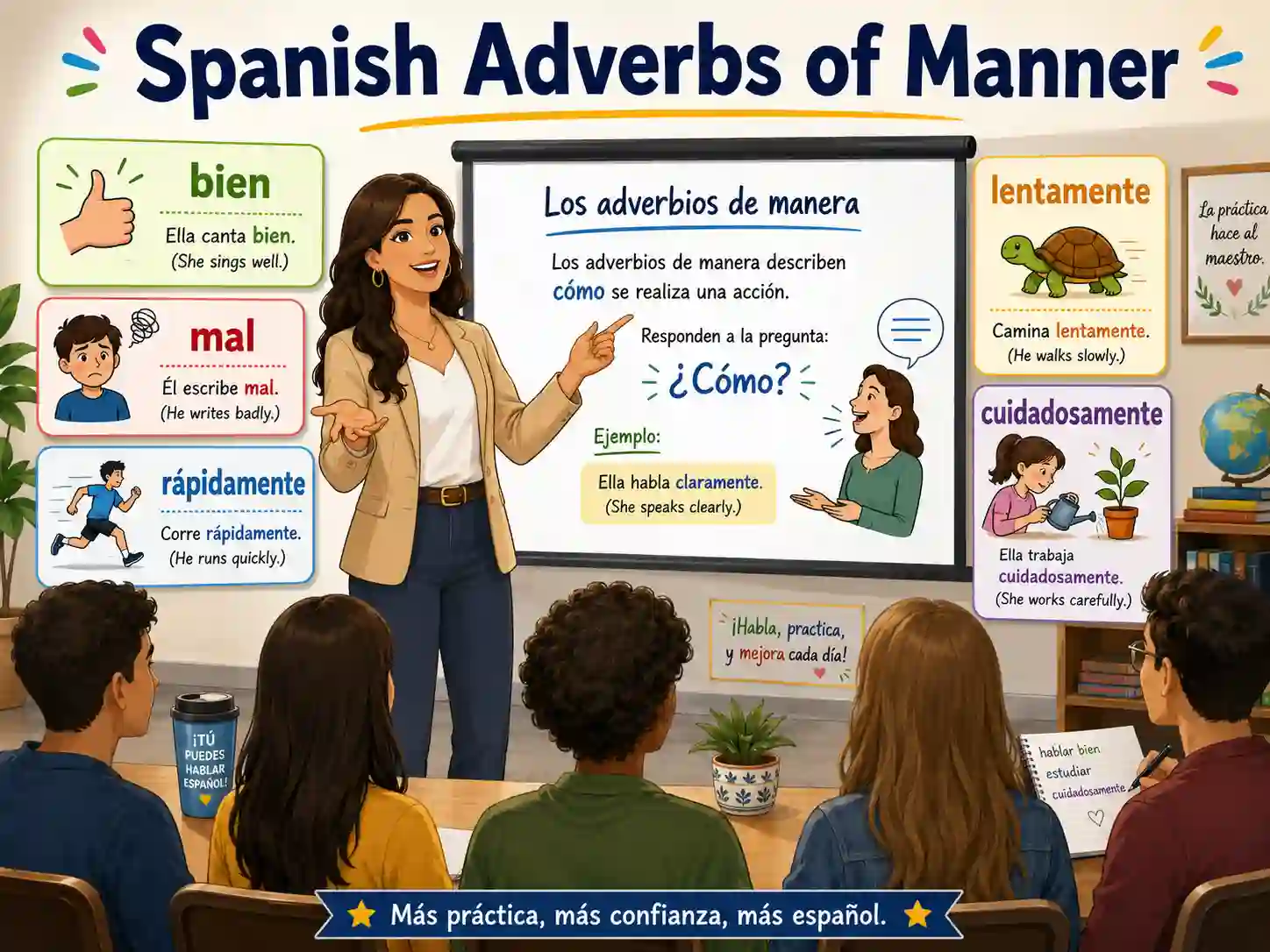
Adverbs of Manner
Learn bien, mal, despacio, rápidamente and other expressions of manner.
Open lesson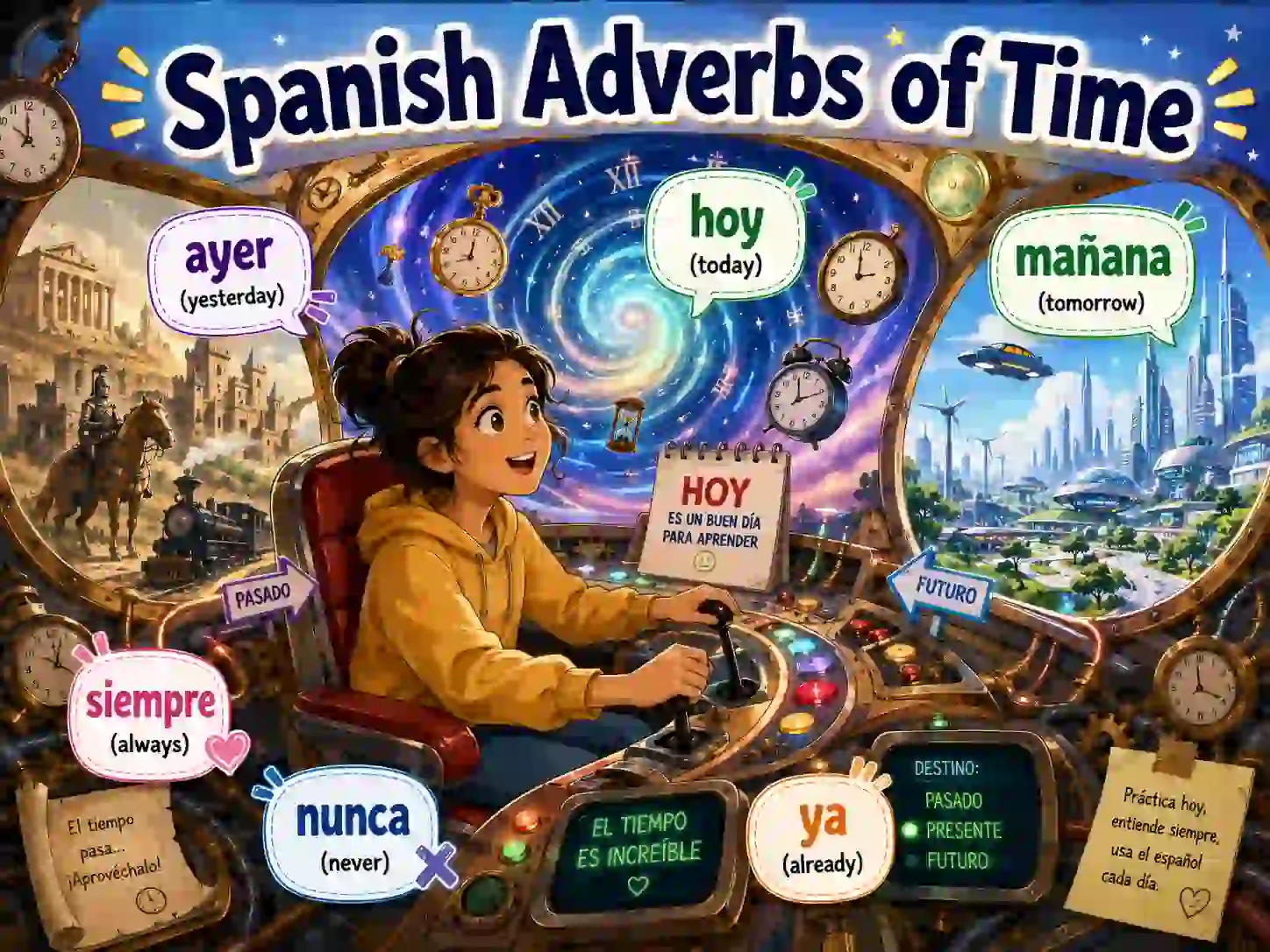
Adverbs of Time
Learn how hoy, mañana, ahora, ya and todavía work in sentences.
Open lesson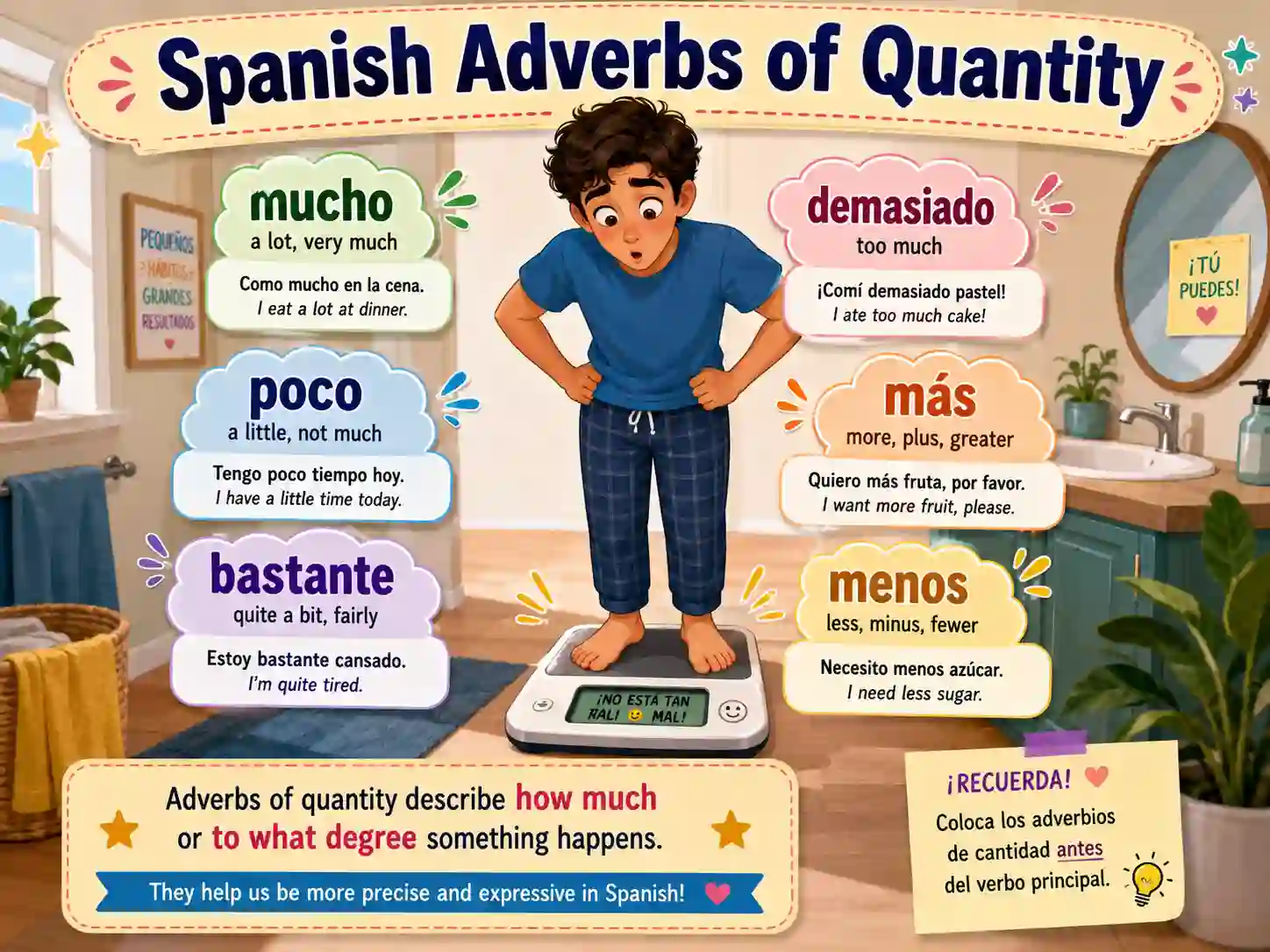
Adverbs of Quantity
Learn why muy, bastante, demasiado, más and menos come before the words they modify.
Open lessonCommon errors
Common mistakes with Spanish adverb position
- Putting no after the verb: say No entiendo, not Entiendo no.
- Putting a degree adverb after an adjective: say muy interesante, not interesante muy.
- Separating a pronoun from the conjugated verb: say No lo entiendo bien.
- Splitting compound verb forms unnecessarily: prefer Ha explicado la situación claramente.
- Putting manner adverbs between a verb and its short object: the neutral pattern is often Explica la regla claramente.
- Using no before nunca when nunca already comes first: say Nunca voy or No voy nunca.
- Assuming flexible means identical: Hoy estudio and Estudio hoy are both correct, but they organise the information differently.
- Adding commas mechanically: introductory sentence comments often take commas, but closely integrated adverbs do not always need one.
Frequently asked questions
Questions about Spanish adverb position
Where do adverbs go in Spanish?
Manner adverbs often follow the verb or its object, degree adverbs precede adjectives and other adverbs, no precedes the conjugated verb, and time or sentence adverbs often appear at the beginning or end.
Do Spanish adverbs go before or after the verb?
Many manner adverbs go after the verb: Habla claramente. Frequency and sentence adverbs may also appear before the verb or at the beginning.
Where does no go in Spanish?
No normally goes before the conjugated verb. Pronouns remain between no and the verb: No lo entiendo.
Where does muy go in Spanish?
Muy goes directly before an adjective or adverb: muy interesante, muy bien and muy rápidamente.
Can Spanish time adverbs move?
Yes. Hoy estudio español and Estudio español hoy are both possible. The position changes the focus and rhythm.
Where do frequency adverbs go in Spanish?
They can appear at the beginning, before the conjugated verb or after the verb phrase. The natural position depends on the expression and context.
Practice and support
Practise Spanish word order in complete sentences
Adverb position becomes easier when you practise manner, degree, frequency, negation and time expressions inside complete sentences.
Spanish Tutoring
Work on word order, negation, sentence focus and individual grammar difficulties.
Private Spanish Lessons
Practise natural adverb placement through speaking, writing and personalised exercises.
Intensive Spanish Course
Combine grammar with structured speaking, listening and sentence-building activities.

About MundoDele
Spanish learning for education, work and real communication
MundoDele connects online Spanish courses, DELE preparation, Business Spanish and cultural context into a personal Spanish learning platform.
The grammar guides explain Spanish with practical examples, clear comparisons and complete sentences.