
MundoDele Spanish Grammar
Spanish Adverbs of Manner: Bien, Mal, Así and -mente
Learn how Spanish describes the way an action happens with bien, mal, así, despacio, rápido, claramente, lentamente, cuidadosamente and expressions such as con cuidado.
Definition
What are Spanish adverbs of manner?
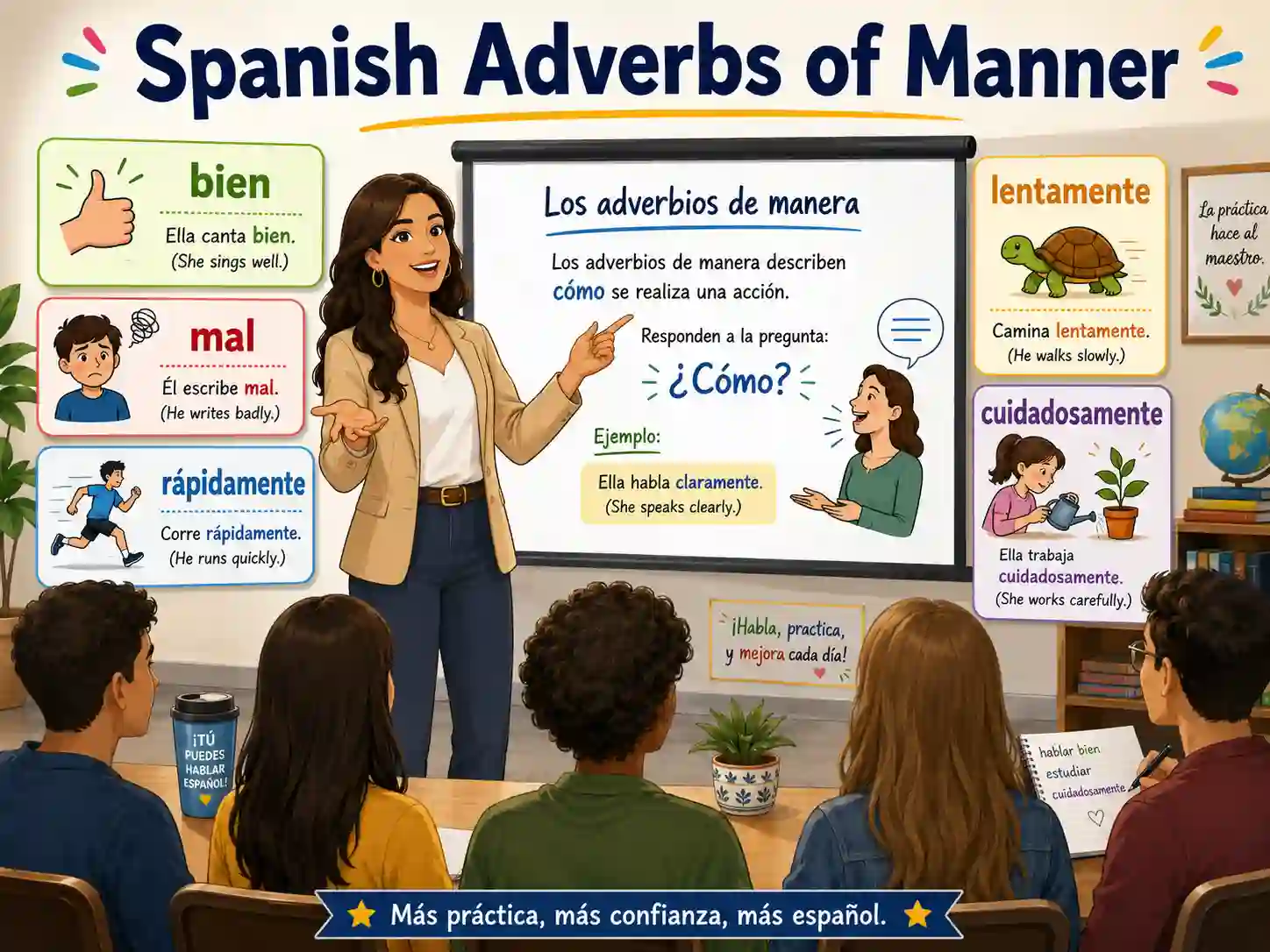
Spanish adverbs of manner describe how an action is performed. They can express quality, speed, care, style, clarity or method.
Habla bien.
He or she speaks well.
Camina despacio.
He or she walks slowly.
Explica claramente.
He or she explains clearly.
Adverbs normally remain unchanged. Spanish says ella habla bien and ellos hablan bien.
Overview
Spanish adverbs of manner at a glance
| Form | Meaning | Spanish example | English meaning | Use |
|---|---|---|---|---|
| bien | well | Habla bien. | He or she speaks well. | Quality of an action |
| mal | badly, poorly | Escribe mal. | He or she writes badly. | Negative quality |
| así | like this, like that | Hazlo así. | Do it like this. | Way or method |
| despacio | slowly | Habla despacio. | Speak slowly. | Slow speed |
| rápido | fast, quickly | Corre rápido. | He or she runs fast. | Common adverbial use |
| claramente | clearly | Explica claramente. | He or she explains clearly. | Clarity |
| lentamente | slowly | Lee lentamente. | He or she reads slowly. | Explicit slow manner |
| cuidadosamente | carefully | Examina el documento cuidadosamente. | Examine the document carefully. | Careful action |
| con cuidado | carefully, with care | Lee con cuidado. | Read carefully. | Common natural expression |
Well and badly
Bien and mal
Bien and mal describe the quality of an action. They are adverbs and do not agree with the subject.
| Form | Grammar function | Spanish example | English meaning |
|---|---|---|---|
| bien | Adverb | Ella canta bien. | She sings well. |
| mal | Adverb | Ellos escriben mal. | They write badly. |
| bueno / buena | Adjective | Es una buena cantante. | She is a good singer. |
| malo / mala | Adjective | Es una mala respuesta. | It is a bad answer. |
Say Habla bien, not Habla bueno.
Everyday manner
Así, despacio and rápido
Así
Means “like this”, “like that” or “in this way”.
Hazlo así.
No hables así.
Se escribe así.
Despacio
Means slowly and is very common in everyday speech.
Habla despacio.
Camina despacio.
Rápido
Is commonly used adverbially to mean fast or quickly.
Corre rápido.
Ellas trabajan rápido.
Una respuesta rápida contains an adjective that agrees with respuesta. In Responde rápido, the word describes the action and remains unchanged.
Adverbs ending in -mente
How to form Spanish adverbs with -mente
Many manner adverbs are formed from adjectives. Use the feminine singular form of the adjective and add -mente.
| Adjective | Feminine base | Adverb | English meaning |
|---|---|---|---|
| claro | clara | claramente | clearly |
| lento | lenta | lentamente | slowly |
| rápido | rápida | rápidamente | quickly |
| cuidadoso | cuidadosa | cuidadosamente | carefully |
| fácil | fácil | fácilmente | easily |
| frecuente | frecuente | frecuentemente | frequently |
Rápida becomes rápidamente and fácil becomes fácilmente.
When two adverbs are joined, Spanish often adds -mente only to the final one: Habla clara y lentamente.
Continue with: Spanish Adverbs with -mente .
Natural expressions
Spanish expressions of manner
Spanish often uses short phrases instead of a long -mente adverb.
| Expression | Meaning | Spanish example | English meaning |
|---|---|---|---|
| con cuidado | carefully | Abre la caja con cuidado. | Open the box carefully. |
| de prisa | quickly, in a hurry | Salimos de prisa. | We left in a hurry. |
| a mano | by hand | Escribo a mano. | I write by hand. |
| en voz alta | aloud | Lee en voz alta. | Read aloud. |
| en silencio | silently | Trabajan en silencio. | They work silently. |
| poco a poco | little by little | Aprende poco a poco. | He or she learns little by little. |
Word order
Where do Spanish adverbs of manner go?
Manner adverbs usually appear after the verb or after the verb and its object. Their position can change when the speaker wants to emphasise the manner.
| Pattern | Spanish example | English meaning | Use |
|---|---|---|---|
| Verb + adverb | Habla bien. | He or she speaks well. | Neutral order |
| Verb + adverb | Camina despacio. | He or she walks slowly. | Common everyday order |
| Verb + object + adverb | Explica la regla claramente. | He or she explains the rule clearly. | Adverb follows the complete verb phrase |
| Adverb + sentence | Cuidadosamente, abrió la caja. | Carefully, he or she opened the box. | Marked emphasis or written style |
Continue with: Position of Adverbs in Spanish .
Important difference
Spanish adjective or adverb?
An adjective describes a noun and normally agrees with it. An adverb describes an action, quality or other adverb and normally remains unchanged.
| Adjective | Adverb | Difference |
|---|---|---|
| una buena explicación | Explica bien. | Buena describes the noun; bien describes the action. |
| una mala respuesta | Responde mal. | Mala describes the noun; mal describes how someone responds. |
| una respuesta rápida | Responde rápido. | Rápida agrees with the noun; adverbial rápido remains unchanged. |
| una explicación clara | Explica claramente. | Clara describes the explanation; claramente describes the action. |
Review: Spanish Adjectives .
Comparison
Comparing actions with manner adverbs
| Structure | Spanish example | English meaning |
|---|---|---|
| mejor que | Habla mejor que yo. | He or she speaks better than I do. |
| peor que | Escribe peor que antes. | He or she writes worse than before. |
| más + adverb + que | Corre más rápido que su hermano. | He or she runs faster than the sibling. |
| menos + adverb + que | Trabaja menos cuidadosamente que antes. | He or she works less carefully than before. |
| tan + adverb + como | Explica tan claramente como la profesora. | He or she explains as clearly as the teacher. |
Continue with: Spanish Comparison .
Exercises
Practice Spanish adverbs of manner
Choose bien, mal or así
- Ella canta ___. — well
- No escribas la palabra ___. — incorrectly
- Hazlo ___. — like this
- Ellos hablan español muy ___. — well
Show answers
1. Ella canta bien.
2. No escribas la palabra mal.
3. Hazlo así.
4. Ellos hablan español muy bien.
Form the -mente adverb
- claro
- rápido
- fácil
- cuidadoso
Show answers
1. claramente
2. rápidamente
3. fácilmente
4. cuidadosamente
Correct the sentence
- Habla bueno.
- Ellas trabajan rápidas.
- Explica claro la regla.
- Los niños cantan buenas.
Show answers
1. Habla bien.
2. Ellas trabajan rápido.
3. Explica la regla claramente.
4. Los niños cantan bien.
Continue learning
Related Spanish adverb lessons
Spanish Adverbs
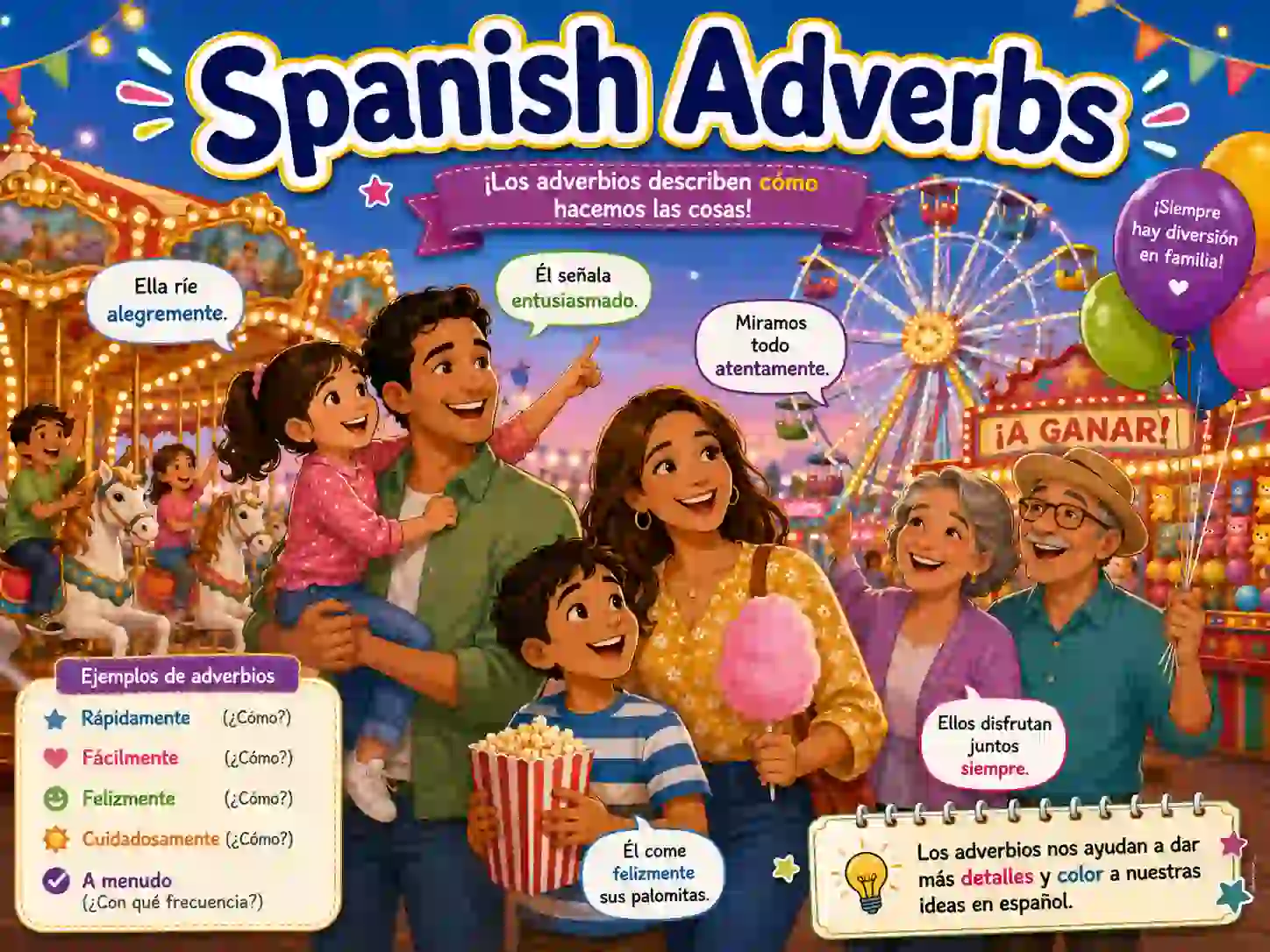
Review adverbs of time, place, manner, quantity, frequency, doubt, affirmation and negation.
Open lesson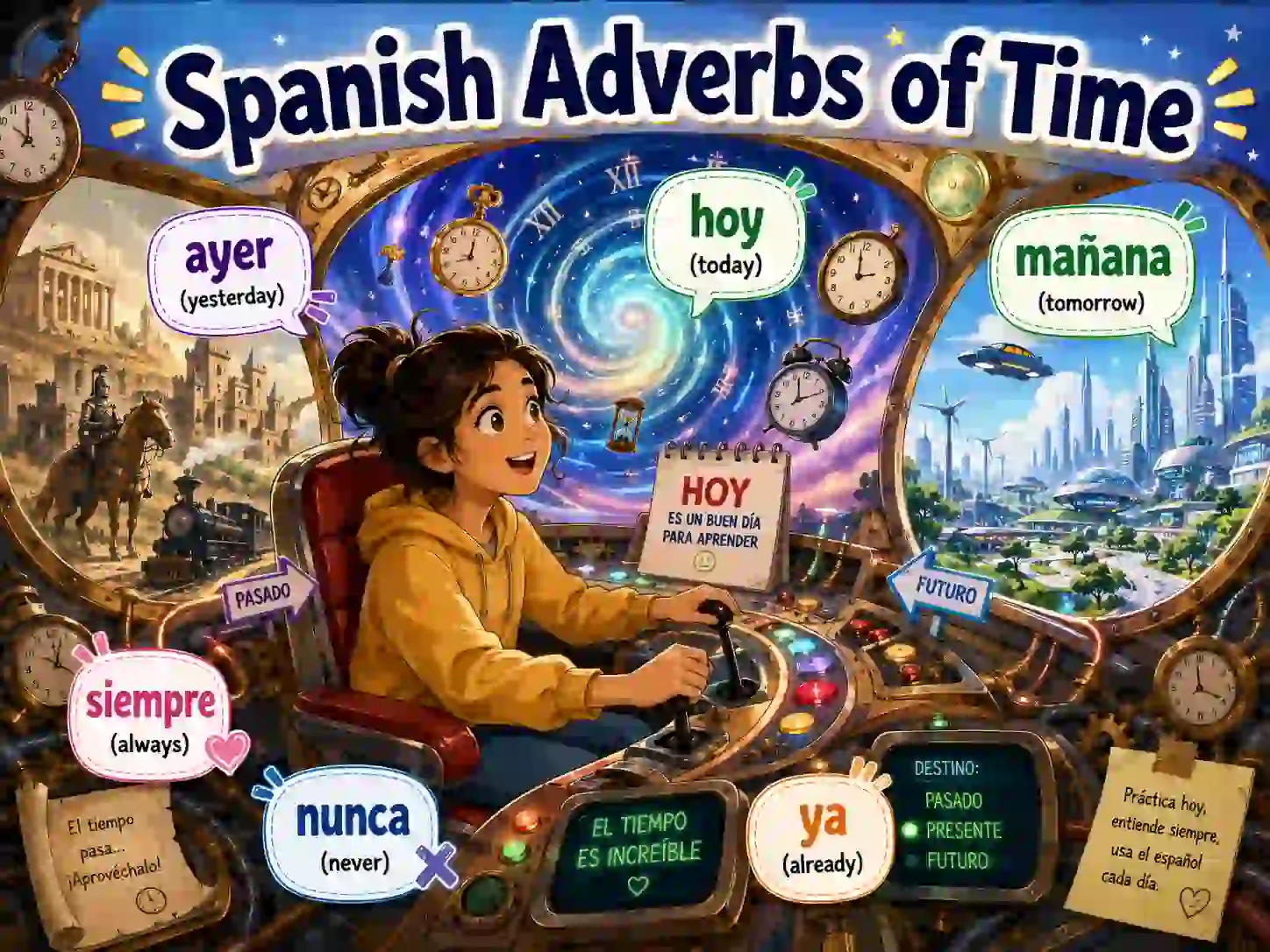
Adverbs of Time
Learn hoy, ayer, mañana, ahora, ya and todavía.
Open lesson
Adverbs of Place
Learn aquí, acá, ahí, allí, cerca and lejos.
Open lesson
Position of Adverbs
Learn when Spanish adverbs appear before the verb, after the verb or at the beginning or end of a sentence.
Open lessonCommon errors
Common mistakes with Spanish adverbs of manner
- Using an adjective instead of an adverb: say habla bien, not habla bueno.
- Making an adverb agree: say ellas trabajan rápido, not ellas trabajan rápidas.
- Putting every manner adverb before the verb: the neutral order is often habla claramente.
- Overusing -mente: expressions such as con cuidado and de prisa are often more natural.
- Forgetting accents: write rápidamente and fácilmente.
- Confusing bien with bueno: bien describes an action; bueno describes a noun.
- Assuming all manner adverbs end in -mente: common forms include bien, mal, así, despacio and rápido.
Frequently asked questions
Questions about Spanish adverbs of manner
What are Spanish adverbs of manner?
They describe how an action happens. Common examples include bien, mal, así, despacio, rápido, claramente and cuidadosamente.
Where do Spanish adverbs of manner go?
They normally appear after the verb or after the verb and its object: Habla bien and Explica la regla claramente.
What is the difference between bien and bueno?
Bien is an adverb meaning “well”: habla bien. Bueno is an adjective meaning “good”: un buen libro.
Can rápido be used as an adverb?
Yes. It is commonly used adverbially in expressions such as corre rápido and trabajan rápido.
How are -mente adverbs formed?
Use the feminine singular form of the adjective and add -mente: claro → clara → claramente.
Do manner adverbs change for gender or number?
No. They remain unchanged: ella habla bien and ellos hablan bien.
Practice and support
Practise Spanish manner adverbs in complete sentences
These adverbs become easier when you practise their meaning, position, formation and differences from adjectives.
Spanish Tutoring
Work on adverb formation, word order, adjective contrasts and individual grammar problems.
Private Spanish Lessons
Practise manner adverbs in speaking, writing and everyday descriptions.
Intensive Spanish Course
Combine grammar with structured speaking, listening and sentence-building activities.

About MundoDele
Spanish learning for education, work and real communication
MundoDele connects online Spanish courses, DELE preparation, Business Spanish and cultural context into a personal Spanish learning platform.
The grammar guides explain Spanish with practical examples, clear comparisons and complete sentences.