
MundoDele Spanish Grammar
Spanish Adverbs of Doubt: Quizá, Tal Vez and Probablemente
Learn how Spanish expresses uncertainty, possibility and probability with quizá, quizás, tal vez, probablemente, posiblemente, seguramente, acaso and a lo mejor.
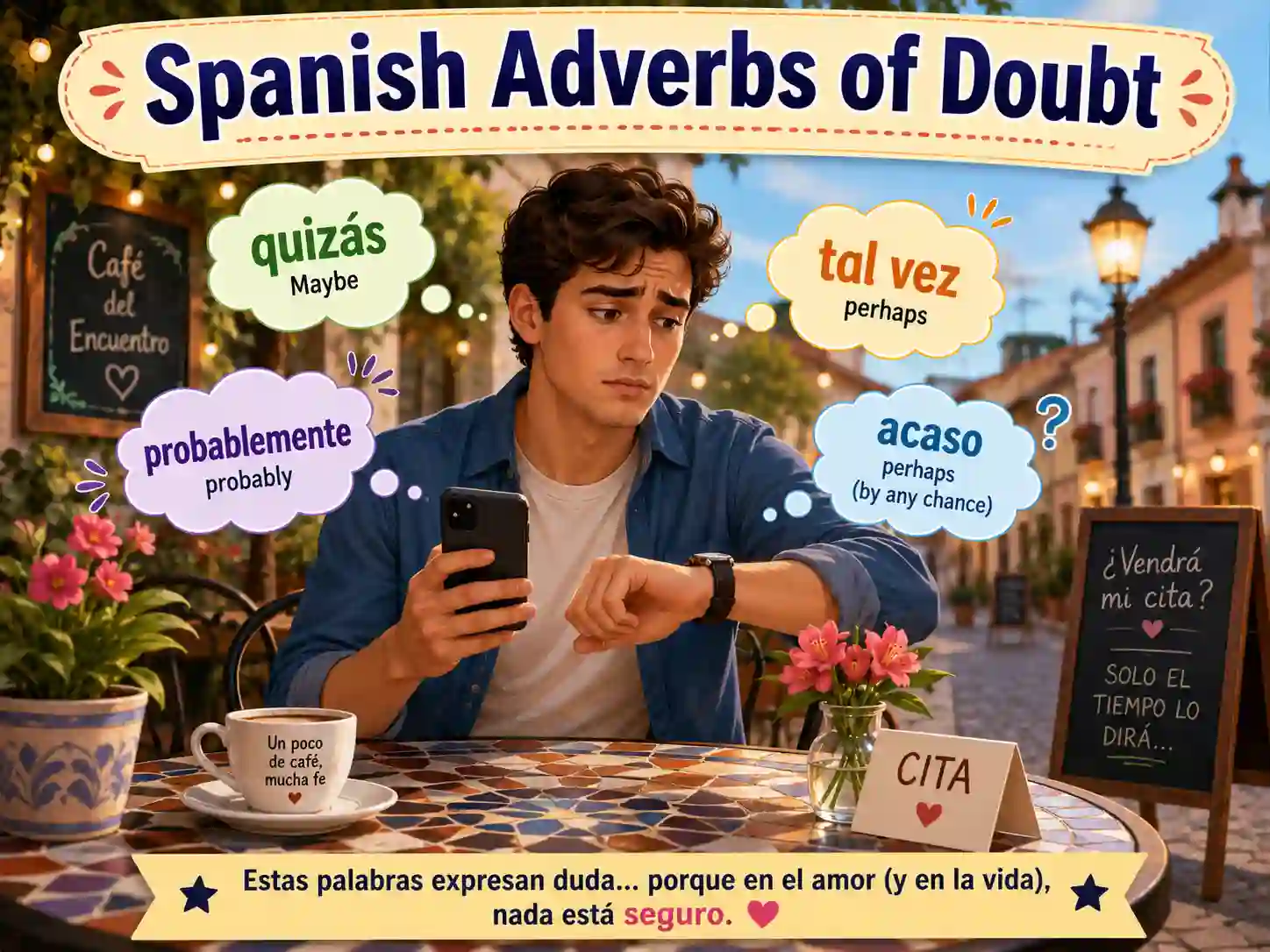
Definition
What are Spanish adverbs of doubt?
Spanish adverbs of doubt show that a statement is possible, probable, uncertain or not completely confirmed. They often comment on the complete sentence rather than on one single action.
Quizá venga mañana.
Maybe he or she will come tomorrow.
Probablemente llegará tarde.
He or she will probably arrive late.
A lo mejor tiene razón.
Maybe he or she is right.
Unlike adverbs of manner, these words often express the speaker’s attitude toward the entire statement.
Overview
Spanish adverbs of doubt at a glance
| Form | Main meaning | Spanish example | English meaning | Usage note |
|---|---|---|---|---|
| quizá | maybe, perhaps | Quizá venga mañana. | Maybe he or she will come tomorrow. | Can be followed by indicative or subjunctive. |
| quizás | maybe, perhaps | Quizás tienes razón. | Maybe you are right. | Generally interchangeable with quizá. |
| tal vez | perhaps, maybe | Tal vez sea mejor esperar. | Perhaps it is better to wait. | Can be followed by indicative or subjunctive. |
| probablemente | probably | Probablemente llegará hoy. | He or she will probably arrive today. | Expresses probability rather than certainty. |
| posiblemente | possibly | Posiblemente cambie el plan. | The plan may possibly change. | Often presents an open possibility. |
| seguramente | probably, most likely | Seguramente está en casa. | He or she is probably at home. | Often expresses strong probability. |
| a lo mejor | maybe, perhaps | A lo mejor viene después. | Maybe he or she will come later. | Common in conversation; normally with indicative. |
| acaso | perhaps, by chance | Acaso no lo sabe. | Perhaps he or she does not know. | Often formal, literary or rhetorical. |
Approximate probability
From open possibility to strong probability
These expressions do not represent fixed mathematical percentages. Context, intonation and verb mood can change their force.
Open possibility without stating how likely it is.
Neutral uncertainty in spoken or written Spanish.
Presents something as possible but not confirmed.
Presents an outcome as relatively likely.
Often expresses strong probability, not absolute proof.
Maybe and perhaps
Quizá, quizás and tal vez
Quizá, quizás and tal vez all express possibility. They are common at the beginning of a sentence, but other positions are also possible.
Quizá
Means “maybe” or “perhaps”.
Quizá venga mañana.
Quizá tiene razón.
Quizás
Has the same basic meaning as quizá.
Quizás podamos ayudar.
Quizás no entiende.
Tal vez
Means “perhaps” or “maybe”.
Tal vez sea mejor esperar.
Tal vez sabe la respuesta.
The final -s does not make quizás stronger or weaker. The two forms are generally interchangeable.
Probability
Probablemente, posiblemente and seguramente
These adverbs end in -mente and often comment on the entire sentence.
| Adverb | Main meaning | Spanish example | Typical force |
|---|---|---|---|
| posiblemente | possibly | Posiblemente cambie de trabajo. | Open possibility |
| probablemente | probably | Probablemente llegará mañana. | Relatively likely |
| seguramente | probably, most likely | Seguramente está ocupado. | Strong probability |
In everyday Spanish, Seguramente está en casa frequently means “He or she is probably at home”, not that the speaker has absolute proof.
Conversational Spanish
A lo mejor
A lo mejor is a fixed expression meaning “maybe” or “perhaps”. It is especially common in everyday conversation.
A lo mejor viene mañana. — Maybe he or she will come tomorrow.
A lo mejor tiene razón. — Maybe he or she is right.
A lo mejor no sabe la respuesta. — Maybe he or she does not know the answer.
A lo mejor podemos salir después. — Maybe we can go out later.
The standard learner pattern is: A lo mejor viene mañana.
Do not automatically copy the subjunctive patterns used after quizá or tal vez.
Formal and rhetorical use
Acaso
Acaso can express possibility, but it often sounds formal, literary or rhetorical. It is less common than quizá, tal vez or a lo mejor in ordinary conversation.
| Use | Spanish example | English meaning |
|---|---|---|
| Possibility | Acaso no lo sabe. | Perhaps he or she does not know. |
| Rhetorical question | ¿Acaso no entiendes? | Do you not understand? |
| Conditional expression | Si acaso viene, avísame. | If he or she happens to come, let me know. |
Indicative and subjunctive
Which mood follows Spanish adverbs of doubt?
Expressions such as quizá, quizás, tal vez, probablemente and posiblemente can be followed by either the indicative or subjunctive.
The difference is not a mechanical certainty scale. The mood shows how the speaker chooses to present the possibility.
| Indicative | Subjunctive | Typical contrast |
|---|---|---|
| Quizá viene mañana. | Quizá venga mañana. | The indicative presents the possibility more assertively; the subjunctive presents it as less directly asserted. |
| Tal vez tiene razón. | Tal vez tenga razón. | Both are possible. Context, region and speaker attitude influence the choice. |
| Probablemente llegará tarde. | Probablemente llegue tarde. | Both express probability; the subjunctive leaves the outcome more open. |
| Posiblemente está en casa. | Posiblemente esté en casa. | The subjunctive is common when the information is presented as uncertain. |
| A lo mejor viene mañana. | Not the standard learner pattern | A lo mejor is normally followed by the indicative. |
a lo mejor + indicative;
quizá, quizás and tal vez can use either indicative or subjunctive.
Continue with: Spanish Subjunctive .
Related uncertainty expressions
Puede que and es posible que
Not every expression of doubt is an adverb. Spanish also uses verbal and impersonal structures followed by que.
| Expression | Verb mood | Spanish example | English meaning |
|---|---|---|---|
| puede que | Subjunctive | Puede que venga mañana. | He or she may come tomorrow. |
| es posible que | Subjunctive | Es posible que llueva. | It is possible that it will rain. |
| es probable que | Subjunctive | Es probable que llegue tarde. | It is probable that he or she will arrive late. |
| puede ser que | Subjunctive | Puede ser que tenga razón. | It may be that he or she is right. |
They are included because they express the same general meanings of possibility and uncertainty and are common alternatives in real Spanish.
Word order
Where do Spanish adverbs of doubt go?
Doubt adverbs commonly appear at the beginning of a sentence because they frame the complete statement. Some also appear inside or at the end of the sentence.
| Position | Spanish example | English meaning | Use |
|---|---|---|---|
| Beginning | Quizá venga mañana. | Maybe he or she will come tomorrow. | Very common and neutral |
| Beginning | Probablemente llegará tarde. | He or she will probably arrive late. | Comments on the complete sentence |
| Inside the sentence | Vendrá quizá mañana. | He or she may come tomorrow. | Possible, but more marked |
| After the subject | María probablemente no viene. | María probably is not coming. | Connects probability to the statement |
| End position | Vendrá mañana, quizá. | He or she will come tomorrow, perhaps. | Afterthought or hesitation |
Continue with: Position of Adverbs in Spanish .
Exercises
Practice Spanish adverbs of doubt
Choose the best expression
-
___ venga mañana.
perhaps -
___ está en casa.
probably -
___ podemos salir después.
maybe, conversational -
___ cambie el plan.
possibly
Show possible answers
1. Quizá venga mañana.
2. Seguramente está en casa.
3. A lo mejor podemos salir después.
4. Posiblemente cambie el plan.
Choose indicative or subjunctive
-
Quizá ___ mañana.
venir — stronger uncertainty -
A lo mejor ___ razón.
tener -
Puede que ___ tarde.
llegar -
Tal vez ___ la respuesta.
saber — less directly asserted
Show answers
1. Quizá venga mañana.
2. A lo mejor tiene razón.
3. Puede que llegue tarde.
4. Tal vez sepa la respuesta.
Match the expression
- probablemente
- posiblemente
- a lo mejor
- acaso
A. common conversational maybe
B. possibly
C. probably
D. formal or rhetorical perhaps
Show answers
1–C · 2–B · 3–A · 4–D
Correct the sentence
- A lo mejor venga mañana.
- Quizás y tal vez viene.
- Seguramente significa siempre certainly.
- Puede que viene tarde.
Show answers
1. A lo mejor viene mañana.
2. Use one expression:
Quizás viene or
Tal vez viene.
3. Seguramente often means “probably” or
“most likely”.
4. Puede que llegue tarde.
Adverb or another expression?
- probablemente
- puede que
- tal vez
- es posible que
- seguramente
Show answers
Adverbs or adverbial expressions:
probablemente,
tal vez,
seguramente.
Other possibility structures:
puede que,
es posible que.
Translate into Spanish
- Maybe she will come tomorrow.
- He is probably at home.
- Perhaps it is better to wait.
- It is possible that they are tired.
Show possible answers
1. Quizá venga mañana.
2. Seguramente está en casa.
3. Tal vez sea mejor esperar.
4. Es posible que estén cansados.
Continue learning
Related Spanish adverb lessons
Spanish Adverbs
Review adverbs of time, place, manner, quantity, frequency, doubt, affirmation and negation.
Open lesson
Adverbs of Time
Learn hoy, ayer, mañana, ahora, ya and todavía.
Open lesson
Adverbs of Quantity
Learn muy, mucho, poco, bastante, demasiado, más and menos.
Open lesson
Position of Adverbs
Learn when Spanish adverbs appear at the beginning, inside or at the end of a sentence.
Open lessonCommon errors
Common mistakes with Spanish adverbs of doubt
- Thinking seguramente always means certainly: it frequently means “probably” or “most likely”.
- Using only one mood after quizá: both indicative and subjunctive are possible.
- Assuming mood choice is a fixed percentage: context, speaker attitude and regional usage also matter.
- Using the subjunctive automatically after a lo mejor: the standard pattern is a lo mejor + indicative.
- Thinking quizá and quizás have different meanings: they are generally interchangeable.
- Overusing acaso in everyday conversation: it often sounds formal, literary or rhetorical.
- Using the indicative after puede que: puede que is followed by the subjunctive.
- Translating English maybe with one fixed Spanish expression: Spanish offers several choices depending on tone and context.
Frequently asked questions
Questions about Spanish adverbs of doubt
What are Spanish adverbs of doubt?
They express uncertainty, possibility or probability. Common examples include quizá, quizás, tal vez, probablemente, posiblemente, seguramente and acaso.
What is the difference between quizá and quizás?
Both mean “maybe” or “perhaps”. They are generally interchangeable.
Does quizá use the indicative or subjunctive?
Both moods are possible. The indicative presents the possibility more assertively, while the subjunctive presents it as less directly asserted or more open.
Does a lo mejor use the subjunctive?
It is normally followed by the indicative: A lo mejor viene mañana.
What does seguramente mean?
It often means “probably” or “most likely”. It does not always express absolute certainty.
Where do Spanish adverbs of doubt go?
They commonly appear at the beginning of a sentence: Quizá venga and Probablemente llegará tarde. Other positions are also possible.
Practice and support
Practise uncertainty and probability in complete sentences
Adverbs of doubt become easier when you practise their meaning, sentence position and interaction with the indicative and subjunctive.
Spanish Tutoring
Work on doubt expressions, mood choice, word order and individual grammar difficulties.
Private Spanish Lessons
Practise speculation, uncertainty and probability in conversation and writing.
Intensive Spanish Course
Combine grammar with structured speaking, listening and sentence-building activities.

About MundoDele
Spanish learning for education, work and real communication
MundoDele connects online Spanish courses, DELE preparation, Business Spanish and cultural context into a personal Spanish learning platform.
The grammar guides explain Spanish with practical examples, clear comparisons and complete sentences.