
MundoDele Spanish Grammar
Spanish Adverbs of Time: Hoy, Ayer, Mañana and Ahora
Learn how Spanish expresses past, present, future, continuation and sequence with hoy, ayer, mañana, ahora, antes, después, luego, ya, todavía, aún, pronto, tarde and temprano.
Definition
What are Spanish adverbs of time?
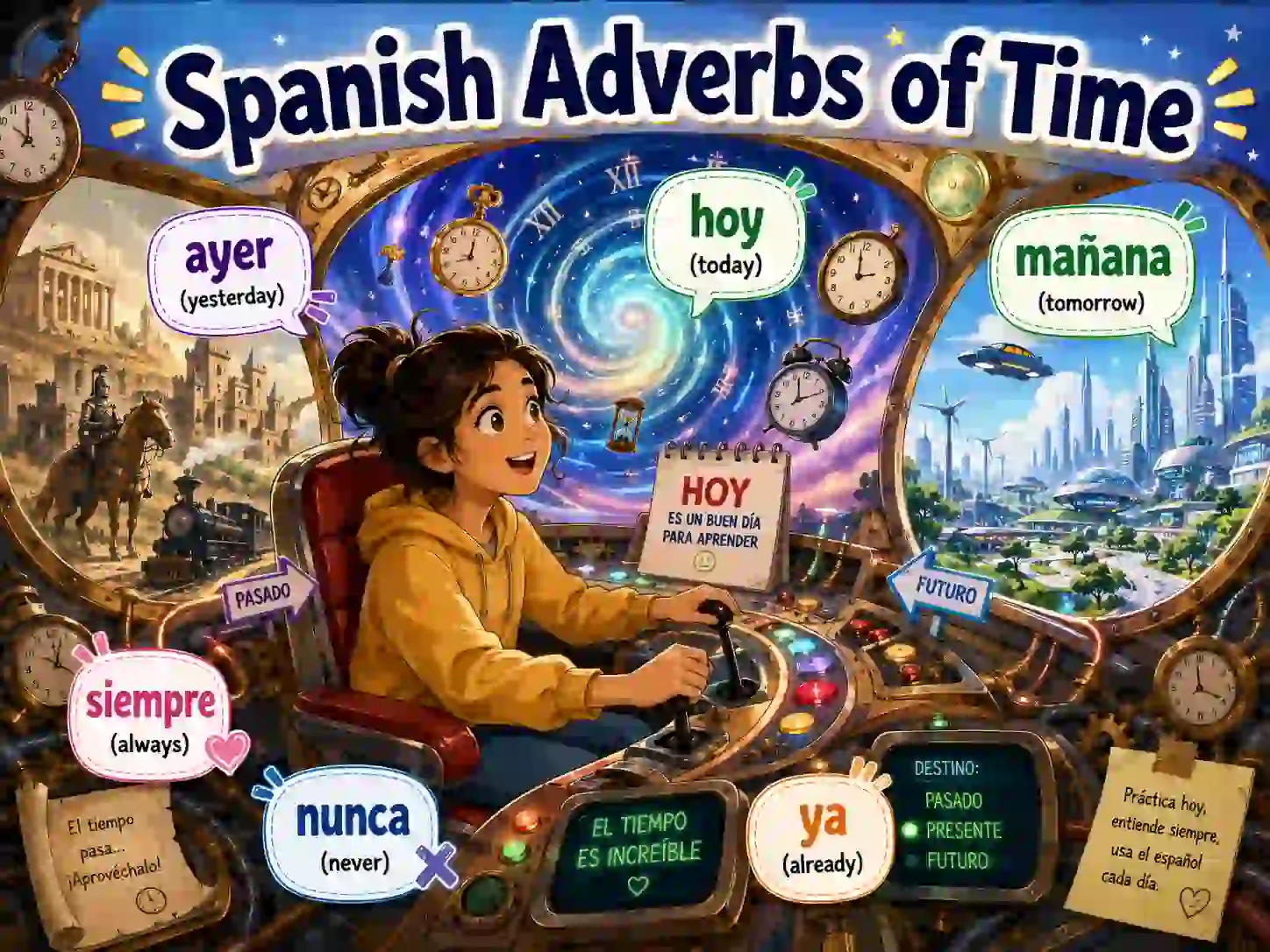
Spanish adverbs of time locate an action, event or situation in the past, present or future. They can also show sequence, continuation, completion, proximity or delay.
Ayer trabajé.
Yesterday I worked.
Ahora estudio.
I am studying now.
Mañana viajo.
I am travelling tomorrow.
A time word gives the listener the time reference. The verb form still expresses the grammatical tense.
Overview
Spanish adverbs of time at a glance
| Form | Meaning | Spanish example | English meaning | Use |
|---|---|---|---|---|
| hoy | today | Hoy estudio español. | Today I study Spanish. | Current day |
| ayer | yesterday | Ayer trabajé mucho. | Yesterday I worked a lot. | Previous day |
| mañana | tomorrow | Mañana viajamos. | Tomorrow we are travelling. | Following day |
| ahora | now | Ahora vivo aquí. | Now I live here. | Current moment or period |
| antes | before, earlier | Antes vivía en Alemania. | Before, I lived in Germany. | Earlier time |
| después | afterwards, later | Después hablamos. | We will talk afterwards. | Later action |
| luego | later, then | Luego te llamo. | I will call you later. | Next action |
| ya | already, now | Ya terminé. | I have already finished. | Completion or change |
| todavía | still, yet | Todavía trabajo aquí. | I still work here. | Continuation |
| aún | still, yet | Aún no sabemos. | We still do not know. | Continuation or incomplete action |
| pronto | soon | Vuelvo pronto. | I will return soon. | Near future |
| tarde | late | Llegamos tarde. | We arrived late. | Late timing |
| temprano | early | Me levanto temprano. | I get up early. | Early timing |
Today, yesterday and tomorrow
Hoy, ayer and mañana
| Form | Time reference | Spanish example | Usual meaning |
|---|---|---|---|
| hoy | Today | Hoy tengo clase. | Present or near future |
| ayer | Yesterday | Ayer tuve clase. | Past |
| mañana | Tomorrow | Mañana tengo clase. | Future |
Mañana trabajo. — I work tomorrow.
Trabajo por la mañana. — I work in the morning.
The article in la mañana identifies the part of the day.
Current time and order
Ahora, antes, después and luego
Ahora
Refers to now or the current situation.
Ahora vivo en Argentina.
Now I live in Argentina.
Antes
Refers to an earlier situation or action.
Antes vivía en Alemania.
Before, I lived in Germany.
Después and luego
Introduce a later action or the next step.
Después hablamos.
Luego te llamo.
Early, late and soon
Pronto, tarde and temprano
| Form | Meaning | Spanish example | Typical use |
|---|---|---|---|
| pronto | soon | Vuelvo pronto. | Near future |
| tarde | late | Llegamos tarde. | Late arrival or action |
| temprano | early | Me levanto temprano. | Early action or routine |
These words are common when talking about routines, appointments and arrival times: cenamos tarde, llegó temprano and vuelvo pronto.
Completion and continuation
Ya, todavía and aún
These forms show whether something is complete, continues or has not happened yet.
| Structure | Meaning | Spanish example | English meaning |
|---|---|---|---|
| ya | Already | Ya terminé. | I have already finished. |
| ya no | No longer | Ya no vivo allí. | I no longer live there. |
| todavía | Still | Todavía trabajo aquí. | I still work here. |
| todavía no | Not yet | Todavía no terminé. | I have not finished yet. |
| aún | Still | Aún vive aquí. | He or she still lives here. |
| aún no | Still not, not yet | Aún no sabemos. | We still do not know. |
Todavía continúa. — It is still continuing.
Todavía no terminó. — It has not finished yet.
Use aún with an accent when it means “still” or “yet”. Aun without an accent can mean “even” in expressions such as aun así.
Recent time
Recién, recientemente and últimamente
| Form | Meaning | Spanish example | Use |
|---|---|---|---|
| recién | just, recently | Recién llegué. | Very common in Latin America |
| recientemente | recently | Recientemente cambié de trabajo. | Neutral or formal |
| últimamente | lately | Últimamente estudio más. | Recent period or trend |
| acabar de + infinitive | to have just done something | Acabo de llegar. | Verb construction |
Word order
Where do Spanish adverbs of time go?
Time adverbs often appear at the beginning or end of a sentence. Beginning position gives the time more emphasis. End position often sounds more neutral.
| Beginning position | End position | Meaning | Difference |
|---|---|---|---|
| Hoy estudio español. | Estudio español hoy. | I study Spanish today. | Beginning position emphasises today. |
| Mañana viajamos. | Viajamos mañana. | We travel tomorrow. | Both are natural. |
| Ayer trabajé mucho. | Trabajé mucho ayer. | I worked a lot yesterday. | End position often sounds neutral. |
| Ahora no puedo. | No puedo ahora. | I cannot now. | The focus changes slightly. |
Ya terminé.
Todavía trabajo aquí.
Aún no sé.
Time and verb forms
Adverbs of time and Spanish verb tense
The time word gives context. The verb form expresses the grammatical tense.
| Time word | Spanish example | Verb form | Meaning |
|---|---|---|---|
| ayer | Ayer estudié. | Preterite | Completed past action |
| antes | Antes vivía aquí. | Imperfect | Previous situation or habit |
| hoy | Hoy estudio en casa. | Present | Current-day action |
| ahora | Ahora estoy trabajando. | Present progressive | Action in progress now |
| mañana | Mañana voy a estudiar. | Ir a + infinitive | Planned future action |
| mañana | Mañana estudio en casa. | Present with future meaning | Scheduled or planned action |
| ya | Ya terminé. | Completed action | Highlights completion |
Important difference
Adverbs of time vs adverbs of frequency
Adverbs of time answer “when?”. Adverbs of frequency answer “how often?”.
| Time adverb | Question | Frequency adverb | Question |
|---|---|---|---|
| hoy | When? Today. | siempre | How often? Always. |
| ayer | When? Yesterday. | nunca | How often? Never. |
| mañana | When? Tomorrow. | a veces | How often? Sometimes. |
| ahora | When? Now. | normalmente | How often? Normally. |
Exercises
Practice Spanish adverbs of time
Choose the correct time word
- ___ trabajé mucho. — yesterday
- ___ tengo clase. — tomorrow
- ___ no puedo hablar. — now
- Vuelvo ___. — soon
Show answers
1. Ayer trabajé mucho.
2. Mañana tengo clase.
3. Ahora no puedo hablar.
4. Vuelvo pronto.
Choose ya or todavía
- ___ terminé. — already
- ___ trabajo aquí. — still
- ___ no entiendo. — not yet
- ___ no vive allí. — no longer
Show answers
1. Ya terminé.
2. Todavía trabajo aquí.
3. Todavía no entiendo.
4. Ya no vive allí.
Time or frequency?
- hoy
- siempre
- mañana
- a veces
Show answers
1. Hoy: time.
2. Siempre: frequency.
3. Mañana: time.
4. A veces: frequency.
Continue learning
Related Spanish adverb lessons

Spanish Adverbs
Review adverbs of time, place, manner, quantity, frequency, doubt, affirmation and negation.
Open lesson
Spanish Adverbs of Place
Learn aquí, acá, ahí, allí, allá, cerca and lejos.
Open lesson
Position of Adverbs
Learn when Spanish adverbs appear before the verb, after the verb or at the beginning or end of a sentence.
Open lessonCommon errors
Common mistakes with Spanish adverbs of time
- Confusing mañana and la mañana: mañana can mean tomorrow; la mañana means the morning.
- Assuming the time word creates the tense: the verb still carries the grammatical tense.
- Using only one sentence position: both Hoy estudio and Estudio hoy can be correct.
- Confusing time and frequency: hoy answers when; siempre answers how often.
- Translating ya with one fixed English word: it can mean already, now or form ya no, meaning no longer.
- Confusing todavía with ya: todavía normally expresses continuation or something that has not happened yet.
- Writing aun without considering the meaning: use aún when it means still or yet.
Frequently asked questions
Questions about Spanish adverbs of time
What are Spanish adverbs of time?
They explain when something happens. Common examples include hoy, ayer, mañana, ahora, antes, después, ya, todavía, pronto, tarde and temprano.
Where do Spanish adverbs of time go?
They often appear at the beginning or end of a sentence: Hoy estudio español or Estudio español hoy.
What is the difference between hoy, ayer and mañana?
Hoy means today, ayer means yesterday and mañana means tomorrow.
What is the difference between ya and todavía?
Ya commonly means already or signals a changed state. Todavía means still or yet and signals continuation or an incomplete action.
Does mañana mean morning or tomorrow?
Mañana can mean tomorrow. La mañana means the morning. Context and the article distinguish the meanings.
What is the difference between time and frequency adverbs?
Time adverbs answer when: hoy, ayer and mañana. Frequency adverbs answer how often: siempre, nunca and a veces.
Practice and support
Practise Spanish time words with the correct tense
Time adverbs become easier when you practise their meaning, position and connection with past, present and future verb forms.
Spanish Tutoring
Work on time adverbs, sentence order, tense choice and individual grammar problems.
Private Spanish Lessons
Practise time expressions in conversation, narratives, appointments and daily routines.
Intensive Spanish Course
Combine grammar with structured speaking, listening and sentence-building practice.

About MundoDele
Spanish learning for education, work and real communication
MundoDele connects online Spanish courses, DELE preparation, Business Spanish and cultural context into a personal Spanish learning platform.
The grammar guides explain Spanish with practical examples, clear comparisons and complete sentences.