
MundoDele Spanish Grammar
Spanish Adverbs of Place: Aquí, Allí, Cerca and Lejos
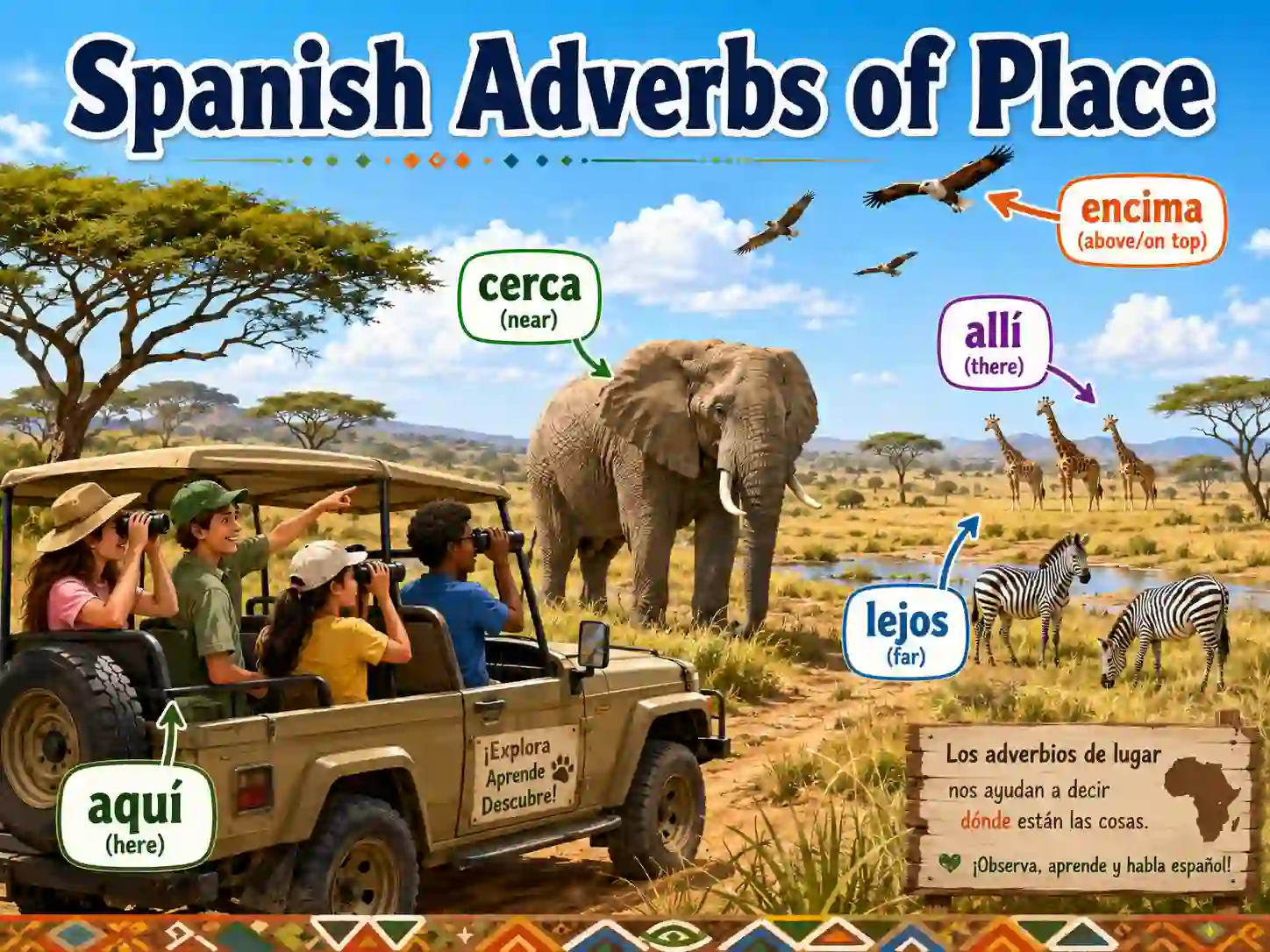
Learn how Spanish describes location, distance and direction with aquí, acá, ahí, allí, allá, cerca, lejos, arriba, abajo, dentro, fuera, delante, detrás, encima and debajo.
Definition
What are Spanish adverbs of place?
Spanish adverbs of place describe where someone or something is, where an action happens or where movement is directed. They can indicate distance, position, direction and spatial relationships.
Estoy aquí.
I am here.
La escuela está cerca.
The school is nearby.
Vamos allá.
We are going over there.
Overview
Spanish adverbs of place at a glance
| Form | Meaning | Spanish example | English meaning | Use |
|---|---|---|---|---|
| aquí | here | Estoy aquí. | I am here. | Place near the speaker |
| acá | here, over here | Ven acá. | Come here. | Common in Latin America |
| ahí | there | Déjalo ahí. | Leave it there. | Place away from the speaker |
| allí | there, over there | Vive allí. | He or she lives there. | Often a specific distant place |
| allá | over there, that way | Vamos allá. | We are going over there. | Often broader or directional |
| cerca | near | Está cerca. | It is nearby. | Use cerca de before a noun |
| lejos | far | Vive lejos. | He or she lives far away. | Use lejos de before a noun |
| arriba | up, upstairs, above | Está arriba. | It is upstairs. | Position or direction |
| abajo | down, downstairs, below | Está abajo. | It is downstairs. | Position or direction |
| dentro | inside | Está dentro. | It is inside. | Use dentro de before a noun |
| fuera | outside | Estoy fuera. | I am outside. | Use fuera de before a noun |
| delante | in front | Está delante. | It is in front. | Use delante de before a noun |
| detrás | behind | Está detrás. | It is behind. | Use detrás de before a noun |
| encima | on top, above | Está encima. | It is on top. | Use encima de before a noun |
| debajo | under, below | Está debajo. | It is underneath. | Use debajo de before a noun |
Here and there
Aquí, acá, ahí, allí and allá
Spanish uses several words for “here” and “there”. Their use depends on distance, context and regional preference. The distinctions are useful, but they are not identical in every Spanish-speaking country.
| Form | Usual meaning | Spanish example | Typical use |
|---|---|---|---|
| aquí | here | Trabajo aquí. | A place near the speaker |
| acá | here, over here | Ven acá. | Common with movement and in Latin America |
| ahí | there | Pon el libro ahí. | A place away from the speaker or already identified |
| allí | there, over there | La escuela está allí. | Often a specific distant place |
| allá | over there, that way | Vamos allá. | Often a broader area or direction |
In Argentina and many other Latin American countries, acá and allá are especially common. Speakers may use these forms more often than aquí and allí.
Distance
Cerca and lejos
Cerca means “near” or “nearby”. Lejos means “far” or “far away”. Both can stand alone.
| Standalone form | With a reference point | English meaning |
|---|---|---|
| Está cerca. | Está cerca de la escuela. | It is nearby / near the school. |
| Vive lejos. | Vive lejos del centro. | He or she lives far away / far from downtown. |
| Trabajo cerca. | Trabajo cerca de casa. | I work nearby / near home. |
| No está lejos. | No está lejos de aquí. | It is not far / not far from here. |
cerca de mí · lejos de Madrid · cerca del hotel
Inside, outside, up and down
Dentro, fuera, arriba and abajo
Dentro
Means inside.
El perro está dentro.
El perro está dentro de la casa.
Fuera
Means outside.
Los niños están fuera.
Está fuera del edificio.
Arriba and abajo
Refer to a higher or lower place.
El dormitorio está arriba.
La cocina está abajo.
Arriba can mean upstairs or in a higher place: La oficina está arriba. Encima de expresses a relationship between two things: El libro está encima de la mesa.
Relative position
Delante, detrás, encima and debajo
These forms describe the position of one thing in relation to another. Use de when the reference object is mentioned.
| Form | With reference object | Meaning | Spanish example |
|---|---|---|---|
| delante | delante de | in front of | El coche está delante de la casa. |
| detrás | detrás de | behind | El jardín está detrás de la casa. |
| encima | encima de | on top of, above | El libro está encima de la mesa. |
| debajo | debajo de | under, below | El gato está debajo de la cama. |
Delante de means in front of something. Enfrente de normally means opposite or facing something: El banco está enfrente de la estación.
Using de
Place adverbs before nouns and pronouns
Many place adverbs can stand alone. When a noun, pronoun or named place follows, Spanish often uses de.
| Without a reference object | With a reference object | English meaning |
|---|---|---|
| Está cerca. | Está cerca de la casa. | It is near / near the house. |
| Está lejos. | Está lejos de aquí. | It is far / far from here. |
| Está dentro. | Está dentro de la caja. | It is inside / inside the box. |
| Está fuera. | Está fuera del edificio. | It is outside / outside the building. |
| Está delante. | Está delante de mí. | It is in front / in front of me. |
| Está detrás. | Está detrás de la puerta. | It is behind / behind the door. |
Location and movement
Place adverbs with estar, ir and venir
The verb shows whether the sentence describes a location or movement.
| Verb | Spanish example | English meaning | Function |
|---|---|---|---|
| estar | Estoy aquí. | I am here. | Location |
| estar | La escuela está cerca. | The school is nearby. | Location or distance |
| ir | Voy allá. | I am going over there. | Movement to another place |
| venir | Ven acá. | Come here. | Movement toward the speaker |
| quedarse | Me quedo aquí. | I am staying here. | Remaining in a place |
La oficina está aquí. — The office is here.
La reunión es aquí. — The meeting is here.
Word order
Where do Spanish adverbs of place go?
Place adverbs commonly appear after the verb or at the end of the sentence. Beginning position gives the place stronger emphasis.
| Position | Spanish example | English meaning | Use |
|---|---|---|---|
| After the verb | Estoy aquí. | I am here. | Neutral location |
| End of the sentence | Mi hermano trabaja allí. | My brother works there. | Common neutral order |
| Beginning of the sentence | Aquí vivimos tranquilos. | Here we live peacefully. | Emphasises the place |
| After a movement verb | Vamos allá. | We are going over there. | Destination or direction |
Learn more in Position of Adverbs in Spanish .
Exercises
Practice Spanish adverbs of place
Choose aquí, ahí or allí
- Estoy ___. — here with the speaker
- Deja el vaso ___. — there on the table
- La montaña está ___. — over there
Show answers
1. Estoy aquí.
2. Deja el vaso ahí.
3. La montaña está allí.
Add de when necessary
- Vive cerca ___ la escuela.
- El gato está debajo ___ la mesa.
- La mochila está dentro ___.
- Trabajo lejos ___ aquí.
Show answers
1. Vive cerca de la escuela.
2. El gato está debajo de la mesa.
3. La mochila está dentro.
4. Trabajo lejos de aquí.
Location or direction?
- Estoy aquí.
- Ven acá.
- Vive allá.
- Vamos allí.
Show answers
1. Location.
2. Direction toward the speaker.
3. Location.
4. Direction toward a destination.
Continue learning
Related Spanish adverb lessons
Spanish Adverbs
Review adverbs of time, place, manner, quantity, frequency, doubt, affirmation and negation.
Open lesson
Adverbs of Time
Learn hoy, ayer, mañana, ahora, ya and todavía.
Open lesson
Adverbs of Manner
Learn bien, mal, así, despacio, rápido and -mente forms.
Open lesson
Position of Adverbs
Learn when Spanish adverbs appear before the verb, after the verb or at the beginning or end of a sentence.
Open lessonCommon errors
Common mistakes with Spanish adverbs of place
- Using aquí, ahí and allí as exact equivalents: their meaning depends on distance, context and regional usage.
- Forgetting de: say cerca de la casa, not cerca la casa.
- Using ser for the location of a person or object: say Estoy aquí and La casa está cerca.
- Using estar for the location of an event: say La reunión es aquí.
- Confusing arriba with encima de: arriba can mean upstairs; encima de means on top of something.
- Confusing delante de with enfrente de: the first means in front of; the second usually means opposite or facing.
- Ignoring regional differences: acá and allá are especially common in many Latin American countries.
Frequently asked questions
Questions about Spanish adverbs of place
What are Spanish adverbs of place?
They explain where something is, where an action happens or where something moves. Common examples include aquí, acá, ahí, allí, allá, cerca, lejos, dentro and fuera.
What is the difference between aquí, ahí and allí?
Aquí means here. Ahí normally refers to a place away from the speaker or already identified. Allí normally refers to a more distant place.
What is the difference between aquí and acá?
Both can mean here. Aquí often identifies a particular location. Acá is especially common in Latin America and is frequently used with movement toward the speaker.
What is the difference between allí and allá?
Both refer to a place farther away. Allí often identifies a more specific place, while allá can refer to a broader area or direction. Regional use varies.
Do Spanish adverbs of place need de?
Many can stand alone. Before a noun or pronoun, expressions such as cerca de, lejos de, dentro de, delante de and detrás de require de.
Where do Spanish adverbs of place go?
They commonly appear after the verb or at the end of the sentence: Estoy aquí, Vive lejos and Mi hermano trabaja allí.
Practice and support
Practise Spanish place words in complete sentences
Place adverbs become easier when you practise distance, location, direction, expressions with de and common verbs such as estar, ir and venir.
Spanish Tutoring
Work on place adverbs, prepositions, sentence order and individual grammar problems.
Private Spanish Lessons
Practise locations, directions, travel situations and everyday descriptions.
Intensive Spanish Course
Combine grammar with speaking, listening and practical sentence-building activities.

About MundoDele
Spanish learning for education, work and real communication
MundoDele connects online Spanish courses, DELE preparation, Business Spanish and cultural context into a personal Spanish learning platform.
The grammar guides explain Spanish with practical examples, clear comparisons and complete sentences.