
MundoDele Spanish Grammar
Spanish Pronouns: Subject, Object, Reflexive and More
Learn the main types of Spanish pronouns and how they work in real sentences. This guide connects subject pronouns, personal pronouns, object pronouns, reflexive pronouns, prepositional pronouns, possessive pronouns, demonstrative pronouns, indefinite pronouns, interrogative pronouns and relative pronouns.
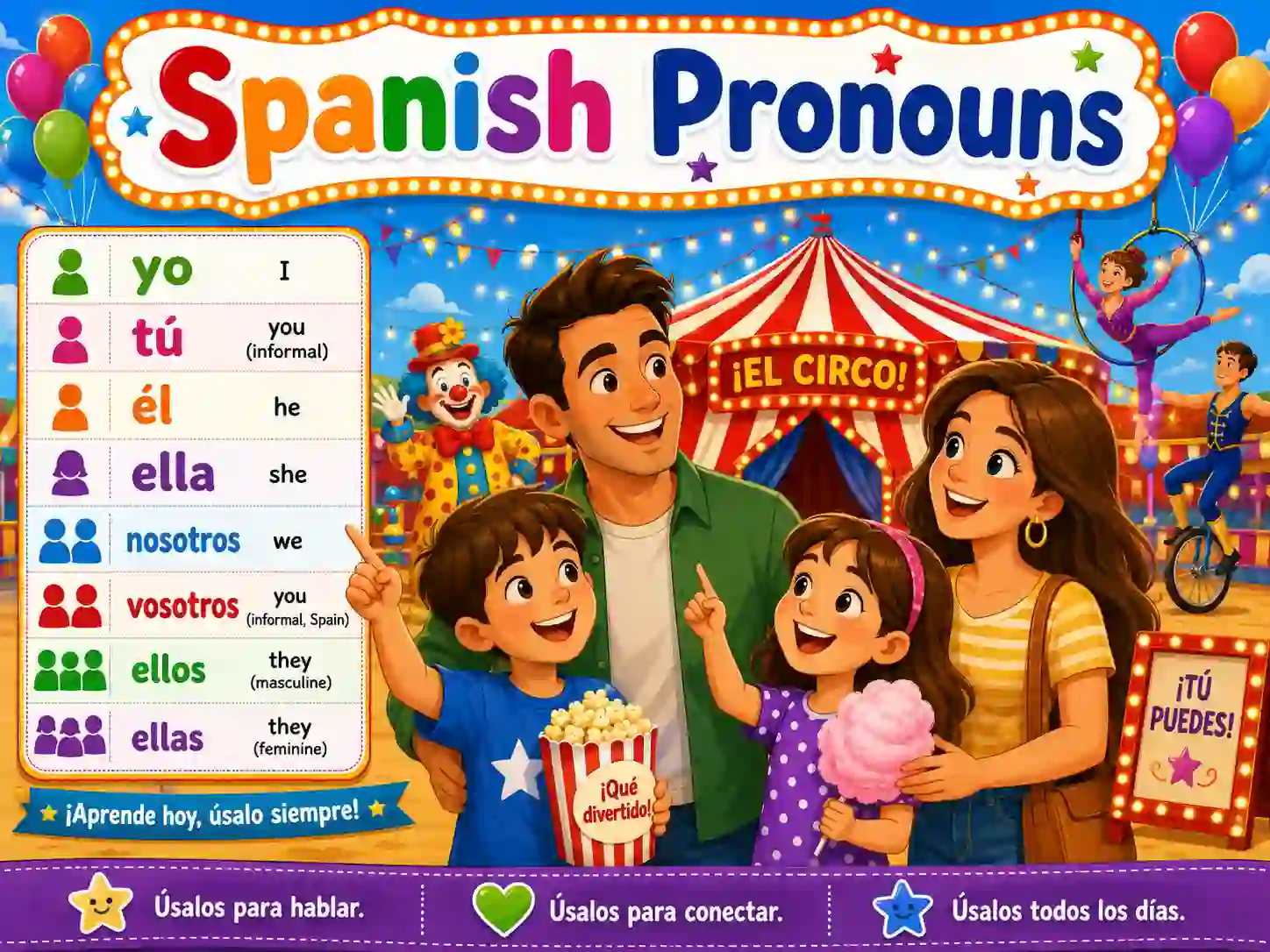
Why pronouns matter
Spanish pronouns change according to sentence role
Spanish pronouns are essential because they affect verb endings, word order, meaning, formality and sentence flow. English often uses one form where Spanish uses several: I can become yo, me or mí. You can become tú, vos, usted, te, ti, os or ustedes.
Yo estudio. The pronoun shows who does the action.
Lo veo. The pronoun replaces what or whom the verb affects.
para mí. Special forms appear after prepositions.
Learning sequence
How to use this Spanish pronouns guide
Use this page as a map of the Spanish pronoun system. Start with subject and personal pronouns, then move to object pronouns, reflexive pronouns and prepositional pronouns. After that, continue with possessive, demonstrative, indefinite, interrogative and relative pronouns.
Learn yo, tú, vos, él, ella, usted, nosotros, vosotros, ellos and ustedes.
Study direct and indirect object pronouns: lo veo, la conozco, le escribo, se lo doy.
Learn pronoun position, object pronoun doubling, reflexive use and pronouns after prepositions.
Core system
The core system: pronoun form depends on function
Spanish pronouns become easier when you ask what the pronoun does in the sentence: subject, direct object, indirect object, reflexive object, prepositional form or clause connector.
Subject function
Use subject pronouns for the person or thing doing the action.
Yo estudio español.
I study Spanish.
Object function
Use object pronouns for the person or thing affected by the verb.
Lo veo.
I see it / him.
Prepositional function
Use prepositional pronouns after prepositions.
Este libro es para mí.
This book is for me.
Pronoun table
Spanish pronouns at a glance
This table gives a practical overview of the main Spanish pronoun types, their forms and their function.
| Pronoun type | Main forms | Example | What it does | Detail page |
|---|---|---|---|---|
| Subject pronouns | yo, tú, vos, él, ella, usted, nosotros, vosotros, ellos, ustedes | Yo estudio. | Shows who does the action. | Subject Pronouns |
| Direct object pronouns | me, te, lo, la, nos, os, los, las | Lo veo. | Replaces what or whom the verb affects directly. | Direct Object Pronouns |
| Indirect object pronouns | me, te, le, nos, os, les | Le escribo. | Shows to whom or for whom something happens. | Indirect Object Pronouns |
| Reflexive pronouns | me, te, se, nos, os, se | Me levanto. | Shows that the subject and object refer to the same person. | Reflexive Pronouns |
| Prepositional pronouns | mí, ti, él, ella, nosotros, vosotros, ellos, conmigo, contigo | para mí | Appears after prepositions. | Prepositional Pronouns |
| Possessive pronouns | mío, tuyo, suyo, nuestro, vuestro | Este libro es mío. | Replaces a possessed noun. | Possessive Pronouns |
| Demonstrative pronouns | este, ese, aquel, esto, eso, aquello | Prefiero este. | Points to something near, farther away or distant. | Demonstrative Pronouns |
| Indefinite pronouns | algo, nada, alguien, nadie, alguno, ninguno, todo | No veo nada. | Refers to non-specific people, things or quantities. | Indefinite Pronouns |
| Interrogative pronouns | qué, quién, cuál, cuánto | ¿Quién viene? | Introduces questions. | Interrogative Pronouns |
| Relative pronouns | que, quien, el que, el cual, cuyo | La casa que compré. | Connects clauses and refers back to a noun. | Relative Pronouns |
Personal and subject pronouns
Personal and subject pronouns
Personal pronouns refer to people or grammatical persons. Subject pronouns are the forms used when the pronoun is the subject of the verb.
| Person | Subject pronoun | Example | Use note |
|---|---|---|---|
| First person singular | yo | Yo hablo español. | Often omitted: Hablo español. |
| Second person singular informal | tú / vos | Tú estudias. / Vos estudiás. | Vos is common in Argentina and several Latin American regions. |
| Third person singular | él / ella / usted | Ella trabaja. / Usted habla. | Usted means “you formal” but uses third-person verb forms. |
| First person plural | nosotros / nosotras | Nosotros aprendemos. | Use nosotras for all-female groups. |
| Second person plural | vosotros / ustedes | Vosotros habláis. / Ustedes hablan. | Vosotros is mainly Spain; ustedes is standard in Latin America. |
| Third person plural | ellos / ellas | Ellos trabajan. | Use ellas for all-female groups. |
Continue here: Spanish Personal Pronouns and Spanish Subject Pronouns.
Object pronouns
Object pronouns: direct, indirect and position
Object pronouns are one of the most important Spanish pronoun systems. They replace nouns affected by the verb and have strict position rules.
| Object type | Pronouns | Example | Question answered |
|---|---|---|---|
| Direct object | me, te, lo, la, nos, os, los, las | Lo veo. | What? Whom? |
| Indirect object | me, te, le, nos, os, les | Le escribo. | To whom? For whom? |
| Double object pronouns | me lo, te la, se los, nos las | Se lo doy. | What + to whom? |
| Object doubling | le + a Ana, lo + a Juan | Le escribí a Ana. | Clarifies or repeats the object. |
Continue here: Direct and Indirect Object Pronouns, Direct Object Pronouns, Indirect Object Pronouns, Pronoun Position and Object Pronoun Doubling.
Reflexive and prepositional
Reflexive and prepositional pronouns
Reflexive pronouns show that the subject and object refer to the same person. Prepositional pronouns are used after prepositions such as para, de, sin, con and por.
| Type | Main forms | Example | Meaning |
|---|---|---|---|
| Reflexive pronouns | me, te, se, nos, os, se | Me levanto temprano. | I get up early. |
| Reflexive verb structure | lavarse, ducharse, llamarse | Se llama Ana. | Her name is Ana. |
| Prepositional pronouns | mí, ti, él, ella, nosotros, ellos | Este regalo es para mí. | This gift is for me. |
| Special con-forms | conmigo, contigo, consigo | Ven conmigo. | Come with me. |
Continue here: Reflexive Pronouns and Prepositional Pronouns.
Reference pronouns
Possessive, demonstrative, indefinite, interrogative and relative pronouns
These pronouns do not simply mark subject or object function. They point to possession, distance, unknown people or things, questions and relationships between clauses.
Possessive Pronouns
Learn mío, tuyo, suyo, nuestro and related forms.
Este libro es mío.
Demonstrative Pronouns
Learn este, ese, aquel, esto, eso and aquello.
Prefiero este.
Indefinite Pronouns
Learn algo, nada, alguien, nadie, todo and related forms.
No veo nada.
Interrogative Pronouns
Learn qué, quién, cuál and cuánto in questions.
¿Quién viene?
Relative Pronouns
Learn que, quien, el que, el cual and cuyo.
La casa que compré.
Personal Pronouns
Use personal pronouns as the foundation before studying all other pronoun types.
yo · me · mí
Comparison
One English pronoun, several Spanish forms
A common difficulty is that English uses the same form in several places, while Spanish changes the pronoun according to sentence role.
| English idea | Spanish subject | Spanish object | Spanish after preposition | Examples |
|---|---|---|---|---|
| I / me | yo | me | mí | Yo estudio. Me ves. Es para mí. |
| you | tú / vos / usted | te / lo / la / le | ti / usted | Tú estudias. Te llamo. Es para ti. |
| he / him | él | lo / le | él | Él trabaja. Lo veo. Hablo con él. |
| she / her | ella | la / le | ella | Ella trabaja. La veo. Hablo con ella. |
| we / us | nosotros / nosotras | nos | nosotros / nosotras | Nosotros vivimos aquí. Nos ayudan. Es para nosotros. |
Recommended order
Recommended learning order for Spanish pronouns
Subject Pronouns
Start with yo, tú, vos, él, ella, usted, nosotros and ustedes.
Direct and Indirect Object Pronouns
Learn the core object contrast: lo veo vs le escribo.
Pronoun Position
Learn where pronouns go before verbs, after infinitives and with commands.
Reflexive Pronouns
Study me levanto, te duchas, se llama and reflexive verbs.
Prepositional Pronouns
Learn para mí, de ti, conmigo and contigo.
Relative Pronouns
Continue with clause connectors such as que, quien, cuyo and el cual.
Typical mistakes
Typical mistakes with Spanish pronouns
- Using subject pronouns too often: Spanish often omits them when the verb ending is clear.
- Confusing direct and indirect objects: lo veo means “I see him/it”; le escribo means “I write to him/her”.
- Using le lo or les la: Spanish uses se lo, se la, se los, se las.
- Forgetting pronoun position: say Lo veo, quiero verlo, dímelo, no me lo digas.
- Confusing subject and prepositional forms: say para mí, not para yo; de ti, not de tú.
- Forgetting accents: él means “he”; el means “the”; mí means “me”; mi means “my”.
Where to go next
Where to go next
If you are learning Spanish pronouns from the beginning, continue with subject pronouns, direct and indirect object pronouns, and pronoun position. These three pages give the strongest foundation for the rest of the pronoun system.
Subject Pronouns
Learn yo, tú, vos, él, ella, usted and plural forms.
Direct and Indirect Object Pronouns
Learn lo, la, le, les, se lo and object contrast.
Pronoun Position
Learn where Spanish pronouns go in real sentences.
When you need help
Practise Spanish pronouns in real sentences
If Spanish pronouns feel confusing, individual guidance can help you practise subject pronouns, object pronouns, reflexive pronouns, prepositional pronouns, word order, double pronouns and real sentence patterns.
Spanish Tutoring
Useful if you need help with pronouns, homework, writing, school Spanish or weak points.
Private Spanish Lessons
Use pronouns in conversation, writing, examples and personal practice.
Spanish for Students
Useful for school, university, grammar review and exam-related Spanish.
FAQ
FAQ: Spanish pronouns
What are Spanish pronouns?
Spanish pronouns are words that replace or refer to nouns. They can refer to people, things, possession, questions, relationships between clauses or sentence objects.
What are the main types of Spanish pronouns?
The main types are subject pronouns, direct object pronouns, indirect object pronouns, reflexive pronouns, prepositional pronouns, possessive pronouns, demonstrative pronouns, indefinite pronouns, interrogative pronouns and relative pronouns.
Why does Spanish have different forms for yo, me and mí?
Yo is used as a subject, me is used as an object or reflexive pronoun, and mí is used after most prepositions.
What is the difference between lo and le?
Lo is usually a masculine direct object pronoun. Le is an indirect object pronoun meaning “to him”, “to her” or “to you formal”.
Where do Spanish object pronouns go?
Spanish object pronouns usually go before a conjugated verb: Lo veo. They can attach to infinitives, gerunds and affirmative commands: verlo, viéndolo, dímelo.
Which Spanish pronouns should beginners learn first?
Beginners should start with subject pronouns, then direct and indirect object pronouns, reflexive pronouns and prepositional pronouns.
Can MundoDele help if Spanish pronouns are confusing?
Yes. MundoDele grammar pages can be combined with Spanish tutoring or private lessons if you need personal explanation, correction or practice with Spanish pronouns.

About
About MundoDele
MundoDele connects online Spanish lessons, tutoring, intensive Spanish courses, DELE and SIELE preparation, Business Spanish, grammar resources and cultural context into one personal Spanish learning platform.
Grammar pages are designed to explain Spanish clearly, with practical examples, sentence logic and useful links to related learning support.