
MundoDele Spanish Grammar
Spanish Indirect Object Pronouns: Me, Te, Le, Nos and Les
Learn how Spanish indirect object pronouns identify the recipient, beneficiary or person affected by an action. This guide explains me, te, le, nos, os and les, plus gustar-type verbs, object doubling, pronoun position and combinations such as se lo.
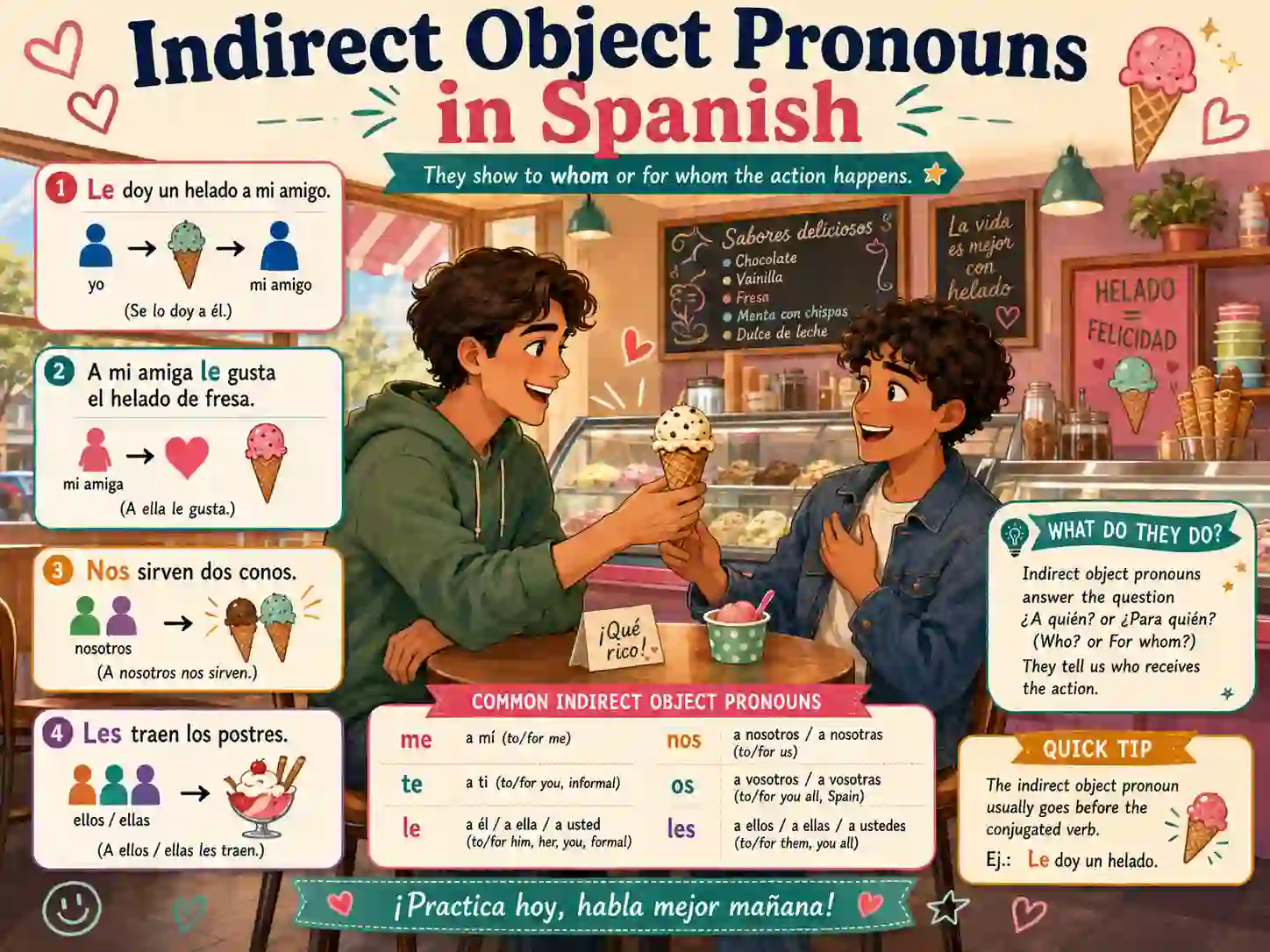
Definition
What is an indirect object in Spanish?
An indirect object is usually the recipient, beneficiary, listener or person affected by an action. It commonly answers to whom? or for whom?.
In Doy el libro a Ana, the book is the direct object because it is the thing being given. Ana is the indirect object because she receives the book.
Le doy el libro a Ana.
Ana receives the book.
Te explico la regla.
You receive the explanation.
Me gusta el español.
The speaker experiences the reaction.
Pronoun table
Spanish indirect object pronouns at a glance
The pronoun is selected according to the person and number of the recipient or affected person.
| Meaning | Pronoun | Spanish example | English meaning | Grammar note |
|---|---|---|---|---|
| to or for me | me | Me escribes. | You write to me. | First-person singular. |
| to or for you | te | Te mando un mensaje. | I send you a message. | Informal singular. |
| to or for him, her or usted | le | Le doy el libro. | I give him, her or you the book. | Singular third person or formal you. |
| to or for us | nos | Nos explican la regla. | They explain the rule to us. | First-person plural. |
| to or for you all in Spain | os | Os envío el correo. | I send you all the email. | Mainly used in Spain. |
| to or for them or ustedes | les | Les escribo. | I write to them or to you all. | Plural third person or ustedes. |
Identify the object
How to find the indirect object
Start with the verb and identify the person who receives, benefits from or experiences the action.
Find the action
Determine what the verb expresses.
Explico la regla a Luis.
Find the thing involved
The thing explained is the direct object.
What do I explain? La regla.
Find the recipient
The person receiving the explanation is indirect.
To whom? A Luis → le.
| Sentence | Question | Indirect object | Pronoun sentence |
|---|---|---|---|
| Escribo a Ana. | To whom do I write? | a Ana | Le escribo. |
| Doy el libro a Luis. | To whom do I give the book? | a Luis | Le doy el libro. |
| Compramos flores para mi madre. | For whom do we buy flowers? | para mi madre | Le compramos flores. |
| Explico la lección a los alumnos. | To whom do I explain the lesson? | a los alumnos | Les explico la lección. |
A person can also be a direct object: Veo a Ana → La veo. Always check the function of the person in relation to the verb.
Third-person forms
Le and les: number matters, gender does not
Le refers to one recipient and can mean “to him”, “to her” or “to you” in formal singular address. Les refers to more than one recipient or to ustedes.
| Pronoun | Possible meaning | Basic example | Clarified example |
|---|---|---|---|
| le | to him | Le escribo. | Le escribo a él. |
| le | to her | Le escribo. | Le escribo a ella. |
| le | to you, formal singular | Le escribo. | Le escribo a usted. |
| les | to them | Les escribo. | Les escribo a ellos. |
| les | to you all | Les escribo. | Les escribo a ustedes. |
Word position
Where do indirect object pronouns go?
Indirect object pronouns normally go before a conjugated verb. They can attach to infinitives, gerunds and affirmative commands.
| Verb form | Pronoun position | Spanish example | English meaning |
|---|---|---|---|
| Conjugated verb | Before the verb | Le escribo. | I write to him or her. |
| Compound tense | Before the auxiliary | Le he escrito. | I have written to him or her. |
| Infinitive | Before the conjugated verb or attached | Le voy a escribir. / Voy a escribirle. | I am going to write to him or her. |
| Gerund | Before the conjugated verb or attached | Le estoy escribiendo. / Estoy escribiéndole. | I am writing to him or her. |
| Affirmative command | Attached to the command | Escríbele. | Write to him or her. |
| Negative command | Before the verb | No le escribas. | Do not write to him or her. |
Affected person
Indirect object pronouns with gustar-type verbs
Verbs such as gustar, encantar, interesar, importar, doler, molestar and parecer use an indirect object pronoun to identify the person experiencing the reaction.
| Pronoun | Spanish example | Natural English | Spanish sentence logic |
|---|---|---|---|
| me | Me gusta el español. | I like Spanish. | Spanish is pleasing to me. |
| te | Te interesa la historia. | You are interested in history. | History interests you. |
| le | Le duele la cabeza. | His or her head hurts. | The pain affects him or her. |
| nos | Nos encanta viajar. | We love travelling. | Travelling delights us. |
| les | Les importa mucho. | It matters a lot to them. | The issue matters to them. |
Me gusta el libro
Use a singular verb when the thing liked is singular.
Me gusta el libro.
Me gustan los libros
Use a plural verb when the things liked are plural.
Me gustan los libros.
Me gusta viajar
An infinitive normally takes a singular form of gustar.
Nos gusta aprender.
Object doubling
Why Spanish says le escribí a Ana
Spanish frequently uses an indirect object pronoun together with the full recipient phrase. The pronoun and the full phrase refer to the same person.
| Pronoun | Full recipient | Spanish sentence | English meaning |
|---|---|---|---|
| le | a Ana | Le escribí a Ana. | I wrote to Ana. |
| le | a mi profesor | Le pregunté algo a mi profesor. | I asked my teacher something. |
| les | a mis padres | Les mandé un mensaje a mis padres. | I sent my parents a message. |
| les | a los estudiantes | Les expliqué la regla a los estudiantes. | I explained the rule to the students. |
The full phrase can clarify an ambiguous pronoun: Le escribo could refer to him, her or usted. Le escribo a Ana removes the ambiguity.
Emphasis and contrast
A mí me, a ti te and a ella le
An additional a-phrase can add emphasis, contrast or clarification. The short pronoun remains in the sentence.
| Full phrase | Pronoun | Spanish example | Main function |
|---|---|---|---|
| a mí | me | A mí me gusta. | Emphasis or contrast. |
| a ti | te | A ti te parece fácil. | Emphasises the listener. |
| a él / a ella | le | A ella le interesa. | Clarifies the gender or identity. |
| a nosotros | nos | A nosotros nos importa. | Contrasts us with other people. |
| a ellos / a ustedes | les | A ellos les encanta. | Clarifies the plural group. |
A mí me gusta is correct. A mí gusta is not the normal Spanish structure.
Two object pronouns
Why le and les become se before lo, la, los and las
When an indirect object pronoun appears with a third-person direct object pronoun, le or les changes to se.
| Underlying combination | Correct form | Incorrect form | English meaning |
|---|---|---|---|
| le + lo | Se lo doy. | Le lo doy. | I give it to him or her. |
| le + la | Se la mando. | Le la mando. | I send it to him or her. |
| les + los | Se los explico. | Les los explico. | I explain them to them. |
| les + las | Se las compro. | Les las compro. | I buy them for them. |
Useful verbs
Common verbs with indirect object pronouns
dar
Le doy una respuesta.
I give him or her an answer.
decir
Te digo la verdad.
I tell you the truth.
mandar
Nos mandan un correo.
They send us an email.
explicar
Les explico el problema.
I explain the problem to them.
preguntar
Le pregunto algo.
I ask him or her something.
mostrar
Me muestra la foto.
He or she shows me the photo.
Mini practice
Practice Spanish indirect object pronouns
Answer each exercise before opening the solution.
Exercise 1: choose the pronoun
- Yo escribo a Ana.
- Ella explica la regla a nosotros.
- Compramos flores para mi madre.
- El profesor manda tareas a los alumnos.
Show answers
1. Le escribo.
2. Nos explica la regla.
3. Le compramos flores.
4. Les manda tareas.
Exercise 2: add clarification
- Le escribo. — add a Luis
- Les explico la regla. — add a los estudiantes
- Me gusta el español. — add a mí
- Le duele la cabeza. — add a ella
Show answers
1. Le escribo a Luis.
2. Les explico la regla a los estudiantes.
3. A mí me gusta el español.
4. A ella le duele la cabeza.
Exercise 3: use two pronouns
- Doy el libro a Ana.
- Mando la carta a Luis.
- Explico las reglas a ellos.
- Compro los billetes para ti.
Show answers
1. Se lo doy.
2. Se la mando.
3. Se las explico.
4. Te los compro.
Connected lessons
Continue with these Spanish pronoun pages
These lessons connect indirect objects with direct objects, double-pronoun order, placement rules and the wider pronoun system.
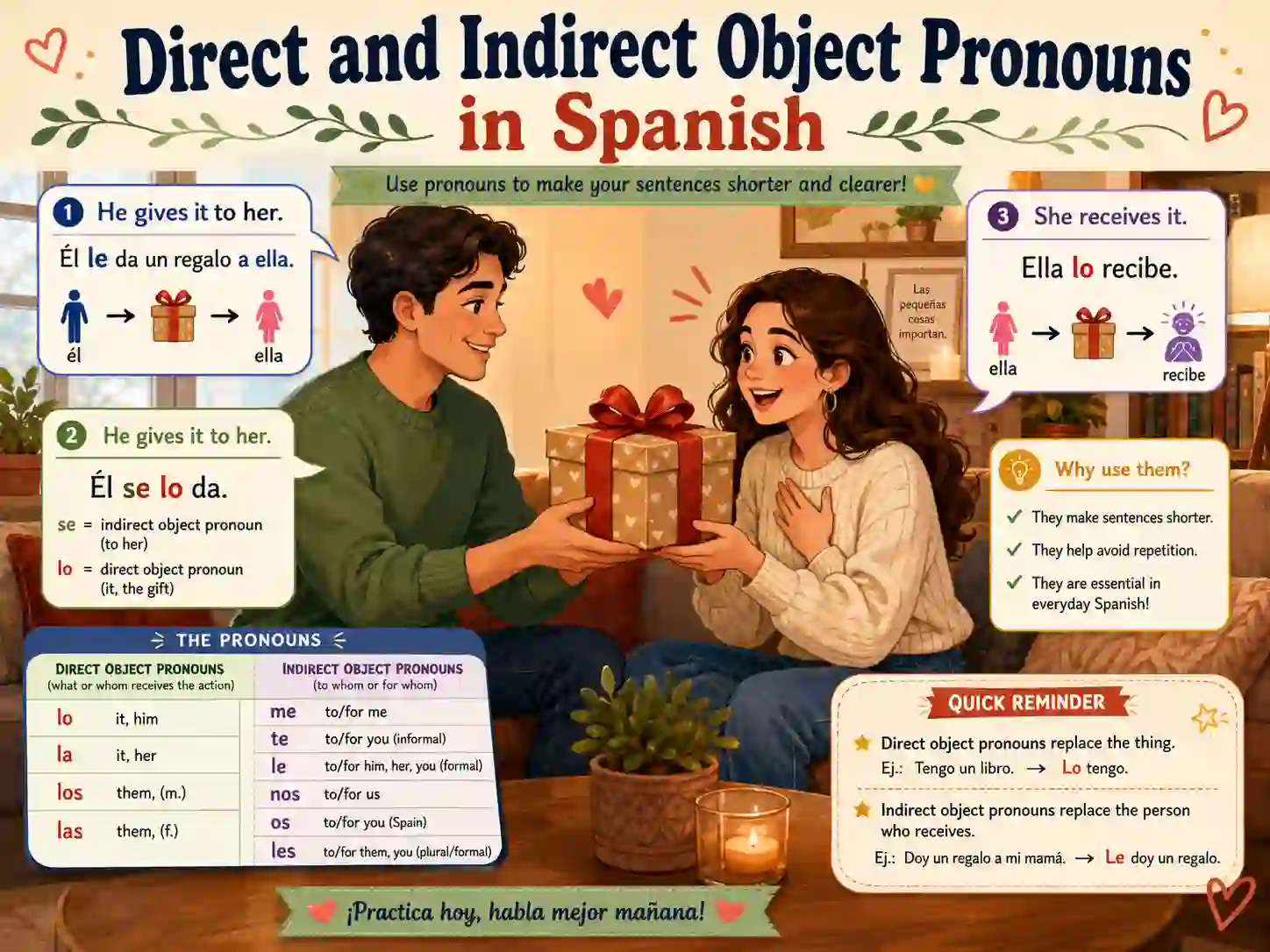
Direct and Indirect Object Pronouns
Compare direct and indirect objects and learn combinations such as me lo and se la.
Open lesson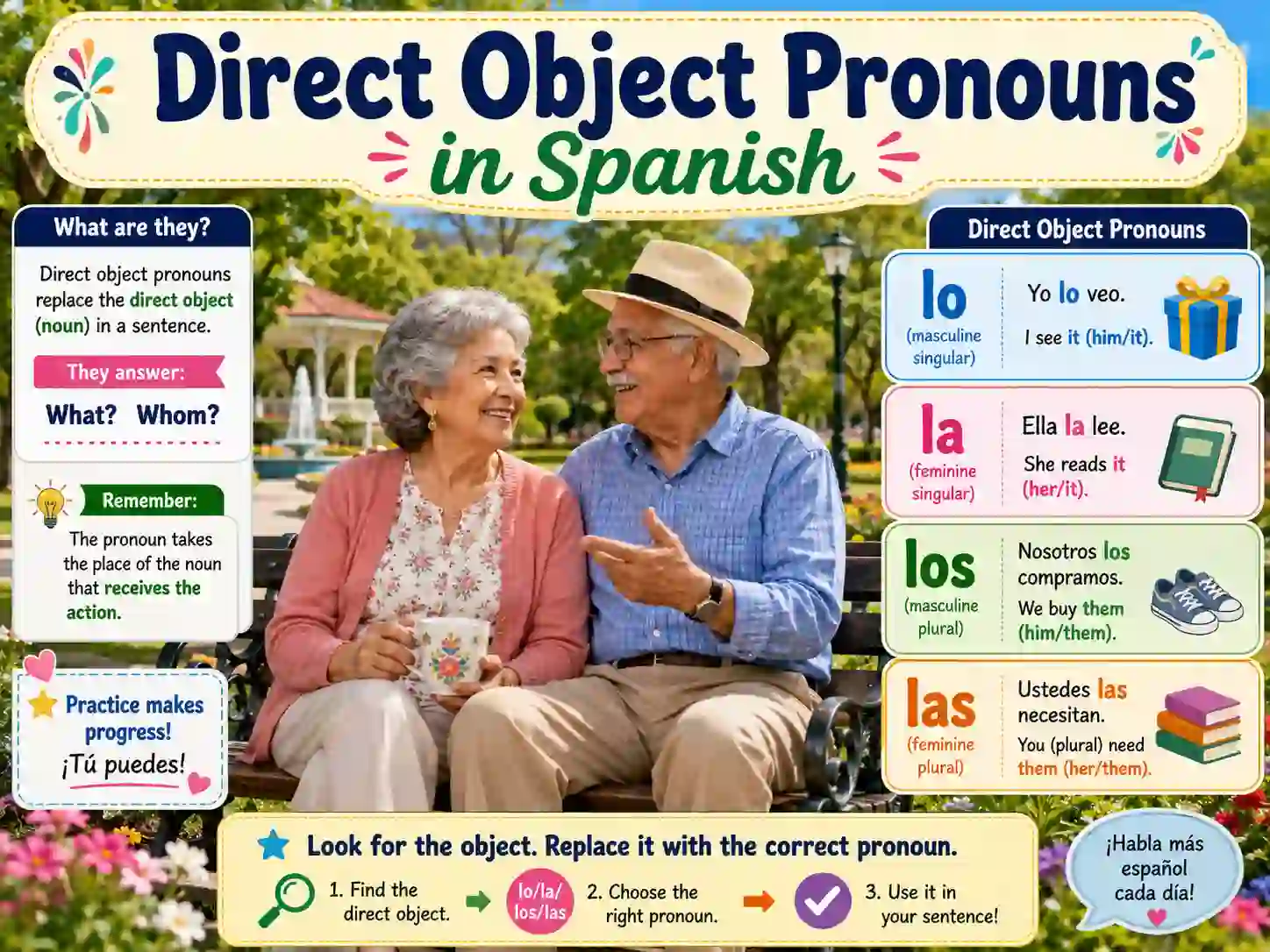
Spanish Direct Object Pronouns
Compare indirect le and les with direct lo, la, los and las.
Open lesson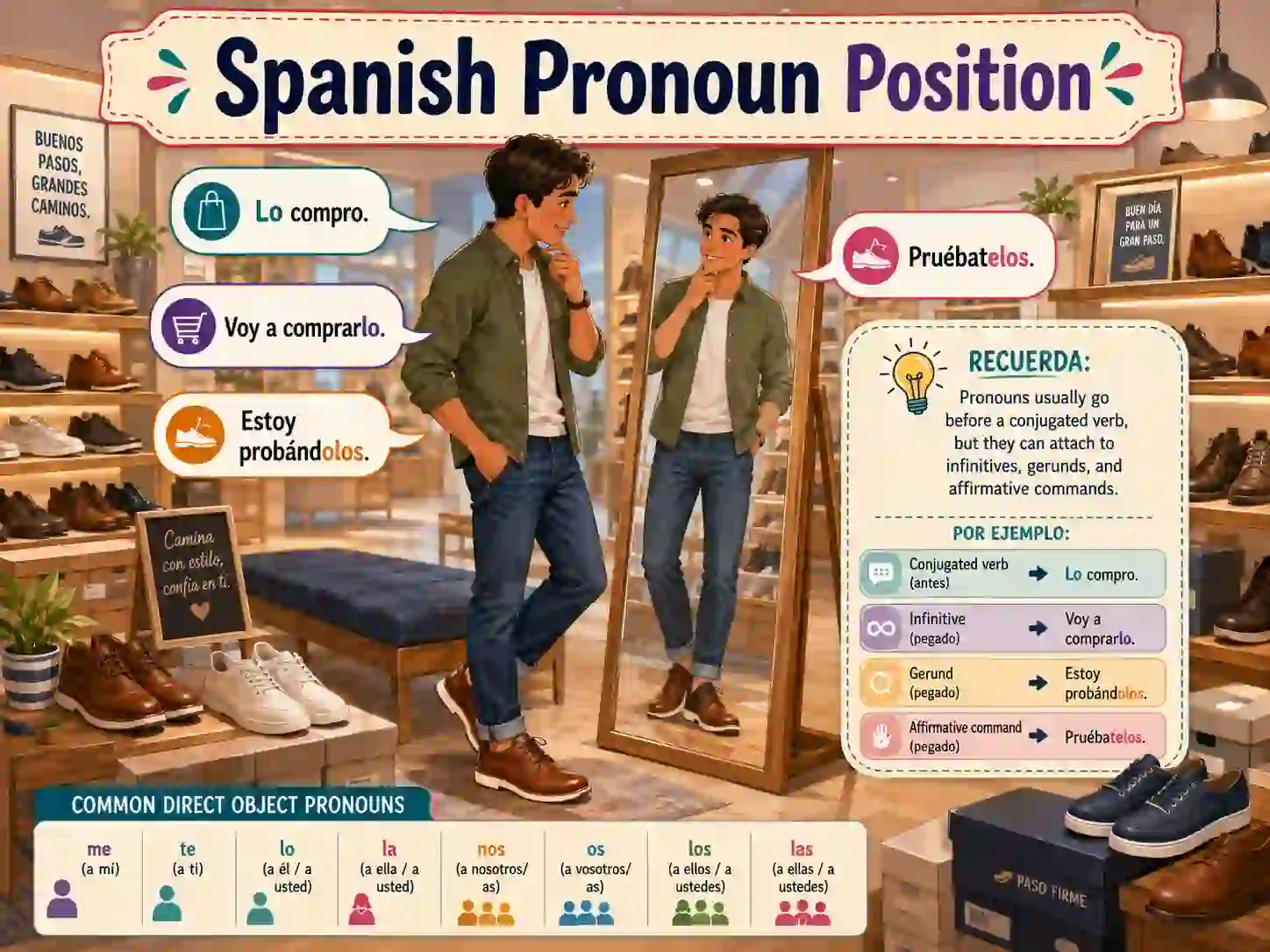
Spanish Pronoun Position
Learn where object pronouns go with conjugated verbs, infinitives, gerunds and commands.
Open lesson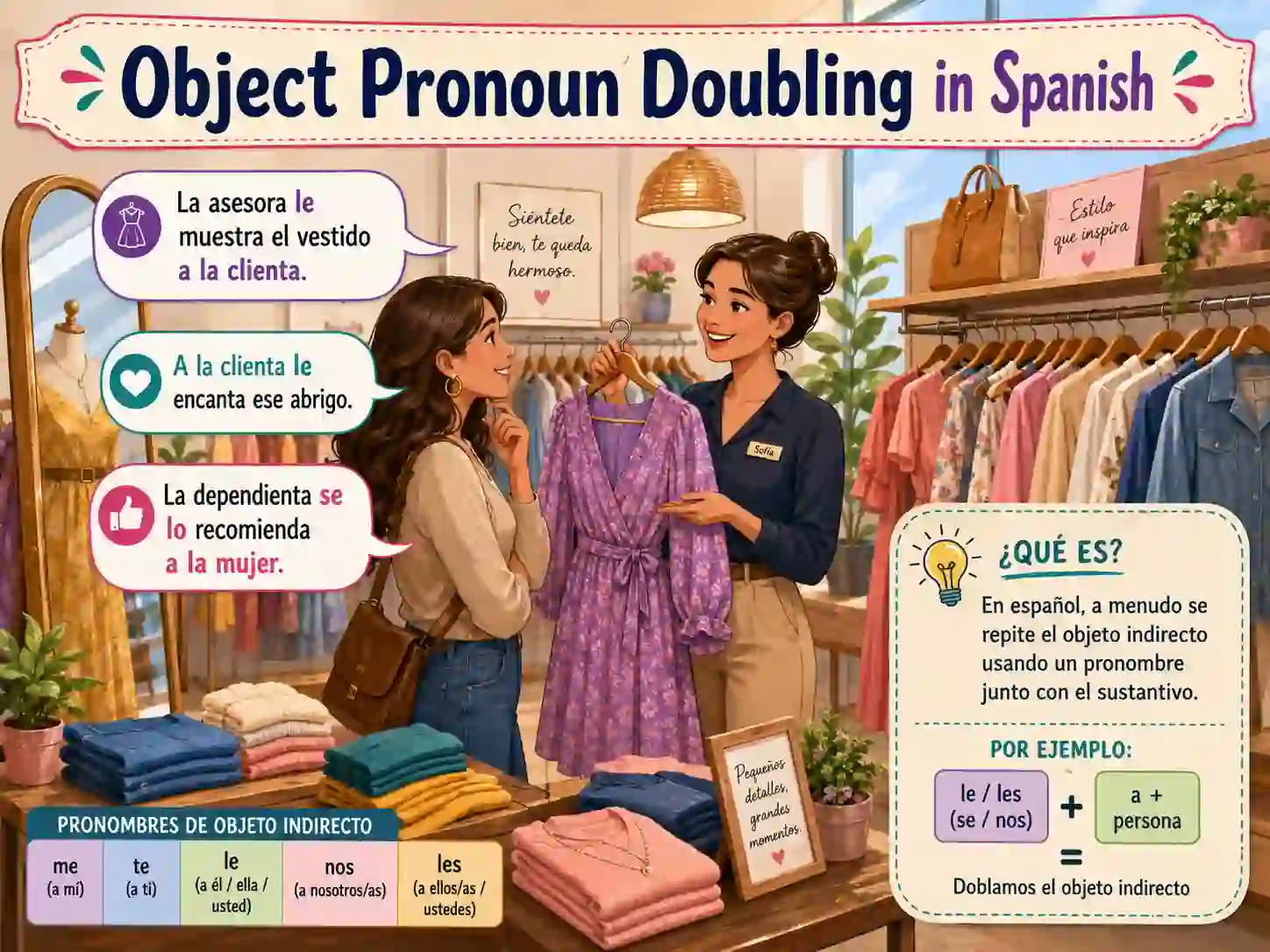
Object Pronoun Doubling
Understand Le escribí a Ana, A Juan lo vi and A mí me gusta.
Open lesson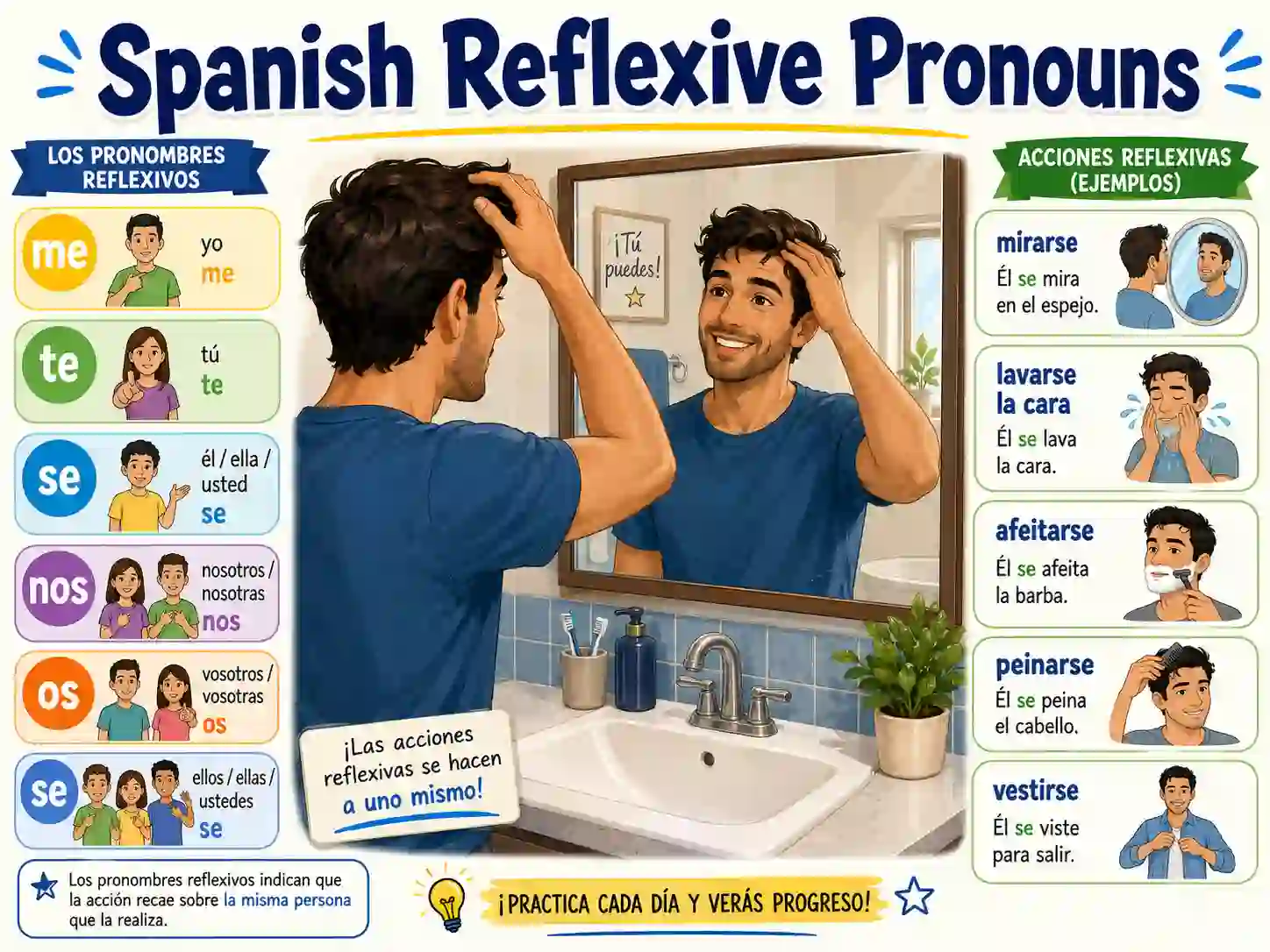
Spanish Reflexive Pronouns
Compare indirect-object forms with reflexive me, te, se, nos and os.
Open lesson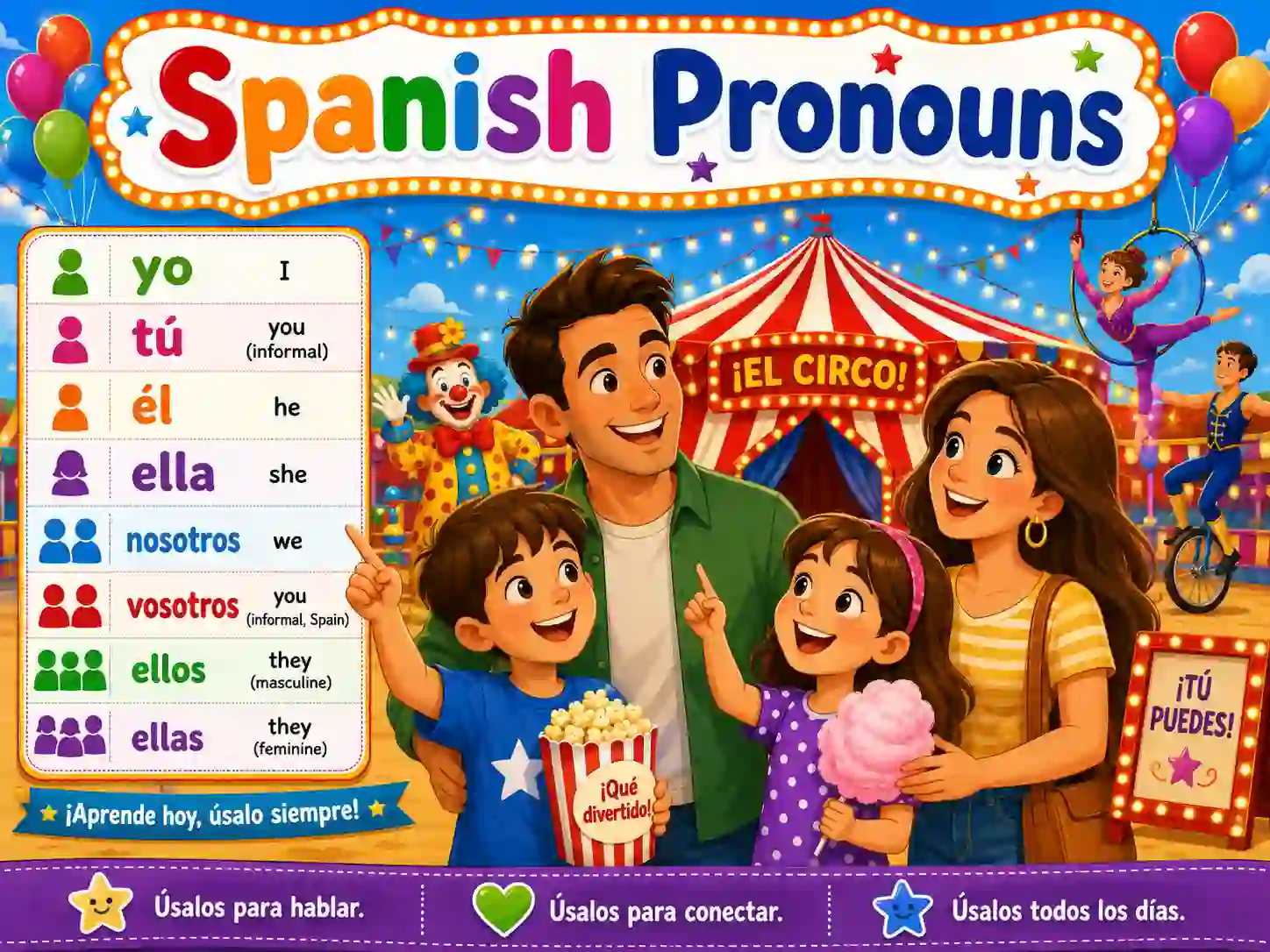
Spanish Pronouns
Return to the complete overview of subject, object, reflexive, possessive and relative pronouns.
Open overviewCommon errors
Common mistakes with indirect object pronouns
- Confusing direct and indirect objects: use le for a recipient, but normally lo or la for a direct object.
- Thinking every phrase with a is indirect: Veo a Ana has a direct object: La veo.
- Using le for multiple recipients: use les: Les escribí a mis padres.
- Dropping the pronoun with gustar: say Me gusta or A mí me gusta, not A mí gusta.
- Using le lo or les la: use se lo, se la, se los or se las.
- Putting the pronoun after a conjugated verb: say Le escribo, not Escribo le.
Frequently asked questions
Questions about Spanish indirect object pronouns
What are Spanish indirect object pronouns?
The forms are me, te, le, nos, os and les. They identify the recipient, beneficiary or affected person.
What does le mean in Spanish?
Le can mean “to him”, “to her” or “to you” in formal singular address. It does not show gender.
What is the difference between le and les?
Le refers to one recipient. Les refers to multiple recipients or to ustedes.
Why does Spanish say le escribí a Ana?
Spanish commonly uses the short indirect object pronoun together with the full recipient phrase. Both elements refer to Ana.
Why does Spanish say me gusta?
With gustar, the thing liked is the grammatical subject and the person experiencing the reaction is expressed with an indirect object pronoun.
Why does le lo become se lo?
Le and les change to se before lo, la, los and las.
Practice and support
Practise indirect object pronouns in complete sentences
Indirect object pronouns become easier when you practise recipients, gustar-type verbs, pronoun doubling, word position and double-pronoun combinations in context.
Spanish Tutoring
Work on pronouns, homework, sentence correction and individual grammar problems.
Private Spanish Lessons
Practise le escribo, me gusta, se lo doy and natural sentence patterns.
Spanish Grammar
Continue with verbs, tenses, pronouns, prepositions and sentence structures.

About MundoDele
Spanish learning connected with culture and real life
MundoDele combines clear Spanish grammar explanations with private lessons, tutoring, DELE and SIELE preparation, Business Spanish, cultural context and travel experiences from the Spanish-speaking world.
The grammar guides use practical examples, connected lessons and clear sentence logic to help international learners move from individual rules to confident Spanish use.