
MundoDele Spanish Grammar
Direct and Indirect Object Pronouns in Spanish
Learn how Spanish direct and indirect object pronouns replace people and things in a sentence. This guide explains me, te, lo, la, le, nos, os, los, las and les, plus combinations such as me lo, te la and se los.
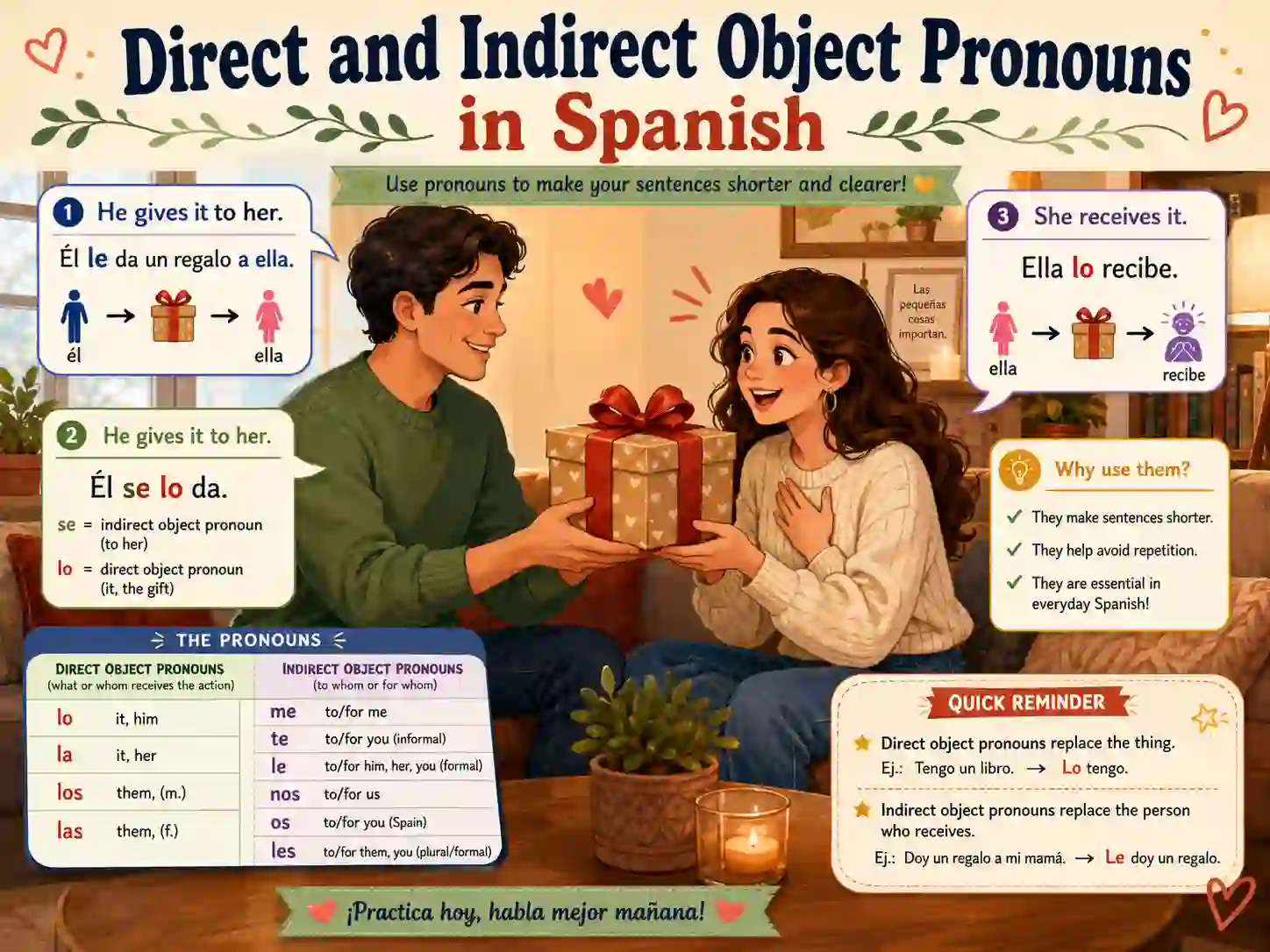
Core difference
Direct vs indirect object pronouns in Spanish
The difference depends on the function of the object. A direct object receives the action directly. An indirect object identifies the recipient, beneficiary or person affected.
Veo el libro → Lo veo.
What do I see? The book.
Escribo a Ana → Le escribo.
To whom do I write? To Ana.
Doy el libro a Ana → Se lo doy.
I give it to her.
Find the verb
Start with the action before identifying the objects.
Doy el libro a Ana.
Ask what or whom
The answer is normally the direct object.
What do I give? El libro.
Ask to whom or for whom
The answer is normally the indirect object.
To whom do I give it? A Ana.
Object-pronoun table
Direct and indirect object pronouns at a glance
The first- and second-person forms overlap in both systems. The clearest difference appears in the third person: direct lo, la, los, las versus indirect le, les.
| Person | Direct object | Indirect object | Direct example | Indirect example |
|---|---|---|---|---|
| First person singular | me | me | Me ve. | Me escribe. |
| Second person singular | te | te | Te veo. | Te compro un café. |
| Third person singular | lo / la | le | Lo veo. La conozco. | Le escribo. |
| First person plural | nos | nos | Nos llama. | Nos explica la regla. |
| Second person plural in Spain | os | os | Os veo. | Os mando un mensaje. |
| Third person plural | los / las | les | Los veo. Las conozco. | Les escribo. |
Direct object
Direct object pronouns: me, te, lo, la, nos, os, los and las
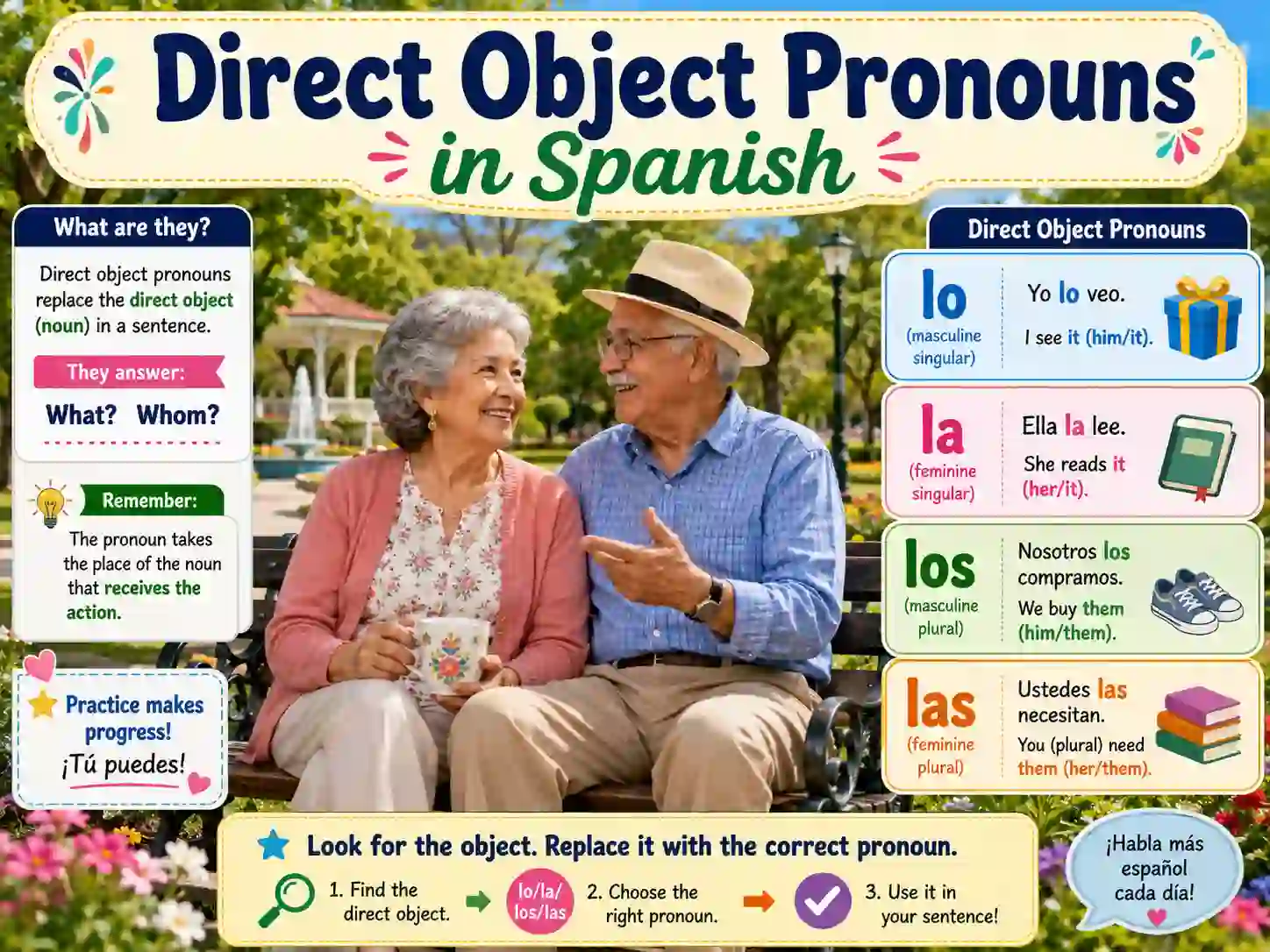
Direct object pronouns replace the person or thing directly affected by the verb. Third-person forms agree with the replaced noun in gender and number.
| Replaced object | Pronoun | Sentence with noun | Sentence with pronoun |
|---|---|---|---|
| Me | me | Ana ve a Juan y a mí. | Ana me ve. |
| You, informal | te | Veo a ti. | Te veo. |
| Masculine singular | lo | Veo el libro. | Lo veo. |
| Feminine singular | la | Conozco a Ana. | La conozco. |
| Us | nos | El profesor ve a nosotros. | El profesor nos ve. |
| You all in Spain | os | Veo a vosotros. | Os veo. |
| Masculine or mixed plural | los | Compro los libros. | Los compro. |
| Feminine plural | las | Leo las cartas. | Las leo. |
Continue with the detailed lesson: Spanish Direct Object Pronouns .
Indirect object
Indirect object pronouns: me, te, le, nos, os and les
Indirect object pronouns identify the recipient, beneficiary or person affected by an action. The forms le and les do not show gender.
| Meaning | Pronoun | Spanish example | English meaning |
|---|---|---|---|
| To or for me | me | Me escribe. | He or she writes to me. |
| To or for you | te | Te compro un café. | I buy you a coffee. |
| To or for him, her or usted | le | Le doy el libro. | I give him, her or you the book. |
| To or for us | nos | Nos explica la regla. | He or she explains the rule to us. |
| To or for you all in Spain | os | Os mando un mensaje. | I send you all a message. |
| To or for them or ustedes | les | Les escribo. | I write to them or to you all. |
Continue with the detailed lesson: Spanish Indirect Object Pronouns .
Two object pronouns
Using direct and indirect object pronouns together
When both pronouns appear in one sentence, the indirect object pronoun comes first. The direct object pronoun comes second.
Indirect before direct
Use combinations such as me lo, te la and nos los.
Te lo explico.
Le and les become se
Use se before lo, la, los and las.
Le doy el libro → Se lo doy.
Context identifies se
The full person can be added for clarity: Se lo doy a Ana.
Se las mando a ellos.
| Full sentence | Indirect pronoun | Two pronouns | English meaning |
|---|---|---|---|
| Doy el libro a Ana. | Le doy el libro. | Se lo doy. | I give it to her. |
| Compro las flores para ti. | Te compro las flores. | Te las compro. | I buy them for you. |
| Mandamos los documentos a Luis. | Le mandamos los documentos. | Se los mandamos. | We send them to him. |
| Explico la regla a mis alumnos. | Les explico la regla. | Se la explico. | I explain it to them. |
Use se lo, se la, se los and se las.
Word position
Where do direct and indirect object pronouns go?
Object-pronoun position depends mainly on the verb form. Pronouns go before a normal conjugated verb but attach to infinitives, gerunds and affirmative commands.
| Verb form | Pronoun position | Spanish example | English meaning |
|---|---|---|---|
| Conjugated verb | Before the verb | Se lo doy. | I give it to him, her or them. |
| Compound tense | Before the auxiliary | Se lo he dado. | I have given it to him, her or them. |
| Infinitive | Before the conjugated verb or attached | Se lo voy a dar. / Voy a dárselo. | I am going to give it. |
| Gerund | Before the conjugated verb or attached | Se lo estoy dando. / Estoy dándoselo. | I am giving it. |
| Affirmative command | Attached to the command | Dáselo. | Give it to him, her or them. |
| Negative command | Before the verb | No se lo des. | Do not give it to him, her or them. |
Continue with the full placement guide: Spanish Pronoun Position .
Pronoun doubling
Why Spanish sometimes repeats the object
Spanish can use an object pronoun together with the full object phrase. This is especially common with indirect objects, fronted objects and verbs such as gustar.
| Structure | Spanish example | Doubled elements | English meaning |
|---|---|---|---|
| Indirect object doubling | Le escribí a Ana. | le + a Ana | I wrote to Ana. |
| Plural indirect object | Les mandé un mensaje a mis padres. | les + a mis padres | I sent my parents a message. |
| Fronted direct object | A Juan lo vi ayer. | a Juan + lo | I saw Juan yesterday. |
| Gustar-type structure | A mí me gusta. | a mí + me | I like it. |
Continue with: Object Pronoun Doubling in Spanish .
Mini practice
Practice direct and indirect object pronouns
Answer each exercise before opening the solution.
Exercise 1: direct or indirect?
- Veo la película.
- Escribo a mi hermano.
- Compro el pan.
- Explico la regla a los estudiantes.
Show answers
1. Direct: la película → la
2. Indirect: a mi hermano → le
3. Direct: el pan → lo
4. Direct: la regla → la;
indirect: a los estudiantes → les
Exercise 2: replace the object
- Veo el coche.
- Leo las cartas.
- Escribo a Ana.
- Compro flores para mis padres.
Show answers
1. Lo veo.
2. Las leo.
3. Le escribo.
4. Les compro flores.
Exercise 3: use two pronouns
- Doy el libro a Ana.
- Mando las fotos a Luis.
- Compro los billetes para ti.
- Explicamos la regla a ellos.
Show answers
1. Se lo doy.
2. Se las mando.
3. Te los compro.
4. Se la explicamos.
Connected lessons
Continue with these Spanish pronoun pages
Use the detail pages to study each object-pronoun system, pronoun position, doubling and related reflexive forms.
Spanish Direct Object Pronouns
Study me, te, lo, la, nos, os, los and las in detail.
Open lesson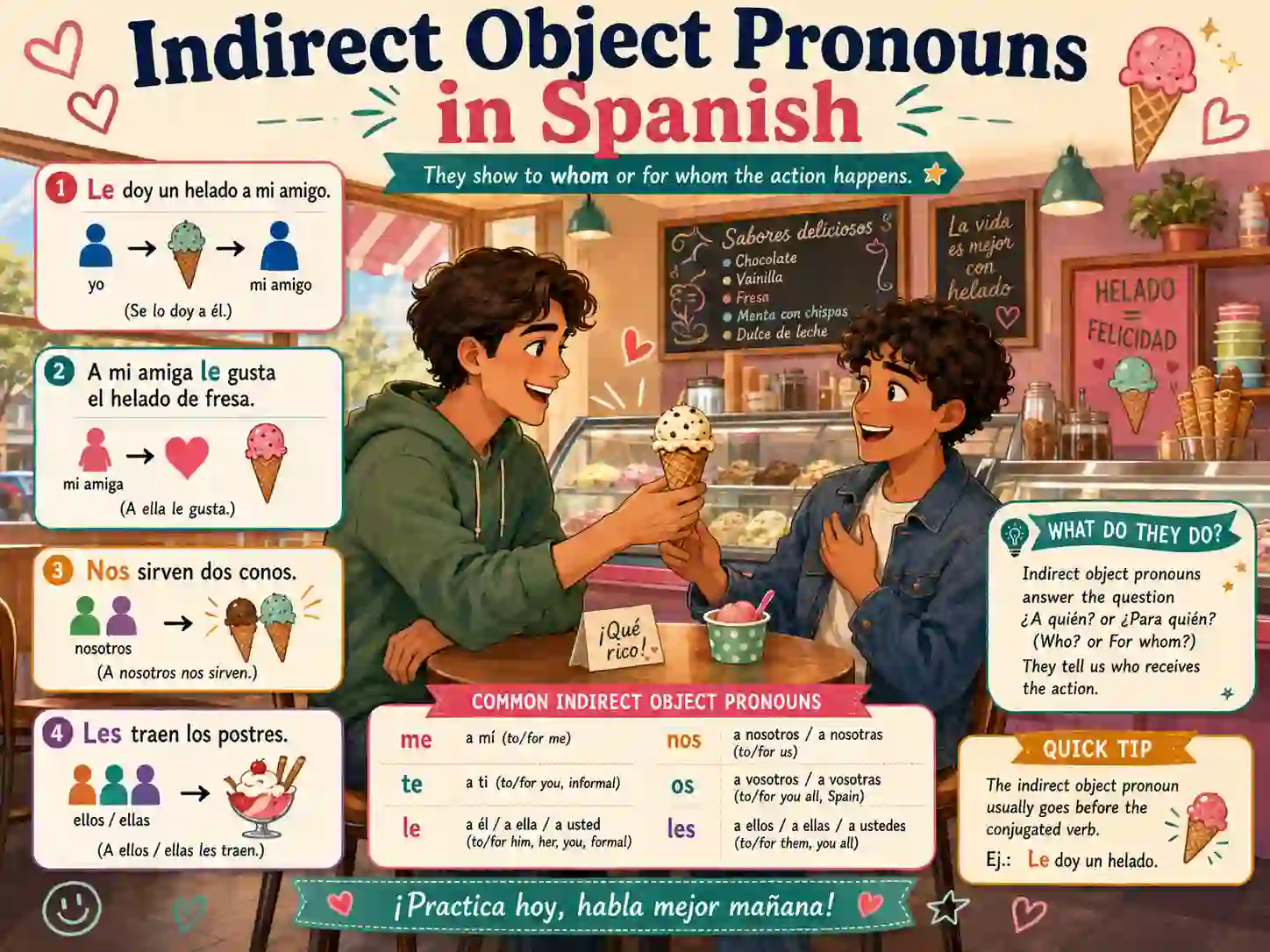
Spanish Indirect Object Pronouns
Learn recipients, beneficiaries, le, les and indirect-object clarification.
Open lesson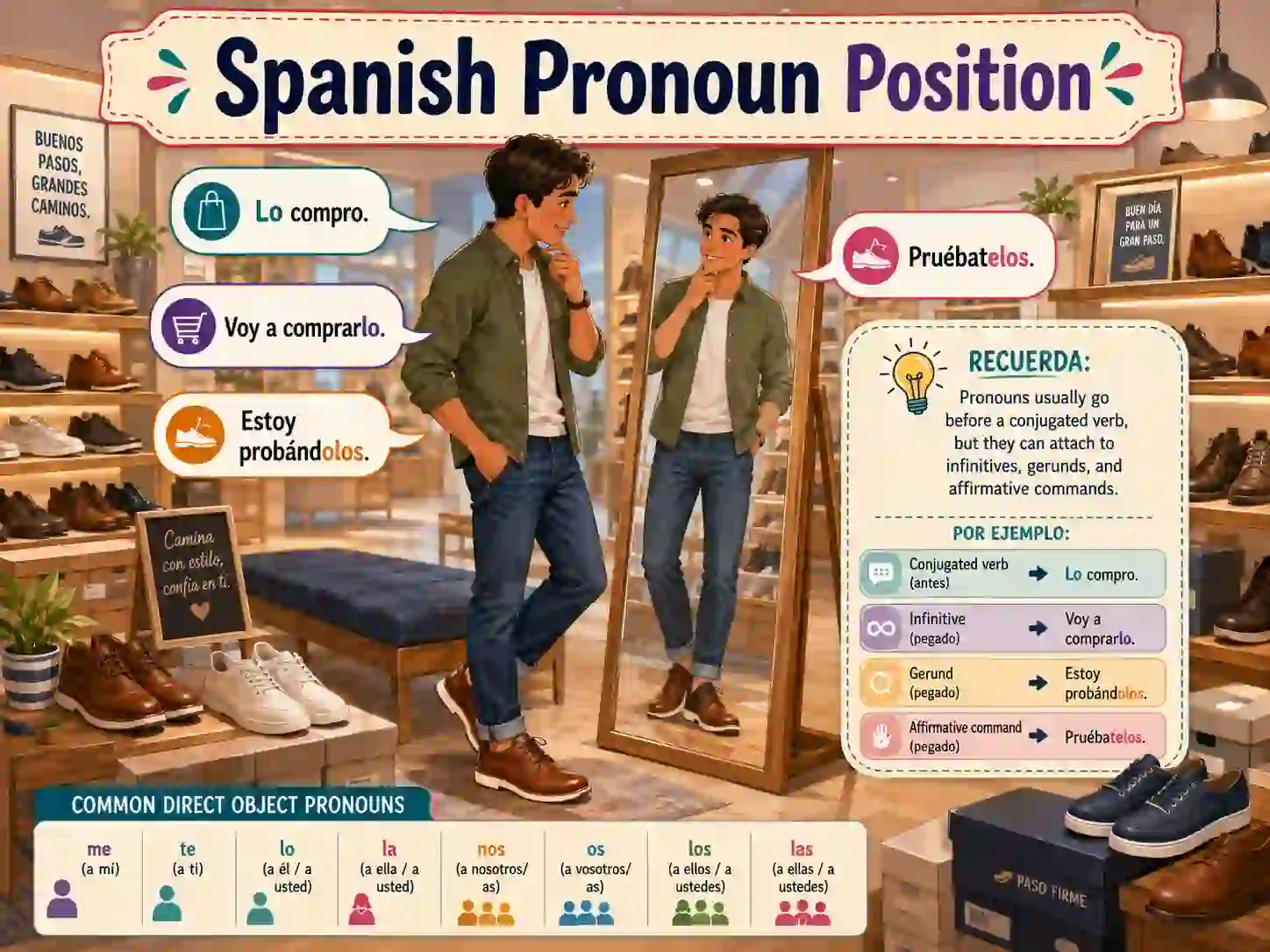
Spanish Pronoun Position
Learn where pronouns go with conjugated verbs, infinitives, gerunds and commands.
Open lesson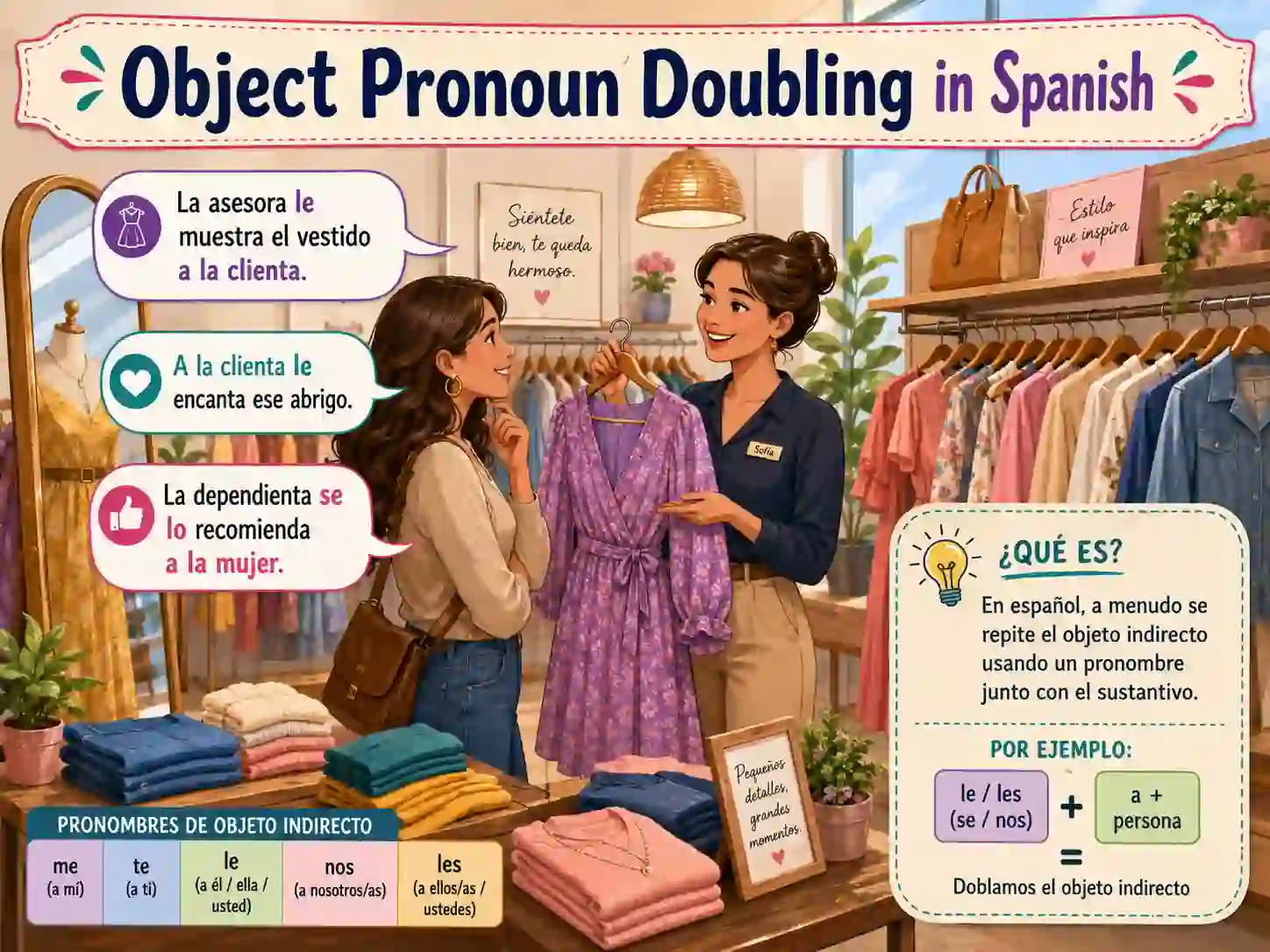
Object Pronoun Doubling
Understand Le escribí a Ana, A Juan lo vi and A mí me gusta.
Open lesson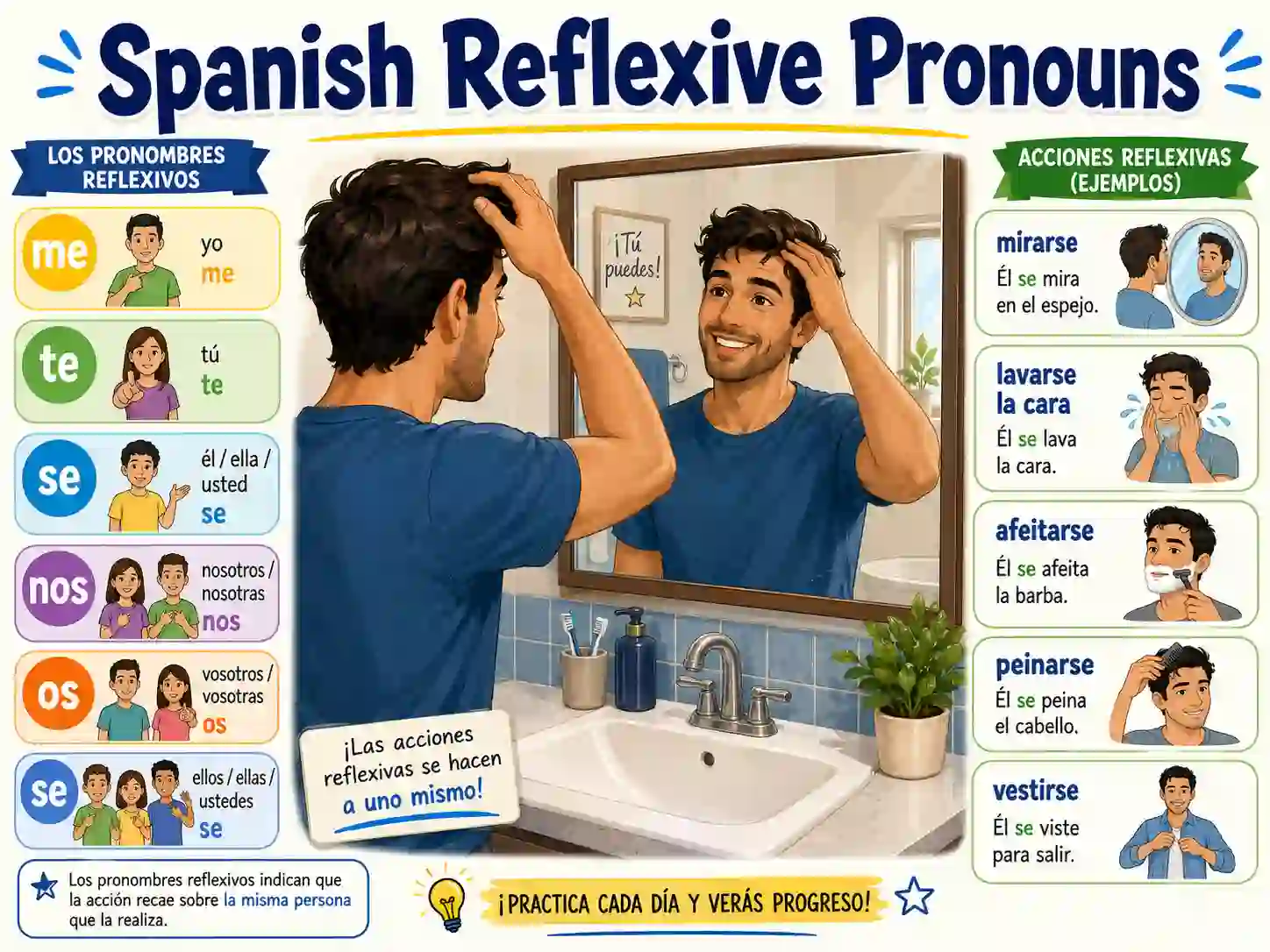
Spanish Reflexive Pronouns
Compare object-pronoun forms with reflexive me, te, se, nos and os.
Open lesson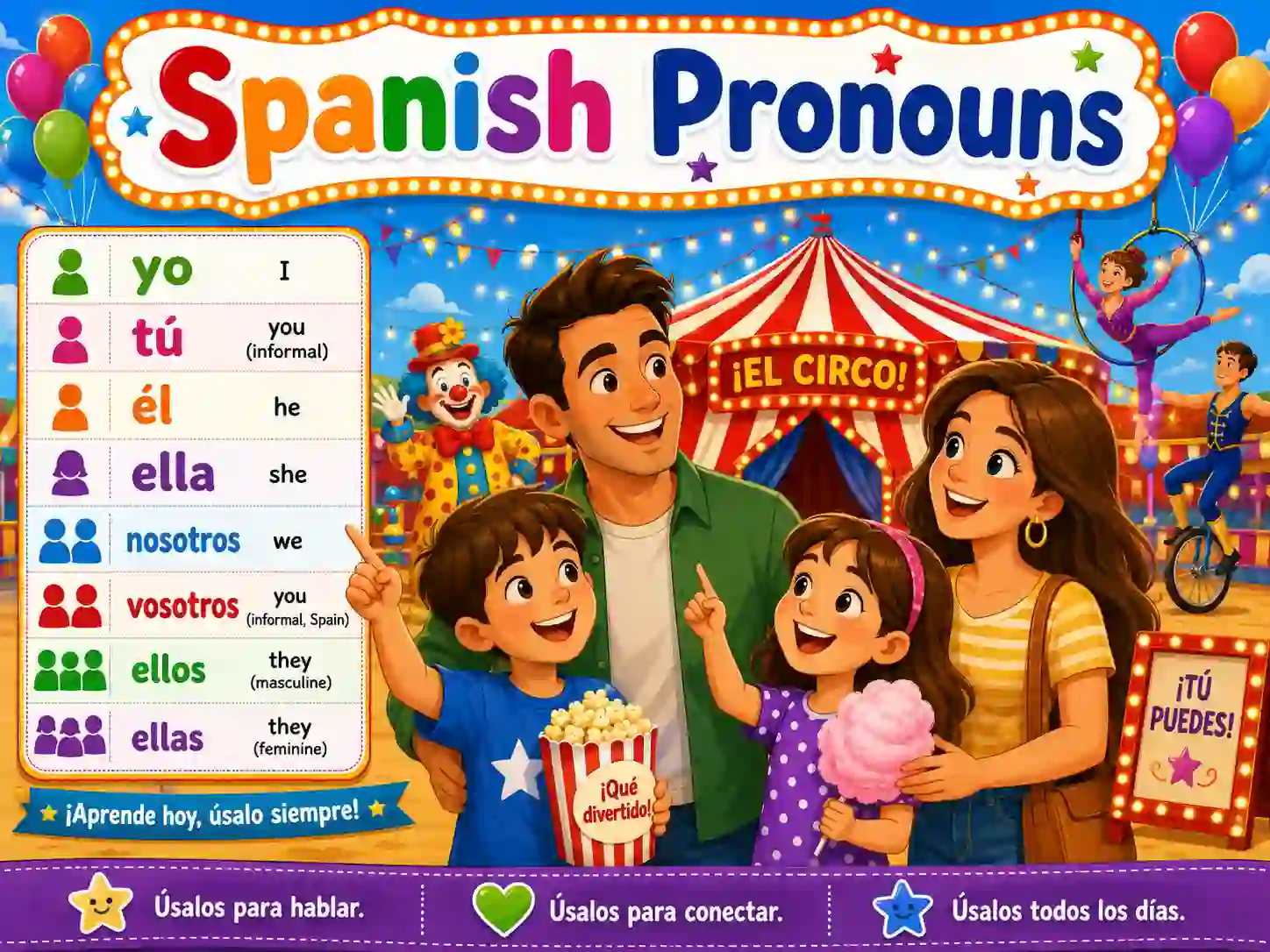
Spanish Pronouns
Return to the complete overview of subject, object, reflexive, possessive and relative pronouns.
Open overviewCommon errors
Common mistakes with Spanish object pronouns
- Using le for every person: direct objects normally require lo, la, los or las.
- Forgetting gender and number: el libro becomes lo, while las cartas becomes las.
- Confusing the questions: direct objects answer “what?” or “whom?”; indirect objects answer “to whom?” or “for whom?”.
- Using le lo or les la: use se lo, se la, se los or se las.
- Putting pronouns after a conjugated verb: say Lo veo, not Veo lo.
- Dropping the pronoun with gustar: say A mí me gusta, not A mí gusta.
Frequently asked questions
Questions about direct and indirect object pronouns
What are direct object pronouns in Spanish?
Direct object pronouns replace the person or thing directly affected by the verb. The forms are me, te, lo, la, nos, os, los and las.
What are indirect object pronouns in Spanish?
Indirect object pronouns identify the recipient, beneficiary or person affected. The forms are me, te, le, nos, os and les.
How do I identify a direct or indirect object?
Ask “what?” or “whom?” to find the direct object. Ask “to whom?” or “for whom?” to find the indirect object.
What is the order of two object pronouns?
The indirect object pronoun comes first and the direct object pronoun comes second: me lo, te la, nos los, se las.
Why does le lo become se lo?
Spanish changes le and les to se before lo, la, los and las.
Where do Spanish object pronouns go?
They normally go before a conjugated verb. They attach to infinitives, gerunds and affirmative commands and appear before negative commands.
Practice and support
Practise object pronouns in complete sentences
Direct and indirect object pronouns become easier when you practise object type, pronoun choice, word order and double-pronoun combinations in real sentences.
Spanish Tutoring
Work on object pronouns, homework, sentence correction and individual grammar problems.
Private Spanish Lessons
Practise lo veo, le escribo, se lo doy and natural sentence patterns.
Spanish Grammar
Continue with verbs, tenses, pronouns, prepositions and sentence structures.

About MundoDele
Spanish learning connected with culture and real life
MundoDele combines clear Spanish grammar explanations with private lessons, tutoring, DELE and SIELE preparation, Business Spanish, cultural context and travel experiences from the Spanish-speaking world.
The grammar guides use practical examples, connected lessons and clear sentence logic to help international learners move from individual rules to confident Spanish use.