
Irregular Verbs in the Spanish Subjunctive
Learn the most important irregular verbs in the Spanish subjunctive: sea, esté, vaya, sepa, dé, haya, tenga, venga, haga, diga, ponga, salga, pueda, quiera and more. This page explains fully irregular verbs, yo-form irregulars, stem-changing verbs, spelling changes, irregular past participles and common irregular imperfect subjunctive forms.
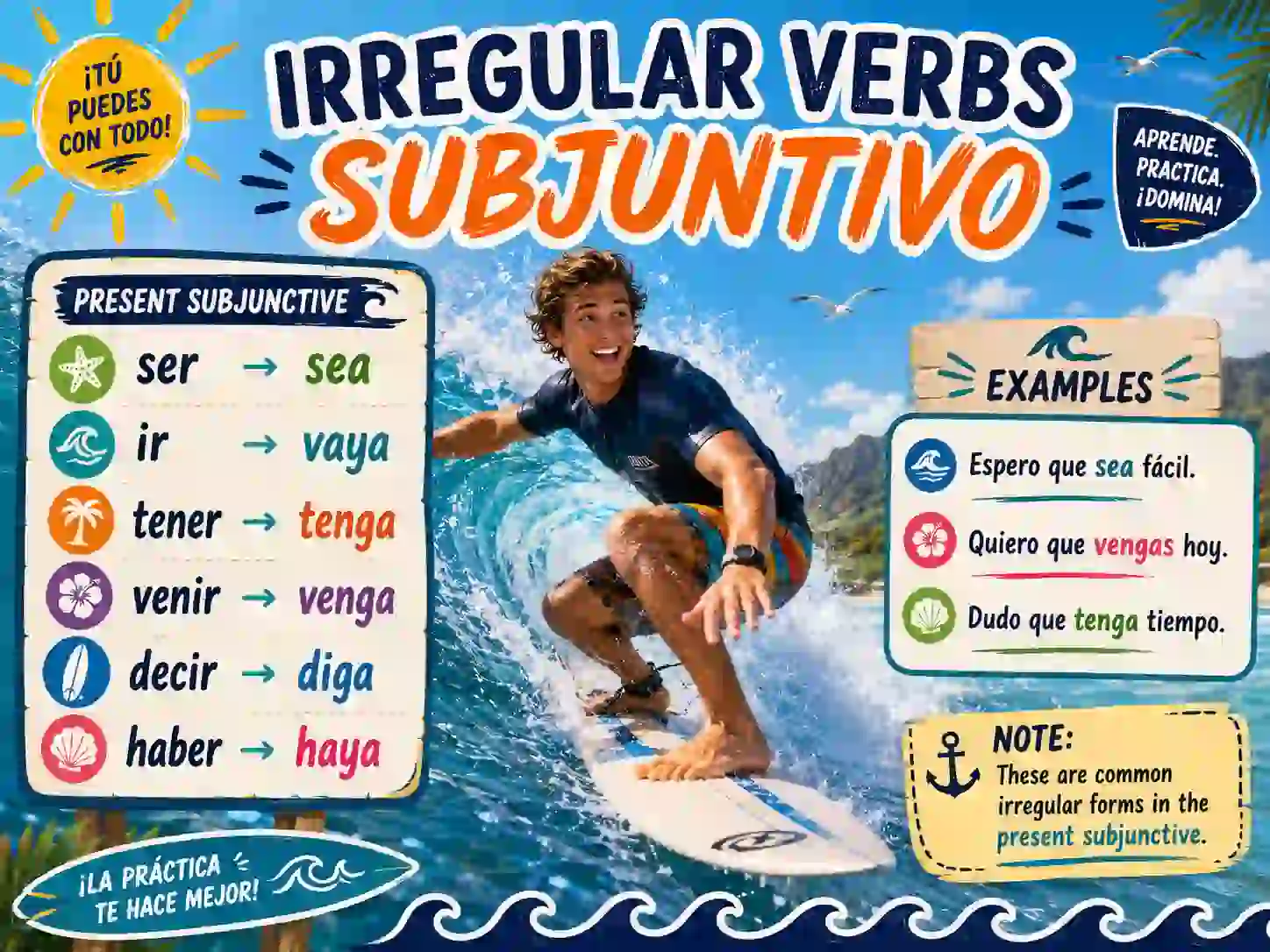
Why learn irregular subjunctive verbs with MundoDele?
Irregular subjunctive forms appear constantly in real Spanish. MundoDele teaches them by pattern, not as a random list: fully irregular verbs, yo-form irregulars, stem changes, spelling changes and compound forms.
The practical goal is simple: recognise forms such as sea, esté, venga, tenga, haga and haya inside real sentence patterns like quiero que vengas, dudo que sea verdad and espero que hayas entendido.
How to use this page
Use this page after learning the regular present subjunctive. First learn the fully irregular verbs. Then study yo-form irregulars, stem-changing verbs and spelling changes. Finally connect these forms with common subjunctive triggers such as quiero que, no creo que, es posible que and para que.
Fully irregular
Some verbs have special forms that must be learned directly.
ser → sea
ir → vaya
haber → haya
Yo-form irregulars
Many irregular forms come from the present indicative yo form.
tengo → tenga
hago → haga
digo → diga
Stem and spelling changes
Some verbs keep stem changes or spelling changes in the subjunctive.
poder → pueda
buscar → busque
empezar → empiece
Main groups of irregular subjunctive verbs
Irregular verbs in the Spanish subjunctive are easier to learn when they are grouped by pattern. Some are fully irregular, some follow the irregular yo form, some keep stem changes, and some change spelling to preserve pronunciation.
| Group | Examples | Typical forms | What to learn |
|---|---|---|---|
| Fully irregular verbs | ser, estar, ir, saber, dar, haber | sea, esté, vaya, sepa, dé, haya | Learn directly as core forms. |
| Yo-form irregulars | tener, venir, hacer, decir, poner, salir | tenga, venga, haga, diga, ponga, salga | Use the irregular yo stem. |
| Stem-changing verbs | poder, querer, pensar, dormir, pedir | pueda, quiera, piense, duerma, pida | Keep or adapt the stem change. |
| Spelling-change verbs | buscar, llegar, empezar | busque, llegue, empiece | Spelling changes preserve sound. |
| Compound subjunctive forms | hacer, decir, ver, poner | haya hecho, haya dicho, haya visto, haya puesto | Learn irregular past participles. |
Fully irregular present subjunctive verbs
These verbs are among the most important irregular forms in Spanish. They appear very often after subjunctive triggers such as quiero que, dudo que, es posible que, me alegra que and para que.
| Infinitive | Present subjunctive forms | Example |
|---|---|---|
| ser | sea, seas, sea, seamos, seáis, sean | Dudo que sea verdad. |
| estar | esté, estés, esté, estemos, estéis, estén | Me alegra que estés aquí. |
| ir | vaya, vayas, vaya, vayamos, vayáis, vayan | Quiero que vayas conmigo. |
| saber | sepa, sepas, sepa, sepamos, sepáis, sepan | Busco a alguien que sepa programar. |
| dar | dé, des, dé, demos, deis, den | Espero que me des una respuesta. |
| haber | haya, hayas, haya, hayamos, hayáis, hayan | Es posible que haya problemas. |
Yo-form irregulars: tenga, venga, haga, diga
Many present subjunctive forms are built from the irregular yo form of the present indicative. Remove the final -o and add the subjunctive endings.
| Infinitive | Present indicative yo | Subjunctive stem | Example |
|---|---|---|---|
| tener | tengo | teng- | No creo que tengas razón. |
| venir | vengo | veng- | Quiero que vengas. |
| hacer | hago | hag- | Prefiero que lo hagas tú. |
| decir | digo | dig- | No quiero que digas eso. |
| poner | pongo | pong- | Es mejor que lo pongas aquí. |
| salir | salgo | salg- | Espero que salga bien. |
| traer | traigo | traig- | Quiero que traigas el libro. |
| oír | oigo | oig- | Espero que me oigas. |
| conocer | conozco | conozc- | Busco a alguien que conozca Madrid. |
| traducir | traduzco | traduzc- | Necesito a alguien que traduzca esto. |
Stem-changing verbs in the subjunctive
Many stem-changing verbs keep their stem change in the present subjunctive. The pattern is especially important with common verbs such as poder, querer, pensar, dormir and pedir.
| Stem change | Infinitive | Present subjunctive forms | Example |
|---|---|---|---|
| e → ie | pensar | piense, pienses, piense, pensemos, penséis, piensen | No creo que piense eso. |
| e → ie | querer | quiera, quieras, quiera, queramos, queráis, quieran | Espero que quieras venir. |
| o → ue | poder | pueda, puedas, pueda, podamos, podáis, puedan | Espero que puedas venir. |
| o → ue | dormir | duerma, duermas, duerma, durmamos, durmáis, duerman | Espero que duermas bien. |
| e → i | pedir | pida, pidas, pida, pidamos, pidáis, pidan | Es mejor que pidas ayuda. |
| e → i | servir | sirva, sirvas, sirva, sirvamos, sirváis, sirvan | Busco algo que sirva. |
| e → ie / e → i | sentir | sienta, sientas, sienta, sintamos, sintáis, sientan | Siento que no te sientas bien. |
Spelling changes: busque, llegue, empiece
Some verbs change spelling in the present subjunctive to keep the same pronunciation. These changes are especially common with verbs ending in -car, -gar and -zar.
| Infinitive | Change | Present subjunctive example | Reason |
|---|---|---|---|
| buscar | c → qu | busque, busques, busque | The k sound is preserved before e. |
| explicar | c → qu | explique, expliques, explique | The k sound is preserved. |
| llegar | g → gu | llegue, llegues, llegue | The hard g sound is preserved before e. |
| pagar | g → gu | pague, pagues, pague | The hard g sound is preserved. |
| empezar | z → c | empiece, empieces, empiece | The spelling changes before e. |
| cruzar | z → c | cruce, cruces, cruce | The spelling changes before e. |
Irregular past participles in compound subjunctive forms
Compound subjunctive forms such as the present perfect subjunctive use haya plus a past participle. If the past participle is irregular, the compound subjunctive form is irregular too.
| Infinitive | Past participle | Present perfect subjunctive | Example |
|---|---|---|---|
| hacer | hecho | haya hecho | No creo que lo haya hecho. |
| decir | dicho | haya dicho | Me sorprende que hayas dicho eso. |
| ver | visto | haya visto | Dudo que lo haya visto. |
| poner | puesto | haya puesto | Espero que hayan puesto la mesa. |
| escribir | escrito | haya escrito | No parece que haya escrito mucho. |
| abrir | abierto | haya abierto | Es posible que hayan abierto ya. |
| volver | vuelto | haya vuelto | No creo que haya vuelto. |
| morir | muerto | haya muerto | Dudo que haya muerto. |
Related page: Present Perfect Subjunctive in Spanish.
Irregular imperfect subjunctive forms
The imperfect subjunctive is formed from the third-person plural preterite. If the preterite stem is irregular, the imperfect subjunctive keeps that irregular stem.
| Infinitive | Preterite base | -ra form | -se form | Example |
|---|---|---|---|---|
| ser / ir | fueron → fue- | fuera | fuese | Si fuera posible, lo haría. |
| tener | tuvieron → tuvie- | tuviera | tuviese | Si tuviera tiempo, iría. |
| estar | estuvieron → estuvie- | estuviera | estuviese | Me alegró que estuvieras allí. |
| poder | pudieron → pudie- | pudiera | pudiese | Ojalá pudiera ayudarte. |
| saber | supieron → supie- | supiera | supiese | Si supiera la respuesta, te la diría. |
| venir | vinieron → vinie- | viniera | viniese | Quería que vinieras. |
| hacer | hicieron → hicie- | hiciera | hiciese | Prefería que lo hicieras tú. |
| decir | dijeron → dije- | dijera | dijese | No quería que dijeras eso. |
Related page: Imperfect Subjunctive in Spanish.
Irregular subjunctive verbs in real sentences
Irregular forms matter because they appear in very common Spanish sentences. Learn them together with their trigger expressions.
| Trigger | Spanish example | Irregular form | English meaning |
|---|---|---|---|
| dudo que | Dudo que sea verdad. | sea | I doubt that it is true. |
| me alegra que | Me alegra que estés aquí. | estés | I am glad that you are here. |
| quiero que | Quiero que vengas. | vengas | I want you to come. |
| no creo que | No creo que tengas razón. | tengas | I do not think you are right. |
| es posible que | Es posible que haya problemas. | haya | It is possible that there are problems. |
| para que | Lo explico para que lo sepas. | sepas | I explain it so that you know it. |
| busco a alguien que | Busco a alguien que pueda ayudarme. | pueda | I am looking for someone who can help me. |
| espero que | Espero que lo hagas bien. | hagas | I hope you do it well. |
Practice exercises: irregular subjunctive verbs
Try to answer before opening the solutions. These exercises focus on fully irregular forms, yo-form irregulars and stem-changing subjunctive forms.
Exercise 1: choose the correct irregular form
- Dudo que ___ verdad. ser
- Me alegra que tú ___ aquí. estar
- Quiero que tú ___ conmigo. venir
- No creo que tú ___ razón. tener
Show answers
1. sea
2. estés
3. vengas
4. tengas
Exercise 2: complete the subjunctive form
- Espero que tú lo ___ bien. hacer
- No quiero que tú ___ eso. decir
- Es posible que ___ problemas. haber
- Busco a alguien que ___ programar. saber
Show answers
1. hagas
2. digas
3. haya
4. sepa
Exercise 3: stem and spelling changes
- Espero que tú ___ venir. poder
- Quiero que tú ___ ayuda. pedir
- Necesito que lo ___ aquí. buscar
- Es mejor que ___ temprano. empezar
Show answers
1. puedas
2. pidas
3. busques
4. empieces
Typical mistakes with irregular subjunctive verbs
- Using indicative forms instead of subjunctive forms: say dudo que sea, not dudo que es.
- Forgetting fully irregular forms: ser → sea, estar → esté, ir → vaya, saber → sepa, dar → dé, haber → haya.
- Ignoring the irregular yo stem: tengo → tenga, hago → haga, digo → diga.
- Forgetting stem changes: poder → pueda, querer → quiera, pedir → pida.
- Forgetting spelling changes: buscar → busque, llegar → llegue, empezar → empiece.
- Mixing up present and imperfect subjunctive: quiero que vengas is present; quería que vinieras is imperfect subjunctive.
- Using the wrong participle in compound forms: say haya hecho, haya dicho, haya visto, not regularized forms.
Related grammar topics
Spanish Subjunctive
Return to the main subjunctive overview and the core mood logic.
Present Subjunctive
Review regular and irregular present subjunctive forms in one place.
Present Perfect Subjunctive
Learn haya hecho, haya dicho, haya visto and other compound forms.
Imperfect Subjunctive
Study fuera, tuviera, pudiera, supiera and other past/hypothetical forms.
Indicative vs Subjunctive
Compare fact, certainty, wish, doubt, emotion and uncertainty.
Spanish Irregular Verbs
Review irregular verbs outside the subjunctive system.
Where to go next
After irregular subjunctive verbs, continue with the present subjunctive and the present perfect subjunctive. These pages help you place irregular forms inside real sentence structures.
Learn Spanish grammar with MundoDele
If irregular Spanish subjunctive forms feel confusing, this lesson helps you practise sea, esté, vaya, tenga, venga, haga, diga, pueda, haya and real Spanish sentence patterns in a clear and structured way.
FAQ: irregular verbs in the Spanish subjunctive
What are the most important irregular Spanish subjunctive verbs?
The most important forms include sea, esté, vaya, sepa, dé, haya, tenga, venga, haga, diga, ponga, salga and pueda.
Why is ser irregular in the subjunctive?
Ser has its own present subjunctive forms: sea, seas, sea, seamos, seáis, sean. These forms must be learned directly.
How do yo-form irregulars work in the subjunctive?
Many verbs use the irregular yo stem from the present indicative: tengo → tenga, vengo → venga, hago → haga, digo → diga.
Are stem-changing verbs irregular in the subjunctive?
Yes. Many stem-changing verbs keep stem changes in the present subjunctive: poder → pueda, querer → quiera, pedir → pida, dormir → duerma.
What are spelling-change verbs in the subjunctive?
Spelling-change verbs change spelling to preserve pronunciation: buscar → busque, llegar → llegue, empezar → empiece.
Are irregular past participles important for the subjunctive?
Yes. Compound subjunctive forms use past participles, so forms such as haya hecho, haya dicho, haya visto and haya puesto are important.

About MundoDele
MundoDele connects online Spanish courses, DELE preparation, Business Spanish and cultural context into a personal Spanish learning platform.
Grammar pages are designed to explain Spanish clearly, with practical examples, real sentence logic and connected learning paths.