
Relative Clauses in Spanish Using the Subjunctive
Learn when Spanish relative clauses use the subjunctive. This guide explains the difference between known and unknown antecedents, specific and non-specific nouns, affirmative and negative expressions, and patterns such as busco una persona que hable español, no hay nadie que pueda ayudar and conozco a alguien que habla español.
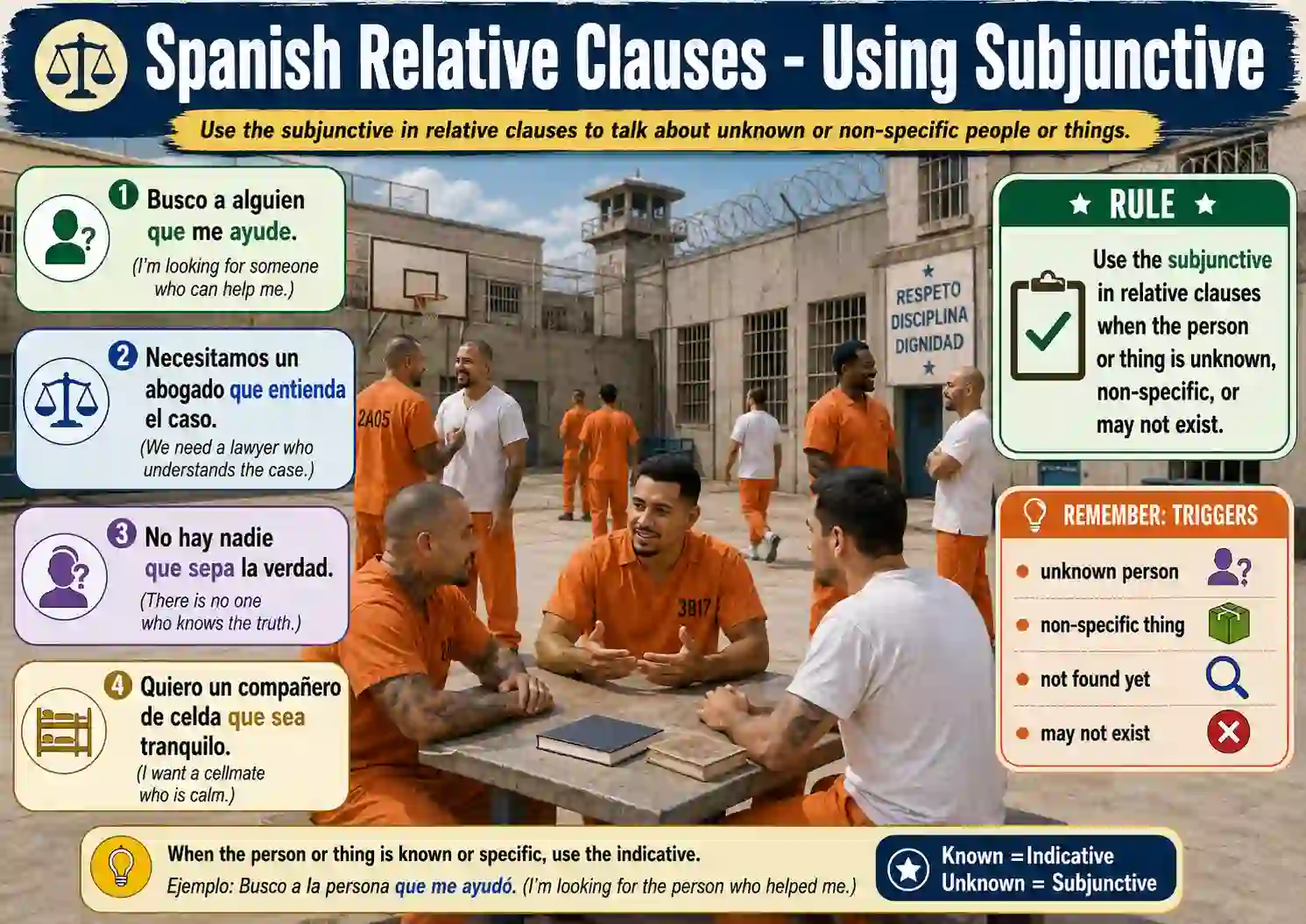
Why learn relative clauses with MundoDele?
Spanish relative clauses become much clearer when they are taught through reference, not only through verb forms. MundoDele explains the key question behind the structure: are you talking about someone or something specific, or are you describing what you are looking for, imagining or denying?
The central contrast is simple: conozco a alguien que habla español refers to a known person, while busco a alguien que hable español describes the kind of person you want to find.
How to use this page
Use this page after learning the basic difference between the Spanish indicative and subjunctive. First identify the noun before the relative clause. Then ask whether it is specific and known, or unknown, indefinite, hypothetical or negated.
Known person or thing
Use the indicative when the antecedent is specific and known.
Conozco a una profesora que habla español.
I know a teacher who speaks Spanish.
Unknown person or thing
Use the subjunctive when the antecedent is desired, searched for or not yet identified.
Busco una profesora que hable español.
I am looking for a teacher who speaks Spanish.
Non-existent antecedent
Use the subjunctive when the sentence denies that such a person or thing exists.
No hay nadie que pueda ayudarme.
There is nobody who can help me.
The main rule: specific vs non-specific antecedent
In Spanish, the mood in a relative clause often depends on the antecedent. The antecedent is the noun or pronoun that the relative clause describes. If the antecedent is specific and known, use the indicative. If the antecedent is unknown, indefinite, desired or non-existent, use the subjunctive.
| Meaning | Spanish example | Verb mood | Why? |
|---|---|---|---|
| Known person | Conozco a una persona que habla francés. | Indicative | The person exists and is known. |
| Wanted / unknown person | Busco a una persona que hable francés. | Subjunctive | The person is not identified yet. |
| Known place | Tengo un hotel que acepta perros. | Indicative | The hotel is specific. |
| Wanted / unknown place | Necesito un hotel que acepte perros. | Subjunctive | The hotel is only described as a requirement. |
| Non-existent antecedent | No hay nadie que pueda ayudar. | Subjunctive | The sentence denies that such a person exists. |
Known antecedent: relative clause with indicative
Use the indicative when you refer to a specific person, thing or place that exists and is known to the speaker. The relative clause gives information about something already identified.
| Spanish example | English meaning | Indicative form | Reason |
|---|---|---|---|
| Conozco a alguien que habla alemán. | I know someone who speaks German. | habla | The person is known. |
| Tengo un libro que explica el subjuntivo. | I have a book that explains the subjunctive. | explica | The book exists and is specific. |
| Hay una tienda que vende productos argentinos. | There is a shop that sells Argentinian products. | vende | The shop exists. |
| Vivo en una ciudad que tiene mucha historia. | I live in a city that has a lot of history. | tiene | The city is known and real. |
Unknown or desired antecedent: relative clause with subjunctive
Use the subjunctive when you describe the kind of person, thing or place you are looking for, need, want or imagine. The antecedent is not yet identified as a real, known item.
| Spanish example | English meaning | Subjunctive form | Reason |
|---|---|---|---|
| Busco a alguien que hable alemán. | I am looking for someone who speaks German. | hable | The person is not identified yet. |
| Necesito un libro que explique el subjuntivo. | I need a book that explains the subjunctive. | explique | The book is a requirement, not a known item. |
| Quiero una casa que tenga jardín. | I want a house that has a garden. | tenga | The house is desired, not identified. |
| Buscamos un hotel que acepte perros. | We are looking for a hotel that accepts dogs. | acepte | The hotel is still unknown. |
| Necesito una aplicación que funcione sin internet. | I need an app that works without internet. | funcione | The app is described by a requirement. |
Negative antecedents: no hay nadie que, no conozco a nadie que
Negative expressions often trigger the subjunctive in relative clauses because they deny the existence or availability of the person or thing described.
| Expression | Spanish example | English meaning | Subjunctive form |
|---|---|---|---|
| no hay nadie que | No hay nadie que pueda ayudarme. | There is nobody who can help me. | pueda |
| no conozco a nadie que | No conozco a nadie que hable japonés. | I do not know anyone who speaks Japanese. | hable |
| no tengo nada que | No tengo nada que pueda servir. | I have nothing that could be useful. | pueda |
| no existe ningún lugar que | No existe ningún lugar que sea perfecto. | There is no place that is perfect. | sea |
Questions with relative clauses
Questions often use the subjunctive when the speaker does not know whether the person or thing exists. If the speaker asks about a specific known person or thing, the indicative may be used.
| Spanish example | English meaning | Verb mood | Reason |
|---|---|---|---|
| ¿Hay alguien que hable inglés? | Is there someone who speaks English? | Subjunctive | The speaker does not know if such a person exists. |
| ¿Conoces a alguien que sepa programar? | Do you know someone who knows how to program? | Subjunctive | The person is not identified yet. |
| ¿Tienes un libro que explique esto? | Do you have a book that explains this? | Subjunctive | The speaker asks whether such a book exists. |
| ¿Dónde está el libro que explica esto? | Where is the book that explains this? | Indicative | The book is treated as known and specific. |
Cualquier, cualquiera que and quienquiera que
Expressions such as cualquier, cualquiera que and quienquiera que often introduce non-specific or indefinite reference. These structures commonly use the subjunctive.
| Expression | Spanish example | English meaning | Subjunctive form |
|---|---|---|---|
| cualquier persona que | Cualquier persona que quiera participar puede inscribirse. | Anyone who wants to participate can register. | quiera |
| cualquier cosa que | Cualquier cosa que necesites, dímelo. | Whatever you need, tell me. | necesites |
| cualquiera que | Cualquiera que tenga preguntas puede escribirnos. | Anyone who has questions can write to us. | tenga |
| quienquiera que | Quienquiera que sea, debe esperar. | Whoever it is must wait. | sea |
El que quiera, quien quiera and lo que sea
Spanish often uses the subjunctive in open or indefinite relative expressions such as el que quiera, quien quiera and lo que sea. These expressions do not identify one specific person or thing.
| Expression | Spanish example | English meaning | Meaning |
|---|---|---|---|
| el que quiera | El que quiera venir puede venir. | Whoever wants to come can come. | Open group of people. |
| quien quiera | Quien quiera participar debe registrarse. | Whoever wants to participate must register. | Indefinite person. |
| lo que sea | Haré lo que sea necesario. | I will do whatever is necessary. | Indefinite thing or action. |
| donde sea | Podemos reunirnos donde sea más cómodo. | We can meet wherever it is most comfortable. | Indefinite place. |
Useful present subjunctive forms in relative clauses
These present subjunctive forms are common in Spanish relative clauses with unknown, indefinite or negative antecedents.
| Infinitive | Subjunctive forms | Example |
|---|---|---|
| hablar | hable, hables, hable, hablemos, habléis, hablen | Busco a alguien que hable español. |
| tener | tenga, tengas, tenga, tengamos, tengáis, tengan | Quiero una casa que tenga jardín. |
| poder | pueda, puedas, pueda, podamos, podáis, puedan | No hay nadie que pueda ayudar. |
| ser | sea, seas, sea, seamos, seáis, sean | No existe ningún lugar que sea perfecto. |
| funcionar | funcione, funciones, funcione, funcionemos, funcionéis, funcionen | Necesito una app que funcione sin internet. |
| saber | sepa, sepas, sepa, sepamos, sepáis, sepan | ¿Conoces a alguien que sepa programar? |
Indicative vs subjunctive in relative clauses
The same sentence structure can change meaning depending on whether Spanish uses the indicative or the subjunctive.
| Indicative | Subjunctive | Difference |
|---|---|---|
| Tengo un amigo que habla italiano. I have a friend who speaks Italian. |
Busco un amigo que hable italiano. I am looking for a friend who speaks Italian. |
Known friend vs desired or unknown friend. |
| Hay una tienda que vende pan sin gluten. There is a shop that sells gluten-free bread. |
¿Hay una tienda que venda pan sin gluten? Is there a shop that sells gluten-free bread? |
Known existence vs uncertain existence. |
| Conozco un lugar que es tranquilo. I know a place that is quiet. |
Quiero un lugar que sea tranquilo. I want a place that is quiet. |
Known place vs desired place. |
| Tengo algo que funciona. I have something that works. |
Necesito algo que funcione. I need something that works. |
Existing thing vs required thing. |
Relative pronouns and the subjunctive
The subjunctive is not caused by the relative pronoun alone. It is caused by the meaning of the antecedent. Relative words such as que, quien, el que, lo que and donde can appear with either indicative or subjunctive depending on the sentence.
| Relative word | Indicative example | Subjunctive example |
|---|---|---|
| que | Tengo un libro que explica esto. | Necesito un libro que explique esto. |
| quien | Conozco a quien puede ayudarte. | Busca a quien pueda ayudarte. |
| el que | El que llegó tarde es mi hermano. | El que quiera venir puede venir. |
| lo que | Hice lo que me dijiste. | Haré lo que sea necesario. |
| donde | Vivo donde trabaja mi padre. | Quiero vivir donde haya más tranquilidad. |
Related page: Spanish Relative Pronouns.
Practice exercises: relative clauses with the subjunctive
Try to answer before opening the solutions. These exercises focus on known vs unknown antecedents, negative expressions and indicative-subjunctive contrast.
Exercise 1: choose the mood
- Conozco a alguien que ___ español. hablar
- Busco a alguien que ___ español. hablar
- No hay nadie que me ___ ayudar. poder
- Tengo un libro que lo ___ bien. explicar
Show answers
1. habla
2. hable
3. pueda
4. explica
Exercise 2: indicative or subjunctive?
- Necesito una app que ___ sin internet. funcionar
- Tengo una app que ___ sin internet. funcionar
- ¿Hay alguien que ___ francés? saber
- Hay una persona que ___ francés. saber
Show answers
1. funcione
2. funciona
3. sepa
4. sabe
Exercise 3: translate into English
- Busco una casa que tenga jardín.
- Tengo una casa que tiene jardín.
- No conozco a nadie que hable japonés.
- Cualquier persona que quiera participar puede inscribirse.
Show answers
1. I am looking for a house that has a garden.
2. I have a house that has a garden.
3. I do not know anyone who speaks Japanese.
4. Anyone who wants to participate can register.
Typical mistakes with Spanish relative clauses and the subjunctive
- Using the subjunctive only because the sentence contains que: que alone does not trigger the subjunctive.
- Using indicative for a searched or desired person: say busco a alguien que hable español, not busco a alguien que habla español.
- Using subjunctive for a known person: say conozco a alguien que habla español, not conozco a alguien que hable español, when the person is specific and known.
- Forgetting the subjunctive after negative existence: no hay nadie que pueda ayudar.
- Confusing questions with statements: hay una tienda que vende... confirms existence; ¿hay una tienda que venda...? asks whether it exists.
- Learning only translations: the English translation may look the same, but Spanish changes mood according to whether the antecedent is known or unknown.
Related grammar topics
Spanish Subjunctive
Learn the main uses of the Spanish subjunctive and how it differs from the indicative.
Subjunctive vs Indicative
Compare fact, certainty, doubt, wish, uncertainty and non-specific reference.
Present Subjunctive
Review forms such as hable, tenga, pueda, sea and sepa.
Relative Pronouns
Study que, quien, el que, lo que, cuyo and donde.
Conjunctions with Que
Compare relative que with other Spanish que-structures.
Spanish Verbs
Review Spanish verb forms before working deeper with subjunctive clauses.
Where to go next
After relative clauses with the subjunctive, continue with subjunctive vs indicative and relative pronouns. These pages help you separate verb mood from the relative words themselves.
Learn Spanish grammar with MundoDele
If Spanish relative clauses with the subjunctive feel confusing, this lesson can help you practise known and unknown antecedents, negative expressions, que-clauses and real Spanish sentence patterns in a clear and structured way.
FAQ: relative clauses in Spanish using the subjunctive
When do Spanish relative clauses use the subjunctive?
Spanish relative clauses often use the subjunctive when the antecedent is unknown, indefinite, hypothetical, desired or non-existent.
What is an antecedent in a relative clause?
The antecedent is the noun or pronoun that the relative clause describes. In busco una persona que hable español, una persona is the antecedent.
What is the difference between conozco a alguien que habla and busco a alguien que hable?
Conozco a alguien que habla uses the indicative because the person is known. Busco a alguien que hable uses the subjunctive because the person is not identified yet.
Does no hay nadie que take the subjunctive?
Yes. Negative existence expressions such as no hay nadie que usually take the subjunctive: no hay nadie que pueda ayudarme.
Does que always trigger the subjunctive in relative clauses?
No. Que alone does not trigger the subjunctive. The mood depends on whether the antecedent is known and specific or unknown, indefinite or non-existent.
Can questions with relative clauses use the subjunctive?
Yes. Questions often use the subjunctive when the speaker does not know whether the person or thing exists: ¿Hay alguien que hable inglés?

About MundoDele
MundoDele connects online Spanish courses, DELE preparation, Business Spanish and cultural context into a personal Spanish learning platform.
Grammar pages are designed to explain Spanish clearly, with practical examples, real sentence logic and connected learning paths.