
MundoDele Spanish Grammar
Spanish Subjunctive Conjugation
Learn how to conjugate the Spanish subjunctive across its main forms: present subjunctive, present perfect subjunctive, imperfect subjunctive and pluperfect subjunctive. This guide shows regular patterns, irregular verbs, compound forms and examples such as hable, coma, viva, sea, tenga, haya hablado, tuviera and hubiera estudiado.
Why subjunctive conjugation matters
Forms become easier when they are connected to meaning
Subjunctive conjugation becomes easier when forms and sentence patterns are learned together. MundoDele connects verb forms such as hable, venga, haya entendido, tuviera and hubiera estudiado with real Spanish examples.
The practical goal is simple: know which form you need, how to build it and why the sentence uses the subjunctive at all.
Quiero que vengas. A wish or request points to a present or future action.
Espero que hayas entendido. A completed action is viewed through hope or uncertainty.
Si tuviera tiempo, iría. A hypothetical condition uses the imperfect subjunctive.
Learning sequence
How to use this Spanish subjunctive conjugation guide
Use this page as the central conjugation overview for the Spanish subjunctive. Start with the present subjunctive, then move to compound forms with haber, and finally study the imperfect and pluperfect subjunctive for past and hypothetical meanings.
Present forms
Use opposite endings and learn the key irregular forms.
Compound forms
Use subjunctive forms of haber plus the past participle.
Past and hypothetical forms
Use the imperfect subjunctive for past triggers and hypothetical conditions.
Overview
Spanish subjunctive conjugation overview
The Spanish subjunctive is not one single tense. It is a mood with several forms. The most important forms for learners are the present subjunctive, present perfect subjunctive, imperfect subjunctive and pluperfect subjunctive.
| Subjunctive form | Basic pattern | Example | Typical use |
|---|---|---|---|
| Present subjunctive | hable, coma, viva | Quiero que vengas. | Wishes, doubts, emotions, purpose, future time clauses. |
| Present perfect subjunctive | haya + participle | Espero que hayas entendido. | Completed action inside a present subjunctive frame. |
| Imperfect subjunctive | hablara / hablase | Si tuviera tiempo, iría. | Past triggers and hypothetical conditions. |
| Pluperfect subjunctive | hubiera / hubiese + participle | Si hubiera estudiado, habría aprobado. | Unreal past conditions, regrets, past doubts. |
Present subjunctive
Present subjunctive conjugation
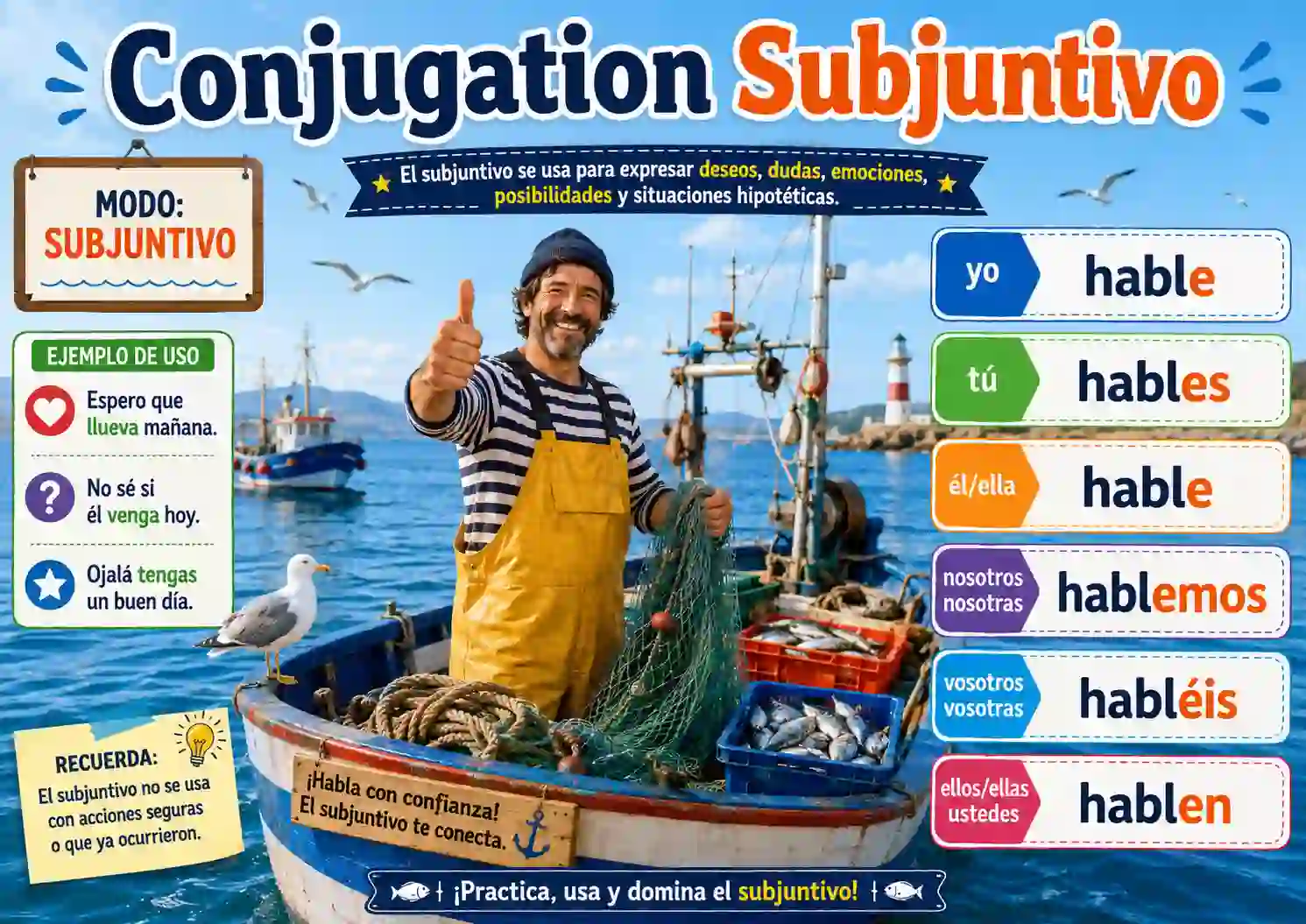
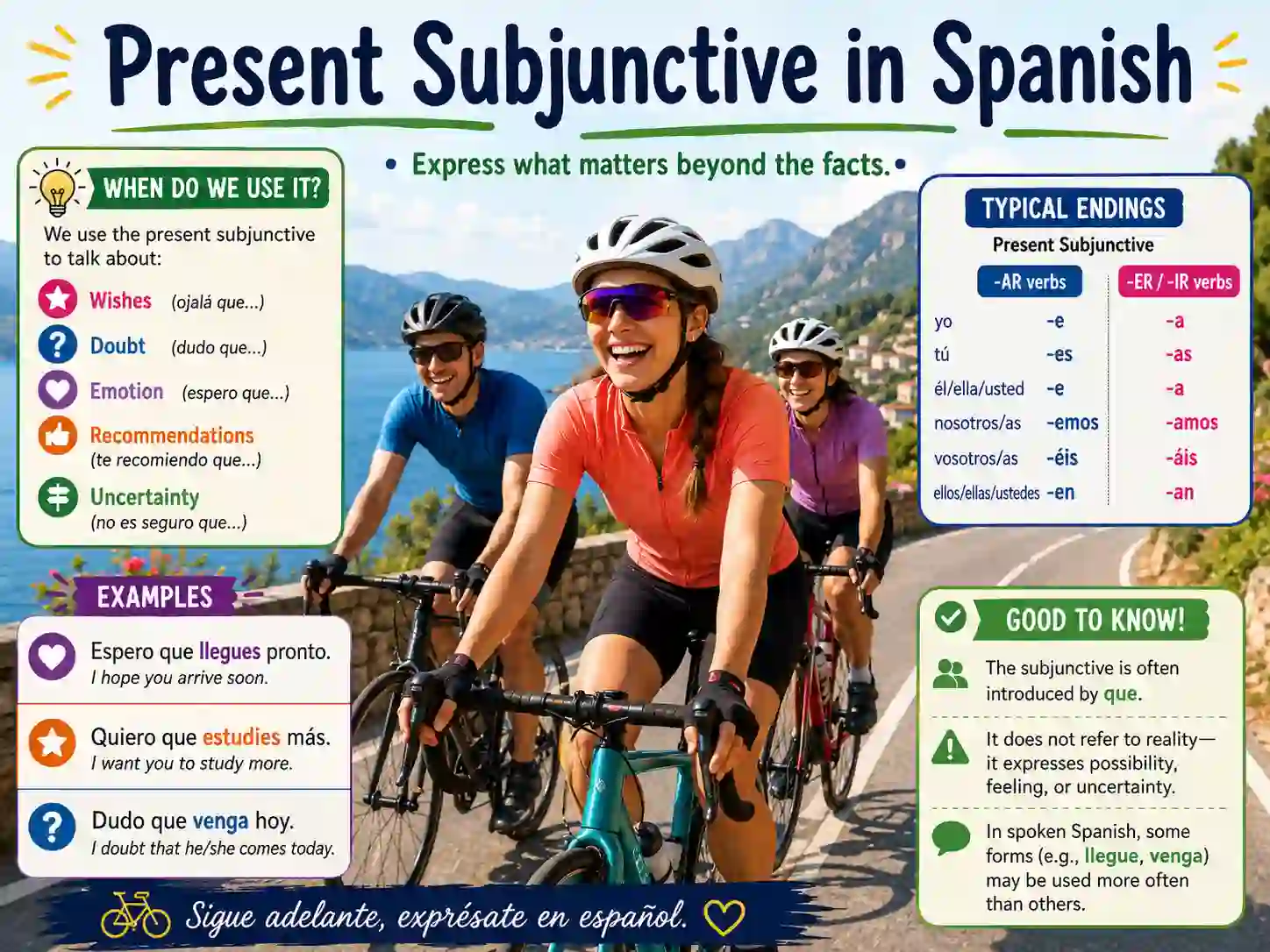
The present subjunctive is usually formed from the yo form of the present indicative. Remove the final -o and add the opposite endings: -ar verbs take -e endings, while -er and -ir verbs take -a endings.
| Subject | Hablar | Comer | Vivir |
|---|---|---|---|
| yo | hable | coma | viva |
| tú | hables | comas | vivas |
| él, ella, usted | hable | coma | viva |
| nosotros/as | hablemos | comamos | vivamos |
| vosotros/as | habléis | comáis | viváis |
| ellos, ellas, ustedes | hablen | coman | vivan |
Detailed page: Present Subjunctive in Spanish.
Irregular forms
Important irregular present subjunctive forms
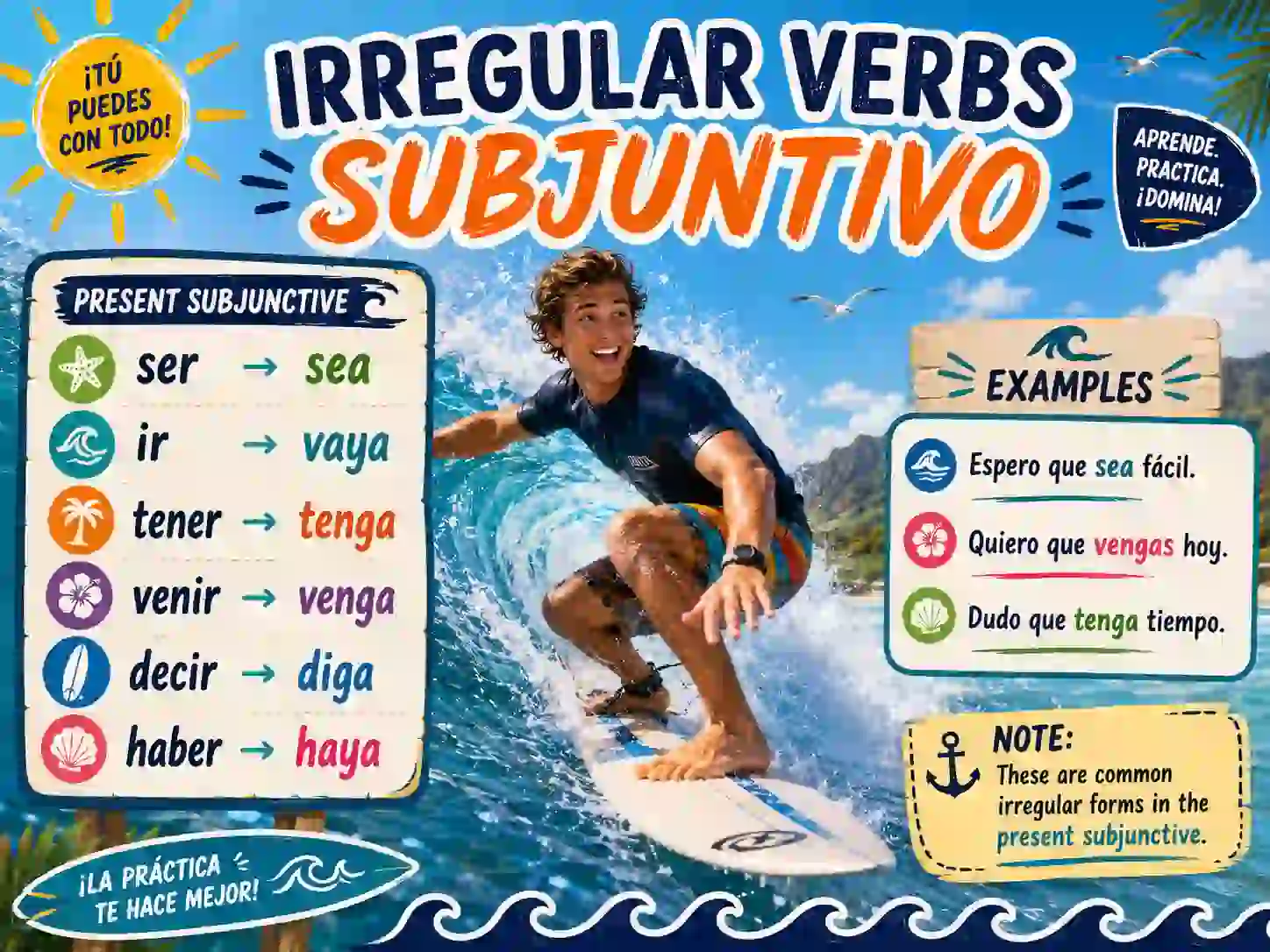
Some irregular forms must be learned directly. Others come from the irregular yo form of the present indicative.
| Infinitive | Subjunctive forms | Example |
|---|---|---|
| ser | sea, seas, sea, seamos, seáis, sean | Dudo que sea verdad. |
| estar | esté, estés, esté, estemos, estéis, estén | Me alegra que estés aquí. |
| ir | vaya, vayas, vaya, vayamos, vayáis, vayan | Quiero que vayas conmigo. |
| haber | haya, hayas, haya, hayamos, hayáis, hayan | Es posible que haya problemas. |
| tener | tenga, tengas, tenga, tengamos, tengáis, tengan | No creo que tengas razón. |
| venir | venga, vengas, venga, vengamos, vengáis, vengan | Quiero que vengas. |
| hacer | haga, hagas, haga, hagamos, hagáis, hagan | Prefiero que lo hagas tú. |
| poder | pueda, puedas, pueda, podamos, podáis, puedan | Espero que puedas venir. |
Detailed page: Irregular Verbs in the Spanish Subjunctive.
Present perfect
Present perfect subjunctive conjugation
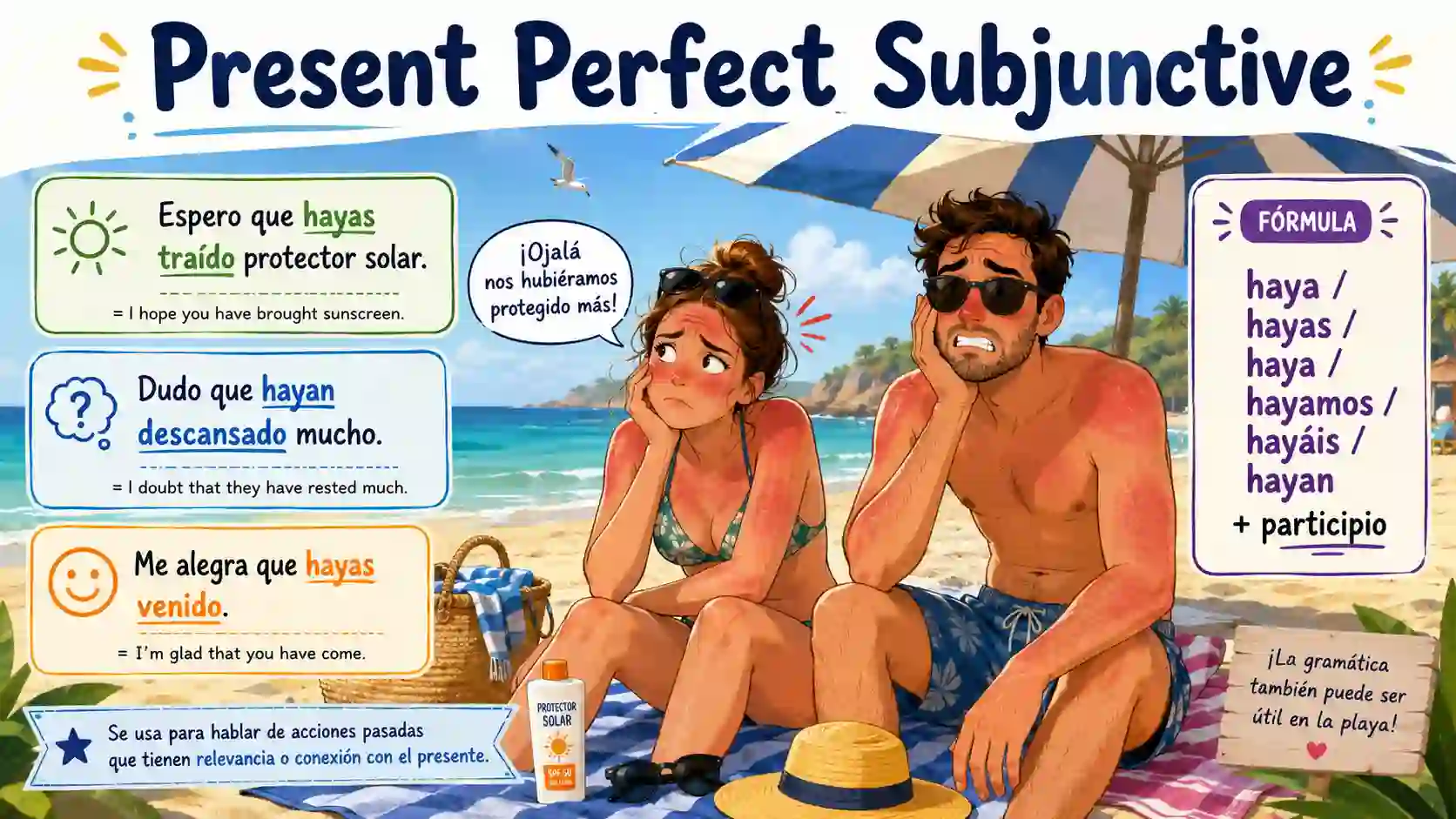
The present perfect subjunctive is formed with the present subjunctive of haber plus the past participle of the main verb. It often describes a completed action inside a present subjunctive context.
| Subject | Haber form | Example with hablar | Example sentence |
|---|---|---|---|
| yo | haya | haya hablado | Espero que haya hablado claro. |
| tú | hayas | hayas hablado | Espero que hayas entendido. |
| él, ella, usted | haya | haya hablado | No creo que haya terminado. |
| nosotros/as | hayamos | hayamos hablado | Me alegra que hayamos hablado. |
| vosotros/as | hayáis | hayáis hablado | Dudo que hayáis terminado. |
| ellos, ellas, ustedes | hayan | hayan hablado | Es posible que hayan salido. |
Detailed page: Present Perfect Subjunctive in Spanish.
Imperfect
Imperfect subjunctive conjugation
The imperfect subjunctive is formed from the third-person plural preterite. Remove -ron and add the imperfect subjunctive endings. Spanish has two correct forms: -ra forms and -se forms.
| Subject | Hablar: -ra form | Hablar: -se form | Tener: -ra form |
|---|---|---|---|
| yo | hablara | hablase | tuviera |
| tú | hablaras | hablases | tuvieras |
| él, ella, usted | hablara | hablase | tuviera |
| nosotros/as | habláramos | hablásemos | tuviéramos |
| vosotros/as | hablarais | hablaseis | tuvierais |
| ellos, ellas, ustedes | hablaran | hablasen | tuvieran |
Detailed page: Imperfect Subjunctive in Spanish.
Pluperfect
Pluperfect subjunctive conjugation
The pluperfect subjunctive is formed with the imperfect subjunctive of haber plus the past participle. It is common in unreal past conditions, past regrets and past doubts.
| Subject | Hubiera form | Hubiese form | Example with estudiar |
|---|---|---|---|
| yo | hubiera | hubiese | hubiera / hubiese estudiado |
| tú | hubieras | hubieses | hubieras / hubieses estudiado |
| él, ella, usted | hubiera | hubiese | hubiera / hubiese estudiado |
| nosotros/as | hubiéramos | hubiésemos | hubiéramos / hubiésemos estudiado |
| vosotros/as | hubierais | hubieseis | hubierais / hubieseis estudiado |
| ellos, ellas, ustedes | hubieran | hubiesen | hubieran / hubiesen estudiado |
Si hubiera estudiado, habría aprobado.
If I had studied, I would have passed.
Detailed page: Pluperfect Subjunctive in Spanish.
Verb comparison
Subjunctive conjugation by common verbs
This table shows how common verbs move through the main subjunctive forms. It is useful for comparing simple and compound forms.
| Infinitive | Present subjunctive | Present perfect subjunctive | Imperfect subjunctive | Pluperfect subjunctive |
|---|---|---|---|---|
| hablar | hable | haya hablado | hablara | hubiera hablado |
| comer | coma | haya comido | comiera | hubiera comido |
| vivir | viva | haya vivido | viviera | hubiera vivido |
| ser | sea | haya sido | fuera | hubiera sido |
| tener | tenga | haya tenido | tuviera | hubiera tenido |
| hacer | haga | haya hecho | hiciera | hubiera hecho |
| venir | venga | haya venido | viniera | hubiera venido |
| poder | pueda | haya podido | pudiera | hubiera podido |
Sentence patterns
Common sentence patterns with subjunctive conjugation
Subjunctive forms are easier to remember when they are learned inside useful sentence patterns.
| Pattern | Example | Subjunctive form | Meaning |
|---|---|---|---|
| querer que + present subjunctive | Quiero que vengas. | vengas | I want you to come. |
| no creer que + present subjunctive | No creo que sea verdad. | sea | I do not think it is true. |
| esperar que + present perfect subjunctive | Espero que hayas entendido. | hayas entendido | I hope you have understood. |
| si + imperfect subjunctive + conditional | Si tuviera tiempo, iría. | tuviera | If I had time, I would go. |
| si + pluperfect subjunctive + conditional perfect | Si hubiera estudiado, habría aprobado. | hubiera estudiado | If I had studied, I would have passed. |
| busco a alguien que + present subjunctive | Busco a alguien que hable español. | hable | I am looking for someone who speaks Spanish. |
Recommended order
Recommended learning order for subjunctive conjugation
Present subjunctive endings
Learn hable, coma and viva as the basic pattern.
Irregular present forms
Practise sea, esté, vaya, tenga, venga and haya.
Present perfect subjunctive
Build forms with haya + participle.
Imperfect subjunctive
Learn tuviera, fuera, pudiera and viniera.
Pluperfect subjunctive
Use hubiera + participle for unreal past conditions.
Sentence patterns
Connect the forms with wishes, doubts, emotions, conditions and non-specific references.
Practice
Practice exercises: Spanish subjunctive conjugation
Try to answer before opening the solutions. These exercises review present, perfect, imperfect and pluperfect subjunctive forms.
Exercise 1: present subjunctive
- Quiero que tú ___. venir
- Dudo que ___ verdad. ser
- Espero que todo ___ bien. salir
- No creo que tú ___ razón. tener
Show answers
1. vengas
2. sea
3. salga
4. tengas
Exercise 2: compound forms
- Espero que tú ___ entendido. haber
- No creo que Ana ___ terminado. haber
- Si yo ___ estudiado, habría aprobado. haber
- Ojalá nosotros lo ___ sabido antes. haber
Show answers
1. hayas
2. haya
3. hubiera
4. hubiéramos
Exercise 3: imperfect subjunctive
- Si ___ tiempo, iría. tener
- Si ___ posible, lo haría. ser
- Quería que tú ___. venir
- Ojalá ___ ayudarte. poder
Show answers
1. tuviera
2. fuera
3. vinieras
4. pudiera
Typical mistakes
Typical mistakes with Spanish subjunctive conjugation
- Using indicative endings after subjunctive triggers: say quiero que vengas, not quiero que vienes.
- Forgetting irregular forms: ser → sea, estar → esté, ir → vaya, haber → haya.
- Confusing present and present perfect subjunctive: vengas is simple; hayas venido is completed.
- Using the conditional after si in hypothetical clauses: say si tuviera, not si tendría.
- Using había instead of hubiera in unreal past conditions: si hubiera estudiado.
- Regularising irregular participles: say haya hecho, haya dicho, haya visto.
Where to go next
Where to go next
After this conjugation overview, continue with the present subjunctive and irregular verbs. These two pages give the strongest foundation for the rest of the Spanish subjunctive system.
Present Subjunctive
Learn the main forms and regular endings.
Irregular Verbs
Review the most important irregular subjunctive forms.
Indicative vs Subjunctive
Understand when Spanish needs the subjunctive at all.
Related guides
Continue with related Spanish subjunctive topics
These guides connect directly with subjunctive conjugation: regular present forms, irregular forms and compound forms with haber.
Present Perfect Subjunctive
Learn haya hablado, haya entendido and completed subjunctive actions.
Open guide →When you need help
Learn Spanish subjunctive conjugation with MundoDele
If Spanish subjunctive conjugation feels confusing, this guide gives you a structured overview of the main forms: hable, haya hablado, tuviera and hubiera hablado. From here, you can move into the detailed form pages and practise each pattern step by step.
Spanish Tutoring
Useful if you need help with conjugation, exercises or weak points.
Private Spanish Lessons
Practise subjunctive forms in conversation, writing and personal learning.
Intensive Spanish Course
Work through grammar, speaking and sentence structure in a focused format.
FAQ
FAQ: Spanish subjunctive conjugation
How do you conjugate the Spanish present subjunctive?
Start from the yo form of the present indicative, remove -o, and add opposite endings: hablo → hable, como → coma, vivo → viva.
What are the main Spanish subjunctive forms?
The main forms are the present subjunctive, present perfect subjunctive, imperfect subjunctive and pluperfect subjunctive.
What are common irregular subjunctive forms?
Common irregular forms include sea, esté, vaya, sepa, dé, haya, tenga, venga, haga, diga and pueda.
How do you form the present perfect subjunctive?
Use the present subjunctive of haber plus the past participle: haya hablado, hayas comido, hayamos vivido.
How do you form the imperfect subjunctive?
Take the third-person plural preterite, remove -ron, and add the imperfect subjunctive endings: hablaron → hablara, tuvieron → tuviera.
How do you form the pluperfect subjunctive?
Use hubiera or hubiese plus the past participle: hubiera hablado, hubiese tenido, hubiéramos vivido.

About
About MundoDele
MundoDele connects online Spanish lessons, tutoring, intensive Spanish courses, DELE and SIELE preparation, Business Spanish, grammar resources and cultural context into one personal Spanish learning platform.
Grammar pages are designed to explain Spanish clearly, with practical examples, sentence logic and useful links to related learning support.