
MundoDele Spanish Grammar
Wishes, Doubts and Emotions in Spanish
Learn when wishes, doubts and emotions trigger the Spanish subjunctive. This guide explains structures such as quiero que, espero que, dudo que, no creo que, me alegra que, siento que, temo que and es una pena que, with clear examples and indicative-subjunctive contrasts.
Why this topic matters
Wishes, doubts and emotions explain many everyday subjunctive sentences
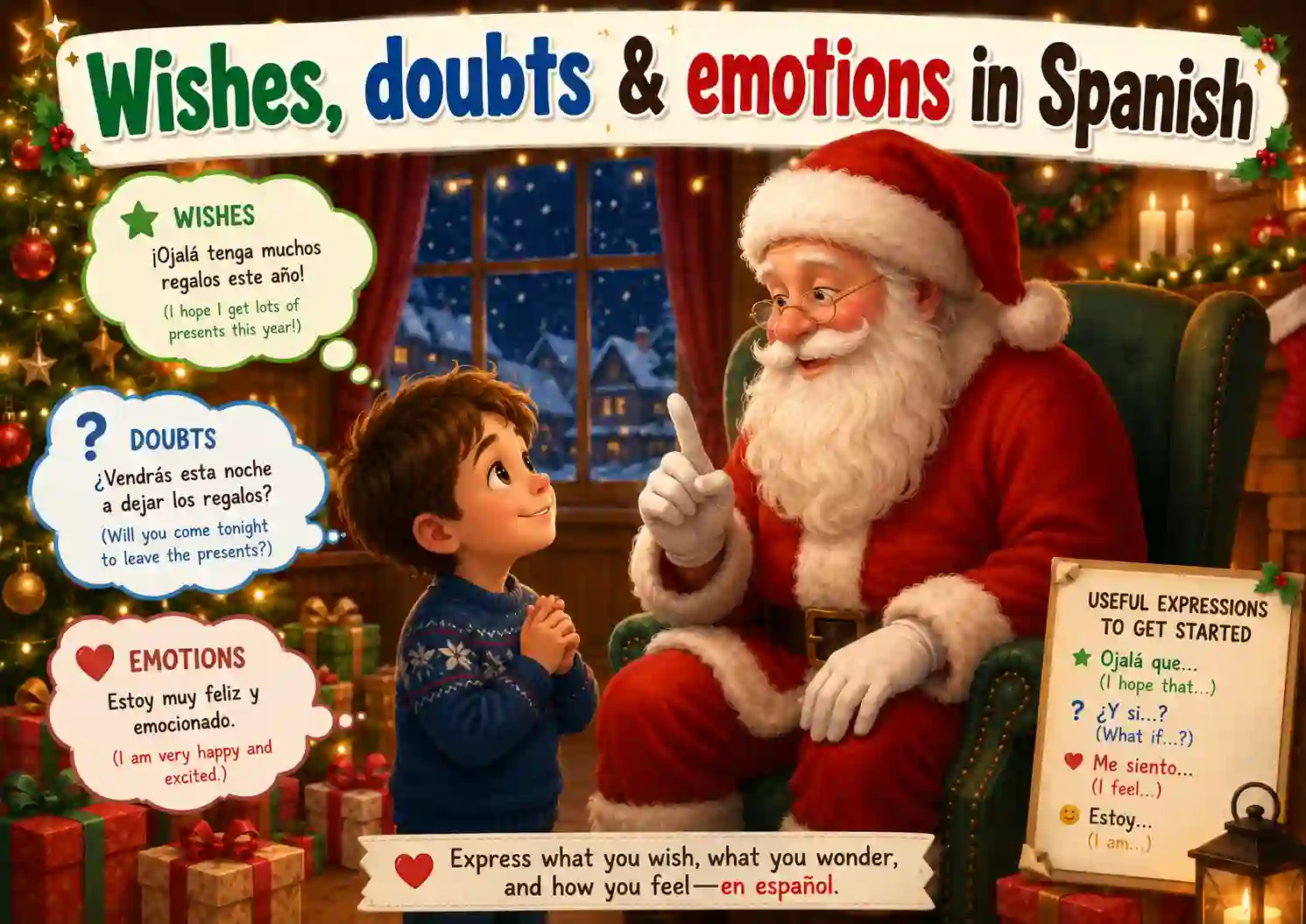
The Spanish subjunctive becomes clearer when it is taught through meaning, not only through endings. MundoDele explains wishes, doubts and emotions as sentence patterns that show what is wanted, uncertain or emotionally evaluated.
The key idea is simple: the subjunctive often appears when the second clause is not presented as plain fact. It may be desired, doubted, feared, hoped for or emotionally judged: quiero que vengas, dudo que sea verdad, me alegra que estés aquí.
Quiero que vengas. The action is wanted.
Dudo que sea verdad. The statement is doubted.
Me alegra que estés aquí. The speaker reacts emotionally.
Learning sequence
How to use this page
Use this page after learning the basic idea of the Spanish subjunctive. First identify the trigger: wish, doubt, emotion or certainty. Then check whether the sentence has two subjects connected by que. This is one of the most common patterns for the subjunctive.
Main pattern
The main pattern: trigger + que + subjunctive
The most common pattern is a trigger expression followed by que and a verb in the subjunctive. This often happens when the sentence has two different subjects.
| Trigger | Que-clause | Spanish example | English meaning |
|---|---|---|---|
| Quiero | que vengas | Quiero que vengas. | I want you to come. |
| Espero | que todo salga bien | Espero que todo salga bien. | I hope everything goes well. |
| Dudo | que sea verdad | Dudo que sea verdad. | I doubt that it is true. |
| No creo | que tengas razón | No creo que tengas razón. | I do not think you are right. |
| Me alegra | que estés aquí | Me alegra que estés aquí. | I am glad that you are here. |
Wishes
Wishes and wants: querer que, esperar que, preferir que
Wishes and wants often trigger the subjunctive because the second action is desired, not presented as a fact. This is one of the most important uses of the Spanish subjunctive.
| Expression | Spanish example | English meaning | Subjunctive form |
|---|---|---|---|
| querer que | Quiero que vengas. | I want you to come. | vengas |
| esperar que | Espero que todo salga bien. | I hope everything goes well. | salga |
| preferir que | Prefiero que lo hagas tú. | I prefer that you do it. | hagas |
| desear que | Deseo que tengas éxito. | I wish you success / I hope you succeed. | tengas |
| necesitar que | Necesito que me ayudes. | I need you to help me. | ayudes |
Same or different subject
Querer + infinitive vs querer que + subjunctive
Use an infinitive when the same subject wants to do the action. Use que + subjunctive when one subject wants another subject to do something.
| Structure | Spanish example | English meaning | Reason |
|---|---|---|---|
| querer + infinitive | Quiero ir. | I want to go. | Same subject: I want, I go. |
| querer que + subjunctive | Quiero que vayas. | I want you to go. | Different subject: I want, you go. |
| esperar + infinitive | Espero aprobar. | I hope to pass. | Same subject: I hope, I pass. |
| esperar que + subjunctive | Espero que apruebes. | I hope you pass. | Different subject: I hope, you pass. |
| preferir + infinitive | Prefiero hacerlo yo. | I prefer to do it myself. | Same subject. |
| preferir que + subjunctive | Prefiero que lo hagas tú. | I prefer that you do it. | Different subject. |
Doubts
Doubt and uncertainty: dudar que, no creer que, no estar seguro de que
Doubt and uncertainty often trigger the subjunctive because the speaker does not present the second clause as certain fact.
| Expression | Spanish example | English meaning | Subjunctive form |
|---|---|---|---|
| dudar que | Dudo que sea verdad. | I doubt that it is true. | sea |
| no creer que | No creo que tengas razón. | I do not think you are right. | tengas |
| no pensar que | No pienso que sea buena idea. | I do not think it is a good idea. | sea |
| no estar seguro de que | No estoy seguro de que funcione. | I am not sure that it works. | funcione |
| es posible que | Es posible que llueva. | It is possible that it may rain. | llueva |
Key contrast
Creo que vs no creo que
This contrast is essential. Creo que usually takes the indicative because the speaker presents the statement as believed information. No creo que usually takes the subjunctive because the speaker denies or questions the statement.
| Expression | Spanish example | Verb mood | Explanation |
|---|---|---|---|
| creo que | Creo que tienes razón. | Indicative | The speaker presents it as believed information. |
| no creo que | No creo que tengas razón. | Subjunctive | The speaker does not present it as accepted fact. |
| pienso que | Pienso que es importante. | Indicative | Opinion presented as a statement. |
| no pienso que | No pienso que sea importante. | Subjunctive | Negative opinion or doubt. |
| sé que | Sé que funciona. | Indicative | The speaker presents it as known. |
| no sé si | No sé si funciona. | Indicative with si | Uncertainty, but si questions often use the indicative. |
Related page: Indicative vs Subjunctive in Spanish.
Emotions
Emotions: me alegra que, siento que, temo que
Emotional reactions often trigger the subjunctive because the speaker comments emotionally on the second clause. The focus is not simply on information, but on the speaker’s reaction to it.
| Expression | Spanish example | English meaning | Subjunctive form |
|---|---|---|---|
| me alegra que | Me alegra que estés aquí. | I am glad that you are here. | estés |
| siento que | Siento que no puedas venir. | I am sorry that you cannot come. | puedas |
| temer que | Temo que sea demasiado tarde. | I fear that it is too late. | sea |
| me sorprende que | Me sorprende que digas eso. | It surprises me that you say that. | digas |
| es una pena que | Es una pena que no puedas venir. | It is a pity that you cannot come. | puedas |
| me molesta que | Me molesta que no respondas. | It bothers me that you do not answer. | respondas |
Impersonal expressions
Impersonal expressions with emotion, evaluation or uncertainty
Many impersonal expressions trigger the subjunctive when they express emotion, judgement, necessity or uncertainty.
| Expression | Spanish example | English meaning | Meaning type |
|---|---|---|---|
| es importante que | Es importante que estudies. | It is important that you study. | Necessity / evaluation. |
| es necesario que | Es necesario que vengas. | It is necessary that you come. | Necessity. |
| es mejor que | Es mejor que lo hagas ahora. | It is better that you do it now. | Recommendation. |
| es extraño que | Es extraño que no responda. | It is strange that he/she does not answer. | Emotional or evaluative reaction. |
| es posible que | Es posible que cambie el plan. | It is possible that the plan changes. | Uncertainty. |
| es probable que | Es probable que llegue tarde. | It is likely that he/she arrives late. | Probability. |
Indicative contrast
When not to use the subjunctive
Not every expression with que triggers the subjunctive. If the speaker presents the second clause as information, certainty or fact, Spanish usually uses the indicative.
| Indicative pattern | Spanish example | English meaning | Why indicative? |
|---|---|---|---|
| creo que | Creo que viene. | I think he/she is coming. | Believed information. |
| sé que | Sé que tienes razón. | I know you are right. | Knowledge. |
| es verdad que | Es verdad que vive aquí. | It is true that he/she lives here. | Confirmed fact. |
| es cierto que | Es cierto que trabaja mucho. | It is true that he/she works a lot. | Certainty. |
| está claro que | Está claro que entiende. | It is clear that he/she understands. | Clear information. |
Useful forms
Useful present subjunctive forms
These forms appear frequently after wish, doubt and emotion triggers.
| Infinitive | Subjunctive forms | Example |
|---|---|---|
| ser | sea, seas, sea, seamos, seáis, sean | Dudo que sea verdad. |
| estar | esté, estés, esté, estemos, estéis, estén | Me alegra que estés aquí. |
| tener | tenga, tengas, tenga, tengamos, tengáis, tengan | Espero que tengas suerte. |
| venir | venga, vengas, venga, vengamos, vengáis, vengan | Quiero que vengas. |
| hacer | haga, hagas, haga, hagamos, hagáis, hagan | Prefiero que lo hagas tú. |
| poder | pueda, puedas, pueda, podamos, podáis, puedan | Siento que no puedas venir. |
Related page: Present Subjunctive in Spanish.
Present or past trigger
Present subjunctive vs imperfect subjunctive with wishes, doubts and emotions
Present trigger expressions often use the present subjunctive. Past trigger expressions often use the imperfect subjunctive.
| Present trigger | Past trigger | Difference |
|---|---|---|
| Quiero que vengas. I want you to come. |
Quería que vinieras. I wanted you to come. |
Present wish vs past wish. |
| Dudo que sea verdad. I doubt that it is true. |
Dudaba que fuera verdad. I doubted that it was true. |
Present doubt vs past doubt. |
| Me alegra que estés aquí. I am glad you are here. |
Me alegró que estuvieras allí. I was glad you were there. |
Present reaction vs past reaction. |
| Es importante que estudies. It is important that you study. |
Era importante que estudiaras. It was important that you studied. |
Present evaluation vs past evaluation. |
Related page: Imperfect Subjunctive in Spanish.
Recommended order
Recommended learning order for wishes, doubts and emotions
Learn the trigger pattern
Start with trigger expression + que + subjunctive.
Learn wishes and wants
Practise quiero que, espero que, prefiero que.
Learn doubts and denial
Practise dudo que, no creo que, no estoy seguro de que.
Learn emotional reactions
Use me alegra que, siento que, me sorprende que.
Compare with indicative
Separate creo que tienes from no creo que tengas.
Check the subject
Use infinitive for the same subject and que + subjunctive for a different subject.
Practice
Practice exercises: wishes, doubts and emotions
Try to answer before opening the solutions. These exercises focus on triggers, subjunctive forms and indicative-subjunctive contrast.
Exercise 1: choose the mood
- Quiero que tú ___. venir
- Creo que tú ___ razón. tener
- No creo que tú ___ razón. tener
- Me alegra que tú ___ aquí. estar
Show answers
1. vengas
2. tienes
3. tengas
4. estés
Exercise 2: infinitive or subjunctive?
- Quiero ___. ir
- Quiero que tú ___. ir
- Espero ___. aprobar
- Espero que Ana ___. aprobar
Show answers
1. ir
2. vayas
3. aprobar
4. apruebe
Exercise 3: translate into English
- Quiero que vengas.
- Dudo que sea verdad.
- Me alegra que estés aquí.
- No estoy seguro de que funcione.
Show answers
1. I want you to come.
2. I doubt that it is true.
3. I am glad that you are here.
4. I am not sure that it works.
Typical mistakes
Typical mistakes with wishes, doubts and emotions
- Using indicative after querer que: say quiero que vengas, not quiero que vienes.
- Forgetting the difference between creo que and no creo que: creo que tienes, but no creo que tengas.
- Using que + subjunctive when the subject is the same: say quiero ir, not quiero que vaya when you mean “I want to go”.
- Thinking emotion always means uncertainty: emotional triggers can use the subjunctive even when the event is real.
- Using the infinitive with a different subject: say quiero que estudies, not quiero estudiar if you mean “I want you to study”.
- Learning only endings: learn the trigger expression and the sentence meaning together.
Where to go next
Where to go next
After wishes, doubts and emotions, continue with the general subjunctive overview, the present subjunctive and the indicative-subjunctive comparison. These pages help you connect trigger expressions with actual verb forms.
Spanish Subjunctive
Learn the main uses and logic of the Spanish subjunctive.
Present Subjunctive
Review present subjunctive forms such as sea, tenga, venga and haga.
Indicative vs Subjunctive
Compare certainty, fact, doubt, wish and emotional reaction.
Related guides
Continue with related Spanish subjunctive topics
These guides connect directly with wishes, doubts and emotions: the full subjunctive overview, the present subjunctive forms and the contrast between indicative and subjunctive.

Spanish Subjunctive
Review the full subjunctive system with forms, meanings and common sentence patterns.
Open guide →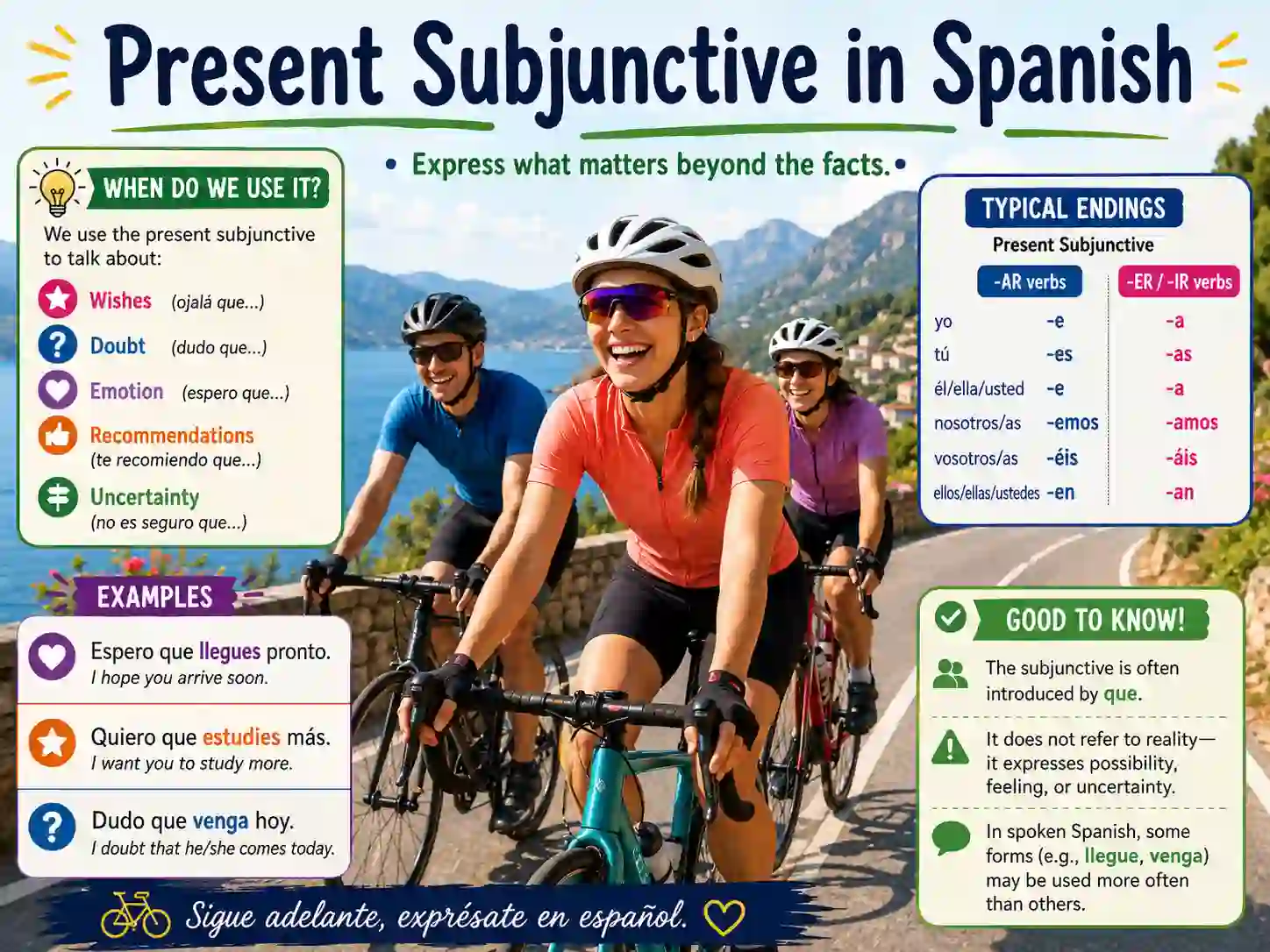
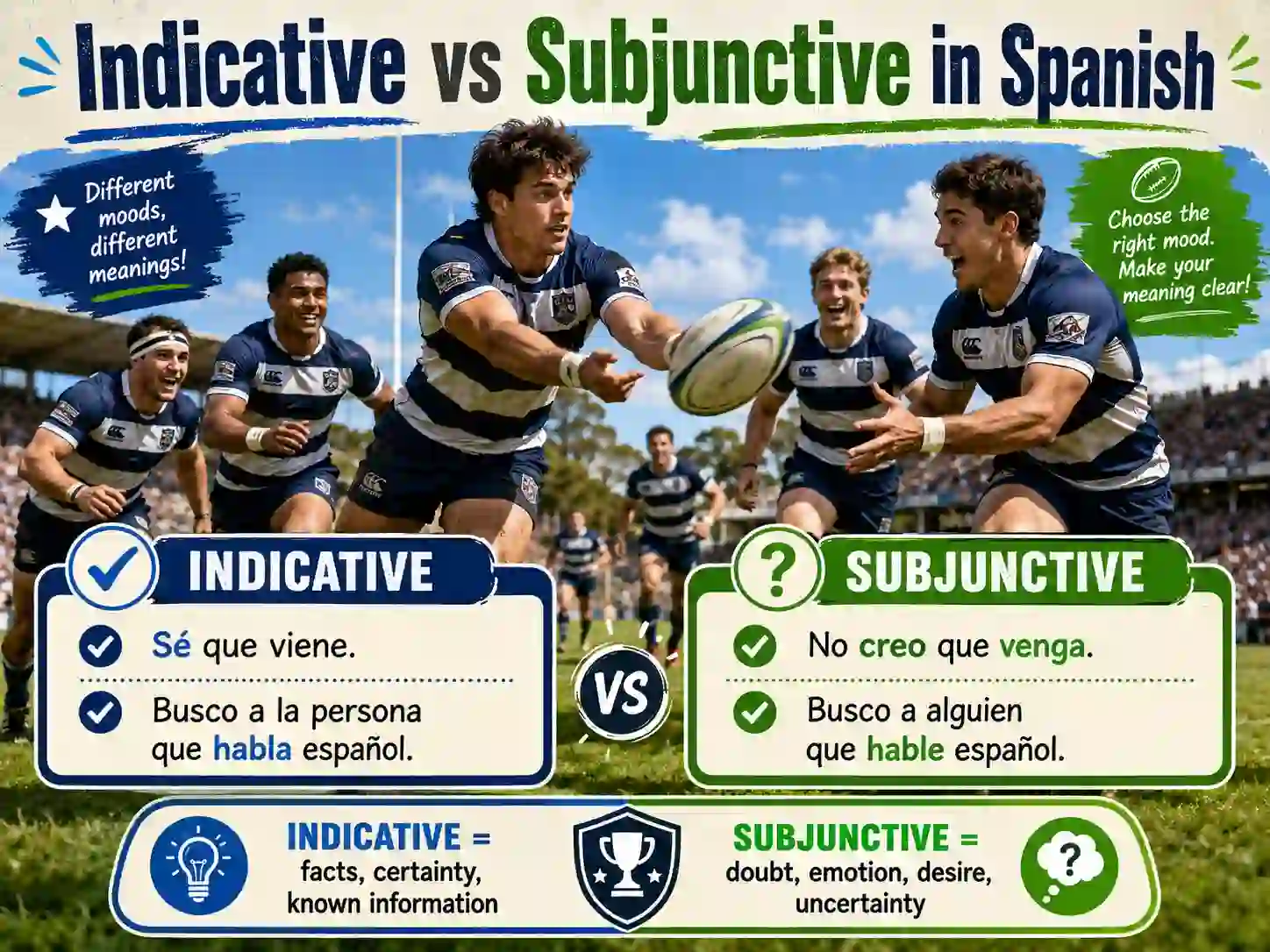
Indicative vs Subjunctive
Compare fact, certainty, doubt, wish, emotion and non-specific reference.
Open guide →When you need help
Learn the Spanish subjunctive with MundoDele
If the Spanish subjunctive feels confusing, this lesson can help you practise wishes, doubts, emotions, que-clauses and real Spanish sentence patterns in a clear and structured way.
Spanish Tutoring
Useful if you need help with subjunctive triggers, forms or exercises.
Private Spanish Lessons
Practise wishes, doubts and emotions in conversation, writing and personal learning.
Intensive Spanish Course
Work through grammar, speaking and sentence structure in a focused format.
FAQ
FAQ: wishes, doubts and emotions in Spanish
Do wishes trigger the subjunctive in Spanish?
Yes. Wishes and wants often trigger the subjunctive when one subject wants another subject to do something: quiero que vengas.
Does dudar que take the subjunctive?
Yes. Dudar que normally takes the subjunctive because it expresses doubt: dudo que sea verdad.
What is the difference between creo que and no creo que?
Creo que usually takes the indicative: creo que tienes razón. No creo que usually takes the subjunctive: no creo que tengas razón.
Do emotions take the subjunctive in Spanish?
Emotional reactions often take the subjunctive after que: me alegra que estés aquí, siento que no puedas venir.
What is the pattern for wishes, doubts and emotions?
The common pattern is trigger expression + que + subjunctive, as in quiero que vengas, dudo que sea verdad or me alegra que estés aquí.
When do you use an infinitive instead of the subjunctive?
Use the infinitive when the subject is the same: quiero ir. Use que + subjunctive when the subject changes: quiero que vayas.

About
About MundoDele
MundoDele connects online Spanish lessons, tutoring, intensive Spanish courses, DELE and SIELE preparation, Business Spanish, grammar resources and cultural context into one personal Spanish learning platform.
Grammar pages are designed to explain Spanish clearly, with practical examples, sentence logic and useful links to related learning support.