
Irregular Verbs in Spanish: Patterns, Forms and Examples
Learn how Spanish irregular verbs work by pattern — from stem-changing verbs such as poder and querer to highly irregular verbs such as ser, ir, haber, tener, hacer and decir.
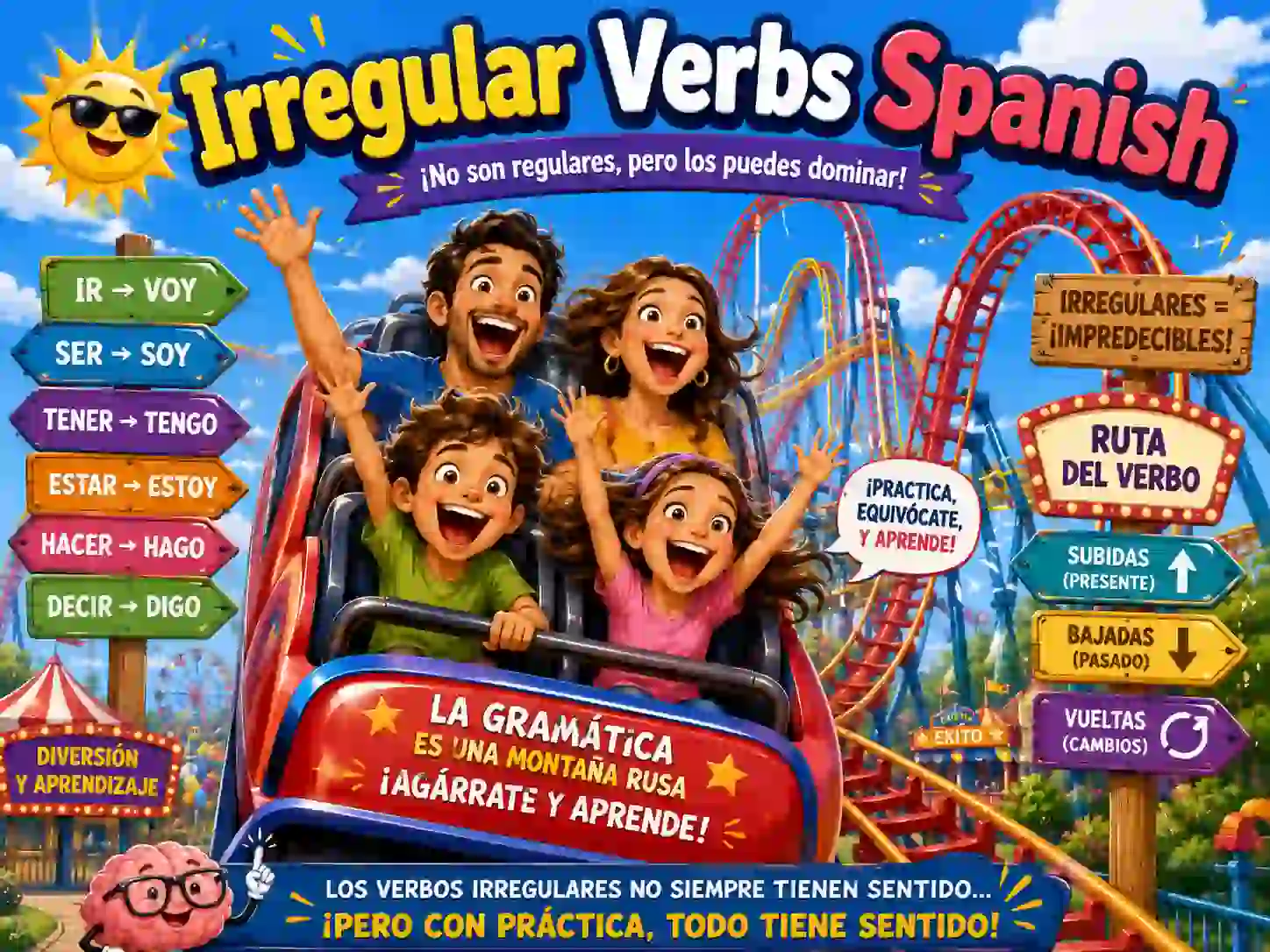
Why Spanish irregular verbs matter
Irregular verbs are not a marginal topic in Spanish. Many of the most frequent verbs are irregular: ser, estar, ir, tener, hacer, decir, poder, querer and venir. Learning them by type is more useful than memorising one long list.
How to use this page
Use this page as the main hub for Spanish irregular verbs. First understand the main irregular patterns, then move to the detail pages for stem-changing verbs and highly irregular verbs.
Many irregular verbs still keep regular endings even when the stem changes: pienso, puedes, piden.
Separate stem-changing verbs, irregular yo forms, highly irregular verbs and irregular participles.
Focus early on ser, estar, ir, haber, tener, hacer, decir and venir.
The core system: not one exception list, but several patterns
Stem-changing verbs
The vowel inside the stem changes, but many endings remain regular.
pensar → pienso · poder → puedo · pedir → pido
Highly irregular verbs
Some verbs have very special forms and must be learned as core verbs.
ser → soy · ir → voy · haber → he / hay
Irregular forms in specific structures
Some irregularity appears in yo forms, participles, commands or past tenses.
hago · digo · hecho · dicho · ven
Spanish irregular verb types at a glance
Irregular verbs become clearer when you separate the type of irregularity. This overview helps you decide which detail page to study next.
| Irregular type | What changes? | Examples | Typical level | Detail lesson |
|---|---|---|---|---|
| Stem-changing verbs | The vowel inside the stem changes. | pienso, puedo, pido, juego | A1–A2 | Stem-changing Verbs |
| Highly irregular verbs | The verb has special high-frequency forms. | soy, estoy, voy, he, tengo | A1–B1 | Highly Irregular Verbs |
| Irregular yo forms | The first-person singular form is irregular. | hago, digo, vengo, salgo, pongo | A1–A2 | Present Tense |
| Irregular past participles | The participle does not use the regular -ado or -ido form. | hecho, dicho, visto, escrito, puesto | A2–B1 | Past Participle |
| Irregular preterite stems | The stem changes in the simple past. | tuve, hice, vine, dije, pude | A2–B1 | Preterite Tense |
| Irregular commands | Some imperative forms are short or irregular. | ven, di, haz, ten, ve, sé | A2–B1 | Irregular Imperative Forms |
Stem-changing irregular verbs
Stem-changing verbs are one of the most common irregular verb groups in Spanish. They often keep regular endings, but the vowel inside the stem changes.
pensar → pienso, piensas, piensa, pensamos, pensáis, piensan
poder → puedo, puedes, puede, podemos, podéis, pueden
pedir → pido, pides, pide, pedimos, pedís, piden
jugar → juego, juegas, juega, jugamos, jugáis, juegan
Learn the full system here: Stem-changing Verbs in Spanish.
Highly irregular Spanish verbs
Some Spanish verbs are so frequent and so irregular that they should be learned as a core group. These verbs often build important sentence structures.
| Verb | Key present forms | Main use | Example |
|---|---|---|---|
| ser | soy, eres, es, somos, sois, son | identity, origin, classification | Soy estudiante. |
| estar | estoy, estás, está, estamos, estáis, están | location, state, progressive forms | Estoy en casa. |
| ir | voy, vas, va, vamos, vais, van | movement, near future | Voy a estudiar. |
| haber | he, has, ha, hemos, habéis, han; hay | perfect tenses, existence | He visto. Hay café. |
| tener | tengo, tienes, tiene, tenemos, tenéis, tienen | possession, obligation | Tengo que salir. |
Learn this core group here: Highly Irregular Verbs in Spanish.
Irregular yo forms in the present tense
Many Spanish verbs are mostly regular in the present tense but have an irregular yo form. These forms are very common in everyday Spanish.
hacer → hago
decir → digo
venir → vengo
salir → salgo
poner → pongo
traer → traigo
conocer → conozco
dar → doy
ver → veo
Some of these verbs combine an irregular yo form with another irregular pattern: decir → digo, dices, dice and venir → vengo, vienes, viene.
Irregular past participles
Regular past participles usually end in -ado or -ido. Some very common verbs have irregular participles. These are important because they appear in perfect tenses with haber.
| Infinitive | Irregular participle | Example with haber | English meaning |
|---|---|---|---|
| hacer | hecho | He hecho la tarea. | I have done the homework. |
| decir | dicho | Ha dicho la verdad. | He / she has told the truth. |
| ver | visto | Hemos visto la película. | We have seen the movie. |
| escribir | escrito | Han escrito el texto. | They have written the text. |
| poner | puesto | He puesto la mesa. | I have set the table. |
| abrir | abierto | Has abierto la puerta. | You have opened the door. |
| volver | vuelto | Ha vuelto tarde. | He / she has returned late. |
| morir | muerto | Ha muerto. | He / she has died. |
Learn this form here: Past Participle in Spanish.
Irregular verbs in the preterite
Some verbs that are irregular in the present tense are also irregular in the preterite, but the pattern is different. Common preterite stems include tuv-, hic-, vin-, dij-, pud- and quis-.
tener → tuve
hacer → hice
venir → vine
decir → dije
poder → pude
querer → quise
estar → estuve
This is why irregular verbs should not be learned only in the present tense. Important verbs often have separate irregular patterns in different tenses.
Irregular verbs in modal and auxiliary structures
Several important modal and auxiliary structures use irregular verbs. These structures are often more useful than isolated forms.
| Structure | Irregular verb | Example | Related grammar |
|---|---|---|---|
| poder + infinitive | poder → puedo | Puedo ayudarte. | Modal Verbs |
| querer + infinitive | querer → quiero | Quiero aprender. | Modal Verbs |
| tener que + infinitive | tener → tengo | Tengo que estudiar. | Modal Verbs |
| haber + past participle | haber → he, has, ha | He visto la película. | Auxiliary Verbs |
| estar + gerund | estar → estoy | Estoy aprendiendo. | Ser and Estar |
| ir a + infinitive | ir → voy | Voy a viajar. | Near Future |
When to focus on each irregular verb type
Stem-changing verbs
Study these when you want to understand repeated vowel changes in the present tense.
pienso · puedo · pido · juego
Highly irregular verbs
Study these early because they appear constantly and build many other structures.
soy · estoy · voy · he · tengo
Irregular participles
Study these when learning perfect tenses with haber.
hecho · dicho · visto · escrito
Related grammar topics
Regular Verbs
Review regular -ar, -er and -ir patterns before studying irregular verbs.
Stem-changing Verbs
Learn e → ie, o → ue, e → i and u → ue patterns.
Highly Irregular Verbs
Learn high-frequency verbs such as ser, ir, haber and tener.
Ser and Estar
Study two of the most important highly irregular Spanish verbs in detail.
Haber and Hay
Understand haber as an auxiliary verb and hay as “there is” or “there are”.
Irregular Imperative Forms
Learn irregular command forms such as ven, di, haz, ten, ve and sé.
Typical mistakes with Spanish irregular verbs
- Treating all irregular verbs as random: many irregular verbs belong to clear groups such as stem-changing verbs or irregular yo forms.
- Changing nosotros and vosotros in present stem-changing verbs: say pensamos, not piensamos.
- Regularizing high-frequency verbs: learn forms such as soy, voy, tengo, hago and digo directly.
- Using regular participles for irregular verbs: say he hecho, not he hacido.
- Learning only one tense: some verbs are irregular in several different ways depending on tense or structure.
Where to go next
After this overview, continue with stem-changing verbs and highly irregular verbs. These two pages separate the most important irregular verb types clearly.
Want personal guidance?
If Spanish irregular verbs feel confusing, individual guidance can help you organise them by pattern, practise high-frequency forms and use them correctly in real sentences.
FAQ: Irregular verbs in Spanish
What are irregular verbs in Spanish?
Spanish irregular verbs are verbs that do not follow the regular -ar, -er or -ir conjugation patterns completely.
What are common irregular verbs in Spanish?
Common irregular verbs include ser, estar, ir, haber, tener, hacer, decir, venir, poder, querer and pedir.
Are stem-changing verbs irregular?
Yes. Stem-changing verbs are a major type of irregular Spanish verb. The stem vowel changes, as in pensar → pienso, poder → puedo and pedir → pido.
What are highly irregular Spanish verbs?
Highly irregular verbs are very common verbs with special forms, such as ser, estar, ir, haber, tener, hacer, decir, venir, dar and ver.
What are irregular yo forms?
Irregular yo forms are first-person singular present-tense forms such as hago, digo, vengo, salgo, pongo, doy and veo.
What are irregular past participles in Spanish?
Irregular past participles include hecho, dicho, visto, escrito, puesto, abierto, vuelto and muerto.

MundoDele – Spanish learning for education, work and intercultural understanding
MundoDele connects online Spanish courses, DELE preparation, Business Spanish and cultural context into a personal Spanish learning platform.
Grammar pages are designed to explain Spanish clearly, with practical examples, real sentence logic and connected learning paths.