
Para in Spanish
Learn how to use para in Spanish. This guide explains the main meanings of para: purpose, goal, intended use, destination, recipient, deadline, opinion, comparison with expectation and common expressions.
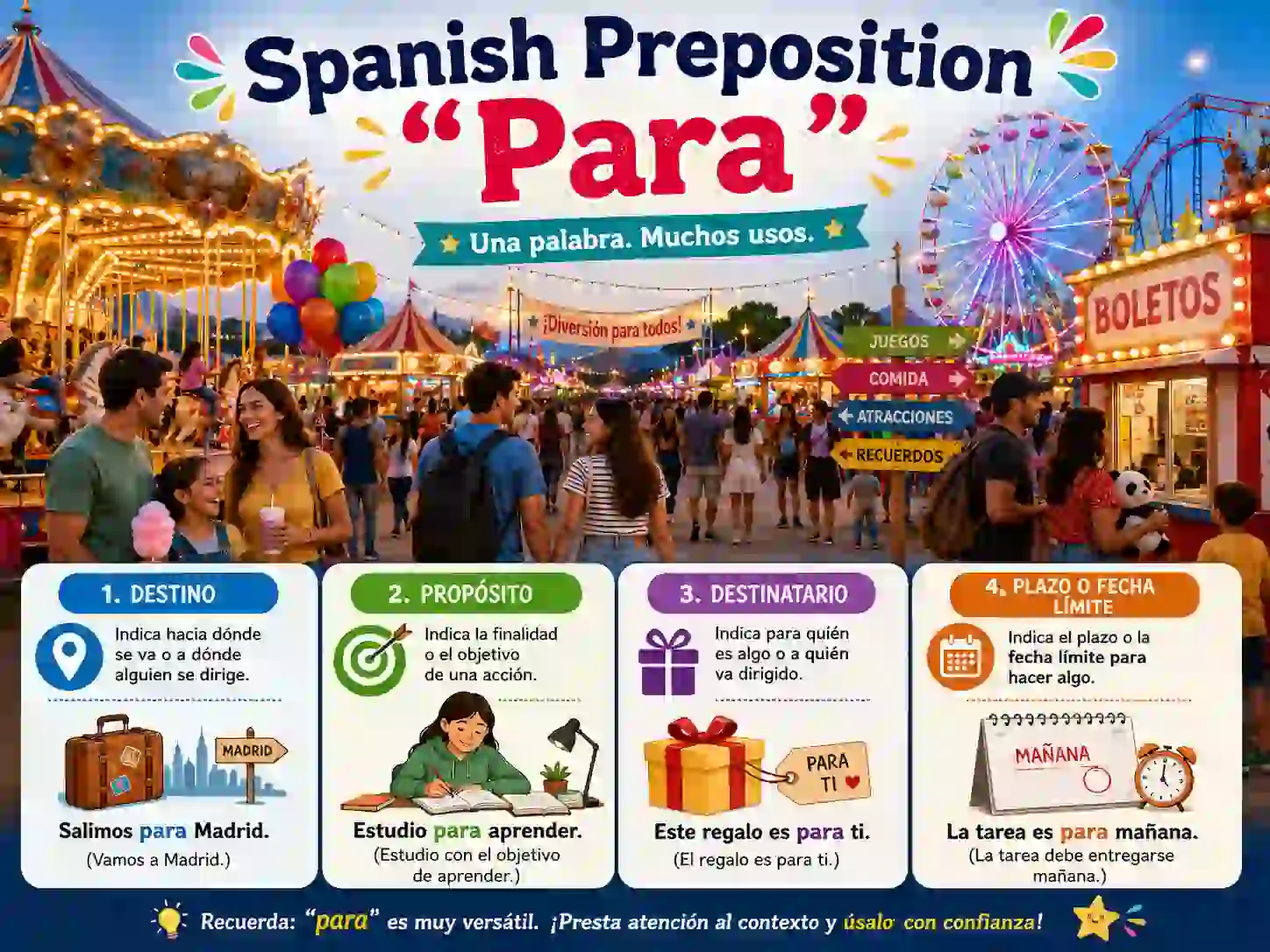
Why learn para with MundoDele?
Para is one of the most important Spanish prepositions because it often points forward: to a purpose, a goal, a person, a destination or a deadline.
MundoDele teaches para through sentence meaning. Instead of translating every English “for” mechanically, learners see whether the sentence points to a purpose, recipient, destination, deadline or point of view.
How to use this page
First learn the core idea of para: it often points to what something is for, who it is for, where something is going or when something must be ready. Then compare it with por.
Purpose
Para explains what an action is intended to achieve.
Estudio para aprender.
I study in order to learn.
Recipient
Para marks the person something is intended for.
Este regalo es para Ana.
This gift is for Ana.
Deadline
Para can point to a target time or deadline.
Necesito el informe para mañana.
I need the report by tomorrow.
What does para mean in Spanish?
Para is a Spanish preposition used to express purpose, goal, destination, recipient, deadline, intended use, opinion and comparison with expectation. It often answers questions such as “what for?”, “for whom?”, “where to?” or “by when?”.
| Meaning of para | Spanish example | English meaning | Function |
|---|---|---|---|
| Purpose | Estudio para aprender. | I study in order to learn. | Goal of the action. |
| Intended use | Esta taza es para café. | This cup is for coffee. | What something is used for. |
| Recipient | Este regalo es para Ana. | This gift is for Ana. | Person who receives something. |
| Destination | Salimos para Madrid. | We leave for Madrid. | Direction toward a destination. |
| Deadline | El informe es para mañana. | The report is due tomorrow. | Target time or deadline. |
| Opinion | Para mí, es importante. | For me, it is important. | Point of view. |
Para for purpose and goal
Use para when the sentence explains what an action is for. In this use, para often translates as “to” or “in order to”.
| Spanish phrase | Spanish sentence | English meaning | Why para? |
|---|---|---|---|
| para aprender | Estudio para aprender. | I study in order to learn. | Learning is the goal. |
| para aprobar | Estudio para aprobar el examen. | I study to pass the exam. | Passing the exam is the purpose. |
| para ahorrar | Trabajo para ahorrar dinero. | I work in order to save money. | Saving money is the goal. |
| para practicar | Uso esta app para practicar español. | I use this app to practise Spanish. | Practising Spanish is the purpose. |
| para entender | Leo el texto para entender la idea. | I read the text to understand the idea. | Understanding is the goal. |
Para for intended use
Use para to say what something is used for. This often appears with nouns or infinitives after para.
| Spanish expression | Spanish sentence | English meaning | Use |
|---|---|---|---|
| para café | Esta taza es para café. | This cup is for coffee. | Intended use. |
| para niños | Este libro es para niños. | This book is for children. | Intended audience. |
| para estudiar | Necesito una mesa para estudiar. | I need a desk for studying. | Use or function. |
| para viajar | Compré una mochila para viajar. | I bought a backpack for travelling. | Intended activity. |
| para principiantes | Es un curso para principiantes. | It is a course for beginners. | Target group. |
Para for recipient
Use para when something is intended for a person, group or recipient. This is one of the most common meanings of para.
| Spanish phrase | Spanish sentence | English meaning | Recipient meaning |
|---|---|---|---|
| para Ana | Este regalo es para Ana. | This gift is for Ana. | Ana receives the gift. |
| para ti | Este café es para ti. | This coffee is for you. | You receive it. |
| para mis padres | Compré flores para mis padres. | I bought flowers for my parents. | The parents are the intended recipients. |
| para todos | Hay comida para todos. | There is food for everyone. | Everyone is included as recipient. |
| para el profesor | La tarea es para el profesor. | The homework is for the teacher. | The teacher is the intended receiver. |
Para for destination and direction
Use para to express movement toward a destination, especially with verbs such as salir, ir, partir or viajar. In many everyday movement sentences, a is also common, but para strongly points to the intended destination.
| Spanish phrase | Spanish sentence | English meaning | Destination meaning |
|---|---|---|---|
| para Madrid | Salimos para Madrid mañana. | We leave for Madrid tomorrow. | Madrid is the destination. |
| para casa | Voy para casa. | I am heading home. | Home is the intended direction. |
| para el aeropuerto | El taxi va para el aeropuerto. | The taxi is going to the airport. | The airport is the destination. |
| para el norte | Viajamos para el norte. | We travel north. | General direction. |
| para la estación | Salgo para la estación. | I am leaving for the station. | Target place. |
Related page: Spanish Prepositions of Place.
Para for deadlines and target time
Use para when something must be ready by a certain time. In this use, para often means “by” or “for” in English.
| Spanish phrase | Spanish sentence | English meaning | Deadline meaning |
|---|---|---|---|
| para mañana | Necesito el informe para mañana. | I need the report by tomorrow. | Tomorrow is the deadline. |
| para el lunes | La tarea es para el lunes. | The homework is due Monday. | Monday is the target date. |
| para las cinco | Termina esto para las cinco. | Finish this by five. | Five o’clock is the deadline. |
| para fin de mes | El proyecto debe estar listo para fin de mes. | The project must be ready by the end of the month. | End of month is the target time. |
| para entonces | Para entonces, ya sabremos más. | By then, we will know more. | Future reference point. |
Related page: Spanish Prepositions of Time.
Para for opinion and point of view
Use para to introduce a personal opinion or point of view. In English this often translates as “for me”, “to me” or “in my opinion”.
| Spanish phrase | Spanish sentence | English meaning | Viewpoint meaning |
|---|---|---|---|
| para mí | Para mí, es importante. | For me, it is important. | Personal opinion. |
| para ti | Para ti, ¿qué significa? | For you, what does it mean? | Asking for a personal view. |
| para muchos | Para muchos, es una oportunidad. | For many people, it is an opportunity. | Group viewpoint. |
| para nosotros | Para nosotros, la educación es central. | For us, education is central. | Shared point of view. |
Related page: Spanish Prepositional Pronouns.
Para for comparison with expectation
Use para when something is compared with what would normally be expected. This structure often translates as “for a...” in English.
| Spanish sentence | English meaning | Expectation | Meaning |
|---|---|---|---|
| Para ser principiante, habla muy bien. | For a beginner, he/she speaks very well. | A beginner usually speaks less well. | Better than expected. |
| Para su edad, corre muy rápido. | For his/her age, he/she runs very fast. | Age creates an expectation. | Comparison with normal expectation. |
| Para ser lunes, hay mucha gente. | For a Monday, there are many people. | Mondays are expected to be quieter. | Unexpected amount. |
| Para un curso corto, aprendí mucho. | For a short course, I learned a lot. | Short courses may teach less. | Result exceeds expectation. |
Para vs por: why para is not always “for”
English “for” can translate as para or por. Use para when the idea is purpose, destination, recipient, deadline or opinion. Use por when the idea is cause, route, exchange, duration or means.
| Meaning | Para | Por | Contrast |
|---|---|---|---|
| Purpose vs cause | Estudio para aprender. | No salimos por la lluvia. | In order to learn vs because of the rain. |
| Recipient vs exchange | Lo compré para Ana. | Lo compré por diez euros. | Person who receives it vs price paid. |
| Destination vs route | Salimos para Madrid. | Caminamos por el parque. | Toward a destination vs through a place. |
| Deadline vs duration | El informe es para mañana. | Estudié por dos horas. | Target date vs length of time. |
Detailed comparison: Por vs Para in Spanish.
Common expressions with para
Some expressions with para should be learned as complete phrases. They are common in everyday Spanish and formal Spanish.
| Expression | Meaning | Spanish example | Comment |
|---|---|---|---|
| para mí | for me / in my opinion | Para mí, es correcto. | Point of view. |
| para siempre | forever | Te recordaré para siempre. | Fixed time expression. |
| para nada | not at all | No me gusta para nada. | Strong negation or emphasis. |
| para colmo | to make matters worse | Para colmo, empezó a llover. | Adds a negative detail. |
| estar para + infinitive | to be about to / ready to | Estoy para salir. | Readiness or near action in some contexts. |
| servir para | to be useful for | Este ejercicio sirve para practicar. | Function or use. |
| prepararse para | to prepare for | Me preparo para el examen. | Goal or target event. |
| listo para | ready for | Estoy listo para empezar. | Readiness for an action. |
Practice exercises: para in Spanish
Try to answer before opening the solutions. These exercises focus on purpose, recipient, destination, deadline and opinion with para.
Exercise 1: complete with para
- Estudio ___ aprender español.
- Este regalo es ___ Ana.
- Salimos ___ Madrid mañana.
- Necesito el informe ___ el lunes.
Show answers
1. para
2. para
3. para
4. para
Exercise 2: identify the meaning
- Para mí, es importante.
- Esta taza es para café.
- Para ser principiante, habla bien.
- Trabajo para ahorrar dinero.
Show answers
1. Opinion / point of view
2. Intended use
3. Comparison with expectation
4. Purpose / goal
Exercise 3: translate the phrase
- in order to study
- for my mother
- by tomorrow
- for me, it is clear
Show answers
1. para estudiar
2. para mi madre
3. para mañana
4. para mí, está claro
Typical mistakes with para
- Translating every “for” as para: sometimes English “for” is por, especially for cause, exchange, duration or route.
- Using por for basic purpose: say estudio para aprender, not estudio por aprender in a simple purpose sentence.
- Using para for cause: say por el tráfico, not para el tráfico.
- Confusing recipient and price: para Ana means Ana receives it; por diez euros gives the price.
- Confusing deadline and duration: para mañana gives a target date; por dos horas gives length of time.
- Forgetting the infinitive after para for purpose: say para estudiar, para aprender, para viajar.
- Ignoring point of view: para mí often means “in my opinion”, not only “for me” as a recipient.
Related grammar topics
Spanish Prepositions
Return to the main preposition overview and compare the wider system.
Por vs Para
Compare purpose, recipient, destination and deadline with cause, route, exchange and duration.
Por
Learn cause, route, exchange, price, duration, means and passive agent with por.
Prepositions of Time
Study para mañana, a las ocho, en enero and por la mañana.
Prepositions of Place
Review destination, direction, route, location and origin in place expressions.
Spanish Infinitive
Review the verb form used after para in purpose phrases such as para estudiar.
Where to go next
After learning para, continue with por and then compare both prepositions directly.
Learn Spanish grammar with MundoDele
Para becomes easier when you learn it through meaning patterns: purpose, recipient, destination, deadline, intended use and opinion. MundoDele connects these patterns with clear examples, exercises and related grammar pages.
FAQ: para in Spanish
What does para mean in Spanish?
Para can express purpose, goal, intended use, destination, recipient, deadline, opinion and comparison with expectation.
When do you use para for purpose?
Use para + infinitive when the meaning is “in order to”: estudio para aprender, trabajo para ahorrar dinero.
How do you use para for a recipient?
Use para when something is intended for someone: este regalo es para Ana, este café es para ti.
How do you use para for deadlines?
Use para when something must be ready by a target time: para mañana, para el lunes, para las cinco.
What does para mí mean?
Para mí can mean “for me” as a recipient, but it often means “in my opinion”: para mí, es importante.
What is the difference between para and por?
Para often expresses purpose, destination, recipient, deadline or opinion. Por often expresses cause, route, exchange, duration or means.

About MundoDele
MundoDele connects online Spanish courses, DELE preparation, Business Spanish and cultural context into a personal Spanish learning platform.
Grammar pages are designed to explain Spanish clearly, with practical examples, real sentence logic and connected learning paths.