
Spanish Prepositional Phrases
Learn how Spanish prepositional phrases work in real sentences. This guide explains phrases with a, de, en, con, por and para, as well as phrases of place, time, purpose, cause, manner, material and possession.
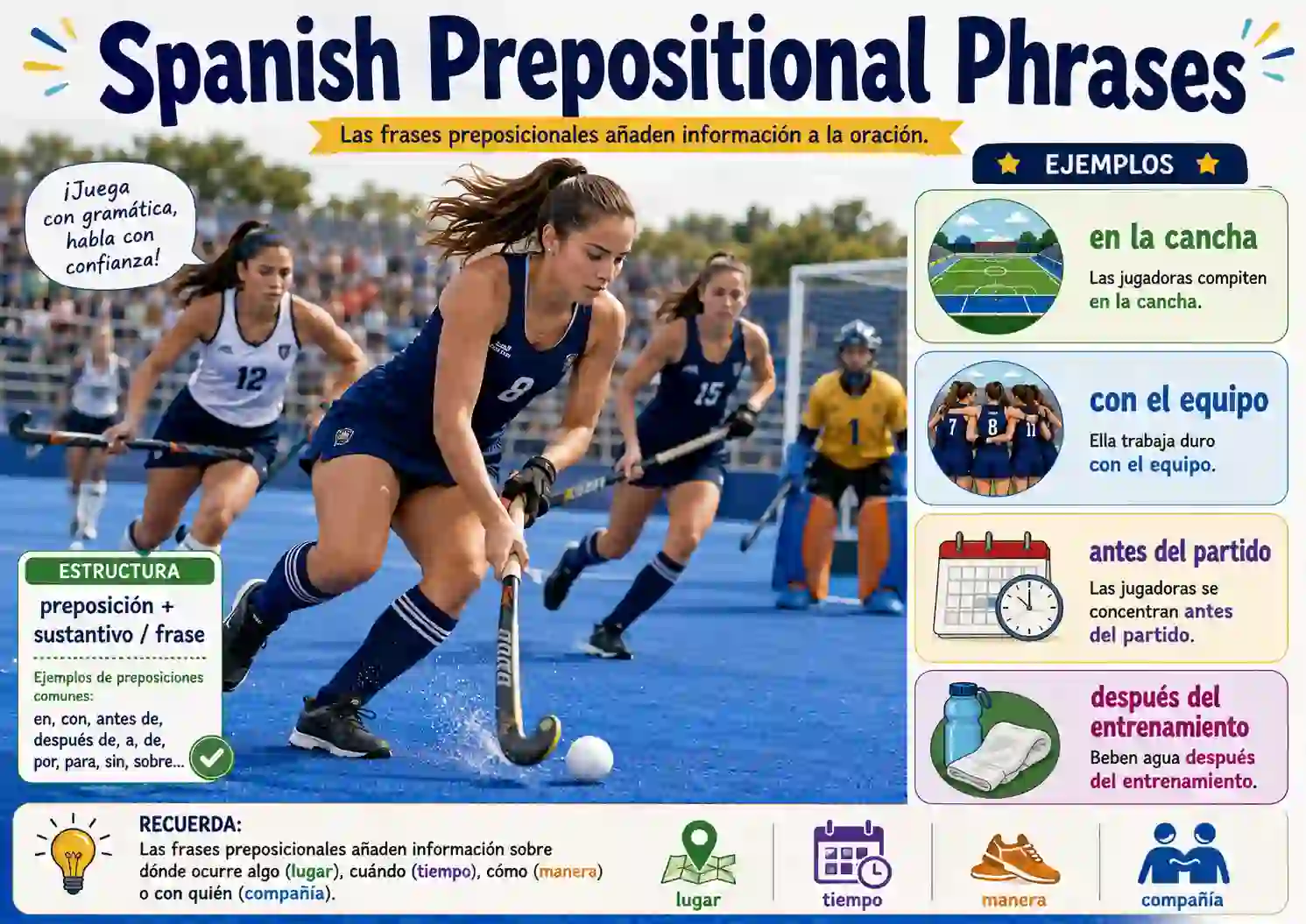
Why learn prepositional phrases with MundoDele?
Prepositions are small words, but prepositional phrases are full sentence building blocks. They help you say where something is, when something happens, why something happens, who someone is with, what something is made of and what something is for.
MundoDele teaches Spanish prepositional phrases as sentence patterns, so learners understand how phrases such as en casa, por la tarde, para mí and de acuerdo con work inside complete sentences.
How to use this page
Use this page after learning the main Spanish prepositions. First understand the basic structure: preposition + noun, pronoun or infinitive. Then study common meanings such as place, time, purpose, cause, manner and possession.
Basic phrase
A prepositional phrase begins with a preposition.
en la casa
in the house
Sentence function
The phrase adds information to the sentence.
Vivo en Madrid.
I live in Madrid.
Meaning
Prepositional phrases often express place, time, purpose, cause or relationship.
Estudio para el examen.
I study for the exam.
What is a prepositional phrase in Spanish?
A prepositional phrase is a group of words that begins with a preposition. It usually contains a noun, pronoun, infinitive or noun phrase after the preposition. In Spanish, prepositional phrases often function as complements inside a sentence.
| Prepositional phrase | Structure | Spanish sentence | English meaning |
|---|---|---|---|
| en la mesa | en + noun phrase | El libro está en la mesa. | The book is on the table. |
| con mi hermano | con + noun phrase | Voy con mi hermano. | I am going with my brother. |
| para estudiar | para + infinitive | Necesito tiempo para estudiar. | I need time to study. |
| de Madrid | de + place | Soy de Madrid. | I am from Madrid. |
| por la mañana | por + time phrase | Trabajo por la mañana. | I work in the morning. |
What do Spanish prepositional phrases express?
Spanish prepositional phrases can express many different meanings. Their meaning depends on the preposition, the words after it and the sentence context.
| Function | Spanish phrase | Example sentence | English meaning |
|---|---|---|---|
| Place | en la ciudad | Vivo en la ciudad. | I live in the city. |
| Time | después de clase | Nos vemos después de clase. | We will see each other after class. |
| Purpose | para aprender | Leo para aprender. | I read in order to learn. |
| Cause | por el tráfico | Llegué tarde por el tráfico. | I arrived late because of the traffic. |
| Company | con mis amigos | Salgo con mis amigos. | I go out with my friends. |
| Material | de madera | La mesa es de madera. | The table is made of wood. |
| Possession | de Ana | El libro es de Ana. | The book belongs to Ana. |
Prepositional phrases of place
Prepositional phrases of place answer the question “where?”. They often use en, a, de, cerca de, lejos de, delante de and detrás de.
| Phrase | Spanish example | English meaning | Use |
|---|---|---|---|
| en casa | Estoy en casa. | I am at home. | Location. |
| a la escuela | Voy a la escuela. | I am going to school. | Direction. |
| de la oficina | Vengo de la oficina. | I am coming from the office. | Origin. |
| cerca del centro | Vivo cerca del centro. | I live near the centre. | Relative location. |
| detrás de la casa | El jardín está detrás de la casa. | The garden is behind the house. | Position. |
Related page: Spanish Prepositions of Place.
Prepositional phrases of time
Prepositional phrases of time answer questions such as when, since when, until when or for how long. Common patterns include por la mañana, desde ayer, hasta el viernes and después de clase.
| Phrase | Spanish example | English meaning | Time meaning |
|---|---|---|---|
| por la mañana | Estudio por la mañana. | I study in the morning. | Part of the day. |
| a las ocho | La clase empieza a las ocho. | The class starts at eight. | Clock time. |
| desde ayer | Estoy aquí desde ayer. | I have been here since yesterday. | Starting point. |
| hasta el lunes | Me quedo hasta el lunes. | I am staying until Monday. | End point. |
| después de clase | Hablamos después de clase. | We talk after class. | Sequence. |
Related page: Spanish Prepositions of Time.
Purpose and cause: para and por
Para often introduces purpose, destination or intended use. Por often introduces cause, reason, exchange, route or general time. This contrast is very important in Spanish prepositional phrases.
| Meaning | Spanish phrase | Example sentence | English meaning |
|---|---|---|---|
| Purpose | para estudiar | Necesito tiempo para estudiar. | I need time to study. |
| Intended recipient | para Ana | Este regalo es para Ana. | This gift is for Ana. |
| Destination | para Madrid | Salimos para Madrid mañana. | We leave for Madrid tomorrow. |
| Cause | por el tráfico | Llegué tarde por el tráfico. | I arrived late because of the traffic. |
| Exchange | por diez euros | Lo compré por diez euros. | I bought it for ten euros. |
| Route | por el parque | Caminamos por el parque. | We walked through the park. |
Related page: Por vs Para in Spanish.
Preposition + infinitive
In Spanish, prepositions are followed by the infinitive when the phrase contains a verb idea. This is different from English, where an -ing form is often used.
| Spanish phrase | Spanish example | English meaning | Note |
|---|---|---|---|
| antes de salir | Como algo antes de salir. | I eat something before leaving. | de + infinitive. |
| después de estudiar | Descanso después de estudiar. | I rest after studying. | de + infinitive. |
| para aprender | Leo para aprender. | I read in order to learn. | Purpose. |
| sin mirar | Contestó sin mirar. | He/she answered without looking. | sin + infinitive. |
| al llegar | Al llegar, llamé a Ana. | Upon arriving, I called Ana. | al + infinitive expresses time. |
Prepositional phrases with pronouns
After prepositions, Spanish uses prepositional pronouns such as mí, ti, él, ella, nosotros and ellos. The preposition con has special forms: conmigo, contigo and consigo.
| Phrase | Spanish example | English meaning | Note |
|---|---|---|---|
| para mí | Este café es para mí. | This coffee is for me. | Prepositional pronoun. |
| sin ti | No puedo hacerlo sin ti. | I cannot do it without you. | Prepositional pronoun. |
| con él | Voy con él. | I am going with him. | Third-person pronoun. |
| conmigo | Ven conmigo. | Come with me. | Special form of con mí. |
| contigo | Quiero hablar contigo. | I want to speak with you. | Special form of con ti. |
Related page: Spanish Prepositional Pronouns.
Common complex prepositional phrases
Spanish also has longer prepositional expressions made of several words. These work as fixed phrase patterns and are very common in formal and everyday Spanish.
| Phrase | Meaning | Spanish example | English meaning |
|---|---|---|---|
| antes de | before | Llego antes de las ocho. | I arrive before eight. |
| después de | after | Hablamos después de clase. | We talk after class. |
| cerca de | near | Vivo cerca de la estación. | I live near the station. |
| lejos de | far from | La casa está lejos del centro. | The house is far from the centre. |
| delante de | in front of | El coche está delante de la casa. | The car is in front of the house. |
| detrás de | behind | El jardín está detrás de la casa. | The garden is behind the house. |
| a causa de | because of | No salimos a causa de la lluvia. | We did not go out because of the rain. |
| de acuerdo con | according to / in agreement with | De acuerdo con el informe, la situación cambió. | According to the report, the situation changed. |
Contractions in prepositional phrases: al and del
Two Spanish prepositions contract with the masculine singular article el. A + el becomes al, and de + el becomes del.
| Combination | Correct form | Spanish example | English meaning |
|---|---|---|---|
| a + el | al | Voy al mercado. | I am going to the market. |
| de + el | del | Vengo del trabajo. | I am coming from work. |
| a + la | a la | Voy a la escuela. | I am going to school. |
| de + la | de la | Vengo de la oficina. | I am coming from the office. |
Where do prepositional phrases go in a Spanish sentence?
Prepositional phrases usually come after the word or verb they complete. They can also appear at the beginning of a sentence for emphasis, especially time and context phrases.
| Position | Spanish example | English meaning | Function |
|---|---|---|---|
| After the verb | Vivo en Buenos Aires. | I live in Buenos Aires. | Completes the verb. |
| After a noun | El libro de Ana está aquí. | Ana’s book is here. | Describes possession. |
| At the beginning | Por la mañana, estudio español. | In the morning, I study Spanish. | Sets time context. |
| After an adjective | Estoy contento con el resultado. | I am happy with the result. | Completes the adjective. |
| After a fixed expression | Estoy de acuerdo con Ana. | I agree with Ana. | Fixed prepositional expression. |
Practice exercises: Spanish prepositional phrases
Try to answer before opening the solutions. These exercises focus on phrase meaning, preposition choice and sentence position.
Exercise 1: identify the phrase
- El libro está en la mesa.
- Trabajo por la mañana.
- Voy con mi hermano.
- Necesito tiempo para estudiar.
Show answers
1. en la mesa
2. por la mañana
3. con mi hermano
4. para estudiar
Exercise 2: choose the preposition
- Voy ___ la escuela.
- Vengo ___ la oficina.
- Estudio ___ aprender.
- Llegué tarde ___ el tráfico.
Show answers
1. a
2. de
3. para
4. por
Exercise 3: translate the phrase
- after class
- with me
- because of the rain
- in order to study
Show answers
1. después de clase
2. conmigo
3. a causa de la lluvia / por la lluvia
4. para estudiar
Typical mistakes with Spanish prepositional phrases
- Translating English prepositions directly: English “in”, “on”, “at” and “to” do not always match one Spanish preposition.
- Forgetting contractions: say al mercado and del trabajo, not a el mercado or de el trabajo.
- Using a conjugated verb after a preposition: say antes de salir, not antes de salgo.
- Confusing por and para: para often expresses purpose; por often expresses cause or route.
- Using subject pronouns after prepositions: say para mí, sin ti, con él.
- Forgetting special forms with con: use conmigo and contigo.
- Ignoring fixed expressions: phrases such as de acuerdo con or a causa de should be learned as complete units.
Related grammar topics
Spanish Prepositions
Review the main Spanish prepositions and their core meanings.
Por vs Para
Understand one of the most important preposition contrasts in Spanish.
Prepositional Pronouns
Learn mí, ti, él, ella, conmigo and contigo.
Prepositions of Place
Study location and direction phrases such as en, a, de, cerca de.
Prepositions of Time
Learn time phrases with a, por, desde, hasta, antes de and después de.
Spanish Sentence Structures
See how phrases, clauses and complements build complete Spanish sentences.
Where to go next
After learning prepositional phrases, continue with the individual prepositions and the pronoun forms that appear after them.
Learn Spanish grammar with MundoDele
Prepositional phrases help you make Spanish sentences more precise. With MundoDele, you can learn how prepositions combine with nouns, pronouns and infinitives to express place, time, cause, purpose and relationship.
FAQ: Spanish prepositional phrases
What is a prepositional phrase in Spanish?
A Spanish prepositional phrase is a group of words that begins with a preposition and adds information about place, time, cause, purpose, manner, possession or relationship.
What are examples of Spanish prepositional phrases?
Examples include en la mesa, con mi hermano, para estudiar, por la mañana, de Madrid, después de clase and a causa de la lluvia.
Can a Spanish prepositional phrase contain an infinitive?
Yes. After a preposition, Spanish uses the infinitive: antes de salir, después de estudiar, para aprender, sin mirar.
What pronouns are used after Spanish prepositions?
Spanish uses prepositional pronouns such as mí, ti, él, ella, nosotros and ellos. With con, special forms include conmigo, contigo and consigo.
What is the difference between por and para in prepositional phrases?
Para often expresses purpose, destination or intended recipient. Por often expresses cause, route, exchange, general time or reason.
What are al and del in Spanish prepositional phrases?
Al is the contraction of a + el. Del is the contraction of de + el. For example: voy al mercado, vengo del trabajo.

About MundoDele
MundoDele connects online Spanish courses, DELE preparation, Business Spanish and cultural context into a personal Spanish learning platform.
Grammar pages are designed to explain Spanish clearly, with practical examples, real sentence logic and connected learning paths.