
De in Spanish
Learn how to use de in Spanish. This guide explains the main meanings of de: origin, possession, material, topic, quantity, content, description, time range, fixed expressions and the contraction del.
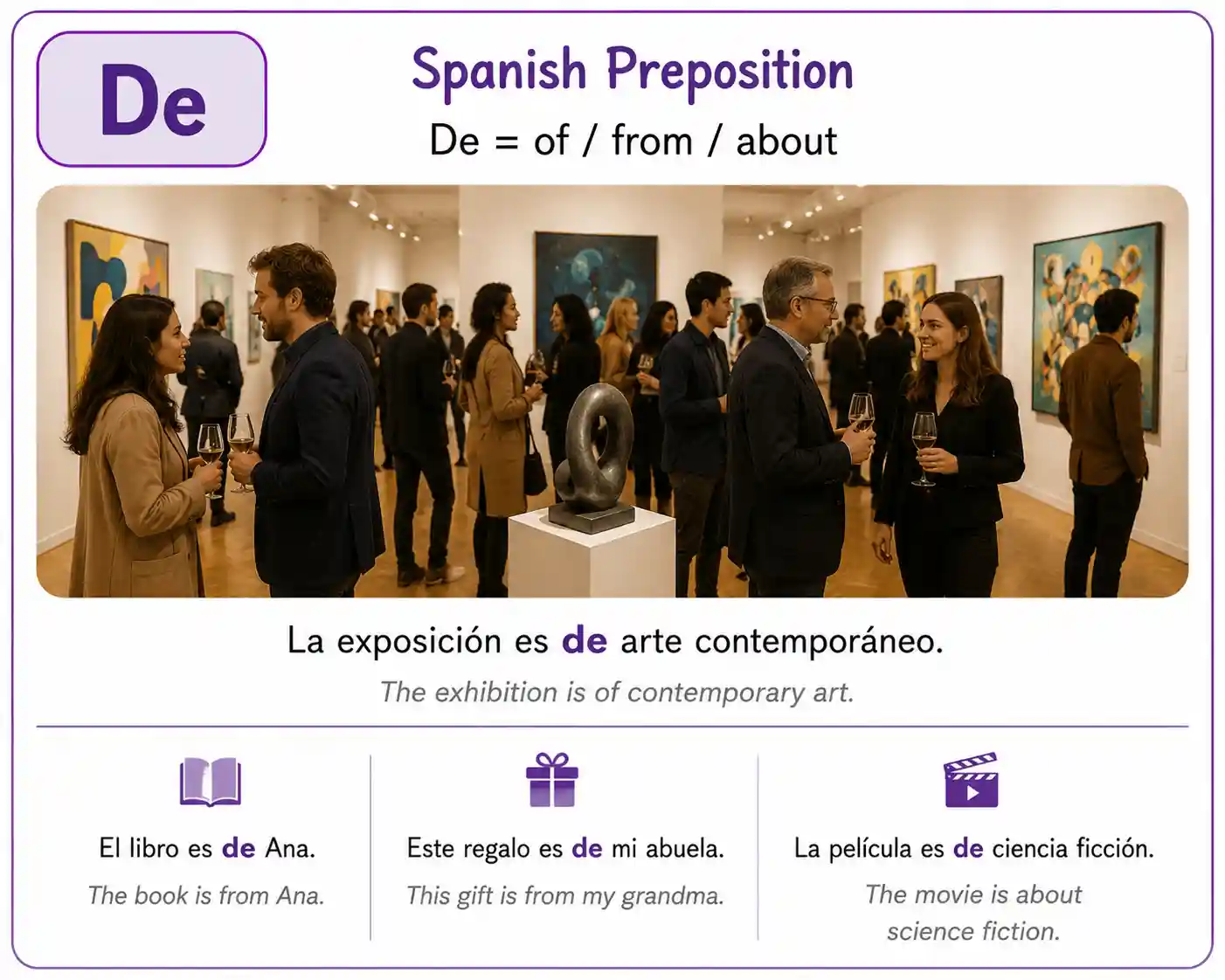
Why learn de with MundoDele?
De is one of the most frequent Spanish prepositions. It connects nouns, places, people, materials, topics and quantities. Many Spanish noun phrases depend on de.
MundoDele teaches de through sentence meaning: where something comes from, who something belongs to, what something is made of, what something contains and what someone is speaking about.
How to use this page
Start with the basic meanings of de: from, of and about. Then study origin, possession, material, content, quantity and fixed expressions. Finally, compare de with en, a and desde.
Origin
De shows where someone or something comes from.
Soy de Madrid.
I am from Madrid.
Possession
De shows who something belongs to.
Es el libro de Ana.
It is Ana’s book.
Material
De says what something is made of.
Una mesa de madera.
A wooden table.
What does de mean in Spanish?
De is a Spanish preposition that can express origin, possession, material, topic, quantity, content, description and time range. It often connects two nouns or connects a verb with the topic of an action.
| Meaning of de | Spanish example | English meaning | Function |
|---|---|---|---|
| Origin | Soy de México. | I am from Mexico. | Where someone comes from. |
| Possession | El coche de Luis. | Luis’s car. | Who owns something. |
| Material | Una mesa de madera. | A wooden table. | What something is made of. |
| Topic | Hablamos de gramática. | We speak about grammar. | Subject of discussion. |
| Quantity | Un vaso de agua. | A glass of water. | Amount plus content. |
| Time range | Trabajo de lunes a viernes. | I work from Monday to Friday. | Scheduled period. |
De for origin: from
Use de to say where someone or something comes from. This can refer to a country, city, place, source or starting point.
| Spanish phrase | Spanish sentence | English meaning | Origin meaning |
|---|---|---|---|
| de Madrid | Soy de Madrid. | I am from Madrid. | Personal origin. |
| de Argentina | Mi amigo es de Argentina. | My friend is from Argentina. | Country origin. |
| de la oficina | Vengo de la oficina. | I am coming from the office. | Starting place. |
| del centro | Salimos del centro. | We leave from the centre. | de + el = del. |
| de aquí | No soy de aquí. | I am not from here. | Local origin. |
Related page: Spanish Prepositions of Place.
De for possession: Ana’s book
Spanish does not use an apostrophe-s for possession. Instead, it often uses de: el libro de Ana, literally “the book of Ana”.
| Spanish phrase | Spanish sentence | English meaning | Possession meaning |
|---|---|---|---|
| el libro de Ana | Es el libro de Ana. | It is Ana’s book. | Ana owns the book. |
| la casa de mis padres | Visitamos la casa de mis padres. | We visit my parents’ house. | The house belongs to the parents. |
| el coche del profesor | Ese es el coche del profesor. | That is the teacher’s car. | de + el = del. |
| la mochila de Clara | La mochila de Clara está aquí. | Clara’s backpack is here. | Owner after de. |
| el nombre de la calle | No recuerdo el nombre de la calle. | I do not remember the street name. | Belonging or association. |
De for material: made of
Use de to describe what something is made of. This use often translates as “made of” or appears as an adjective in English.
| Spanish phrase | Spanish sentence | English meaning | Material meaning |
|---|---|---|---|
| de madera | La mesa es de madera. | The table is made of wood. | Wood is the material. |
| de metal | La puerta es de metal. | The door is made of metal. | Metal is the material. |
| de papel | Es una bolsa de papel. | It is a paper bag. | Paper is the material. |
| de cuero | Compré una chaqueta de cuero. | I bought a leather jacket. | Leather is the material. |
| de plástico | No quiero vasos de plástico. | I do not want plastic cups. | Plastic is the material. |
De for topic: about
Use de after certain verbs and nouns to introduce the topic. In English, this often translates as “about” or “of”.
| Expression | Spanish sentence | English meaning | Topic meaning |
|---|---|---|---|
| hablar de | Hablamos de gramática. | We speak about grammar. | Topic of conversation. |
| tratar de | El libro trata de historia. | The book is about history. | Subject of the book. |
| un curso de español | Hago un curso de español. | I am taking a Spanish course. | Course topic. |
| una clase de gramática | Tengo una clase de gramática. | I have a grammar class. | Class subject. |
| un artículo de cultura | Leí un artículo de cultura. | I read an article about culture. | Article topic. |
De for quantity and content
Use de after quantity words and container words. This structure connects the amount or container with what it contains.
| Spanish phrase | Spanish sentence | English meaning | Structure |
|---|---|---|---|
| un vaso de agua | Quiero un vaso de agua. | I want a glass of water. | Container + content. |
| una taza de café | Tomo una taza de café. | I drink a cup of coffee. | Container + content. |
| un kilo de manzanas | Compré un kilo de manzanas. | I bought a kilo of apples. | Measure + content. |
| mucho de esto | No entiendo mucho de esto. | I do not understand much of this. | Partitive expression. |
| un grupo de estudiantes | Hay un grupo de estudiantes. | There is a group of students. | Collective noun + group members. |
De for description and type
De often describes the type, function or category of a noun. Many English adjective-noun combinations become noun + de + noun in Spanish.
| Spanish phrase | English meaning | Spanish example | Type meaning |
|---|---|---|---|
| clase de español | Spanish class | Tengo clase de español. | Class type. |
| libro de gramática | grammar book | Uso un libro de gramática. | Book subject. |
| zapatos de deporte | sports shoes | Necesito zapatos de deporte. | Type or use. |
| máquina de café | coffee machine | La máquina de café no funciona. | Function. |
| billete de tren | train ticket | Compré un billete de tren. | Ticket type. |
De for time ranges
Use de in time ranges, especially with the structure de... a.... This means “from... to...” in schedules, opening hours and repeated time periods.
| Spanish expression | Spanish sentence | English meaning | Time meaning |
|---|---|---|---|
| de lunes a viernes | Trabajo de lunes a viernes. | I work from Monday to Friday. | Weekly schedule. |
| de nueve a cinco | Trabajo de nueve a cinco. | I work from nine to five. | Work hours. |
| de día | Es mejor viajar de día. | It is better to travel during the day. | Time condition. |
| de noche | Trabajo de noche. | I work at night. | Time condition. |
| de madrugada | Salimos de madrugada. | We leave at dawn / very early. | Fixed time expression. |
Related page: Spanish Prepositions of Time.
De + el = del
When de comes before the masculine singular article el, Spanish contracts the two words: de + el = del. This contraction is mandatory.
| Combination | Correct form | Spanish example | English meaning |
|---|---|---|---|
| de + el | del | Vengo del trabajo. | I am coming from work. |
| de + el | del | El coche del profesor. | The teacher’s car. |
| de + la | de la | Vengo de la oficina. | I am coming from the office. |
| de + los | de los | La casa de los abuelos. | The grandparents’ house. |
| de + las | de las | El nombre de las calles. | The names of the streets. |
Related page: Spanish Definite Articles.
De vs en: origin or location
Use de for origin, source, possession or material. Use en for location, surface or time frame.
| Meaning | De | En | Contrast |
|---|---|---|---|
| Country | Soy de México. I am from Mexico. |
Vivo en México. I live in Mexico. |
Origin vs location. |
| Office | Vengo de la oficina. I am coming from the office. |
Estoy en la oficina. I am at the office. |
Starting point vs current location. |
| Table | La mesa es de madera. The table is made of wood. |
El libro está en la mesa. The book is on the table. |
Material vs surface location. |
| Class | Clase de español. Spanish class. |
Estoy en clase. I am in class. |
Type/topic vs place/activity. |
Related page: En in Spanish.
De vs desde: from or since
Both de and desde can relate to a starting point. De is common for origin and paired ranges such as de... a.... Desde strongly marks the starting point of an action, state or time period.
| Meaning | De | Desde | Contrast |
|---|---|---|---|
| Origin | Soy de Perú. I am from Peru. |
Te llamo desde Perú. I am calling you from Peru. |
Origin identity vs current starting point. |
| Schedule | Trabajo de nueve a cinco. | Trabajo desde las nueve. | Full range vs starting point. |
| Time | de lunes a viernes | desde el lunes | Range vs “since/from Monday”. |
| Place | Vengo de casa. | Lo veo desde la ventana. | Coming from vs perspective/source point. |
Common expressions with de
Many Spanish expressions with de are best learned as complete phrases. They are common in everyday Spanish, grammar, travel, work and formal writing.
| Expression | Meaning | Spanish example | Use |
|---|---|---|---|
| después de | after | Descanso después de clase. | Time sequence. |
| antes de | before | Como antes de salir. | Time sequence. |
| cerca de | near | Vivo cerca del centro. | Place relation. |
| lejos de | far from | La playa está lejos de aquí. | Distance. |
| delante de | in front of | El coche está delante de la casa. | Position. |
| detrás de | behind | El jardín está detrás de la casa. | Position. |
| a causa de | because of | No salimos a causa de la lluvia. | Cause. |
| de acuerdo con | according to / in agreement with | Estoy de acuerdo con Ana. | Agreement or source. |
Common verbs and adjectives with de
Some verbs and adjectives are commonly followed by de. These combinations should be learned as sentence patterns.
| Expression | Meaning | Spanish example | Pattern |
|---|---|---|---|
| hablar de | to speak about | Hablamos de viajes. | Verb + de. |
| depender de | to depend on | Depende del contexto. | Verb + de. |
| acordarse de | to remember | Me acuerdo de ti. | Reflexive verb + de. |
| olvidarse de | to forget about | Me olvidé de la reunión. | Reflexive verb + de. |
| tratar de | to be about / try to | El texto trata de cultura. | Topic meaning. |
| estar cansado de | to be tired of | Estoy cansado de esperar. | Adjective + de. |
De before an infinitive
Some Spanish expressions use de before an infinitive. This is common with time expressions, adjective patterns and certain verbs.
| Expression | Spanish sentence | English meaning | Structure |
|---|---|---|---|
| antes de salir | Como antes de salir. | I eat before leaving. | antes de + infinitive. |
| después de estudiar | Descanso después de estudiar. | I rest after studying. | después de + infinitive. |
| cansado de esperar | Estoy cansado de esperar. | I am tired of waiting. | Adjective + de + infinitive. |
| tratar de entender | Trato de entender. | I try to understand. | Verb pattern. |
| dejar de fumar | Quiero dejar de fumar. | I want to stop smoking. | Verb + de + infinitive. |
Practice exercises: de in Spanish
Try to answer before opening the solutions. These exercises focus on origin, possession, material, quantity and del.
Exercise 1: complete with de or del
- Soy ___ Madrid.
- Vengo ___ trabajo.
- Es el libro ___ Ana.
- La mesa es ___ madera.
Show answers
1. de
2. del
3. de
4. de
Exercise 2: identify the meaning
- Un vaso de agua.
- La casa de mis padres.
- Hablamos de gramática.
- Trabajo de lunes a viernes.
Show answers
1. Quantity / content
2. Possession
3. Topic
4. Time range
Exercise 3: translate the phrase
- Ana’s book
- a wooden table
- a cup of coffee
- from Monday to Friday
Show answers
1. el libro de Ana
2. una mesa de madera
3. una taza de café
4. de lunes a viernes
Typical mistakes with de
- Forgetting del: say del trabajo, not de el trabajo.
- Using English possessive order: say el libro de Ana, not a literal apostrophe-s structure.
- Confusing origin and location: soy de México means origin; vivo en México means location.
- Confusing material and location: mesa de madera means made of wood; libro en la mesa means on the table.
- Forgetting de after quantity words: say un vaso de agua, un kilo de manzanas.
- Ignoring fixed expressions: learn antes de, después de, cerca de, depender de and hablar de as patterns.
- Using a conjugated verb after antes de or después de: say antes de salir, not antes de salgo.
Related grammar topics
Spanish Prepositions
Return to the main preposition overview and compare the full system.
En
Compare origin and material with de and location or time frame with en.
A
Compare de for origin and a for destination.
Prepositional Phrases
Learn full phrase patterns such as de Madrid, de madera, de lunes a viernes.
Prepositions of Time
Study de lunes a viernes, antes de, después de and related time expressions.
Definite Articles
Review el, la, los, las and the contraction del.
Where to go next
After learning de, continue with en, a and prepositional phrases.
Learn Spanish grammar with MundoDele
De becomes easier when you learn it through meaning patterns: origin, possession, material, topic, quantity, time range and fixed expressions. MundoDele connects these patterns with clear examples, exercises and related grammar pages.
FAQ: de in Spanish
What does de mean in Spanish?
De can mean “from”, “of”, “about” or “made of”, depending on context. It is used for origin, possession, material, topic, quantity, content and time ranges.
How do you use de for origin?
Use de to say where someone or something comes from: soy de Madrid, vengo de la oficina, salimos del centro.
How do you use de for possession?
Spanish often uses de instead of apostrophe-s: el libro de Ana, la casa de mis padres, el coche del profesor.
What is del in Spanish?
Del is the contraction of de + el. For example: vengo del trabajo, el coche del profesor.
What is the difference between de and en?
De often expresses origin, possession or material. En often expresses location, surface or time frame.
Can de come before an infinitive?
Yes. Common expressions include antes de salir, después de estudiar, dejar de fumar and estar cansado de esperar.

About MundoDele
MundoDele connects online Spanish courses, DELE preparation, Business Spanish and cultural context into a personal Spanish learning platform.
Grammar pages are designed to explain Spanish clearly, with practical examples, real sentence logic and connected learning paths.