
Por in Spanish
Learn how to use por in Spanish. This guide explains the main meanings of por: cause, reason, route, movement through a place, exchange, price, duration, means, communication channel, substitution, passive agent and fixed expressions.
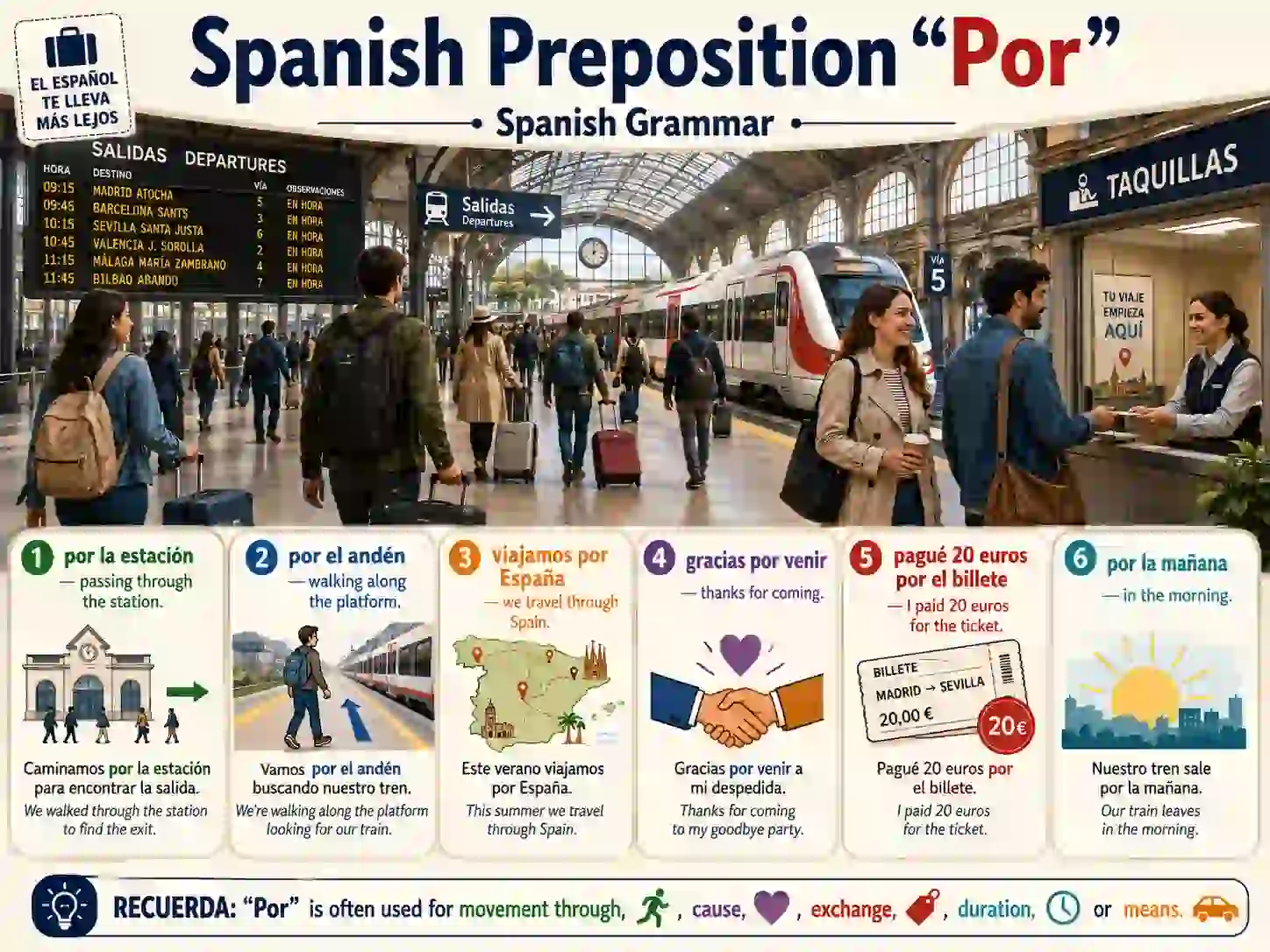
Why learn por with MundoDele?
Por is one of the most flexible Spanish prepositions. It does not have one single English translation. Depending on context, it can mean because of, through, by, for, per, around, instead of or in exchange for.
MundoDele teaches por through meaning patterns: cause, route, exchange, duration, means and agent. This makes the preposition easier to understand than memorising long translation lists.
How to use this page
First learn the core idea of por: it often explains the reason, path, exchange or means behind an action. Then study the main uses one by one and compare them with para.
Reason
Por often explains why something happens.
No salimos por la lluvia.
We did not go out because of the rain.
Route
Por can describe movement through or around a place.
Caminamos por el centro.
We walked through the centre.
Exchange
Por marks price, exchange or replacement.
Lo compré por veinte euros.
I bought it for twenty euros.
What does por mean in Spanish?
Por is a Spanish preposition used to express cause, route, exchange, duration, means and other relationships. It is especially common when Spanish explains why something happens, through where something moves, how something is done or what something is exchanged for.
| Meaning of por | Spanish example | English meaning | Function |
|---|---|---|---|
| Cause | Llegué tarde por el tráfico. | I arrived late because of the traffic. | Reason for the action. |
| Route | Caminamos por el parque. | We walked through the park. | Movement through an area. |
| Exchange | Lo cambié por otro. | I exchanged it for another one. | One thing for another. |
| Price | Lo compré por diez euros. | I bought it for ten euros. | Amount paid. |
| Means | Te llamo por teléfono. | I will call you by phone. | Communication channel. |
| Passive agent | Fue escrito por Cervantes. | It was written by Cervantes. | Agent in passive voice. |
Por for cause and reason
Use por to explain why something happens. In this use, por often means “because of”, “due to” or “for the reason of”.
| Spanish phrase | Spanish sentence | English meaning | Why por? |
|---|---|---|---|
| por el tráfico | Llegué tarde por el tráfico. | I arrived late because of the traffic. | The traffic is the cause. |
| por la lluvia | No salimos por la lluvia. | We did not go out because of the rain. | The rain is the reason. |
| por eso | Por eso no vine. | That is why I did not come. | Por eso gives the reason. |
| por miedo | No habló por miedo. | He/she did not speak out of fear. | The emotion explains the action. |
| por tu ayuda | Gracias por tu ayuda. | Thank you for your help. | The help is the reason for thanks. |
Por for route and movement through a place
Use por when someone or something moves through, around or along a place. The place is not necessarily the destination; it is the route or area of movement.
| Spanish phrase | Spanish sentence | English meaning | Route meaning |
|---|---|---|---|
| por el parque | Caminamos por el parque. | We walked through the park. | The park is the route or area. |
| por el centro | Pasamos por el centro. | We passed through the centre. | Movement through an area. |
| por la costa | Viajamos por la costa. | We travelled along the coast. | Movement along a line or area. |
| por aquí | Ven por aquí. | Come this way. | Path or direction through a place. |
| por la ciudad | Paseamos por la ciudad. | We walked around the city. | Movement within an area. |
Related page: Spanish Prepositions of Place.
Por for exchange, price and replacement
Use por when one thing is exchanged for another, when a price is given or when someone acts in place of another person.
| Use | Spanish example | English meaning | Meaning |
|---|---|---|---|
| Price | Lo compré por veinte euros. | I bought it for twenty euros. | Amount paid. |
| Exchange | Cambié mi libro por el tuyo. | I exchanged my book for yours. | One thing for another. |
| Replacement | Sustituí el café por té. | I replaced coffee with tea. | One thing replaces another. |
| Substitution | Trabajo por mi compañero. | I work instead of my colleague. | Acting in someone’s place. |
| Value | No lo vendo por menos. | I will not sell it for less. | Price or value threshold. |
Por for duration and general time
Por can express duration or a general time period. It is common with parts of the day and approximate time expressions.
| Time expression | Spanish example | English meaning | Time function |
|---|---|---|---|
| por dos horas | Estudié por dos horas. | I studied for two hours. | Duration. |
| por unos días | Me quedo por unos días. | I am staying for a few days. | Approximate duration. |
| por la mañana | Trabajo por la mañana. | I work in the morning. | Part of the day. |
| por la tarde | Estudio por la tarde. | I study in the afternoon. | Part of the day. |
| por ahora | Por ahora, todo está bien. | For now, everything is fine. | Temporary time frame. |
Related page: Spanish Prepositions of Time.
Por for means, channel and communication
Use por to express the channel, medium or means through which something happens. This is especially common with communication.
| Spanish phrase | Spanish sentence | English meaning | Use |
|---|---|---|---|
| por teléfono | Hablamos por teléfono. | We speak by phone. | Communication channel. |
| por correo | Te mando el archivo por correo. | I send you the file by email. | Communication medium. |
| por internet | Lo compré por internet. | I bought it online. | Medium or channel. |
| por radio | Escuché la noticia por radio. | I heard the news on the radio. | Medium of information. |
| por escrito | Necesito la respuesta por escrito. | I need the answer in writing. | Form or medium. |
Por with passive voice
In passive voice, por introduces the agent: the person or thing that performs the action. This use often translates as “by”.
| Spanish passive sentence | English meaning | Agent with por | Comment |
|---|---|---|---|
| El libro fue escrito por Cervantes. | The book was written by Cervantes. | por Cervantes | The agent wrote the book. |
| La canción fue compuesta por Shakira. | The song was composed by Shakira. | por Shakira | The agent composed the song. |
| El proyecto fue aprobado por el comité. | The project was approved by the committee. | por el comité | The committee performed the action. |
| La casa fue construida por una empresa local. | The house was built by a local company. | por una empresa local | The agent built the house. |
Related page: Passive Voice in Spanish.
Por vs para: why por is not always “for”
English “for” can translate as por or para. Use por when the idea is cause, exchange, duration or route. Use para when the idea is purpose, recipient, destination or deadline.
| Meaning | Por | Para | Contrast |
|---|---|---|---|
| Cause vs purpose | No salimos por la lluvia. | Salimos para comprar pan. | Because of rain vs in order to buy bread. |
| Exchange vs recipient | Lo compré por diez euros. | Lo compré para Ana. | Price paid vs person who receives it. |
| Route vs destination | Caminamos por el parque. | Salimos para Madrid. | Through a place vs toward a destination. |
| Duration vs deadline | Estudié por dos horas. | El informe es para mañana. | Length of time vs target date. |
Detailed comparison: Por vs Para in Spanish.
Common expressions with por
Many expressions with por are best learned as complete phrases. These are common in everyday Spanish and formal Spanish.
| Expression | Meaning | Spanish example | Comment |
|---|---|---|---|
| por favor | please | Ayúdame, por favor. | Fixed polite expression. |
| por ejemplo | for example | Por ejemplo, podemos estudiar juntos. | Introduces an example. |
| por supuesto | of course | Por supuesto que sí. | Fixed expression. |
| por eso | that is why | Por eso no vine. | Reason or consequence. |
| por lo tanto | therefore | Estaba enfermo; por lo tanto, no vino. | Formal consequence connector. |
| por ahora | for now | Por ahora, todo está bien. | Temporary situation. |
| por fin | finally | Por fin llegaste. | Relief or completion. |
| por si acaso | just in case | Lleva un paraguas por si acaso. | Precaution. |
Special patterns with por
Some structures with por have meanings that are less literal. They should be learned as sentence patterns.
| Pattern | Spanish example | English meaning | Meaning |
|---|---|---|---|
| estar por + infinitive | Estoy por llamarlo. | I am thinking of calling him / I am about to call him. | Intention or pending action, depending on context. |
| quedar por + infinitive | Queda mucho por hacer. | There is still much to do. | Pending action. |
| por + infinitive | Gracias por venir. | Thank you for coming. | Reason after thanks. |
| por mí | Por mí, podemos salir ahora. | As far as I am concerned, we can leave now. | Personal acceptance or viewpoint. |
| por cada | Pago diez euros por cada clase. | I pay ten euros per class. | Rate or unit. |
Practice exercises: por in Spanish
Try to answer before opening the solutions. These exercises focus on cause, route, exchange, duration, means and fixed expressions with por.
Exercise 1: complete with por
- Gracias ___ tu ayuda.
- No salimos ___ la lluvia.
- Caminamos ___ el parque.
- Lo compré ___ diez euros.
Show answers
1. por
2. por
3. por
4. por
Exercise 2: identify the meaning
- Te llamo por teléfono.
- Estudié por dos horas.
- Fue escrito por Cervantes.
- Trabajo por mi compañero.
Show answers
1. Means / communication channel
2. Duration
3. Passive agent
4. Substitution
Exercise 3: translate the phrase
- because of the traffic
- through the city
- for twenty euros
- by email
Show answers
1. por el tráfico
2. por la ciudad
3. por veinte euros
4. por correo
Typical mistakes with por
- Translating every “for” as por: sometimes English “for” is para, especially for purpose, recipient or deadline.
- Using para for cause: say por el tráfico, not para el tráfico.
- Using por for a basic purpose: say estudio para aprender, not estudio por aprender.
- Confusing route and destination: por el parque means through the park; para Madrid means toward Madrid.
- Confusing price and recipient: por diez euros gives the price; para Ana gives the recipient.
- Forgetting fixed expressions: learn por favor, por ejemplo, por supuesto, por eso and por fin as complete units.
- Ignoring context: por changes meaning depending on whether it expresses cause, route, exchange, duration, means or agent.
Related grammar topics
Spanish Prepositions
Return to the main preposition overview and compare the wider system.
Por vs Para
Compare cause, route, exchange and duration with purpose, recipient, destination and deadline.
Para
Learn purpose, destination, recipient, deadline, intended use and opinion with para.
Prepositions of Time
Study por la mañana, por dos horas, a las ocho and para mañana.
Prepositions of Place
Review location, route, origin and destination in place expressions.
Passive Voice
Learn how por introduces the agent in passive sentences.
Where to go next
After learning por, continue with para and then compare both prepositions directly.
Learn Spanish grammar with MundoDele
Por becomes easier when you learn it through meaning patterns: cause, route, exchange, duration, means and agent. MundoDele connects these patterns with clear examples, exercises and related grammar pages.
FAQ: por in Spanish
What does por mean in Spanish?
Por can express cause, reason, route, exchange, price, duration, means, communication channel, substitution and passive agent. Its meaning depends on context.
When do you use por for cause?
Use por when something happens because of a reason or cause: por el tráfico, por la lluvia, por eso.
How do you use por for route?
Use por when someone or something moves through, around or along a place: caminamos por el parque, pasamos por el centro.
How do you use por for price or exchange?
Use por for price or exchange: lo compré por diez euros, cambié mi libro por el tuyo.
How do you use por in passive voice?
In passive voice, por introduces the agent: el libro fue escrito por Cervantes.
What is the difference between por and para?
Por often expresses cause, route, exchange, duration or means. Para often expresses purpose, destination, recipient, deadline or goal.

About MundoDele
MundoDele connects online Spanish courses, DELE preparation, Business Spanish and cultural context into a personal Spanish learning platform.
Grammar pages are designed to explain Spanish clearly, with practical examples, real sentence logic and connected learning paths.