
Spanish Prepositions of Time
Learn how Spanish prepositions of time work in real sentences. This guide explains time expressions with a, en, por, de, desde, hasta, durante, antes de, después de, para and dentro de.
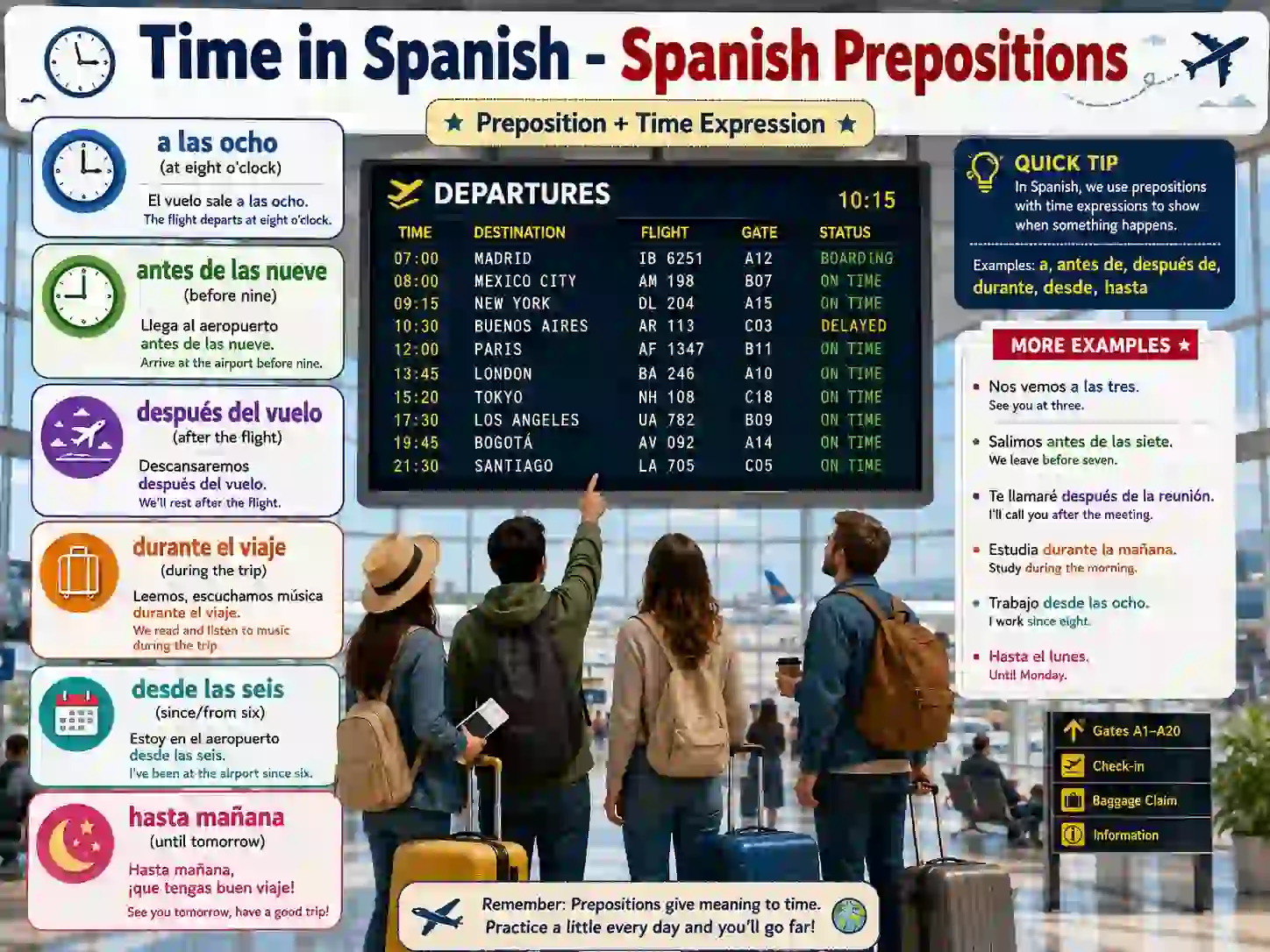
Why learn Spanish time prepositions with MundoDele?
Time expressions are used constantly in Spanish: appointments, routines, travel, stories, plans and deadlines all need them. MundoDele explains them through sentence patterns, not isolated translations.
The core idea is simple: a las ocho gives clock time, en mayo gives a month, por la tarde gives a part of the day, desde ayer gives a starting point, and hasta mañana gives an end point.
How to use this page
Use this page after learning the basic Spanish prepositions. Start with the most common time patterns, then compare similar expressions such as por la mañana, en la mañana, desde, de, hasta and para.
Clock time
Use a for specific times on the clock.
La clase empieza a las ocho.
The class starts at eight.
Months and years
Use en with months, years and seasons.
Viajo en julio.
I travel in July.
Start and end
Use desde for the beginning and hasta for the end.
Trabajo desde las nueve hasta las cinco.
What are Spanish prepositions of time?
Spanish prepositions of time are prepositions and prepositional expressions that show time relationships. They answer questions such as when, since when, until when, for how long, before what, after what or by what deadline.
| Preposition | Main time use | Spanish example | English meaning |
|---|---|---|---|
| a | Clock time | La reunión es a las diez. | The meeting is at ten. |
| en | Months, years, seasons | Nací en 1990. | I was born in 1990. |
| por | Part of the day / approximate time | Trabajo por la mañana. | I work in the morning. |
| desde | Starting point | Estoy aquí desde ayer. | I have been here since yesterday. |
| hasta | End point | Me quedo hasta el lunes. | I am staying until Monday. |
| durante | Duration | Estudié durante dos horas. | I studied for two hours. |
A for clock time
Use a for specific clock times. In Spanish, clock time usually appears as a la una for one o’clock and a las... for other times.
| Spanish expression | Example sentence | English meaning | Note |
|---|---|---|---|
| a la una | La clase empieza a la una. | The class starts at one. | Singular: la una. |
| a las dos | Nos vemos a las dos. | We will see each other at two. | Plural: las dos. |
| a las ocho y media | Trabajo a las ocho y media. | I work at half past eight. | Specific time. |
| a medianoche | Salimos a medianoche. | We leave at midnight. | Fixed time expression. |
| al mediodía | Comemos al mediodía. | We eat at noon. | a + el = al. |
Related page: A in Spanish.
En for months, years and seasons
Use en for months, years and seasons. It is also used with longer periods when Spanish treats the time expression as a general time frame.
| Time expression | Spanish example | English meaning | Use |
|---|---|---|---|
| en enero | Empiezo el curso en enero. | I start the course in January. | Month. |
| en 2026 | Viajo en 2026. | I travel in 2026. | Year. |
| en primavera | Florecen en primavera. | They bloom in spring. | Season. |
| en verano | Hace calor en verano. | It is hot in summer. | Season. |
| en el siglo XXI | Vivimos en el siglo XXI. | We live in the 21st century. | Long time period. |
Related page: En in Spanish.
Por for parts of the day and approximate time
Use por with many parts of the day and approximate time expressions. It often gives a general time frame, not an exact point.
| Time expression | Spanish example | English meaning | Meaning |
|---|---|---|---|
| por la mañana | Trabajo por la mañana. | I work in the morning. | Part of the day. |
| por la tarde | Estudio por la tarde. | I study in the afternoon. | Part of the day. |
| por la noche | Leo por la noche. | I read at night. | Part of the day. |
| por unos días | Me quedo por unos días. | I am staying for a few days. | Approximate duration. |
| por ahora | Por ahora, todo está bien. | For now, everything is fine. | Temporary time frame. |
Related page: Por in Spanish.
De for time ranges and scheduled periods
Use de in many time ranges, especially when combined with a. The pattern de... a... means “from... to...” for opening hours, work hours and scheduled periods.
| Spanish expression | Example sentence | English meaning | Use |
|---|---|---|---|
| de nueve a cinco | Trabajo de nueve a cinco. | I work from nine to five. | Work schedule. |
| de lunes a viernes | Abren de lunes a viernes. | They open from Monday to Friday. | Weekly schedule. |
| de día | Es mejor viajar de día. | It is better to travel during the day. | General time condition. |
| de noche | Trabajo de noche. | I work at night. | Night work / period. |
| de madrugada | Salimos de madrugada. | We leave at dawn / very early. | Fixed time expression. |
Related page: De in Spanish.
Desde and hasta: since, from and until
Desde marks the starting point of a time period. Hasta marks the end point. They can also appear together as desde... hasta....
| Expression | Spanish example | English meaning | Time function |
|---|---|---|---|
| desde ayer | Estoy aquí desde ayer. | I have been here since yesterday. | Starting point. |
| desde las ocho | Trabajo desde las ocho. | I have been working since eight. | Starting time. |
| hasta mañana | Me quedo hasta mañana. | I am staying until tomorrow. | End point. |
| hasta el viernes | Tenemos tiempo hasta el viernes. | We have time until Friday. | Deadline or end point. |
| desde lunes hasta viernes | Trabajo desde lunes hasta viernes. | I work from Monday until Friday. | Start and end. |
Durante for duration
Use durante when you want to say that something happened during a period of time. In many everyday contexts, Spanish can also express duration without a preposition.
| Spanish expression | Example sentence | English meaning | Comment |
|---|---|---|---|
| durante dos horas | Estudié durante dos horas. | I studied for two hours. | Duration. |
| durante la clase | No hablé durante la clase. | I did not speak during class. | During an event. |
| durante el verano | Viajamos durante el verano. | We travelled during the summer. | During a season. |
| dos horas | Estudié dos horas. | I studied for two hours. | Duration without preposition is also common. |
Antes de and después de
Use antes de for “before” and después de for “after”. When a verb follows, Spanish uses the infinitive.
| Expression | Spanish example | English meaning | Structure |
|---|---|---|---|
| antes de clase | Leo antes de clase. | I read before class. | antes de + noun |
| después de clase | Hablamos después de clase. | We talk after class. | después de + noun |
| antes de salir | Como antes de salir. | I eat before leaving. | antes de + infinitive |
| después de estudiar | Descanso después de estudiar. | I rest after studying. | después de + infinitive |
Para and dentro de: deadlines and future time
Para can express a deadline or target time. Dentro de means “in” when speaking about how much time will pass before something happens.
| Expression | Spanish example | English meaning | Use |
|---|---|---|---|
| para el lunes | Necesito el informe para el lunes. | I need the report by Monday. | Deadline. |
| para mañana | La tarea es para mañana. | The homework is for tomorrow / due tomorrow. | Target date. |
| dentro de una hora | Salimos dentro de una hora. | We leave in one hour. | Future time from now. |
| dentro de dos semanas | El curso empieza dentro de dos semanas. | The course starts in two weeks. | Future interval. |
Related page: Para in Spanish.
Al + infinitive for time
The structure al + infinitive means “when” or “upon” doing something. It is a compact way to connect two actions in time.
| Spanish structure | Example sentence | English meaning | Function |
|---|---|---|---|
| al llegar | Al llegar, llamé a Ana. | When I arrived, I called Ana. | Action at arrival. |
| al salir | Al salir, cerré la puerta. | When I left, I closed the door. | Action when leaving. |
| al terminar | Al terminar, descansamos. | When we finished, we rested. | Action after completion. |
| al escuchar | Al escuchar la noticia, se sorprendió. | Upon hearing the news, he/she was surprised. | Immediate time relation. |
Common Spanish time preposition patterns
Some Spanish time expressions are best learned as fixed patterns. They are very common in daily speech, schedules, travel and storytelling.
| Pattern | Example | English meaning | Use |
|---|---|---|---|
| a + clock time | a las seis | at six | Exact time. |
| en + month/year/season | en abril | in April | Calendar period. |
| por + part of day | por la noche | at night | General time of day. |
| de... a... | de lunes a viernes | from Monday to Friday | Scheduled range. |
| desde... hasta... | desde enero hasta marzo | from January until March | Start and end. |
| antes de + infinitive | antes de comer | before eating | Before an action. |
| después de + infinitive | después de estudiar | after studying | After an action. |
| dentro de + time | dentro de tres días | in three days | Future interval. |
Practice exercises: Spanish prepositions of time
Try to answer before opening the solutions. These exercises focus on a, en, por, desde, hasta, durante and después de.
Exercise 1: choose the preposition
- La clase empieza ___ las ocho.
- Viajo ___ julio.
- Trabajo ___ la mañana.
- Estoy aquí ___ ayer.
Show answers
1. a
2. en
3. por
4. desde
Exercise 2: complete the time phrase
- Trabajo de nueve ___ cinco.
- Me quedo ___ el lunes.
- Estudié ___ dos horas.
- Descanso después ___ estudiar.
Show answers
1. a
2. hasta
3. durante
4. de
Exercise 3: translate the expression
- at eight
- in March
- until tomorrow
- in two weeks
Show answers
1. a las ocho
2. en marzo
3. hasta mañana
4. dentro de dos semanas
Typical mistakes with Spanish prepositions of time
- Using en for clock time: say a las ocho, not en las ocho.
- Forgetting a in time ranges: say de lunes a viernes, not only de lunes viernes.
- Confusing desde and de: desde often means “since” or marks a starting point; de... a... is common for schedules.
- Using a conjugated verb after antes de or después de: say antes de salir, not antes de salgo.
- Confusing para and por: para el lunes can mean a deadline; por la mañana is a general time of day.
- Translating “in two weeks” literally with en: for future time from now, use dentro de dos semanas.
- Forgetting fixed expressions: learn al mediodía, a medianoche, de noche and por ahora as complete phrases.
Related grammar topics
Spanish Prepositions
Review the main Spanish prepositions and their basic meanings.
Prepositional Phrases
Learn how prepositions form larger phrases with nouns, pronouns and infinitives.
Por vs Para
Understand purpose, cause, deadlines, route and time expressions with por and para.
A
Study a for clock time, movement, indirect objects and personal a.
Adverbs of Time
Learn words such as hoy, mañana, ayer, siempre and nunca.
Spanish Tenses
Connect time expressions with present, past, future and compound tenses.
Where to go next
After learning prepositions of time, continue with prepositions of place, prepositional phrases and the contrast between por and para.
Learn Spanish grammar with MundoDele
Spanish prepositions of time help you speak about schedules, routines, plans, deadlines and stories. With MundoDele, you can learn them through clear patterns, real examples and connected grammar paths.
FAQ: Spanish prepositions of time
What are Spanish prepositions of time?
Spanish prepositions of time are words and expressions that show when something happens, starts, ends or lasts. Examples include a las ocho, en marzo, por la mañana, desde ayer and hasta mañana.
Which preposition is used for clock time in Spanish?
Spanish uses a for clock time: a la una, a las dos, a las ocho y media.
Which preposition is used for months and years in Spanish?
Spanish usually uses en with months and years: en enero, en 2026, en verano.
What is the difference between desde and hasta?
Desde marks a starting point, as in desde ayer. Hasta marks an end point, as in hasta mañana.
How do you say “in two weeks” in Spanish?
For future time counted from now, Spanish commonly uses dentro de: dentro de dos semanas.
What follows antes de and después de in Spanish?
Antes de and después de can be followed by a noun or an infinitive: antes de clase, antes de salir, después de estudiar.

About MundoDele
MundoDele connects online Spanish courses, DELE preparation, Business Spanish and cultural context into a personal Spanish learning platform.
Grammar pages are designed to explain Spanish clearly, with practical examples, real sentence logic and connected learning paths.