
En in Spanish
Learn how to use en in Spanish. This guide explains the main meanings of en: location, time periods, transport, position, states, activities, surfaces and common expressions.
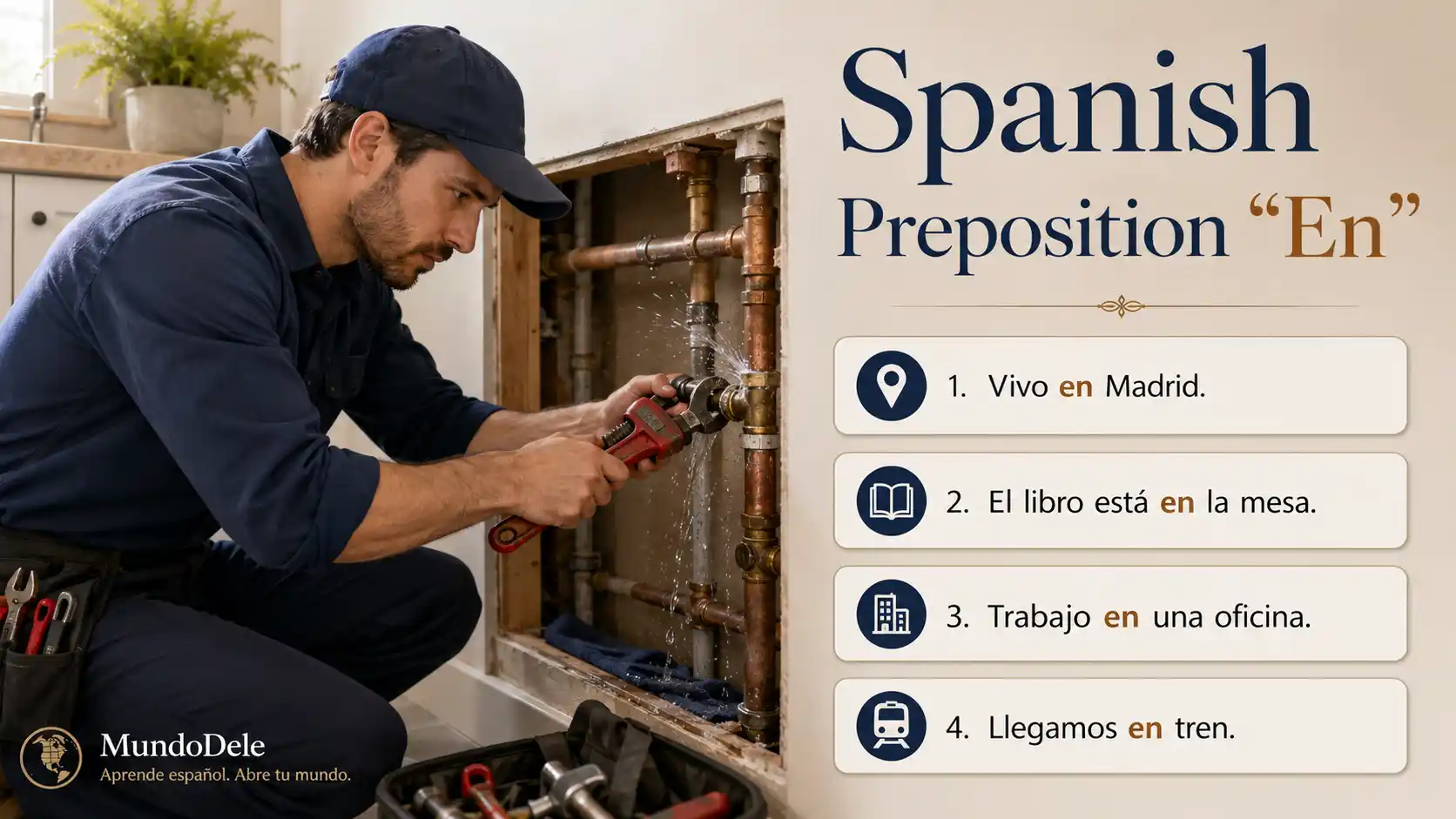
Why learn en with MundoDele?
En is one of the most frequent Spanish prepositions. It often looks easy because English uses “in”, “on” and “at”, but Spanish usually thinks more simply: en often marks where something is or the time frame in which something happens.
MundoDele teaches en through sentence meaning: location, surface, time frame, transport, state and activity. This helps learners avoid direct English-to-Spanish translation mistakes.
How to use this page
Start with the basic idea of en: location or frame. Then study how it works with places, surfaces, months, years, seasons, transport and fixed expressions. Finally, compare en with a, de, por and sobre.
Location
En says where someone or something is.
Estoy en casa.
I am at home.
Time frame
En is used with months, years and seasons.
Viajo en julio.
I travel in July.
Transport
En is common with many means of transport.
Voy en coche.
I go by car.
What does en mean in Spanish?
En is a Spanish preposition used for location, position, time frames, transport, states and activities. In English it can translate as “in”, “on”, “at” or “by”. The exact translation depends on the meaning of the sentence.
| Meaning of en | Spanish example | English meaning | Function |
|---|---|---|---|
| Location | Estoy en casa. | I am at home. | Where someone is. |
| City or country | Vivo en España. | I live in Spain. | Place of living. |
| Surface | El libro está en la mesa. | The book is on the table. | Position on a surface. |
| Time frame | Nací en 1990. | I was born in 1990. | Year or period. |
| Transport | Voy en tren. | I go by train. | Means of transport. |
| State | Está en proceso. | It is in progress. | Situation or state. |
En for location: in, on and at
Use en to say where someone or something is. In English, this may be translated as “in”, “on” or “at”. In Spanish, the main idea is location.
| Spanish phrase | Spanish sentence | English meaning | Location meaning |
|---|---|---|---|
| en casa | Estoy en casa. | I am at home. | Home as location. |
| en la oficina | Trabajo en la oficina. | I work at the office. | Workplace location. |
| en Madrid | Vivo en Madrid. | I live in Madrid. | City location. |
| en la escuela | Los niños están en la escuela. | The children are at school. | Institution or place. |
| en el centro | Nos vemos en el centro. | We will meet downtown / in the centre. | Area or place. |
Related page: Spanish Prepositions of Place.
En for surfaces: on something
English often uses “on” for surfaces. Spanish often uses en when the main idea is location on a surface. For stronger emphasis on “on top of”, Spanish can also use encima de or sobre.
| Spanish phrase | Spanish sentence | English meaning | Comment |
|---|---|---|---|
| en la mesa | El libro está en la mesa. | The book is on the table. | Surface as location. |
| en la pared | Hay un cuadro en la pared. | There is a painting on the wall. | Attached to a surface. |
| en el suelo | La mochila está en el suelo. | The backpack is on the floor. | Object on a surface. |
| en la página | La palabra está en la página. | The word is on the page. | Text location. |
| en la pantalla | La imagen aparece en la pantalla. | The image appears on the screen. | Digital surface. |
En for months, years, seasons and time frames
Use en with months, years, seasons and many larger time frames. It places the action inside a time period.
| Time expression | Spanish sentence | English meaning | Time meaning |
|---|---|---|---|
| en enero | Empiezo el curso en enero. | I start the course in January. | Month. |
| en 2026 | Viajo en 2026. | I travel in 2026. | Year. |
| en primavera | Las flores crecen en primavera. | Flowers grow in spring. | Season. |
| en el siglo XXI | Vivimos en el siglo XXI. | We live in the 21st century. | Long time period. |
| en una semana | Termino el trabajo en una semana. | I finish the work in one week. | Time needed or future frame, depending on context. |
Related page: Spanish Prepositions of Time.
En for transport
Use en with many means of transport. This often translates as “by” in English. With walking, Spanish normally uses a pie, not en pie.
| Transport phrase | Spanish sentence | English meaning | Comment |
|---|---|---|---|
| en coche | Voy en coche. | I go by car. | Means of transport. |
| en tren | Viajamos en tren. | We travel by train. | Means of transport. |
| en autobús | Llego en autobús. | I arrive by bus. | Means of transport. |
| en avión | Volamos en avión. | We fly by plane. | Means of transport. |
| a pie | Voy a pie. | I go on foot. | Important exception: use a pie. |
En for states, situations and processes
En can place a person or thing inside a state, situation or process. These expressions are common in everyday and formal Spanish.
| Spanish expression | Spanish sentence | English meaning | Use |
|---|---|---|---|
| en proceso | El proyecto está en proceso. | The project is in progress. | Process. |
| en peligro | La especie está en peligro. | The species is in danger. | State or situation. |
| en silencio | Trabajan en silencio. | They work in silence. | Manner or state. |
| en calma | El mar está en calma. | The sea is calm. | State. |
| en crisis | La empresa está en crisis. | The company is in crisis. | Situation. |
En for activities and fields
En is also used with areas of activity, study, work or participation. It can show the field or context in which something happens.
| Spanish phrase | Spanish sentence | English meaning | Context |
|---|---|---|---|
| en clase | Aprendo mucho en clase. | I learn a lot in class. | Learning context. |
| en el trabajo | Estoy en el trabajo. | I am at work. | Work context. |
| en español | Hablamos en español. | We speak in Spanish. | Language. |
| en medicina | Trabaja en medicina. | He/she works in medicine. | Professional field. |
| en política | Participa en política. | He/she participates in politics. | Area of activity. |
En vs a: location or direction
One of the most important contrasts is en versus a. Use en for location and a for movement toward a destination.
| Meaning | En | A | Contrast |
|---|---|---|---|
| Home | Estoy en casa. I am at home. |
Voy a casa. I am going home. |
Location vs direction. |
| School | Estoy en la escuela. I am at school. |
Voy a la escuela. I am going to school. |
Being there vs going there. |
| Madrid | Vivo en Madrid. I live in Madrid. |
Llego a Madrid. I arrive in Madrid. |
Place of living vs arrival destination. |
| Office | Trabajo en la oficina. I work at the office. |
Voy a la oficina. I am going to the office. |
Workplace location vs movement. |
Related page: A in Spanish.
En vs de: location or origin
Use en for where something is. Use de for where something or someone comes from, belongs to or is made of.
| Meaning | En | De | Contrast |
|---|---|---|---|
| Place | Vivo en México. I live in Mexico. |
Soy de México. I am from Mexico. |
Location vs origin. |
| Office | Estoy en la oficina. I am at the office. |
Vengo de la oficina. I am coming from the office. |
Being there vs coming from there. |
| Table | El libro está en la mesa. The book is on the table. |
La mesa es de madera. The table is made of wood. |
Position vs material. |
| Possession | Hay flores en el jardín. There are flowers in the garden. |
El jardín es de Ana. The garden belongs to Ana. |
Location vs possession. |
Related page: De in Spanish.
En vs sobre: on or about
For physical position on a surface, Spanish often uses en. Sobre can also mean “on”, but it often adds a stronger sense of “on top of” or means “about” in the sense of topic.
| Meaning | En | Sobre | Contrast |
|---|---|---|---|
| Surface | El libro está en la mesa. | El libro está sobre la mesa. | Both can work; sobre can sound more explicit as “on top of”. |
| Wall | Hay un cuadro en la pared. | Hay una lámpara sobre la mesa. | En is natural for something on a wall. |
| Topic | Escribo en español. | Escribo sobre historia. | En gives language; sobre gives topic. |
| Information | Lo vi en internet. | Leí un artículo sobre gramática. | Medium/location vs topic. |
Common expressions with en
Many expressions with en are best learned as complete phrases. They are very common in spoken and written Spanish.
| Expression | Meaning | Spanish example | Use |
|---|---|---|---|
| en casa | at home | Estoy en casa. | Location. |
| en serio | seriously | Lo digo en serio. | Manner or attitude. |
| en general | in general | En general, me gusta. | General statement. |
| en realidad | actually / in reality | En realidad, no es difícil. | Correction or clarification. |
| en cambio | however / instead | Yo prefiero té; ella, en cambio, prefiere café. | Contrast. |
| en vez de | instead of | Tomo té en vez de café. | Replacement. |
| en cuanto a | as for / regarding | En cuanto a la gramática, necesito practicar. | Topic marker. |
| en primer lugar | first of all | En primer lugar, repasamos los ejemplos. | Ordering ideas. |
Common verbs and adjectives with en
Some Spanish verbs and adjectives are commonly followed by en. These combinations should be learned as sentence patterns.
| Expression | Meaning | Spanish example | Pattern |
|---|---|---|---|
| pensar en | to think about | Pienso en mi familia. | Verb + en. |
| confiar en | to trust / rely on | Confío en ti. | Verb + en. |
| participar en | to participate in | Participo en el curso. | Verb + en. |
| entrar en | to enter into | Entró en la sala. | Movement into a place. |
| interesado en | interested in | Estoy interesado en aprender español. | Adjective + en. |
| especializado en | specialised in | Está especializado en gramática. | Adjective + en. |
Practice exercises: en in Spanish
Try to answer before opening the solutions. These exercises focus on location, time, transport, states and contrasts with other prepositions.
Exercise 1: complete with en
- Estoy ___ casa.
- Vivo ___ Madrid.
- El libro está ___ la mesa.
- Viajo ___ julio.
Show answers
1. en
2. en
3. en
4. en
Exercise 2: choose en, a or de
- Voy ___ la escuela.
- Estoy ___ la escuela.
- Vengo ___ la escuela.
- Trabajo ___ la oficina.
Show answers
1. a
2. en
3. de
4. en
Exercise 3: translate the phrase
- at home
- in January
- by train
- in progress
Show answers
1. en casa
2. en enero
3. en tren
4. en proceso
Typical mistakes with en
- Using en for movement to a place: say voy a la escuela, not voy en la escuela.
- Using a for static location: say estoy en casa, not estoy a casa.
- Translating English “on” too literally: Spanish often uses en: en la mesa, en la pared, en la pantalla.
- Using en for walking: say a pie, not en pie when you mean “on foot”.
- Confusing location and origin: vivo en México means I live in Mexico; soy de México means I am from Mexico.
- Confusing language and topic: en español means in Spanish; sobre español means about Spanish.
- Forgetting fixed verb patterns: learn pensar en, confiar en, participar en and interesado en as complete patterns.
Related grammar topics
Spanish Prepositions
Return to the main preposition overview and compare the full system.
Prepositions of Place
Review en, a, de, cerca de, detrás de and other place expressions.
Prepositions of Time
Study en enero, en 2026, a las ocho, por la mañana and related patterns.
A
Compare static location with en and movement toward a destination with a.
De
Compare location with en and origin, possession or material with de.
Prepositional Phrases
Learn full phrase patterns such as en casa, en la mesa, en enero and en proceso.
Where to go next
After learning en, continue with a, de, prepositions of place and prepositions of time.
Learn Spanish grammar with MundoDele
En becomes easier when you learn it through meaning patterns: location, surface, time frame, transport, state and activity. MundoDele connects these patterns with clear examples, exercises and related grammar pages.
FAQ: en in Spanish
What does en mean in Spanish?
En can mean “in”, “on”, “at” or “by”, depending on context. It is used for location, time frames, transport, surfaces, activities and certain states.
When do you use en for location?
Use en to say where someone or something is: estoy en casa, vivo en Madrid, el libro está en la mesa.
When do you use en for time?
Use en with months, years, seasons and larger time frames: en enero, en 2026, en primavera.
What is the difference between en and a?
En usually expresses location: estoy en casa. A expresses direction or destination: voy a casa.
What is the difference between en and de?
En gives location: vivo en México. De gives origin, possession or material: soy de México, la mesa es de madera.
Do you say en pie or a pie for “on foot”?
To say “on foot”, Spanish normally uses a pie: voy a pie. En pie can mean standing or upright in other contexts.

About MundoDele
MundoDele connects online Spanish courses, DELE preparation, Business Spanish and cultural context into a personal Spanish learning platform.
Grammar pages are designed to explain Spanish clearly, with practical examples, real sentence logic and connected learning paths.