
Spanish Infinitive: -ar, -er and -ir Verb Forms
Learn how the Spanish infinitive works as the basic verb form — from hablar, comer and vivir to structures like quiero aprender, voy a estudiar and después de comer.
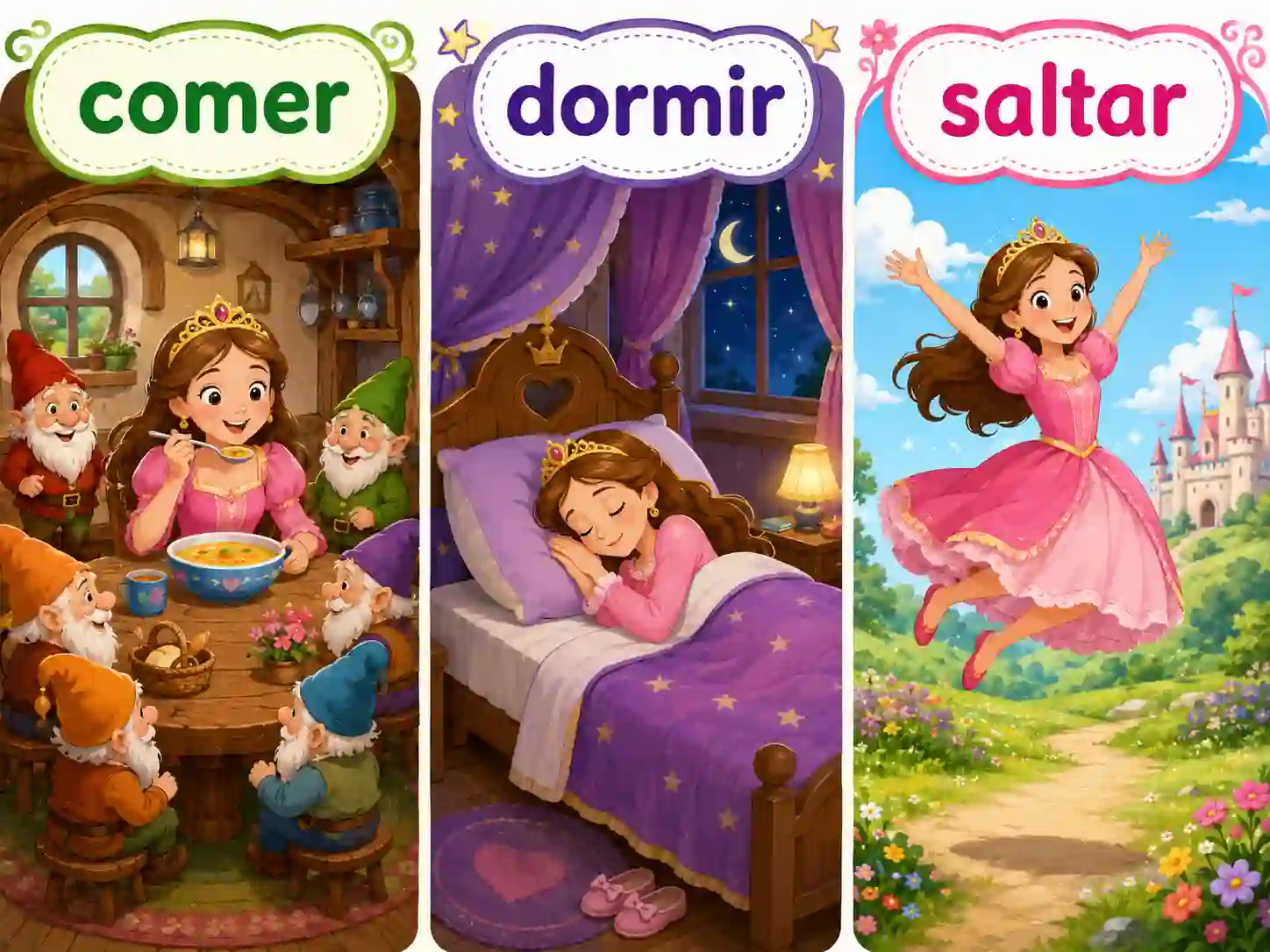
Why the Spanish infinitive matters
The infinitive is the starting point for Spanish verbs. It shows the verb family, helps you recognise conjugation patterns, and appears in many everyday structures. Learners need it for modal verbs, near future forms, prepositions, impersonal expressions and many phrases where English would use an “-ing” form.
How to use this page
Use this page after the general non-finite forms overview. First learn the three infinitive endings, then focus on the most common structures where the infinitive appears.
Spanish infinitives end in -ar, -er or -ir: hablar, comer, vivir.
Combine them with verbs and expressions such as querer, poder, deber, tener que and ir a.
Spanish normally uses the infinitive after prepositions: antes de salir, después de comer, para aprender.
The core system: form, function and position
Basic verb form
The infinitive is the dictionary form of the verb and shows its verb group.
hablar · comer · vivir
After another verb
Many Spanish verbs are followed by an infinitive when the same subject performs both actions.
Quiero aprender. · Puedo hablar. · Debo estudiar.
After prepositions
After prepositions, Spanish normally uses the infinitive.
antes de salir · después de comer · para aprender
The three Spanish infinitive endings
Spanish infinitives belong to one of three verb groups. These endings are important because they help you recognise how regular conjugation patterns work.
| Verb group | Ending | Examples | Basic meaning | Example sentence |
|---|---|---|---|---|
| -ar verbs | -ar | hablar, estudiar, trabajar | to speak, to study, to work | Quiero hablar español. |
| -er verbs | -er | comer, aprender, leer | to eat, to learn, to read | Me gusta leer. |
| -ir verbs | -ir | vivir, escribir, salir | to live, to write, to go out | Vamos a salir temprano. |
Infinitives after verbs and verbal expressions
The Spanish infinitive often appears after another verb or verbal expression. In these structures, the first verb is conjugated and the second verb stays in the infinitive.
| Expression | Meaning | Structure | Example |
|---|---|---|---|
| querer | to want to | querer + infinitive | Quiero aprender español. |
| poder | can, to be able to | poder + infinitive | Puedo hablar contigo. |
| deber | should, must | deber + infinitive | Debes estudiar más. |
| tener que | to have to | tener que + infinitive | Tengo que trabajar. |
| ir a | going to | ir a + infinitive | Voy a viajar mañana. |
| acabar de | to have just done something | acabar de + infinitive | Acabo de llegar. |
| empezar a | to start doing something | empezar a + infinitive | Empieza a llover. |
| aprender a | to learn to do something | aprender a + infinitive | Aprendo a conducir. |
Infinitives after prepositions
After prepositions, Spanish normally uses the infinitive. This is one of the main differences from English, where an “-ing” form often appears after a preposition.
antes de salir — before leaving
después de comer — after eating
para aprender español — in order to learn Spanish
sin decir nada — without saying anything
al llegar — upon arriving
This pattern is especially important in sentence connectors such as antes de, después de, para, sin and al.
Infinitive as a noun-like form
Spanish often uses the infinitive where English uses an “-ing” form as a noun. In this use, the infinitive can work like the subject or object of a sentence.
Aprender español es útil. — Learning Spanish is useful.
Me gusta leer. — I like reading.
Viajar abre la mente. — Traveling opens the mind.
Hablar dos idiomas ayuda en el trabajo. — Speaking two languages helps at work.
This is why the Spanish infinitive is often the correct translation of English “-ing” when that “-ing” form names an activity.
Infinitives with pronouns
Object and reflexive pronouns can be attached to the end of the infinitive. This is very common after modal verbs and verbal expressions.
Quiero hacerlo. — I want to do it.
Voy a llamarte. — I am going to call you.
Necesito explicártelo. — I need to explain it to you.
Prefiero quedarme en casa. — I prefer to stay at home.
Pronouns can often also go before the conjugated verb: Lo quiero hacer and Quiero hacerlo are both possible, depending on the structure and emphasis.
Spanish infinitive vs English “to” and “-ing”
The Spanish infinitive often translates English “to + verb”: to speak → hablar. But it also often translates English “-ing” when the English form names an activity.
I want to learn. → Quiero aprender.
Learning is useful. → Aprender es útil.
After eating, we left. → Después de comer, salimos.
I like writing. → Me gusta escribir.
This is why learners should not translate English “-ing” automatically as the Spanish gerund. In many cases, the infinitive is the natural Spanish form.
When to use the Spanish infinitive
Ability, wish and obligation
Use the infinitive after verbs such as poder, querer, deber and tener que.
Puedo hablar. · Quiero aprender. · Tengo que estudiar.
Before, after, without, in order to
Use the infinitive after prepositions and prepositional expressions.
antes de salir · después de comer · sin hablar
Noun-like use
Use the infinitive to name an activity or action in general.
Leer es importante. · Viajar es interesante.
Related grammar topics
Non-finite Forms
Understand infinitives, gerunds and participles as verb forms without person or tense on their own.
Spanish Gerund
Compare infinitives such as aprender with gerunds such as aprendiendo.
Past Participle
Compare infinitives such as escribir with participles such as escrito.
Regular Verbs
Use the infinitive ending to identify regular conjugation patterns.
Modal Verbs
Learn structures such as poder + infinitive, querer + infinitive and deber + infinitive.
Near Future
Use ir a + infinitive to express near future meaning: voy a estudiar.
Typical mistakes with the Spanish infinitive
- Conjugating the second verb: say quiero aprender, not quiero aprendo.
- Forgetting the preposition in fixed structures: say voy a estudiar, not voy estudiar.
- Using the gerund as a noun: say Aprender español es útil, not Aprendiendo español es útil.
- Using English word order mechanically: Spanish often uses compact infinitive structures after verbs and prepositions.
- Forgetting pronoun attachment: forms such as hacerlo, decírtelo and quedarme are common.
Where to go next
After the Spanish infinitive, continue with the gerund, the past participle and the modal-verb structures that frequently use infinitives.
Want personal guidance?
If Spanish infinitive structures feel confusing, individual guidance can help you practise verb combinations, preposition patterns, pronoun attachment and the difference between infinitive and gerund in real sentences.
FAQ: Spanish infinitive
What is the Spanish infinitive?
The Spanish infinitive is the basic, non-conjugated form of a verb. Spanish infinitives end in -ar, -er or -ir.
What are examples of Spanish infinitives?
Examples of Spanish infinitives are hablar, comer, vivir, aprender, escribir, salir and viajar.
When do you use the infinitive in Spanish?
Use the infinitive after many verbs and expressions, after prepositions, and when naming an activity in general: quiero aprender, después de comer, Leer es útil.
Do you conjugate the infinitive after poder or querer?
No. After verbs such as poder and querer, the second verb stays in the infinitive: puedo hablar, quiero aprender.
Is the Spanish infinitive the same as English “to + verb”?
Often yes, but not always. The Spanish infinitive can translate English “to + verb” and also English “-ing” when the English form names an activity.
Can pronouns be attached to Spanish infinitives?
Yes. Pronouns can be attached to infinitives in forms such as hacerlo, llamarte, explicártelo and quedarme.

MundoDele – Spanish learning for education, work and intercultural understanding
MundoDele connects online Spanish courses, DELE preparation, Business Spanish and cultural context into a personal Spanish learning platform.
Grammar pages are designed to explain Spanish clearly, with practical examples, real sentence logic and connected learning paths.