
A in Spanish
Learn how to use a in Spanish. This guide explains the main meanings of a: direction, destination, clock time, indirect objects, personal a, distance, manner, fixed expressions and the contraction al.
Why learn a with MundoDele?
A is one of the most important Spanish prepositions because it appears in movement, time, object structure and many everyday phrases. It is small, but it changes the logic of a sentence.
MundoDele teaches a through practical sentence patterns: where someone goes, when something happens, who receives something and when a person needs the personal a.
How to use this page
Start with a for movement and destination. Then study clock time, indirect objects, personal a and the contraction al. Finally, compare a with en, de and para.
Direction
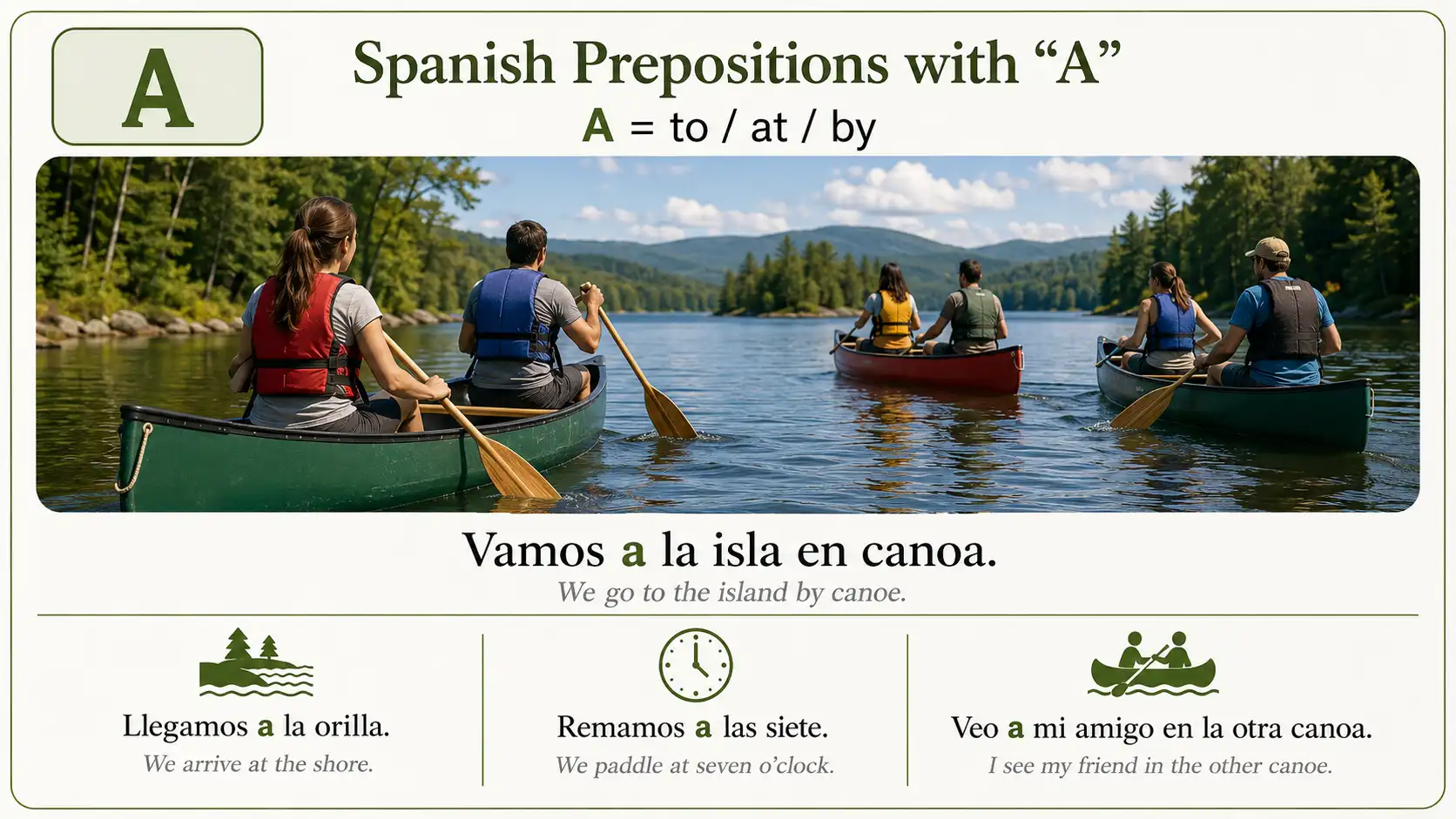
A often points toward a place or destination.
Voy a Madrid.
I am going to Madrid.
Clock time
A is used with specific clock times.
La clase empieza a las ocho.
The class starts at eight.
Personal a
A marks many direct objects when the object is a specific person.
Veo a Ana.
I see Ana.
What does a mean in Spanish?
A is a Spanish preposition used for direction, destination, clock time, indirect objects, personal direct objects, distance and fixed expressions. In English it can translate as “to”, “at”, “on”, “by” or sometimes have no direct translation.
| Meaning of a | Spanish example | English meaning | Function |
|---|---|---|---|
| Direction | Voy a Madrid. | I am going to Madrid. | Destination. |
| Clock time | Salimos a las nueve. | We leave at nine. | Specific time. |
| Indirect object | Le doy el libro a Ana. | I give the book to Ana. | Recipient of the action. |
| Personal a | Veo a mi amigo. | I see my friend. | Specific person as direct object. |
| Manner | Está hecho a mano. | It is handmade. | Way something is done. |
| Movement pattern | Voy a estudiar. | I am going to study. | Near future: ir a + infinitive. |
A for direction and destination
Use a when someone or something moves toward a place. It is common after verbs such as ir, llegar, volver, entrar and venir.
| Spanish phrase | Spanish sentence | English meaning | Destination meaning |
|---|---|---|---|
| a Madrid | Voy a Madrid. | I am going to Madrid. | Madrid is the destination. |
| a casa | Vuelvo a casa. | I am going back home. | Home is the destination. |
| a la escuela | Los niños van a la escuela. | The children go to school. | Movement toward a place. |
| al mercado | Vamos al mercado. | We are going to the market. | a + el = al. |
| a la derecha | Gira a la derecha. | Turn right. | Direction. |
Related page: Spanish Prepositions of Place.
A for clock time
Use a for specific clock times. Spanish uses a la una for one o’clock and a las... for other clock times.
| Spanish time | Spanish sentence | English meaning | Time rule |
|---|---|---|---|
| a la una | La clase empieza a la una. | The class starts at one. | Singular: la una. |
| a las dos | Nos vemos a las dos. | We will see each other at two. | Plural: las dos. |
| a las ocho y media | Trabajo a las ocho y media. | I work at half past eight. | Specific clock time. |
| a medianoche | Salimos a medianoche. | We leave at midnight. | Fixed time expression. |
| al mediodía | Comemos al mediodía. | We eat at noon. | a + el = al. |
Related page: Spanish Prepositions of Time.
A for indirect objects: to someone
Use a to mark the person who receives something or benefits from an action. This is especially common together with indirect object pronouns such as le and les.
| Spanish sentence | English meaning | Recipient | Pattern |
|---|---|---|---|
| Le doy el libro a Ana. | I give the book to Ana. | a Ana | le + verb + object + a + person. |
| Le escribo un mensaje a Luis. | I write a message to Luis. | a Luis | Recipient of the message. |
| Les explico la regla a los estudiantes. | I explain the rule to the students. | a los estudiantes | People receiving the explanation. |
| Le compré flores a mi madre. | I bought flowers for my mother. | a mi madre | Beneficiary or recipient. |
| Le mandé un correo al profesor. | I sent an email to the teacher. | al profesor | a + el = al. |
Related page: Spanish Indirect Object Pronouns.
The personal a in Spanish
Spanish uses the personal a before many direct objects when the object is a specific person or a person-like being. This a often has no direct English translation.
| Spanish sentence | English meaning | Why personal a? | Object type |
|---|---|---|---|
| Veo a Ana. | I see Ana. | Ana is a specific person. | Specific person. |
| Conozco a tu hermano. | I know your brother. | The direct object is a specific person. | Specific person. |
| Llamo a mi madre. | I call my mother. | The direct object is a person. | Family member. |
| Busco a mi profesor. | I am looking for my teacher. | The teacher is a specific person. | Specific person. |
| Veo el coche. | I see the car. | No personal a because the object is not a person. | Thing. |
Related page: Spanish Direct Object Pronouns.
Ir a + infinitive: near future
The structure ir a + infinitive is one of the most common ways to talk about the near future in Spanish. It often translates as “going to do something”.
| Spanish sentence | English meaning | Structure | Use |
|---|---|---|---|
| Voy a estudiar. | I am going to study. | ir + a + infinitive | Near future. |
| Vamos a comer. | We are going to eat. | vamos a + infinitive | Planned action. |
| Van a viajar. | They are going to travel. | van a + infinitive | Future plan. |
| ¿Qué vas a hacer? | What are you going to do? | vas a + infinitive | Question about future action. |
Related page: Near Future in Spanish.
A + el = al
When a comes before the masculine singular article el, Spanish contracts the two words: a + el = al. This contraction is mandatory.
| Combination | Correct form | Spanish example | English meaning |
|---|---|---|---|
| a + el | al | Voy al mercado. | I am going to the market. |
| a + el | al | Le escribo al profesor. | I write to the teacher. |
| a + la | a la | Voy a la escuela. | I am going to school. |
| a + los | a los | Saludo a los estudiantes. | I greet the students. |
| a + las | a las | Llego a las ocho. | I arrive at eight. |
Related page: Spanish Definite Articles.
A in fixed manner expressions
Some Spanish expressions with a describe how something is done. These should be learned as complete phrases.
| Expression | Meaning | Spanish example | Use |
|---|---|---|---|
| a mano | by hand / handmade | Está hecho a mano. | How something is made. |
| a pie | on foot | Voy a pie. | Way of moving. |
| a máquina | by machine / typed | El texto está escrito a máquina. | Means or manner. |
| a la derecha | to the right | Gira a la derecha. | Direction. |
| a la izquierda | to the left | Gira a la izquierda. | Direction. |
A vs en: direction or location
Use a for movement toward a destination. Use en for location. This is one of the most important contrasts in Spanish prepositions.
| Meaning | A | En | Contrast |
|---|---|---|---|
| Home | Voy a casa. I am going home. |
Estoy en casa. I am at home. |
Direction vs location. |
| School | Voy a la escuela. I am going to school. |
Estoy en la escuela. I am at school. |
Movement vs being there. |
| Madrid | Llego a Madrid. I arrive in Madrid. |
Vivo en Madrid. I live in Madrid. |
Arrival destination vs location. |
| Office | Voy a la oficina. I am going to the office. |
Trabajo en la oficina. I work at the office. |
Destination vs workplace location. |
Related page: En in Spanish.
A vs de: destination or origin
Use a for where someone goes. Use de for where someone or something comes from.
| Meaning | A | De | Contrast |
|---|---|---|---|
| Movement | Voy a México. I am going to Mexico. |
Soy de México. I am from Mexico. |
Destination vs origin. |
| Office | Voy a la oficina. I am going to the office. |
Vengo de la oficina. I am coming from the office. |
To a place vs from a place. |
| Market | Voy al mercado. I am going to the market. |
Vengo del mercado. I am coming from the market. |
al vs del. |
| Schedule | Trabajo de nueve a cinco. | Trabajo de nueve a cinco. | In time ranges, de... a... works together. |
Related page: De in Spanish.
A vs para: destination or intended destination
A is the basic preposition for movement to a place. Para can also point toward a destination, but often with a stronger idea of intended direction, goal or purpose.
| Meaning | A | Para | Contrast |
|---|---|---|---|
| Simple destination | Voy a Madrid. | Salimos para Madrid. | Going to Madrid vs leaving for Madrid. |
| Movement and purpose | Voy a la escuela. | Estudio para aprender. | Physical destination vs purpose. |
| Recipient | Le doy el libro a Ana. | El libro es para Ana. | Indirect object recipient vs intended recipient. |
| Deadline | Llego a las ocho. | Necesito esto para mañana. | Specific time vs deadline. |
Related page: Para in Spanish.
Common expressions with a
Many expressions with a are best learned as complete phrases. They appear in everyday Spanish, time expressions, directions and formal language.
| Expression | Meaning | Spanish example | Use |
|---|---|---|---|
| a veces | sometimes | A veces estudio por la noche. | Frequency. |
| a menudo | often | Leo a menudo. | Frequency. |
| al final | in the end / at the end | Al final, entendí la regla. | Sequence or result. |
| al principio | at the beginning | Al principio, fue difícil. | Time sequence. |
| a tiempo | on time | Llegué a tiempo. | Punctuality. |
| a partir de | starting from | A partir de mañana, estudiamos juntos. | Starting point. |
| a causa de | because of | No salimos a causa de la lluvia. | Cause. |
| al lado de | next to | La farmacia está al lado del banco. | Place relation. |
Common verbs and adjectives with a
Some Spanish verbs and adjectives are commonly followed by a. These combinations should be learned as sentence patterns.
| Expression | Meaning | Spanish example | Pattern |
|---|---|---|---|
| ir a | to go to / be going to | Voy a Madrid. Voy a estudiar. | Direction or near future. |
| llegar a | to arrive at / in | Llegamos a la estación. | Arrival destination. |
| volver a | to return to / do again | Vuelvo a casa. Vuelvo a leer. | Return or repetition. |
| empezar a | to start to | Empiezo a estudiar. | Beginning of an action. |
| aprender a | to learn to | Aprendo a cocinar. | Learning an action. |
| ayudar a | to help to / help someone | Ayudo a mi hermano a estudiar. | Person and action. |
Practice exercises: a in Spanish
Try to answer before opening the solutions. These exercises focus on destination, time, indirect objects, personal a and al.
Exercise 1: complete with a or al
- Voy ___ Madrid.
- Vamos ___ mercado.
- La clase empieza ___ las ocho.
- Le escribo ___ profesor.
Show answers
1. a
2. al
3. a
4. al
Exercise 2: choose a, en or de
- Estoy ___ casa.
- Voy ___ casa.
- Vengo ___ casa.
- Llego ___ la estación.
Show answers
1. en
2. a
3. de
4. a
Exercise 3: identify the use of a
- Veo a Ana.
- Voy a estudiar.
- Trabajo de nueve a cinco.
- Está hecho a mano.
Show answers
1. Personal a
2. Near future: ir a + infinitive
3. Time range
4. Manner expression
Typical mistakes with a
- Using en for movement: say voy a la escuela, not voy en la escuela.
- Forgetting al: say voy al mercado, not voy a el mercado.
- Forgetting the personal a: say veo a Ana, not veo Ana.
- Using personal a with ordinary things: say veo el coche, not veo al coche in a normal sentence.
- Forgetting a in clock time: say a las ocho, not only las ocho when giving the time of an action.
- Confusing destination and origin: voy a Madrid means to Madrid; soy de Madrid means from Madrid.
- Forgetting a in near future: say voy a estudiar, not voy estudiar.
Related grammar topics
Spanish Prepositions
Return to the main preposition overview and compare the full system.
En
Compare movement with a and location with en.
De
Compare destination with a and origin with de.
Prepositions of Time
Study a las ocho, al mediodía, en enero and por la mañana.
Indirect Object Pronouns
Connect a with recipients and pronouns such as le and les.
Near Future
Practise ir a + infinitive: voy a estudiar, vamos a viajar.
Where to go next
After learning a, continue with en, de, prepositions of place and indirect object pronouns.
Learn Spanish grammar with MundoDele
A becomes easier when you learn it through meaning patterns: direction, clock time, recipients, personal objects, future actions and fixed expressions. MundoDele connects these patterns with clear examples, exercises and related grammar pages.
FAQ: a in Spanish
What does a mean in Spanish?
A can mean “to”, “at” or sometimes have no direct English translation. It is used for direction, destination, clock time, indirect objects, personal direct objects and fixed expressions.
When do you use a for movement?
Use a when someone or something moves toward a destination: voy a Madrid, llego a casa, vamos al mercado.
When do you use a for time?
Use a with specific clock times: a la una, a las dos, a las ocho y media, al mediodía.
What is the personal a in Spanish?
The personal a appears before many direct objects when the object is a specific person: veo a Ana, conozco a tu hermano.
What is al in Spanish?
Al is the contraction of a + el. For example: voy al mercado, le escribo al profesor.
What is the difference between a and en?
A often expresses direction or destination: voy a casa. En expresses location: estoy en casa.

About MundoDele
MundoDele connects online Spanish courses, DELE preparation, Business Spanish and cultural context into a personal Spanish learning platform.
Grammar pages are designed to explain Spanish clearly, with practical examples, real sentence logic and connected learning paths.