
Spanish Prepositions of Place
Learn how Spanish prepositions of place work in real sentences. This guide explains location and direction with en, a, de, sobre, encima de, debajo de, delante de, detrás de, cerca de, lejos de, entre and al lado de.
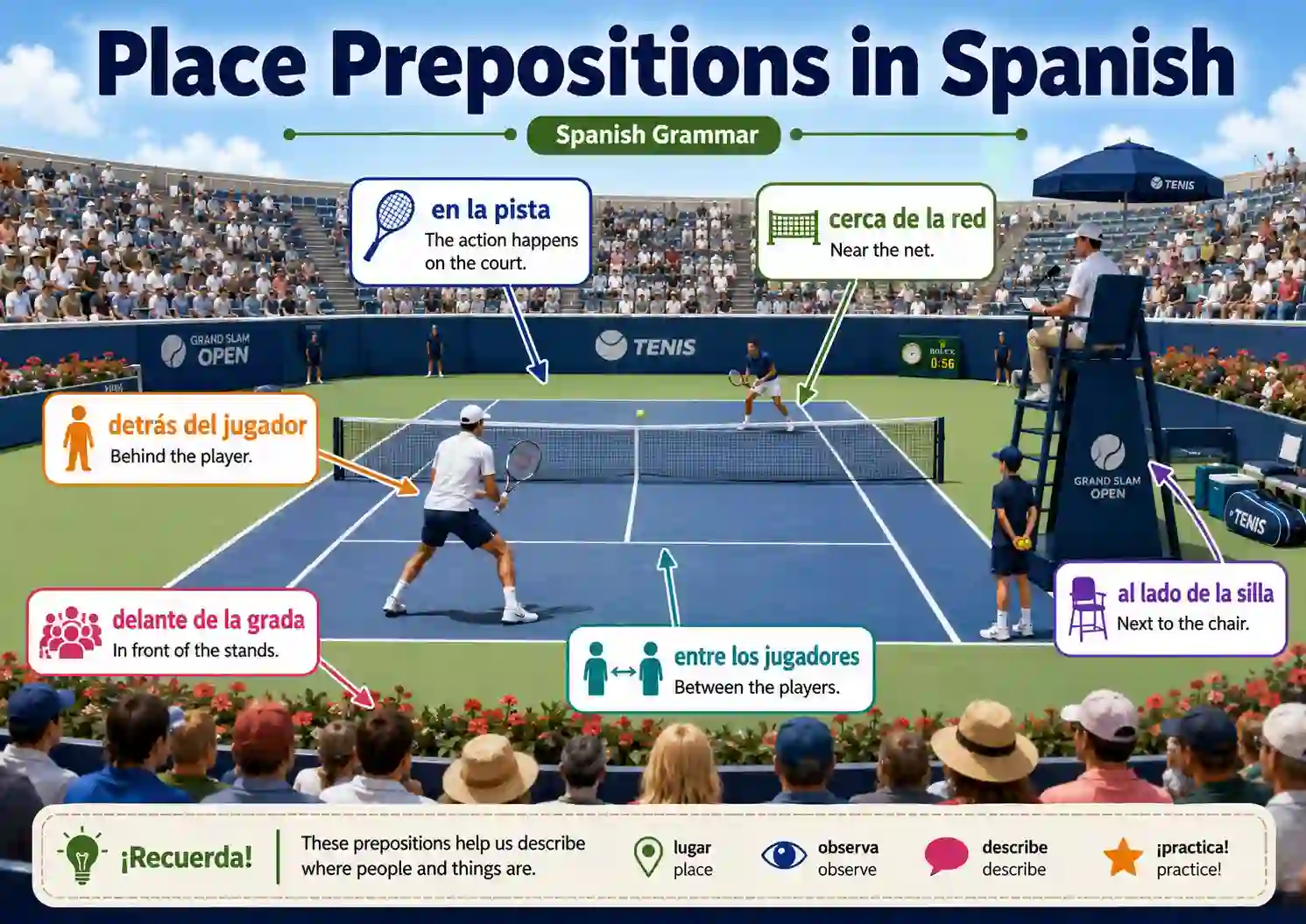
Why learn Spanish place prepositions with MundoDele?
Place prepositions are essential for describing rooms, cities, travel, directions, objects and everyday situations. MundoDele explains them as practical sentence patterns, not only as isolated word translations.
The main contrast is simple: en usually gives location, a gives direction, de gives origin, and longer phrases such as delante de, detrás de, al lado de and cerca de describe position.
How to use this page
Use this page after learning the basic Spanish prepositions. First separate location, direction and origin. Then study fixed place phrases such as encima de, debajo de, delante de, detrás de and cerca de.
Location
Use en to say where someone or something is.
Estoy en casa.
I am at home.
Direction
Use a to say where someone or something goes.
Voy a la escuela.
I am going to school.
Origin
Use de to say where someone or something comes from.
Vengo de Madrid.
I come from Madrid.
What are Spanish prepositions of place?
Spanish prepositions of place are words and expressions that describe location, direction, origin and relative position. They answer questions such as where, where to, where from, near what, under what or next to what.
| Preposition or phrase | Main use | Spanish example | English meaning |
|---|---|---|---|
| en | Location | El libro está en la mesa. | The book is on the table. |
| a | Direction | Voy a la universidad. | I am going to the university. |
| de | Origin | Vengo de la oficina. | I am coming from the office. |
| encima de | On / above | El vaso está encima de la mesa. | The glass is on the table. |
| debajo de | Under | El gato está debajo de la silla. | The cat is under the chair. |
| cerca de | Near | Vivo cerca del centro. | I live near the centre. |
En for location: in, on and at
En is one of the most important Spanish prepositions of place. It can mean “in”, “on” or “at” depending on the English sentence. The Spanish meaning is usually location.
| Spanish expression | Example sentence | English meaning | Place meaning |
|---|---|---|---|
| en casa | Estoy en casa. | I am at home. | Location. |
| en Madrid | Vivo en Madrid. | I live in Madrid. | City or place. |
| en la mesa | El libro está en la mesa. | The book is on the table. | Surface or location. |
| en la oficina | Trabajo en la oficina. | I work at the office. | Workplace location. |
| en el coche | Estoy en el coche. | I am in the car. | Inside a vehicle. |
Related page: En in Spanish.
A for direction: to a place
Use a when someone or something moves toward a place. It often appears after verbs of movement such as ir, venir, llegar and volver.
| Spanish expression | Example sentence | English meaning | Direction meaning |
|---|---|---|---|
| a la escuela | Voy a la escuela. | I am going to school. | Destination. |
| al mercado | Vamos al mercado. | We are going to the market. | a + el = al. |
| a casa | Vuelvo a casa. | I am going back home. | Direction home. |
| a Buenos Aires | Llegamos a Buenos Aires. | We arrive in Buenos Aires. | Arrival destination. |
| a la derecha | Gira a la derecha. | Turn right. | Direction. |
Related page: A in Spanish.
De for origin: from a place
Use de to express origin, source or where someone or something comes from. It also appears in many longer place expressions such as delante de, detrás de and cerca de.
| Spanish expression | Example sentence | English meaning | Place meaning |
|---|---|---|---|
| de Madrid | Soy de Madrid. | I am from Madrid. | Origin. |
| de la oficina | Vengo de la oficina. | I am coming from the office. | Source location. |
| del centro | Salimos del centro. | We leave from the centre. | de + el = del. |
| de aquí | No soy de aquí. | I am not from here. | Origin or belonging. |
| de la estación | El hotel está cerca de la estación. | The hotel is near the station. | Part of a longer place phrase. |
Related page: De in Spanish.
Position phrases: above, below, in front of and behind
Many Spanish place expressions are longer prepositional phrases. They describe the position of one thing in relation to another thing.
| Spanish phrase | English meaning | Example sentence | Position meaning |
|---|---|---|---|
| encima de | on / above | El libro está encima de la mesa. | On top of something. |
| sobre | on / over / about | El cuadro está sobre el sofá. | Above or on a surface. |
| debajo de | under | El perro está debajo de la mesa. | Below something. |
| delante de | in front of | El coche está delante de la casa. | Front position. |
| detrás de | behind | El jardín está detrás de la casa. | Back position. |
| frente a | opposite / facing | El banco está frente a la plaza. | Facing another place. |
Near, far, next to and between
Spanish uses fixed phrases to describe distance and relative position. These expressions are useful for directions, addresses and describing rooms or cities.
| Spanish phrase | English meaning | Example sentence | Use |
|---|---|---|---|
| cerca de | near | Vivo cerca del centro. | Short distance. |
| lejos de | far from | La playa está lejos de aquí. | Long distance. |
| al lado de | next to | La farmacia está al lado del banco. | Adjacent position. |
| junto a | next to / beside | La silla está junto a la ventana. | Very close position. |
| entre | between | La casa está entre dos tiendas. | Middle position. |
| alrededor de | around | Hay árboles alrededor de la plaza. | Surrounding position. |
Location, direction and origin: en, a and de
English often uses “in”, “at”, “to” and “from”. Spanish usually thinks in three basic place functions: location with en, direction with a, and origin with de.
| Function | Spanish question | Example | English meaning |
|---|---|---|---|
| Location | ¿Dónde? | Estoy en la estación. | I am at the station. |
| Direction | ¿Adónde? | Voy a la estación. | I am going to the station. |
| Origin | ¿De dónde? | Vengo de la estación. | I am coming from the station. |
| Movement through | ¿Por dónde? | Camino por el parque. | I walk through the park. |
| Destination purpose | ¿Para dónde? | Salimos para Madrid. | We leave for Madrid. |
Place prepositions with estar, hay and ir
Place prepositions often appear with estar, hay and verbs of movement. Use estar to say where a known thing is, hay to say that something exists somewhere, and ir to say where someone goes.
| Verb pattern | Spanish example | English meaning | Use |
|---|---|---|---|
| estar + en | El libro está en la mesa. | The book is on the table. | Known thing + location. |
| hay + place phrase | Hay una farmacia cerca. | There is a pharmacy nearby. | Existence in a place. |
| ir + a | Voy a la tienda. | I am going to the shop. | Movement to a place. |
| venir + de | Vengo del trabajo. | I am coming from work. | Movement from a place. |
| pasar + por | Pasamos por el centro. | We pass through the centre. | Movement through a place. |
Al and del in place expressions
In place expressions, a + el becomes al and de + el becomes del. These contractions are mandatory before masculine singular nouns with el.
| Combination | Correct form | Spanish example | English meaning |
|---|---|---|---|
| a + el | al | Voy al banco. | I am going to the bank. |
| de + el | del | Vengo del parque. | I am coming from the park. |
| a + la | a la | Voy a la plaza. | I am going to the square. |
| de + la | de la | Vengo de la escuela. | I am coming from school. |
Practice exercises: Spanish prepositions of place
Try to answer before opening the solutions. These exercises focus on en, a, de, cerca de, detrás de and other place expressions.
Exercise 1: choose the preposition
- Estoy ___ casa.
- Voy ___ la escuela.
- Vengo ___ Madrid.
- El libro está ___ la mesa.
Show answers
1. en
2. a
3. de
4. en
Exercise 2: complete the place phrase
- El gato está debajo ___ la silla.
- La farmacia está cerca ___ centro.
- El coche está delante ___ la casa.
- La escuela está al lado ___ banco.
Show answers
1. de
2. del
3. de
4. del
Exercise 3: translate the expression
- near the station
- behind the house
- between two shops
- to the market
Show answers
1. cerca de la estación
2. detrás de la casa
3. entre dos tiendas
4. al mercado
Typical mistakes with Spanish prepositions of place
- Using en for movement: say voy a la escuela, not voy en la escuela.
- Using a for static location: say estoy en casa, not estoy a casa.
- Forgetting de in longer place expressions: say cerca de, delante de, detrás de.
- Forgetting contractions: say al banco and del parque, not a el banco or de el parque.
- Translating English “on” mechanically: Spanish often uses en or encima de, depending on the sentence.
- Confusing delante de and frente a: delante de means in front of; frente a often means facing or opposite.
- Confusing ser, estar and hay: use estar for the location of a known thing and hay to say something exists somewhere.
Related grammar topics
Spanish Prepositions
Return to the main preposition cluster and review the core meanings of Spanish prepositions.
Prepositional Phrases
Learn how prepositions combine with nouns, pronouns and infinitives in full phrases.
Prepositions of Time
Compare place expressions with time expressions such as a las ocho and en enero.
En
Study en for location, time frames and other common uses.
A
Learn a for direction, clock time, indirect objects and personal a.
De
Learn de for origin, possession, material and many fixed phrases.
Where to go next
After learning prepositions of place, continue with prepositional phrases, prepositions of time and the individual pages for a, de and en.
Learn Spanish grammar with MundoDele
Spanish prepositions of place help you describe locations, movement, directions and spatial relationships. With MundoDele, you can learn them through clear sentence patterns, real examples and connected grammar paths.
FAQ: Spanish prepositions of place
What are Spanish prepositions of place?
Spanish prepositions of place are words and expressions that describe where something is, where it goes, where it comes from or how it is positioned in relation to something else.
What is the difference between en and a for place?
En usually expresses location: estoy en casa. A expresses direction or destination: voy a casa.
How do you say “near” in Spanish?
“Near” is usually cerca de: vivo cerca del centro, la escuela está cerca de la plaza.
How do you say “behind” in Spanish?
“Behind” is usually detrás de: el jardín está detrás de la casa.
How do you say “under” in Spanish?
“Under” is usually debajo de: el gato está debajo de la silla.
What are al and del in place expressions?
Al is the contraction of a + el, as in voy al banco. Del is the contraction of de + el, as in vengo del parque.

About MundoDele
MundoDele connects online Spanish courses, DELE preparation, Business Spanish and cultural context into a personal Spanish learning platform.
Grammar pages are designed to explain Spanish clearly, with practical examples, real sentence logic and connected learning paths.