
Concessive Conjunctions in Spanish
Learn how Spanish concessive conjunctions express contrast, concession and unexpected results. This guide explains aunque, a pesar de que, pese a que, si bien, por más que, por mucho que and aun cuando, including the important choice between indicative and subjunctive.
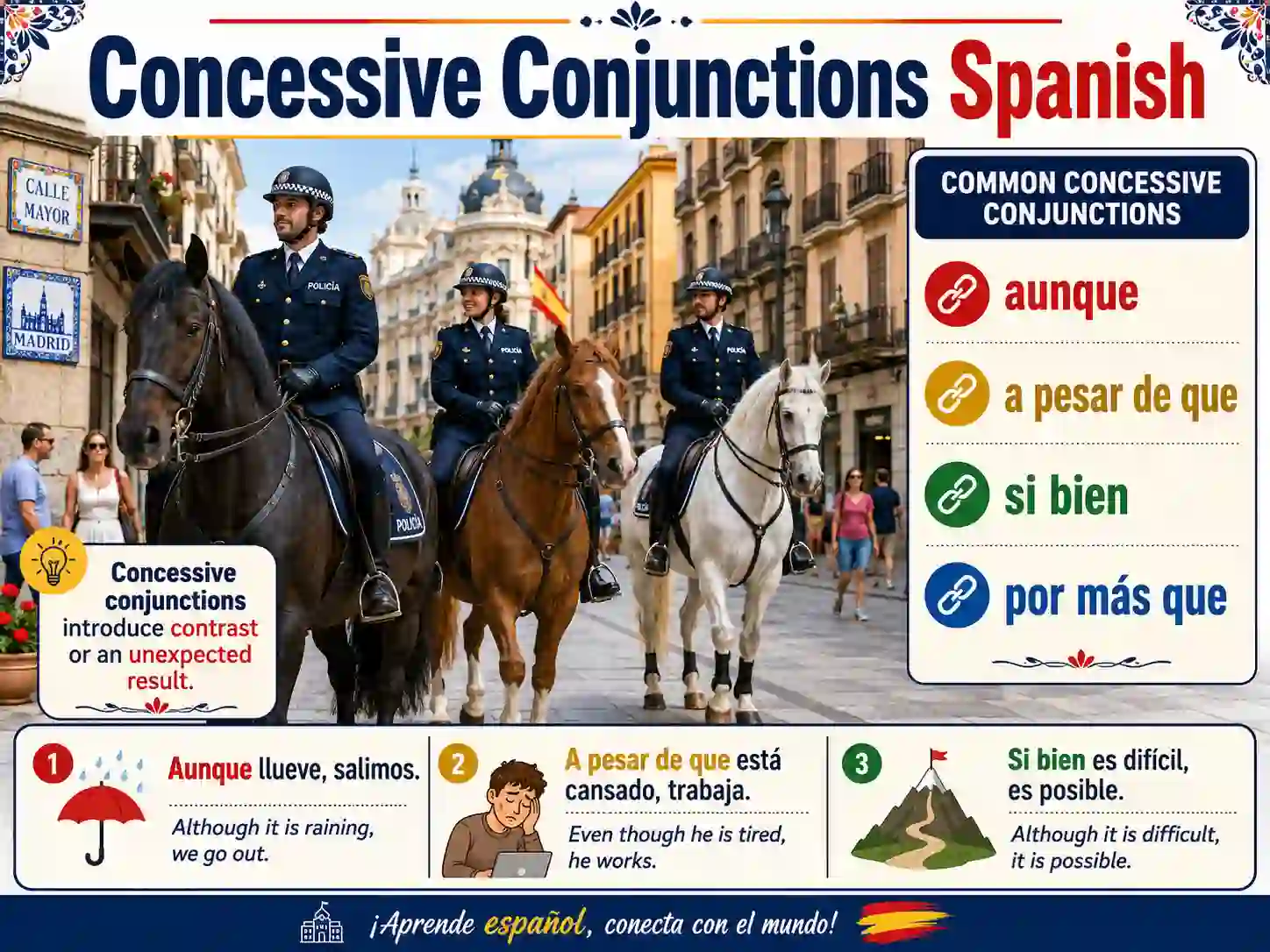
Why concessive conjunctions matter
Concessive conjunctions help you express contrast in a precise way. They are useful when something happens despite a difficulty, objection, condition or unexpected circumstance: aunque es difícil, a pesar de que no tengo tiempo, por más que estudio, aun cuando sea complicado.
How to use this page
Use this page after learning basic conjunctions and before studying more advanced subordinate clauses. First learn the meaning of each concessive connector. Then focus on the verb mood: factual contrast normally uses the indicative, while hypothetical or uncertain contrast often uses the subjunctive.
Factual contrast
Use the indicative when the obstacle or contrast is real.
Aunque está cansado, trabaja.
Although he is tired, he works.
Hypothetical contrast
Use the subjunctive when the obstacle is possible, imagined or not confirmed.
Aunque esté cansado, trabajará.
Even if he is tired, he will work.
Despite + noun or infinitive
Use a pesar de with nouns or infinitives, and a pesar de que with conjugated verbs.
A pesar de la lluvia, salimos.
Despite the rain, we go out.
Main concessive conjunctions in Spanish
Concessive conjunctions introduce a contrast: something is true, possible or expected, but the main action still happens.
| Spanish conjunction | English meaning | Example | Use |
|---|---|---|---|
| aunque | although / even if | Aunque llueve, salimos. | General concessive connector; can take indicative or subjunctive. |
| a pesar de que | despite the fact that | A pesar de que es tarde, seguimos trabajando. | Strong factual or hypothetical contrast. |
| pese a que | despite the fact that | Pese a que no tiene experiencia, aprende rápido. | Formal or written alternative to a pesar de que. |
| si bien | although / while | Si bien es caro, vale la pena. | Formal contrast, often used in written language. |
| por más que | no matter how much / even though | Por más que intento, no puedo. | Effort or repeated attempt that does not change the result. |
| por mucho que | however much / no matter how much | Por mucho que estudie, siempre aprende algo nuevo. | Degree or quantity in contrast. |
| aun cuando | even when / even if | Aun cuando sea difícil, lo intentaré. | Emphatic concession, often hypothetical. |
Aunque: although / even if
Aunque is the most important concessive conjunction in Spanish. It can take the indicative or the subjunctive depending on meaning.
| Spanish | English meaning | Verb mood | Reason |
|---|---|---|---|
| Aunque llueve, salimos. | Although it is raining, we go out. | Indicative | The rain is real or confirmed. |
| Aunque llueva, saldremos. | Even if it rains, we will go out. | Subjunctive | The rain is possible or hypothetical. |
| Aunque estaba cansado, siguió trabajando. | Although he was tired, he kept working. | Indicative | Past factual contrast. |
| Aunque esté cansado, seguirá trabajando. | Even if he is tired, he will keep working. | Subjunctive | Future or uncertain contrast. |
Indicative or subjunctive with concessive conjunctions
The indicative presents the concession as real, factual or known. The subjunctive presents the concession as possible, hypothetical, uncertain or not confirmed.
| Meaning | Indicative | Subjunctive | Difference |
|---|---|---|---|
| Although / even if | Aunque es difícil, lo hago. | Aunque sea difícil, lo haré. | Known difficulty vs possible difficulty. |
| Despite the fact that | A pesar de que no tiene tiempo, ayuda. | A pesar de que no tenga tiempo, ayudará. | Factual lack of time vs possible lack of time. |
| No matter how much | Por más que estudio, no entiendo. | Por más que estudie, no entenderé. | Current repeated effort vs hypothetical effort. |
| Even when / even if | Aun cuando está ocupado, responde. | Aun cuando esté ocupado, responderá. | Real situation vs possible future situation. |
A pesar de and a pesar de que
Use a pesar de with a noun, pronoun or infinitive. Use a pesar de que before a clause with a conjugated verb.
| Structure | Spanish example | English meaning | Grammar point |
|---|---|---|---|
| a pesar de + noun | A pesar de la lluvia, salimos. | Despite the rain, we go out. | No conjugated verb after de. |
| a pesar de + infinitive | A pesar de estar cansado, trabaja. | Despite being tired, he works. | Same subject or general non-finite structure. |
| a pesar de que + indicative | A pesar de que está cansado, trabaja. | Despite the fact that he is tired, he works. | Factual contrast. |
| a pesar de que + subjunctive | A pesar de que esté cansado, trabajará. | Even if he is tired, he will work. | Hypothetical or future contrast. |
Pese a que and si bien
Pese a que and si bien are common in formal or written Spanish. They express a contrast similar to “although” or “despite the fact that”.
| Conjunction | Spanish example | English meaning | Style |
|---|---|---|---|
| pese a que | Pese a que el proyecto es difícil, avanza. | Despite the fact that the project is difficult, it is progressing. | Formal / written. |
| pese a que | Pese a que haya problemas, seguiremos. | Even if there are problems, we will continue. | Formal with subjunctive. |
| si bien | Si bien es caro, ofrece buena calidad. | Although it is expensive, it offers good quality. | Formal balanced contrast. |
| si bien | Si bien no todos están de acuerdo, la decisión es clara. | While not everyone agrees, the decision is clear. | Written or analytical style. |
Por más que and por mucho que
Por más que and por mucho que express effort, intensity or quantity that does not change the final result. They often mean “no matter how much” or “however much”.
| Expression | Spanish example | English meaning | Use |
|---|---|---|---|
| por más que | Por más que intento, no puedo. | No matter how much I try, I cannot. | Repeated real effort. |
| por más que | Por más que lo intente, no cambiará nada. | No matter how much he/she tries, nothing will change. | Hypothetical or future effort. |
| por mucho que | Por mucho que estudia, siempre tiene dudas. | However much he/she studies, he/she always has doubts. | Quantity or intensity. |
| por mucho que | Por mucho que estudie, necesitará práctica. | However much he/she studies, he/she will need practice. | Future or hypothetical contrast. |
Aun cuando: even when / even if
Aun cuando is an emphatic concessive connector. It often has a meaning close to “even when” or “even if”.
| Spanish example | English meaning | Verb mood | Meaning |
|---|---|---|---|
| Aun cuando está ocupado, responde rápido. | Even when he is busy, he answers quickly. | Indicative | Repeated or factual situation. |
| Aun cuando esté ocupado, responderá. | Even if he is busy, he will answer. | Subjunctive | Possible future situation. |
| Aun cuando era difícil, siguieron adelante. | Even though it was difficult, they continued. | Indicative | Past factual concession. |
| Aun cuando fuera difícil, seguirían adelante. | Even if it were difficult, they would continue. | Subjunctive | Hypothetical concession. |
Word order and commas
Concessive clauses can come before or after the main clause. When the concessive clause comes first, a comma is often helpful in writing.
| Order | Spanish example | English meaning |
|---|---|---|
| Main clause first | Salimos aunque llueve. | We go out although it is raining. |
| Concessive clause first | Aunque llueve, salimos. | Although it is raining, we go out. |
| Noun phrase first | A pesar de la lluvia, salimos. | Despite the rain, we go out. |
| Formal contrast first | Si bien es caro, vale la pena. | Although it is expensive, it is worth it. |
Practice exercises: concessive conjunctions
Try to answer before opening the solutions. These exercises focus on meaning, conjunction choice and indicative vs subjunctive.
Exercise 1: choose the conjunction
- ___ llueve, salimos. = although
- ___ de la lluvia, salimos. = despite
- ___ que intento, no puedo. = no matter how much
- ___ es caro, vale la pena. = although / while
Show answers
1. Aunque
2. A pesar
3. Por más
4. Si bien
Exercise 2: indicative or subjunctive?
- Aunque ___ cansado, trabaja. estar, factual
- Aunque ___ cansado, trabajará. estar, possible future
- A pesar de que ___ tarde, seguimos. ser, factual
- Por mucho que ___, necesitará práctica. estudiar, hypothetical
Show answers
1. está
2. esté
3. es
4. estudie
Exercise 3: translate into English
- Aunque sea difícil, lo haré.
- A pesar de que no tiene tiempo, ayuda.
- Por más que intento, no entiendo.
- Si bien es pequeño, funciona bien.
Show answers
1. Even if it is difficult, I will do it.
2. Despite the fact that he/she does not have time, he/she helps.
3. No matter how much I try, I do not understand.
4. Although it is small, it works well.
Typical mistakes with Spanish concessive conjunctions
- Using the same mood after every aunque: aunque llueve and aunque llueva are both correct, but they mean different things.
- Using indicative for hypothetical contrast: say aunque sea difícil when the difficulty is possible or not confirmed.
- Using subjunctive for a clear fact: say aunque es difícil when the difficulty is factual and known.
- Confusing a pesar de and a pesar de que: use a pesar de with nouns or infinitives, and a pesar de que with conjugated verbs.
- Overusing pero: pero gives a simple contrast, while concessive conjunctions show that an obstacle does not prevent the main action.
- Forgetting formal style: pese a que and si bien are often more formal than everyday aunque.
Related grammar topics
Spanish Conjunctions
Learn how conjunctions connect clauses, contrast, time, manner, reasons and conditions.
Modal Conjunctions
Study como, según, conforme, tal como and como si.
Temporal Conjunctions
Study cuando, mientras, antes de que and hasta que.
Spanish Tenses
Review present, future, conditional and past forms used in concessive clauses.
Future Tense
Useful for patterns such as aunque sea difícil, lo haré.
Infinitive
Useful for a pesar de estar cansado and related structures.
Where to go next
After concessive conjunctions, continue with the full conjunctions overview and modal conjunctions. This helps you compare contrast clauses with manner clauses, time clauses and other subordinate structures.
Want personal guidance?
If concessive conjunctions feel confusing, individual guidance can help you practise aunque, a pesar de que, pese a que, si bien, por más que, aun cuando, indicative vs subjunctive and real contrast sentences.
FAQ: concessive conjunctions in Spanish
What are concessive conjunctions in Spanish?
Concessive conjunctions introduce a contrast or obstacle that does not stop the main action. Examples include aunque, a pesar de que, pese a que, si bien, por más que and aun cuando.
What does aunque mean in Spanish?
Aunque means “although” or “even if”. It uses the indicative for factual contrast and the subjunctive for hypothetical or uncertain contrast.
Does aunque take the indicative or subjunctive?
Aunque can take both. Use the indicative for a real or known fact: aunque llueve. Use the subjunctive for a possible or hypothetical situation: aunque llueva.
What is the difference between a pesar de and a pesar de que?
A pesar de is followed by a noun, pronoun or infinitive. A pesar de que introduces a clause with a conjugated verb.
What does por más que mean?
Por más que means “no matter how much” or “even though”. It often expresses effort or repetition that does not change the result.
Is si bien formal in Spanish?
Yes. Si bien is often more formal or written than everyday aunque. It means “although” or “while” in a contrastive sense.

MundoDele – Spanish learning for education, work and intercultural understanding
MundoDele connects online Spanish courses, DELE preparation, Business Spanish and cultural context into a personal Spanish learning platform.
Grammar pages are designed to explain Spanish clearly, with practical examples, real sentence logic and connected learning paths.