
Conditional Conjunctions in Spanish
Learn how Spanish conditional conjunctions introduce conditions, requirements and hypothetical situations. This guide explains si, siempre que, siempre y cuando, con tal de que, a condición de que, en caso de que, a menos que, salvo que and excepto que with examples and mood rules.
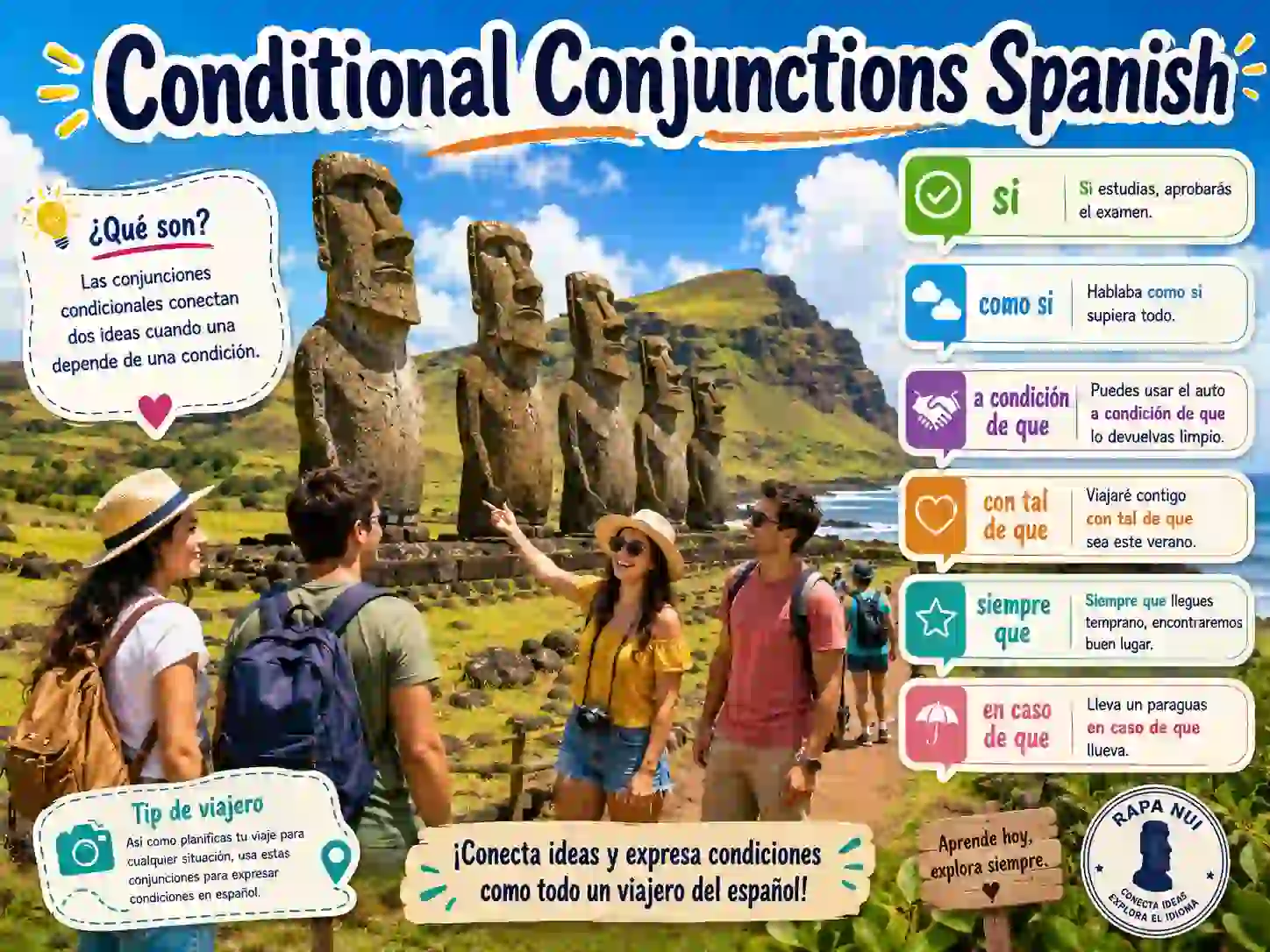
Why conditional conjunctions matter
Conditional conjunctions let you express requirements, limits, warnings, possible situations and hypothetical outcomes. They are central for real-life Spanish because they appear in plans, agreements, rules, negotiations, instructions and imagined situations: si puedo, si tienes tiempo, con tal de que llegues temprano, a menos que llueva, si tuviera dinero.
How to use this page
Use this page after learning basic conjunctions and Spanish tenses. The key is to separate si clauses from other conditional connectors. Si has its own tense rules, while many expressions such as con tal de que, a condición de que and a menos que often take the subjunctive.
Real condition
Use si + present indicative for real or possible conditions.
Si tengo tiempo, voy.
If I have time, I go / I will go.
Hypothetical condition
Use si + imperfect subjunctive + conditional for unreal or unlikely situations.
Si tuviera tiempo, iría.
If I had time, I would go.
Requirement or exception
Expressions such as con tal de que and a menos que usually take the subjunctive.
Voy con tal de que vengas.
I will go provided that you come.
Main conditional conjunctions in Spanish
Conditional conjunctions introduce the condition, requirement or exception that controls the main clause.
| Spanish conjunction | English meaning | Example | Use |
|---|---|---|---|
| si | if | Si tengo tiempo, voy. | Basic real, possible or hypothetical condition. |
| siempre que | provided that / as long as | Puedes venir siempre que avises antes. | Condition or requirement; can also mean “whenever” in temporal use. |
| siempre y cuando | provided that / as long as | Te ayudo siempre y cuando seas puntual. | Stronger explicit condition. |
| con tal de que | provided that / as long as | Voy con tal de que vengas conmigo. | Condition required for willingness or agreement. |
| a condición de que | on condition that | Acepto a condición de que firmes el contrato. | Formal or explicit condition. |
| en caso de que | in case | Llama en caso de que necesites ayuda. | Possible situation and precaution. |
| a menos que | unless | No salimos a menos que deje de llover. | Negative condition or exception. |
| salvo que | unless / except if | Iremos salvo que haya problemas. | Exception or limiting condition. |
| excepto que | except if / unless | Todo está listo excepto que falta una firma. | Exception; can be close to “except that”. |
Si: if
Si is the basic Spanish conditional conjunction. It introduces real, possible, unlikely or impossible conditions. Its tense pattern is especially important because Spanish does not normally use the present subjunctive after si.
| Condition type | Spanish pattern | Example | English meaning |
|---|---|---|---|
| Real or possible condition | si + present indicative | Si tengo tiempo, voy. | If I have time, I go / I will go. |
| Future result from a real condition | si + present indicative + future | Si tengo tiempo, iré. | If I have time, I will go. |
| Hypothetical condition | si + imperfect subjunctive + conditional | Si tuviera tiempo, iría. | If I had time, I would go. |
| Unreal past condition | si + pluperfect subjunctive + conditional perfect | Si hubiera tenido tiempo, habría ido. | If I had had time, I would have gone. |
Three common si-clause patterns
Most learner mistakes happen because English “if” does not map directly onto Spanish tense choice. Spanish separates real conditions, hypothetical conditions and unreal past conditions.
| Type | Spanish example | English meaning | Grammar logic |
|---|---|---|---|
| Open condition | Si estudias, aprobarás. | If you study, you will pass. | The condition is possible. |
| Hypothetical present/future | Si estudiaras más, aprobarías. | If you studied more, you would pass. | The condition is imagined or less likely. |
| Unreal past | Si hubieras estudiado, habrías aprobado. | If you had studied, you would have passed. | The past condition did not happen. |
Detail pages: Spanish Conditional and Spanish Conditional Perfect.
Siempre que, siempre y cuando, con tal de que
These conjunctions mean “provided that” or “as long as”. They introduce a requirement that must be fulfilled. In conditional meaning, they often take the subjunctive.
| Conjunction | Spanish example | English meaning | Grammar point |
|---|---|---|---|
| siempre que | Puedes usar mi coche siempre que tengas cuidado. | You can use my car as long as you are careful. | Subjunctive for condition or requirement. |
| siempre y cuando | Te ayudo siempre y cuando llegues temprano. | I will help you provided that you arrive early. | Explicit condition; subjunctive. |
| con tal de que | Acepto con tal de que me paguen a tiempo. | I accept provided that they pay me on time. | Condition for agreement; subjunctive. |
| siempre que as temporal | Siempre que voy a Madrid, visito el museo. | Whenever I go to Madrid, I visit the museum. | Temporal repeated meaning; indicative. |
A condición de que and con la condición de que
A condición de que and con la condición de que are explicit and often formal. They are useful in agreements, rules, conditions and negotiations.
| Expression | Spanish example | English meaning | Use |
|---|---|---|---|
| a condición de que | Acepto a condición de que firmes hoy. | I accept on condition that you sign today. | Formal or explicit condition. |
| a condición de que | Puedes participar a condición de que respetes las reglas. | You can participate on condition that you respect the rules. | Rule or requirement. |
| con la condición de que | Te presto el dinero con la condición de que me lo devuelvas. | I will lend you the money on condition that you return it to me. | Explicit agreement. |
En caso de que, a menos que, salvo que
En caso de que introduces a possible situation and often means “in case”. A menos que, salvo que and excepto que introduce an exception or negative condition.
| Conjunction | Spanish example | English meaning | Use |
|---|---|---|---|
| en caso de que | Llama en caso de que necesites ayuda. | Call in case you need help. | Possible situation; precaution. |
| a menos que | No salimos a menos que deje de llover. | We are not going out unless it stops raining. | Negative condition. |
| salvo que | Iremos mañana salvo que haya problemas. | We will go tomorrow unless there are problems. | Exception or limiting condition. |
| excepto que | Todo está listo excepto que falta una firma. | Everything is ready except that one signature is missing. | Exception; often close to “except that”. |
Si vs cuando
Si introduces a condition. Cuando introduces a time relationship. English learners often confuse “if” and “when” because both can refer to future situations.
| Meaning | Spanish example | English meaning | Grammar logic |
|---|---|---|---|
| Condition | Si tengo tiempo, te llamo. | If I have time, I will call you. | The call depends on the condition. |
| Future time | Cuando tenga tiempo, te llamaré. | When I have time, I will call you. | The time is future; Spanish uses subjunctive after cuando. |
| Condition with present indicative | Si vienes, cenamos juntos. | If you come, we will have dinner together. | Use present indicative after si. |
| Future time with subjunctive | Cuando vengas, cenaremos juntos. | When you come, we will have dinner together. | Use subjunctive after cuando for future time. |
Related page: Temporal Conjunctions in Spanish.
Si vs other conditional connectors
The most important difference is simple: si normally uses indicative for real conditions, while many other conditional conjunctions use the subjunctive because they express a requirement, exception or uncertain situation.
| Connector | Correct example | Incorrect learner pattern | Rule |
|---|---|---|---|
| si | Si tienes tiempo, ven. | Si tengas tiempo, ven. | Use present indicative for real conditions. |
| con tal de que | Ven con tal de que tengas tiempo. | Ven con tal de que tienes tiempo. | Requirement; use subjunctive. |
| a menos que | Voy a menos que llueva. | Voy a menos que llueve. | Exception; use subjunctive. |
| en caso de que | Llama en caso de que necesites ayuda. | Llama en caso de que necesitas ayuda. | Possible situation; use subjunctive. |
Word order and commas
Conditional clauses can come before or after the main clause. When the conditional clause comes first, a comma is often helpful in writing.
| Order | Spanish example | English meaning |
|---|---|---|
| Condition first | Si tengo tiempo, voy. | If I have time, I go / I will go. |
| Main clause first | Voy si tengo tiempo. | I will go if I have time. |
| Requirement first | Con tal de que vengas, acepto. | Provided that you come, I accept. |
| Exception after main clause | Iremos mañana salvo que haya problemas. | We will go tomorrow unless there are problems. |
Practice exercises: conditional conjunctions
Try to answer before opening the solutions. These exercises focus on connector choice, si-clauses and subjunctive after requirement connectors.
Exercise 1: choose the conjunction
- ___ tengo tiempo, voy. = if
- Voy ___ que vengas conmigo. = provided that
- No salimos ___ que deje de llover. = unless
- Llama ___ de que necesites ayuda. = in case
Show answers
1. Si
2. con tal de
3. a menos
4. en caso
Exercise 2: choose the correct verb form
- Si ___ tiempo, te llamo. tener
- Con tal de que ___ temprano, acepto. llegar
- A menos que ___, iremos. llover
- Si ___ más dinero, viajaría más. tener
Show answers
1. tengo
2. llegues
3. llueva
4. tuviera
Exercise 3: translate into English
- Si estudias, aprobarás.
- Si tuviera tiempo, iría.
- Puedes venir siempre que avises antes.
- No salimos a menos que deje de llover.
Show answers
1. If you study, you will pass.
2. If I had time, I would go.
3. You can come provided that you let us know beforehand.
4. We are not going out unless it stops raining.
Typical mistakes with Spanish conditional conjunctions
- Using present subjunctive after si: say si tengo tiempo, not si tenga tiempo.
- Using future after si in normal future conditions: say si tengo tiempo, iré, not si tendré tiempo, iré.
- Confusing si and cuando: si means “if”; cuando means “when”.
- Forgetting subjunctive after a menos que: say a menos que llueva, not a menos que llueve.
- Forgetting subjunctive after con tal de que: say con tal de que vengas.
- Using siempre que without checking meaning: it can mean “whenever” in temporal use or “provided that” in conditional use.
Related grammar topics
Spanish Conjunctions
Learn how conjunctions connect conditions, causes, results, contrast, time and manner.
Consecutive Conjunctions
Study por eso, así que, por lo tanto and result logic.
Concessive Conjunctions
Compare conditions with contrast: aunque, a pesar de que, si bien.
Temporal Conjunctions
Compare si tengo tiempo with cuando tenga tiempo.
Conditional
Learn hablaría, comería, viviría and hypothetical meaning.
Conditional Perfect
Learn habría hablado and unreal past conditions.
Where to go next
After conditional conjunctions, continue with the Spanish conditional tense and conditional perfect. These pages explain the verb forms used in hypothetical and unreal conditional sentences.
Want personal guidance?
If conditional conjunctions feel confusing, individual guidance can help you practise si, siempre que, con tal de que, a condición de que, en caso de que, a menos que, real conditions, hypothetical conditions and unreal past conditions.
FAQ: conditional conjunctions in Spanish
What are conditional conjunctions in Spanish?
Conditional conjunctions introduce a condition, requirement or exception. Examples include si, siempre que, con tal de que, a condición de que, en caso de que and a menos que.
What does si mean in Spanish?
Si means “if”. It introduces a condition: si tengo tiempo means “if I have time”.
Can you use the present subjunctive after si?
Not in normal real “if” clauses. Say si tengo tiempo, not si tenga tiempo. For hypothetical clauses, use the imperfect subjunctive: si tuviera tiempo.
What is the difference between si tengo and si tuviera?
Si tengo is a real or possible condition. Si tuviera is hypothetical or less likely and is usually followed by the conditional: si tuviera tiempo, iría.
What does a menos que mean?
A menos que means “unless”. It usually takes the subjunctive when the exception is possible or not yet confirmed: a menos que llueva.
What is the difference between si and cuando?
Si means “if” and introduces a condition. Cuando means “when” and introduces a time relationship. Compare si tengo tiempo with cuando tenga tiempo.

MundoDele – Spanish learning for education, work and intercultural understanding
MundoDele connects online Spanish courses, DELE preparation, Business Spanish and cultural context into a personal Spanish learning platform.
Grammar pages are designed to explain Spanish clearly, with practical examples, real sentence logic and connected learning paths.