
MundoDele Spanish Grammar
Spanish Adverbs of Affirmation and Negation: Sí, No, También and Tampoco
Learn how to confirm, deny, agree and disagree in Spanish with sí, no, también, tampoco, nunca, jamás, ya no, claro, ciertamente and efectivamente.
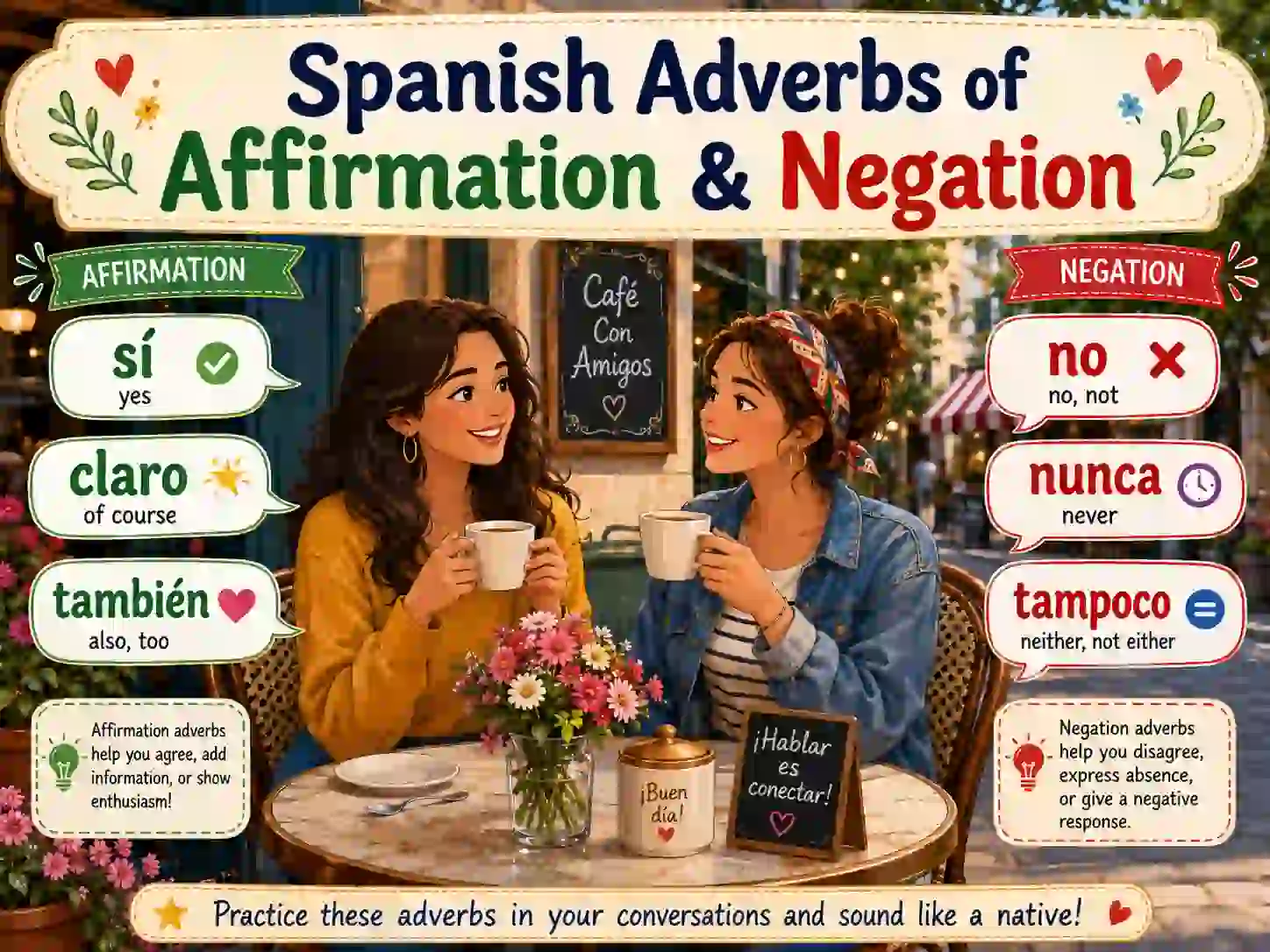
Definition
What are Spanish adverbs of affirmation and negation?
Spanish words and expressions of affirmation confirm a statement, express agreement or add positive information. Words and expressions of negation deny information, reject a statement or add a negative idea.
Sí, entiendo.
Yes, I understand.
No entiendo.
I do not understand.
Yo también. — Me too.
Yo tampoco. — Me neither.
Words such as nadie, nada and ninguno have other grammatical functions. They are included because they are essential for building Spanish negative sentences.
Overview
Spanish affirmation and negation at a glance
| Word or expression | Main meaning | Spanish example | English meaning | Usage note |
|---|---|---|---|---|
| sí | yes | Sí, entiendo. | Yes, I understand. | Written with an accent when it means “yes”. |
| también | also, too | Yo también estudio español. | I also study Spanish. | Adds or agrees with positive information. |
| claro | of course, certainly | Claro que sí. | Of course. | Common conversational confirmation. |
| ciertamente | certainly | Ciertamente es importante. | It is certainly important. | More formal or emphatic. |
| efectivamente | indeed, that is correct | Efectivamente, tienes razón. | Indeed, you are right. | Confirms information or a previous statement. |
| no | no, not | No entiendo. | I do not understand. | Normally placed before the conjugated verb. |
| tampoco | neither, not either | Yo tampoco entiendo. | I do not understand either. | Adds or agrees with negative information. |
| nunca | never | Nunca voy allí. | I never go there. | Can precede the verb or follow it with no. |
| jamás | never, ever | Jamás lo olvidaré. | I will never forget it. | Often stronger or more emphatic than nunca. |
| ya no | no longer, not anymore | Ya no vivo allí. | I no longer live there. | Shows that a previous situation has changed. |
| todavía no | not yet | Todavía no he terminado. | I have not finished yet. | Shows that something is expected later. |
Affirmation
Sí, claro, ciertamente and efectivamente
Spanish uses several words and expressions to confirm information. The best choice depends on whether the response is direct, conversational, formal or corrective.
Sí
Use sí for a direct positive answer.
¿Hablas español? — Sí.
Sí, quiero ir.
Claro
Use claro, claro que sí or por supuesto for “of course”.
Claro que entiendo.
Por supuesto que puedes venir.
Efectivamente
Use efectivamente to confirm that information is correct.
Efectivamente, era verdad.
Efectivamente, tienes razón.
| Expression | Typical use | Example | Register |
|---|---|---|---|
| sí | Direct positive answer | Sí, voy. | Neutral |
| claro | Natural confirmation | Claro que sí. | Conversational |
| por supuesto | Strong confirmation | Por supuesto que puedes venir. | Neutral |
| ciertamente | Emphasised certainty | Ciertamente es difícil. | Formal |
| efectivamente | Confirming a fact | Efectivamente, ocurrió ayer. | Neutral to formal |
Positive and negative agreement
También and tampoco
También and tampoco are often translated with “too”, “also”, “either” or “neither”. The essential difference is whether the original information is positive or negative.
También: positive agreement
Use también after a positive statement.
Estudio español. — Yo también.
I study Spanish. — Me too.
María vive aquí y Pedro también.
María lives here and Pedro does too.
Tampoco: negative agreement
Use tampoco after a negative statement.
No entiendo. — Yo tampoco.
I do not understand. — Me neither.
María no viene y Pedro tampoco.
María is not coming and Pedro is not either.
| Original statement | Agreement | English meaning |
|---|---|---|
| Me gusta el español. | A mí también. | I like Spanish. — Me too. |
| Quiero viajar. | Yo también. | I want to travel. — Me too. |
| No me gusta el café. | A mí tampoco. | I do not like coffee. — Me neither. |
| No quiero salir. | Yo tampoco. | I do not want to go out. — Me neither. |
After No entiendo, the normal agreement is Yo tampoco, not Yo también.
Basic negation
No before the conjugated verb
The basic Spanish negative pattern is no + conjugated verb. The word no normally comes directly before the conjugated verb, including auxiliaries.
| Structure | Spanish example | English meaning |
|---|---|---|
| no + verb | No entiendo. | I do not understand. |
| no + verb + infinitive | No quiero salir. | I do not want to go out. |
| no + auxiliary + participle | No he terminado. | I have not finished. |
| no + estar + gerund | No estoy trabajando. | I am not working. |
| no + object pronoun + verb | No lo sé. | I do not know it. |
| no + reflexive pronoun + verb | No me acuerdo. | I do not remember. |
No lo entiendo.
No me levanto temprano.
No se lo quiero decir.
Continue with: Spanish Negation .
Negative words
Nunca, jamás, nadie, nada and ninguno
Spanish uses several negative words to express “never”, “nobody”, “nothing”, “none” and related meanings.
| Negative word | Meaning | Before the verb | After the verb |
|---|---|---|---|
| nunca | never | Nunca voy allí. | No voy allí nunca. |
| jamás | never, ever | Jamás lo olvidaré. | No lo olvidaré jamás. |
| nadie | nobody, no one | Nadie vino. | No vino nadie. |
| nada | nothing, not anything | Nada funciona. | No funciona nada. |
| ninguno | none, not any | Ninguno sirve. | No sirve ninguno. |
| en ninguna parte | nowhere | En ninguna parte está mejor. | No lo encuentro en ninguna parte. |
negative word before the verb → normally no additional no
negative word after the verb → normally use no before the verb
Sentence structure
Spanish double negation
Spanish allows and often requires more than one negative word in the same sentence. The negative words reinforce one another; they do not normally cancel one another.
| Spanish sentence | Natural English meaning | Structure |
|---|---|---|
| No veo nada. | I do not see anything. | no + verb + nada |
| No conozco a nadie. | I do not know anyone. | no + verb + nadie |
| No viene nunca. | He or she never comes. | no + verb + nunca |
| No tengo ningún problema. | I do not have any problem. | no + verb + ningún + noun |
| No quiero ni café ni té. | I want neither coffee nor tea. | no + verb + ni...ni |
| No dijo nada a nadie. | He or she did not say anything to anyone. | no + verb + nada + nadie |
When the negative word comes before the verb, the additional no normally disappears:
Nadie vino.
Nada funciona.
Nunca lo hago.
English usually says “I do not see anything”. Spanish normally says No veo nada, with two negative elements.
Never
Nunca and jamás
Both nunca and jamás can mean “never”. Jamás often sounds stronger, more emphatic or more dramatic.
Nunca
Neutral and very common in everyday Spanish.
Nunca llego tarde.
I never arrive late.
No trabajo nunca los domingos.
I never work on Sundays.
Jamás
Often stronger or more emphatic.
Jamás lo haría.
I would never do that.
No lo olvidaré jamás.
I will never forget it.
Correct: Nunca voy allí.
Correct: No voy allí nunca.
Incorrect: No nunca voy allí.
Change and expectation
Ya no and todavía no
Ya no and todavía no both contain negation, but they describe different relationships with time.
Ya no: no longer
A situation was true before but is not true now.
Ya no vivo allí.
I no longer live there.
Ya no trabajo los sábados.
I do not work on Saturdays anymore.
Todavía no: not yet
Something has not happened, but it may happen later.
Todavía no he terminado.
I have not finished yet.
Todavía no llega.
He or she has not arrived yet.
Spelling
Sí with an accent and si without an accent
The written accent distinguishes the affirmative word sí from the conditional conjunction si.
| Form | Meaning | Spanish example | English meaning |
|---|---|---|---|
| sí | yes | Sí, quiero aprender. | Yes, I want to learn. |
| si | if | Si tengo tiempo, estudio. | If I have time, I study. |
| sí | yes | Sí, voy mañana. | Yes, I am going tomorrow. |
| si | if | Si voy, te llamo. | If I go, I will call you. |
Word order
Where do affirmation and negation words go?
| Word | Common position | Spanish example | English meaning |
|---|---|---|---|
| sí | Short answer or beginning | Sí, entiendo. | Yes, I understand. |
| no | Before conjugated verb | No entiendo. | I do not understand. |
| también | Before or after the main idea | Yo también estudio. | I also study. |
| tampoco | Before the verb or as a short answer | Yo tampoco entiendo. | I do not understand either. |
| nunca | Before verb or after it with no | Nunca voy. / No voy nunca. | I never go. |
| ya no | Before conjugated verb | Ya no trabajo allí. | I no longer work there. |
Continue with: Position of Adverbs in Spanish .
Exercises
Practice Spanish affirmation and negation
Choose también or tampoco
- Estudio español. — Yo ___.
- No entiendo. — Yo ___.
- María quiere venir y Pedro ___.
- María no viene y Pedro ___.
Show answers
1. también
2. tampoco
3. también
4. tampoco
Put no in the correct position
- Entiendo la pregunta.
- Lo quiero comprar.
- He terminado.
- Me levanto temprano.
Show answers
1. No entiendo la pregunta.
2. No lo quiero comprar.
3. No he terminado.
4. No me levanto temprano.
Complete the negative sentence
-
No veo ___.
anything -
No conozco a ___.
anyone -
No voy allí ___.
never -
No tengo ___ problema.
any
Show answers
1. nada
2. nadie
3. nunca
4. ningún
Correct the sentence
- Entiendo no.
- No nadie vino.
- No nunca trabajo allí.
- No entiendo. — Yo también.
Show answers
1. No entiendo.
2. Nadie vino. or
No vino nadie.
3. Nunca trabajo allí. or
No trabajo allí nunca.
4. No entiendo. — Yo tampoco.
Choose ya no or todavía no
- I lived there before, but I do not live there now.
- I expect to finish, but I have not finished yet.
- She previously worked here, but she does not now.
- The train has not arrived yet.
Show answers
1. Ya no vivo allí.
2. Todavía no he terminado.
3. Ya no trabaja aquí.
4. El tren todavía no ha llegado.
Translate into Spanish
- Yes, I understand.
- I do not know anyone here.
- She never arrives late.
- I do not want coffee or tea.
Show possible answers
1. Sí, entiendo.
2. No conozco a nadie aquí.
3. Nunca llega tarde.
4. No quiero ni café ni té.
Continue learning
Related Spanish grammar lessons

Spanish Adverbs
Review adverbs of time, place, manner, quantity, frequency, doubt, affirmation and negation.
Open lesson
Adverbs of Doubt
Learn quizá, tal vez, probablemente, posiblemente and a lo mejor.
Open lesson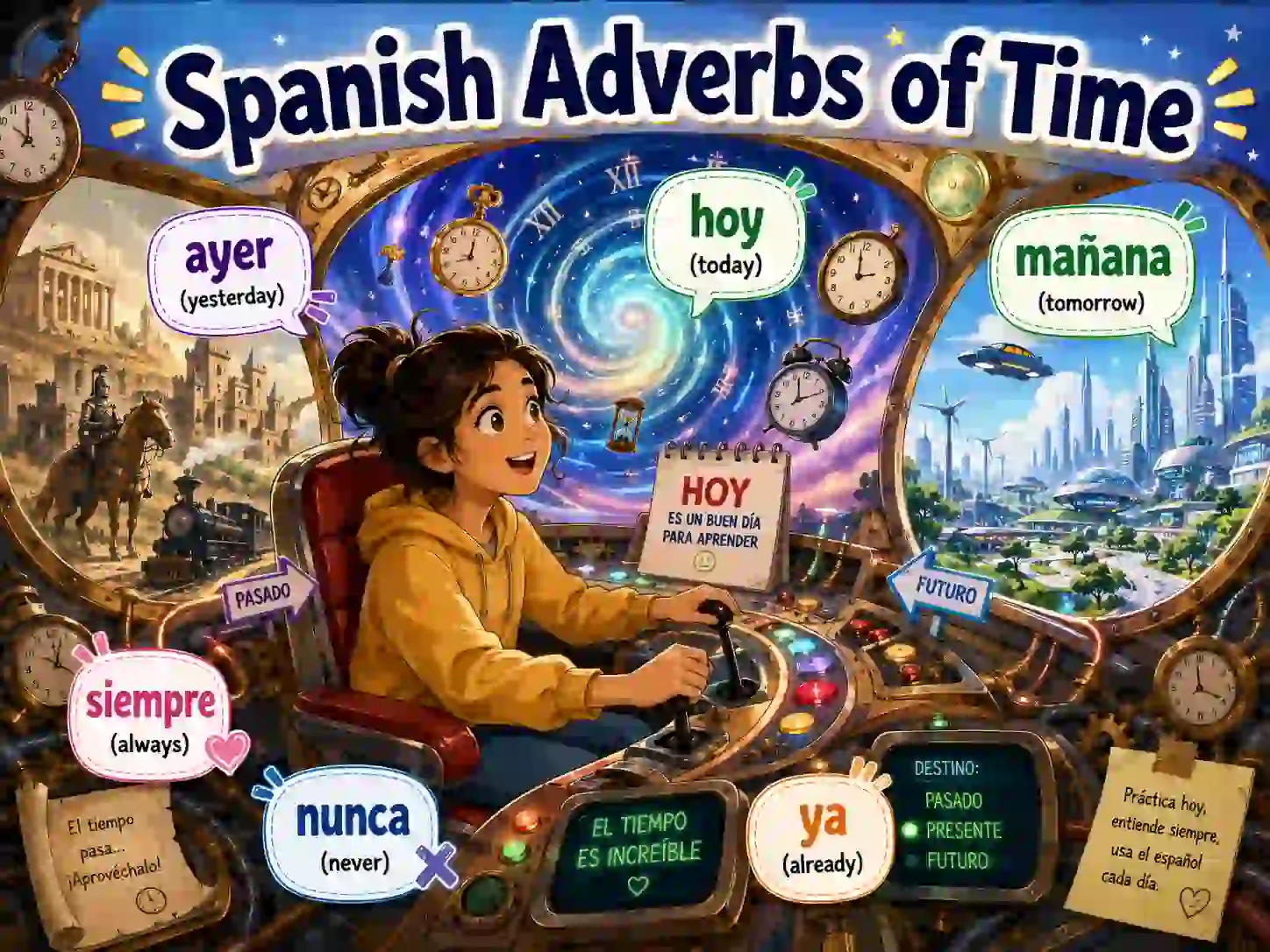
Adverbs of Time
Review ya, todavía, ahora, antes, después and related expressions.
Open lesson
Position of Adverbs
Learn why no comes before the verb and where también, tampoco and nunca appear.
Open lessonCommon errors
Common mistakes with Spanish affirmation and negation
- Putting no after the verb: say No entiendo, not Entiendo no.
- Confusing también and tampoco: use también after positive information and tampoco after negative information.
- Forgetting no before a following negative word: say No veo nada and No conozco a nadie.
- Adding no when the negative word already comes first: say Nadie vino, not No nadie vino.
- Using no nunca before the verb: say Nunca voy or No voy nunca.
- Confusing sí and si: sí means “yes”; si means “if”.
- Confusing ya no and todavía no: ya no means “no longer”; todavía no means “not yet”.
- Translating Spanish double negation literally: No veo nada naturally means “I do not see anything”.
Frequently asked questions
Questions about Spanish affirmation and negation
What are Spanish adverbs of affirmation?
They confirm or support a statement. Common examples include sí, también, claro, ciertamente and efectivamente.
What are Spanish adverbs of negation?
They deny a statement or express negative agreement. Common examples include no, nunca, jamás, tampoco and ya no.
Where does no go in a Spanish sentence?
It normally goes before the conjugated verb: No entiendo, No quiero salir and No he terminado.
What is the difference between también and tampoco?
También adds or agrees with positive information. Tampoco adds or agrees with negative information.
How does Spanish double negation work?
When a negative word follows the verb, Spanish normally also uses no before the verb: No veo nada and No conozco a nadie.
What is the difference between sí and si?
Sí with an accent means “yes”. Si without an accent normally means “if”.
Practice and support
Practise positive and negative Spanish sentences
Affirmation and negation become easier when you practise short answers, agreement, word order and negative words inside complete sentences.
Spanish Tutoring
Work on negation, double negation, word order and individual grammar difficulties.
Private Spanish Lessons
Practise agreement, disagreement and negative responses through conversation and writing.
Intensive Spanish Course
Combine grammar with structured speaking, listening and sentence-building activities.

About MundoDele
Spanish learning for education, work and real communication
MundoDele connects online Spanish courses, DELE preparation, Business Spanish and cultural context into a personal Spanish learning platform.
The grammar guides explain Spanish with practical examples, clear comparisons and complete sentences.