
Spanish Quantifiers: Mucho, Poco, Todo and More
Learn how Spanish quantifiers express amount, quantity and degree — from mucho dinero, pocas personas and todos los días to cada estudiante, bastantes ejemplos and demasiado trabajo.
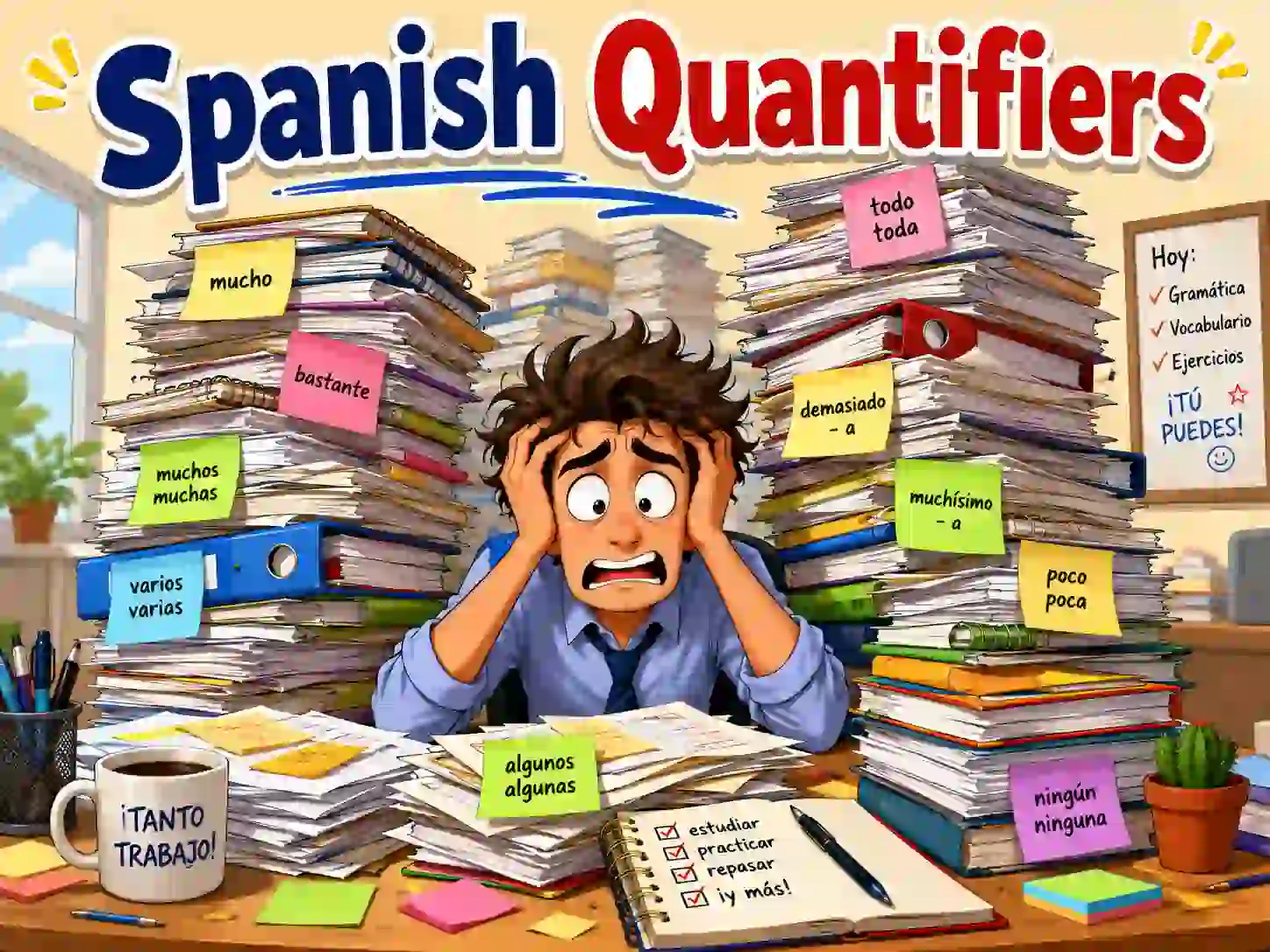
Why Spanish quantifiers matter
Quantifiers are essential for real communication because they let you talk about amount, frequency, groups, limits and general quantity. They connect closely with nouns, articles, adjectives, pronouns and adverbs. The main challenge is agreement: some quantifiers change for masculine, feminine, singular and plural nouns, while others stay unchanged.
How to use this page
Use this page as the main lesson for Spanish quantifiers inside the determiner system. First learn which quantifiers agree with nouns, then separate determiner use from pronoun and adverb use.
Ask what the quantifier refers to: trabajo, agua, libros, personas.
Use agreement when needed: mucho dinero, mucha comida, muchos libros, muchas ideas.
A quantifier can work before a noun, as a pronoun, or as an adverb: muchos libros, muchos, trabaja mucho.
The core system: quantity before a noun
Amount
Use quantifiers such as mucho, poco, bastante and demasiado to express amount.
mucho trabajo · poca agua · demasiado ruido
Group or totality
Use todo, cada, ambos, varios and algunos for groups and totality.
todos los días · cada estudiante · varios ejemplos
Agreement
Many quantifiers agree with the noun, but some stay invariable.
muchos libros · muchas casas · cada día
Spanish quantifiers at a glance
Some quantifiers change according to gender and number. Others are invariable or only change in number.
| Quantifier | Main meaning | Forms | Example | Grammar note |
|---|---|---|---|---|
| mucho | much, many, a lot of | mucho, mucha, muchos, muchas | muchas personas | Agrees with the noun. |
| poco | little, few | poco, poca, pocos, pocas | poco tiempo | Agrees with the noun. |
| todo | all, every, whole | todo, toda, todos, todas | todos los días | Often used with an article in plural noun phrases. |
| cada | each, every | cada | cada estudiante | Invariable and normally used with singular nouns. |
| demasiado | too much, too many | demasiado, demasiada, demasiados, demasiadas | demasiadas preguntas | Agrees with the noun when used before nouns. |
| bastante | enough, quite a lot, several | bastante, bastantes | bastantes ejemplos | Can change in number before nouns. |
| varios | several | varios, varias | varias opciones | Plural quantifier. |
| alguno | some, any | algún, alguna, algunos, algunas | algunos libros | algún before masculine singular nouns. |
| ninguno | no, none, not any | ningún, ninguna | ningún problema | Often used in negative sentences. |
Mucho and poco
Mucho expresses a large amount or number. Poco expresses a small amount or number. Both agree with the noun when used before nouns.
| Form | Use | Example | English meaning |
|---|---|---|---|
| mucho | masculine singular | mucho dinero | a lot of money |
| mucha | feminine singular | mucha agua | a lot of water |
| muchos | masculine plural | muchos libros | many books |
| muchas | feminine plural | muchas personas | many people |
| poco | masculine singular | poco tiempo | little time |
| pocas | feminine plural | pocas preguntas | few questions |
Todo and cada
Todo means “all”, “every” or “the whole”, and it agrees with the noun. Cada means “each” or “every”, stays unchanged and normally comes before a singular noun.
Todo el día. — The whole day.
Toda la semana. — The whole week.
Todos los estudiantes. — All the students.
Todas las clases. — All the classes.
Cada estudiante tiene un libro. — Each student has a book.
Cada día aprendemos algo nuevo. — Every day we learn something new.
Notice the structure todos los and todas las before plural nouns.
Demasiado, bastante and suficiente
Demasiado means “too much” or “too many”. Bastante can mean “enough”, “quite a lot” or “several”, depending on context. Suficiente means “enough”.
| Quantifier | Example | Meaning | Agreement note |
|---|---|---|---|
| demasiado | demasiado ruido | too much noise | masculine singular |
| demasiada | demasiada comida | too much food | feminine singular |
| demasiados | demasiados errores | too many mistakes | masculine plural |
| demasiadas | demasiadas preguntas | too many questions | feminine plural |
| bastante | bastante tiempo | enough time / quite a lot of time | singular use |
| bastantes | bastantes ejemplos | several examples / quite a few examples | plural use |
| suficiente | suficiente dinero | enough money | often singular before uncountable nouns |
| suficientes | suficientes sillas | enough chairs | plural use |
Algunos, varios and ningún
Algunos and varios express an indefinite plural quantity. Ningún and ninguna express absence or “no/not any”.
Algunos estudiantes hablan francés. — Some students speak French.
Algunas personas prefieren estudiar por la mañana. — Some people prefer to study in the morning.
Varios ejemplos son útiles. — Several examples are useful.
Varias opciones son posibles. — Several options are possible.
No tengo ningún problema. — I do not have any problem.
No hay ninguna pregunta. — There is no question.
Before a masculine singular noun, alguno becomes algún, and ninguno becomes ningún: algún día, ningún problema.
Más, menos and un poco de
Más and menos express more or less quantity. They do not change for gender or number. Un poco de is useful for small amounts, especially with mass nouns.
más tiempo — more time
más libros — more books
menos ruido — less noise
menos problemas — fewer problems
un poco de agua — a little water
un poco de paciencia — a little patience
Quantifier, pronoun or adverb?
Some Spanish quantifiers can appear in different grammatical roles. The form and meaning depend on the function in the sentence.
| Function | Example | Meaning | Grammar note |
|---|---|---|---|
| Determiner before a noun | muchos libros | many books | Agrees with the noun. |
| Pronoun | Muchos estudian español. | Many people study Spanish. | The noun is omitted but understood. |
| Adverb | Trabajo mucho. | I work a lot. | Mucho is invariable as an adverb. |
| Degree modifier | muy interesante | very interesting | Use muy, not mucho, before adjectives and adverbs. |
| Indefinite pronoun | Algunos no entienden. | Some do not understand. | Connected to indefinite pronouns. |
This distinction is important because English often translates several of these forms with similar words.
Muy vs mucho
Muy and mucho are often confused. Use muy before adjectives and adverbs. Use mucho with nouns, after verbs, or as a pronoun.
Es muy interesante. — It is very interesting.
Habla muy rápido. — He / she speaks very fast.
Tengo mucho trabajo. — I have a lot of work.
Trabajo mucho. — I work a lot.
Hay muchas personas. — There are many people.
When to use Spanish quantifiers
Use mucho and poco
Use these for basic quantity contrasts.
mucho tiempo · poca agua · muchas ideas
Use todo and cada
Use these for all, the whole, each or every.
todos los días · cada persona
Use algunos, varios and ningún
Use these for some, several or no/not any.
algunas preguntas · varios ejemplos · ningún problema
Related grammar topics
Spanish Determiners
Learn how determiners introduce, specify or quantify nouns in Spanish.
Spanish Nouns
Review gender and number because many quantifiers agree with nouns.
Spanish Adjectives
Compare quantifier agreement with adjective agreement.
Spanish Articles
Understand why Spanish says todos los días and todas las personas.
Indefinite Pronouns
Learn forms such as algunos, ninguno, todos and muchos when the noun is omitted.
Spanish Adverbs
Separate quantifiers before nouns from adverbial use such as trabaja mucho and muy bien.
Typical mistakes with Spanish quantifiers
- Forgetting agreement: say muchas personas, not mucho personas.
- Using mucho before adjectives: say muy interesante, not mucho interesante.
- Changing cada: cada stays unchanged and is normally followed by a singular noun: cada día.
- Forgetting the article after plural todo: say todos los días, not only todos días.
- Using alguno before masculine singular nouns: say algún problema; use ningún problema in negative contexts.
Where to go next
After quantifiers, continue with nouns, adjectives and indefinite pronouns. These topics explain agreement, noun phrases and pronoun use in more detail.
Want personal guidance?
If Spanish quantity words feel confusing, individual guidance can help you practise agreement, noun phrases, muy vs mucho, and common expressions such as todos los días.
FAQ: Spanish quantifiers
What are Spanish quantifiers?
Spanish quantifiers are words that express quantity, amount or degree. Examples include mucho, poco, todo, cada, demasiado, bastante, varios and algunos.
Do Spanish quantifiers agree with nouns?
Many Spanish quantifiers agree with nouns in gender and number, such as mucho dinero, mucha agua, muchos libros and muchas personas.
What is the difference between mucho and muy?
Muy is used before adjectives and adverbs: muy interesante. Mucho is used with nouns, after verbs or as a pronoun: mucho trabajo, trabajo mucho.
How do you use todo in Spanish?
Todo agrees with the noun: todo el día, toda la semana, todos los días, todas las personas.
Does cada change in Spanish?
No. Cada is invariable and normally appears before singular nouns: cada estudiante, cada día, cada clase.
What is the difference between algún and ningún?
Algún means “some” or “any” before masculine singular nouns. Ningún means “no” or “not any” before masculine singular nouns, often in negative sentences.

MundoDele – Spanish learning for education, work and intercultural understanding
MundoDele connects online Spanish courses, DELE preparation, Business Spanish and cultural context into a personal Spanish learning platform.
Grammar pages are designed to explain Spanish clearly, with practical examples, real sentence logic and connected learning paths.