
Por vs Para in Spanish
Learn the difference between por and para in Spanish. This guide explains cause, reason, route, exchange, duration and means with por, and purpose, destination, recipient, deadline, goal and opinion with para.
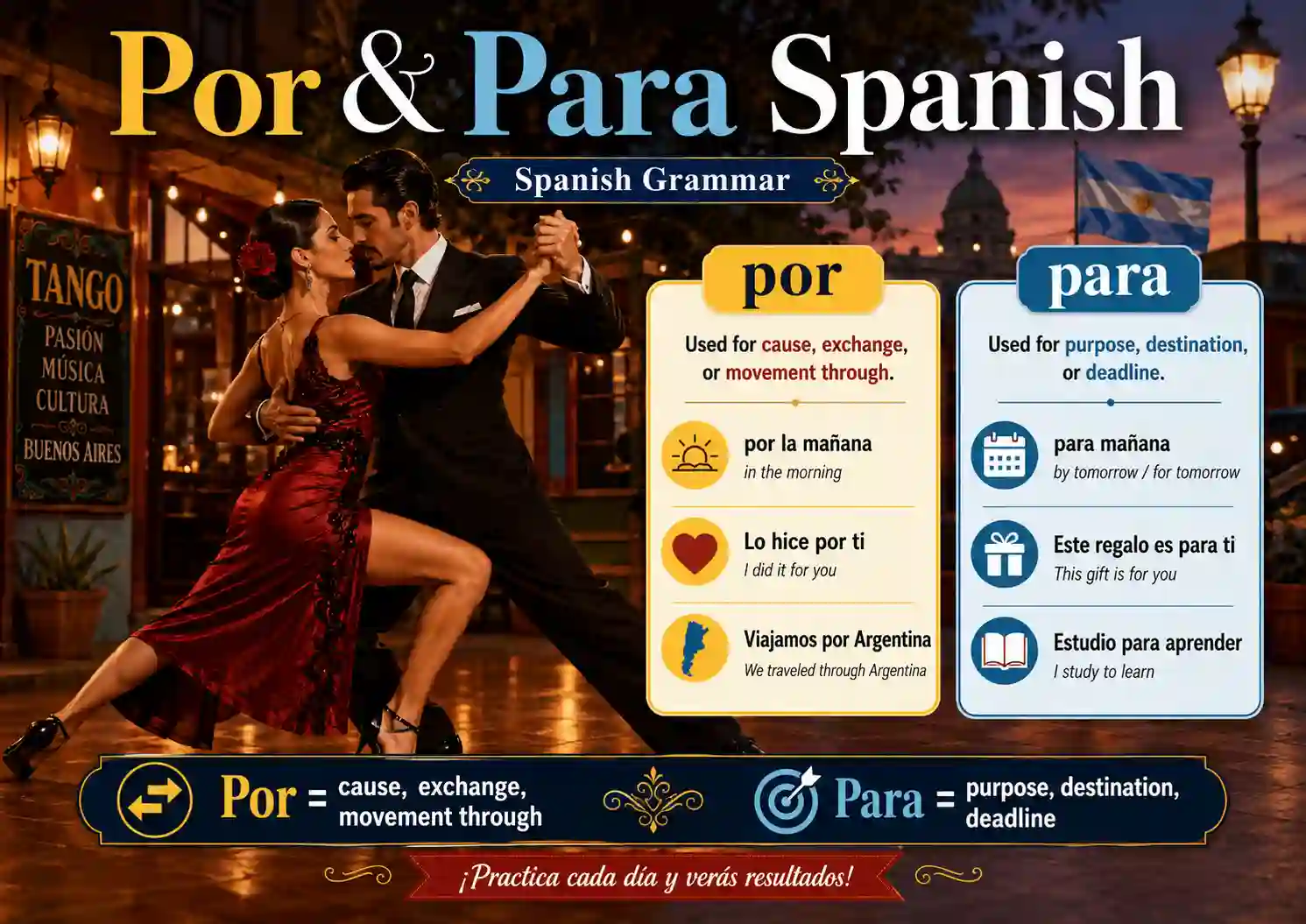
Why learn por vs para with MundoDele?
Por and para are difficult because both can sometimes be translated as “for” in English. But in Spanish they organise meaning differently.
MundoDele teaches the contrast through sentence logic: por often looks backward to cause, reason, route or exchange, while para often looks forward to purpose, destination, recipient or deadline.
How to use this page
Start with the basic contrast. Then study each use in context: cause vs purpose, route vs destination, exchange vs recipient, duration vs deadline. Finally, practise with full sentences.
Por looks at reason
Use por when something happens because of a cause or reason.
Llegué tarde por el tráfico.
I arrived late because of the traffic.
Para looks at purpose
Use para when something is done in order to achieve a goal.
Estudio para aprender.
I study in order to learn.
Compare the direction
Por often explains why or through where. Para often points to what for or where to.
Camino por el parque para llegar al centro.
The core difference between por and para
The simplest way to understand por and para is to separate cause and path from purpose and goal. Por often explains the reason, exchange or route behind an action. Para often points to the goal, recipient, destination or deadline.
| Use | Por | Para | Meaning contrast |
|---|---|---|---|
| Reason vs purpose | Lo hice por ti. I did it because of you / for your sake. |
Lo hice para ti. I made it for you. |
Reason or motivation vs intended recipient. |
| Route vs destination | Camino por el parque. I walk through the park. |
Salgo para Madrid. I leave for Madrid. |
Path through a place vs destination. |
| Exchange vs recipient | Lo compré por diez euros. I bought it for ten euros. |
Lo compré para Ana. I bought it for Ana. |
Price or exchange vs person who receives it. |
| Duration vs deadline | Estudié por dos horas. I studied for two hours. |
El trabajo es para mañana. The work is due tomorrow. |
Length of time vs target date. |
When to use por
Use por for cause, reason, route, movement through a place, exchange, price, duration, means of communication, substitution and passive agents.
| Use of por | Spanish example | English meaning | Meaning |
|---|---|---|---|
| Cause | Llegué tarde por el tráfico. | I arrived late because of the traffic. | Reason for the action. |
| Route | Caminamos por el centro. | We walked through the centre. | Movement through a place. |
| Exchange | Lo cambié por otro. | I exchanged it for another one. | One thing for another. |
| Price | Lo compré por veinte euros. | I bought it for twenty euros. | Money paid. |
| Duration | Estudié por tres horas. | I studied for three hours. | Length of time. |
| Means | Te llamo por teléfono. | I will call you by phone. | Medium or channel. |
| Substitution | Trabajo por mi compañero. | I work instead of my colleague. | In place of someone. |
| Passive agent | El libro fue escrito por Cervantes. | The book was written by Cervantes. | Agent in passive voice. |
Related page: Por in Spanish.
When to use para
Use para for purpose, goal, intended use, recipient, destination, deadline, comparison with an expectation and personal opinion.
| Use of para | Spanish example | English meaning | Meaning |
|---|---|---|---|
| Purpose | Estudio para aprender. | I study in order to learn. | Goal of the action. |
| Intended use | Esta taza es para café. | This cup is for coffee. | What something is used for. |
| Recipient | Este regalo es para Ana. | This gift is for Ana. | Person who receives something. |
| Destination | Salimos para Madrid. | We leave for Madrid. | Direction toward a destination. |
| Deadline | Necesito el informe para mañana. | I need the report by tomorrow. | Target date or deadline. |
| Opinion | Para mí, es importante. | For me, it is important. | Point of view. |
| Comparison with expectation | Para ser principiante, habla muy bien. | For a beginner, he/she speaks very well. | Measured against an expectation. |
| Goal or role | Me preparo para el examen. | I prepare for the exam. | Target or objective. |
Related page: Para in Spanish.
Cause vs purpose: por and para
Cause and purpose are one of the most important contrasts. Por explains why something happened. Para explains what the action is intended to achieve.
| Meaning | Spanish example | English meaning | Why por or para? |
|---|---|---|---|
| Cause | No salimos por la lluvia. | We did not go out because of the rain. | Por gives the cause. |
| Purpose | Salimos para comprar pan. | We went out to buy bread. | Para gives the purpose. |
| Reason | Gracias por tu ayuda. | Thank you for your help. | Por explains the reason for thanks. |
| Goal | Trabajo para ahorrar dinero. | I work in order to save money. | Para gives the goal. |
Route vs destination: por and para
Por can describe movement through or around a place. Para can describe movement toward a destination.
| Meaning | Spanish example | English meaning | Explanation |
|---|---|---|---|
| Route through | Caminamos por el parque. | We walked through the park. | The park is the route or area. |
| Destination | Salimos para Madrid. | We left for Madrid. | Madrid is the destination. |
| Passing by | Pasamos por la estación. | We passed by the station. | The station is on the route. |
| Direction toward | El tren sale para Sevilla. | The train leaves for Seville. | Seville is the intended destination. |
Related page: Spanish Prepositions of Place.
Exchange vs recipient: por and para
If something is exchanged, paid or replaced, Spanish often uses por. If something is intended for someone, Spanish uses para.
| Meaning | Spanish example | English meaning | Why? |
|---|---|---|---|
| Price | Lo compré por diez euros. | I bought it for ten euros. | Por marks exchange or price. |
| Recipient | Lo compré para Ana. | I bought it for Ana. | Para marks intended recipient. |
| Exchange | Cambié mi libro por el tuyo. | I exchanged my book for yours. | One thing replaces another. |
| Gift recipient | Este libro es para ti. | This book is for you. | The person receives the item. |
Time: duration with por, deadline with para
With time expressions, por can express duration or a general period. Para can express a target time, deadline or expected completion.
| Time meaning | Spanish example | English meaning | Preposition logic |
|---|---|---|---|
| Duration | Estudié por dos horas. | I studied for two hours. | Por gives length of time. |
| General time of day | Trabajo por la mañana. | I work in the morning. | Por gives a general period. |
| Deadline | El informe es para el viernes. | The report is due by Friday. | Para gives the target date. |
| Target time | Necesito esto para mañana. | I need this by tomorrow. | Para points forward to a deadline. |
Related page: Spanish Prepositions of Time.
Means and passive agent with por
Por is also used for means of communication or transport in some contexts, and for the agent in passive voice.
| Use | Spanish example | English meaning | Comment |
|---|---|---|---|
| Communication channel | Te mando el archivo por correo. | I send you the file by email. | Means or channel. |
| Phone | Hablamos por teléfono. | We speak by phone. | Means of communication. |
| Route | Viajamos por la costa. | We travel along the coast. | Route or area. |
| Passive agent | La canción fue escrita por Shakira. | The song was written by Shakira. | Agent of the passive action. |
Related page: Passive Voice in Spanish.
Para + infinitive for purpose
One of the most common uses of para is purpose with an infinitive. In English this often translates as “to” or “in order to”.
| Spanish sentence | English meaning | Purpose | Structure |
|---|---|---|---|
| Estudio para aprobar el examen. | I study to pass the exam. | Passing the exam. | para + infinitive |
| Trabajo para ganar dinero. | I work to earn money. | Earning money. | para + infinitive |
| Leo para aprender. | I read in order to learn. | Learning. | para + infinitive |
| Uso esta app para practicar español. | I use this app to practise Spanish. | Practising Spanish. | para + infinitive |
Common expressions with por and para
Some expressions with por and para should be learned as complete units. They are common in everyday Spanish and formal Spanish.
| Expression | Meaning | Example | Comment |
|---|---|---|---|
| gracias por | thank you for | Gracias por tu ayuda. | Reason for thanks. |
| por favor | please | Ayúdame, por favor. | Fixed expression. |
| por ejemplo | for example | Por ejemplo, podemos estudiar juntos. | Fixed expression. |
| por supuesto | of course | Por supuesto que sí. | Fixed expression. |
| para mí | for me / in my opinion | Para mí, es importante. | Point of view. |
| para siempre | forever | Te recordaré para siempre. | Fixed time expression. |
| estar para | to be about to / ready to | Estoy para salir. | Readiness or near future in some contexts. |
| estar por | to be inclined to / still pending | Estoy por llamarlo. | Intention or pending action, depending on context. |
Practice exercises: por vs para
Try to answer before opening the solutions. These exercises focus on cause, purpose, destination, deadline, exchange and duration.
Exercise 1: choose por or para
- Gracias ___ tu ayuda.
- Estudio ___ aprender español.
- Compré este regalo ___ Ana.
- Llegué tarde ___ el tráfico.
Show answers
1. por
2. para
3. para
4. por
Exercise 2: complete the sentence
- Trabajo ___ la mañana.
- Necesito el informe ___ mañana.
- Lo compré ___ diez euros.
- Salimos ___ Madrid.
Show answers
1. por
2. para
3. por
4. para
Exercise 3: explain the difference
- Lo hice por ti.
- Lo hice para ti.
- Caminamos por el parque.
- Salimos para el parque.
Show answers
1. I did it because of you / for your sake.
2. I made/did it for you as the recipient.
3. We walked through the park.
4. We left for the park as destination.
Typical mistakes with por and para
- Translating English “for” automatically: English “for” can be por or para, depending on meaning.
- Using para for causes: say llegué tarde por el tráfico, not para el tráfico.
- Using por for purpose: say estudio para aprender, not por aprender in a basic purpose sentence.
- Confusing recipient and exchange: para Ana means Ana receives it; por diez euros gives the price.
- Confusing route and destination: por el parque means through the park; para Madrid means toward Madrid.
- Confusing duration and deadline: por dos horas gives duration; para mañana gives a deadline.
- Forgetting fixed phrases: learn gracias por, por favor, por ejemplo, para mí and para siempre as complete expressions.
Related grammar topics
Spanish Prepositions
Return to the main preposition overview and compare the wider system.
Por
Study cause, route, exchange, duration, means and passive agents in more detail.
Para
Study purpose, destination, recipient, deadline, goal and opinion in more detail.
Prepositions of Time
Compare por la mañana, durante dos horas and para mañana.
Prepositions of Place
Compare route, location, origin and destination in place expressions.
Prepositional Phrases
Learn complete phrases such as por el tráfico, para estudiar and para mí.
Where to go next
After learning the contrast between por and para, continue with the individual pages for each preposition and then review time and place expressions.
Learn Spanish grammar with MundoDele
Por and para become easier when you learn the meaning behind the sentence: reason, route, exchange and duration with por; purpose, destination, recipient and deadline with para. MundoDele helps you learn these contrasts through clear examples and connected grammar paths.
FAQ: por vs para in Spanish
What is the main difference between por and para?
Por often expresses cause, reason, route, exchange, duration or means. Para often expresses purpose, destination, recipient, deadline, goal or opinion.
When do you use por in Spanish?
Use por for cause, route, exchange, price, duration, means of communication, substitution and passive agents: por el tráfico, por el parque, por diez euros, por correo.
When do you use para in Spanish?
Use para for purpose, destination, recipient, deadline, intended use and opinion: para estudiar, para Madrid, para Ana, para mañana, para mí.
How do you say “because of” in Spanish with por or para?
Use por for “because of”: por el tráfico, por la lluvia, por eso.
How do you say “in order to” in Spanish with por or para?
Use para + infinitive: estudio para aprender, trabajo para ahorrar dinero.
What is the difference between por ti and para ti?
Por ti can mean “because of you” or “for your sake”. Para ti usually means “for you” as the recipient or intended person.

About MundoDele
MundoDele connects online Spanish courses, DELE preparation, Business Spanish and cultural context into a personal Spanish learning platform.
Grammar pages are designed to explain Spanish clearly, with practical examples, real sentence logic and connected learning paths.