Zaragoza · Taifa palace and regional parliament
Aljafería Palace Zaragoza: Islamic Court, Tickets and Access
The Aljafería is neither a surviving pure Islamic palace nor simply a modern parliament building. It preserves an eleventh-century courtly setting, medieval Christian royal alterations and later institutional uses inside one complex.
Visitor informationGuides and tickets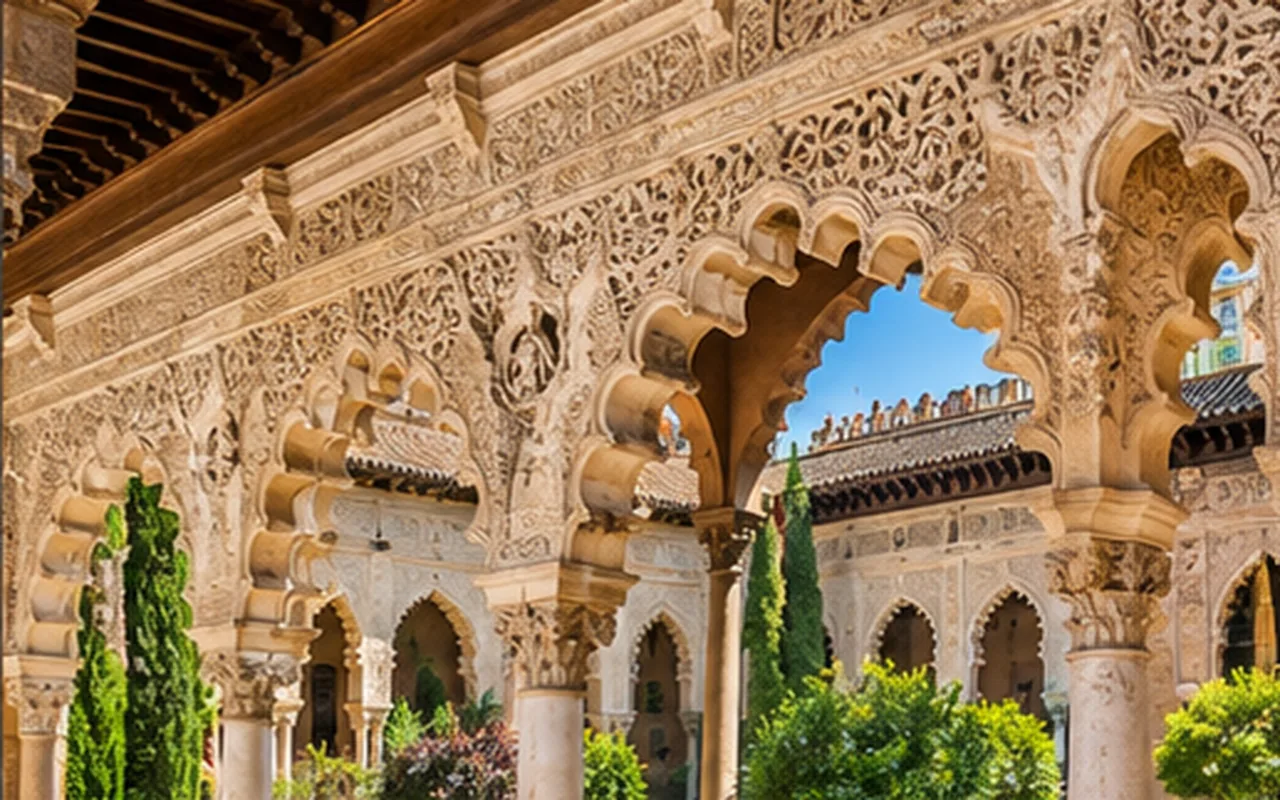
The history behind the visit
The palace is associated with Abu Ja'far Ahmad al-Muqtadir, the Banu Hud ruler of eleventh-century Saraqusta. Its decorated arcades and ceremonial spaces belong to the Taifa court that flourished in the Ebro valley before the Christian conquest of Zaragoza. The name itself is linked to the ruler's name.
After 1118, the complex passed through successive Christian royal uses, alterations, military occupation and restoration. Today it houses the Cortes of Aragon. The visitor is therefore moving through a building that continued to change function for nearly a millennium.
What to know before visiting
Facts checked November 2026; official opening and special-event schedules may change.
The Islamic palace: geometry, courtyards and court ceremony
The Patio de Santa Isabel is the organizing space of the palatial core. Its garden, water and surrounding arcades present a powerful contrast with the exterior military walls. The ornamental arches are not merely structural openings: overlapping forms and plasterwork establish a ceremonial setting appropriate to the ruler's court.
The oratory and the richly treated reception areas show how Islamic sacred and courtly design could share technical vocabulary while serving different purposes. Visitors interested in architecture should look closely at the use of plaster, geometric pattern and spatial sequence between courtyard and interior rooms.
Christian royal building and Mudéjar heritage
Aragonese rulers adapted the palace after the conquest. The Mudéjar elements combine artistic techniques associated with Islamic craftspeople and the patronage of Christian institutions. The Catholic Monarchs' palace occupies another phase, with elaborately worked wooden ceilings and ceremonial rooms.
UNESCO's Mudéjar Architecture of Aragon inscription includes surviving Mudéjar remains of the Aljafería. The listing does not mean every part of the standing palace belongs to one original Islamic construction campaign; distinguishing phases is the central interpretive task.
The regional parliament changes the visitor experience
The Cortes of Aragon operate in the building. That creates a different management environment from a museum whose sole function is tourism. Special events, parliamentary requirements, conservation work and limited spaces may affect the route available on a particular date.
It is sensible to reserve an entry time through the official Aljafería service, especially on busy travel dates, rather than assuming that an external walking-tour description gives direct unrestricted access.
The difference between general, guided and hidden-spaces visits
Turismo de Aragón lists the standard visit at €7 and notes free entry on the first Sunday of the month and the first Monday afternoon. Recent official tariff material lists €9 for a guided standard visit and €12 for a special hidden-spaces visit.
The latter is not simply a longer standard tour. The published 2026 special program entered areas such as former Islamic baths and higher levels of the Torre del Trovador, which involve tight stairs and difficult access. It was not suitable for all visitors, including people with mobility difficulties and children under twelve. Check whether the special product is scheduled for your date; it should not be treated as continuously available.
Goya in the palace — a temporary opportunity
A 2026 exhibition titled Goya: Del Museo al Palacio brings works from the painter's wider collection into spaces of the Aljafería while other museums undergo refurbishment. Zaragoza's cultural program lists a run through 31 December 2026, but exhibition schedules and included access can change.
If your interest is the palace itself, verify whether the exhibition changes the normal route. If your interest is Goya, combine this with his frescoes inside the Basilica del Pilar and check the specific exhibition booking conditions.
Palace vocabulary in Spanish
El patio is the courtyard, el palacio is palace, la entrada general is general admission and la visita guiada is guided tour. Ask ¿Esta visita incluye los espacios ocultos? — Does this visit include the hidden spaces?
Learn more about question forms with MundoDELE's interrogative pronouns.
Guided tour or independent visit?
A guided Aljafería visit should explain the Islamic court, the Christian royal phases and the parliamentary use. Compare the €7 standard entry with official guided options. A special tour to restricted spaces is a different, less accessible product and must be scheduled separately.
View Aljafería English guided visitAffiliate link. MundoDELE may earn a commission. Confirm inclusions, language and availability at the operator before payment.
Available GetYourGuide experiences
Aljafería Palace English guided tour including admission; distinct from the restricted hidden-spaces program.