
Spanish Adverbs of Quantity and Degree: Muy, Mucho, Poco and Más
Learn how Spanish expresses amount, intensity and degree with adverbs such as muy, mucho, poco, bastante, demasiado, más, menos, tan, tanto, casi, apenas, algo, nada and suficientemente.
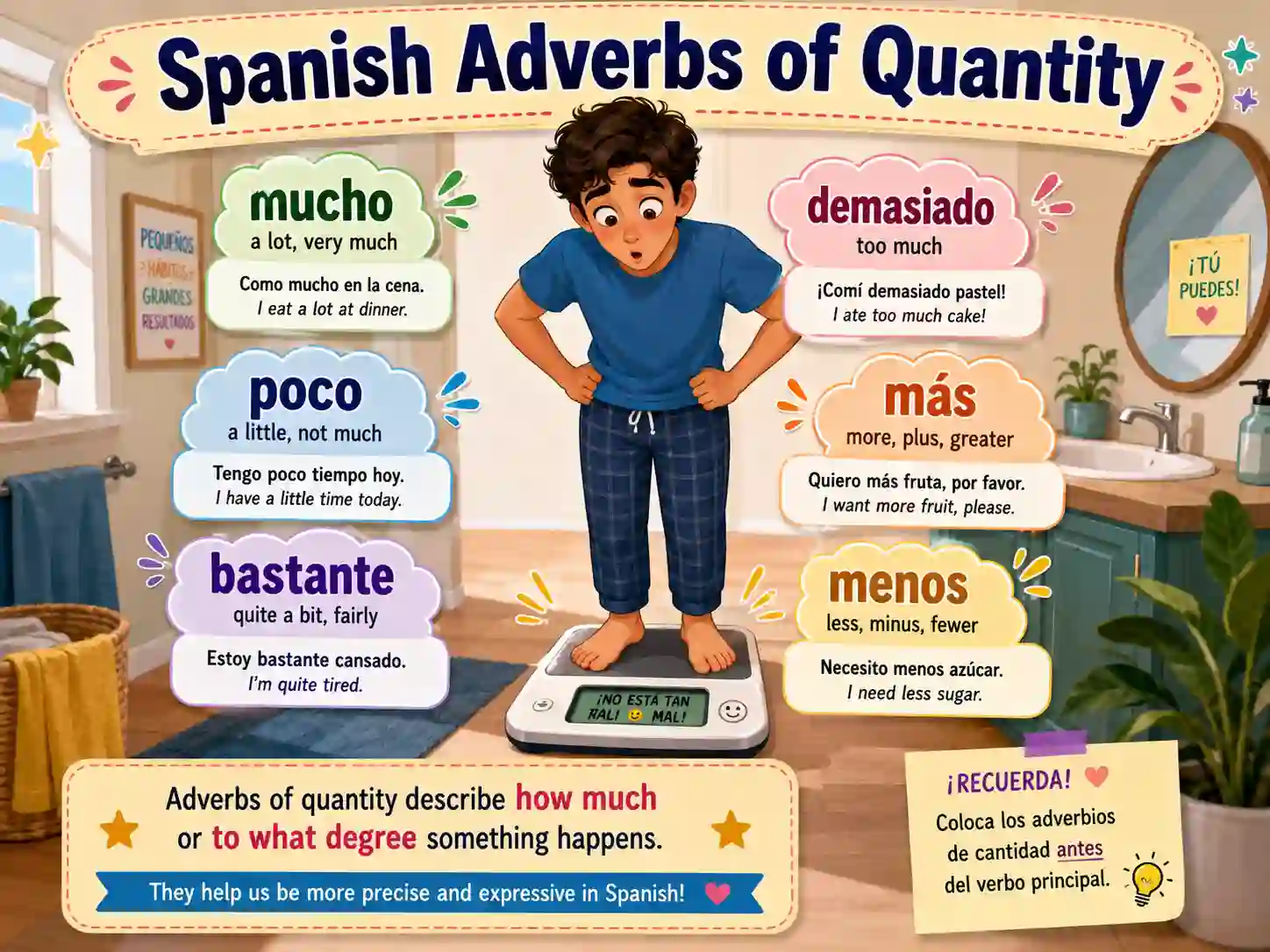
Why Spanish adverbs of quantity matter
Adverbs of quantity and degree are used constantly in Spanish because they show how intense, frequent, sufficient, excessive or limited something is. They appear with verbs, adjectives and other adverbs: trabaja mucho, muy interesante, demasiado rápido. The main difficulty is that the same forms can sometimes work as adverbs, determiners or pronouns depending on the sentence.
How to use this page
Use this page after learning basic adverbs and quantifiers. First learn the difference between muy and mucho, then study degree words before adjectives and adverbs, and quantity words after verbs.
If it modifies a verb, it functions as an adverb: estudia mucho. If it comes before a noun, it may be a quantifier: muchos libros.
Say muy difícil, muy rápido, muy bien, but not muy trabajo.
Say trabaja mucho, estudia mucho, viaja mucho.
The core system: amount, degree and intensity
Before adjectives and adverbs
Use degree adverbs before adjectives or other adverbs.
muy difícil · bastante bien · demasiado rápido
After verbs
Use quantity adverbs after verbs to describe how much an action happens.
estudia mucho · trabaja poco · viaja demasiado
Comparison and degree
Use más, menos, tan and tanto to compare degree or amount.
más rápido · menos caro · tan bien · trabaja tanto
Spanish adverbs of quantity at a glance
These adverbs express amount or degree. Some mainly modify verbs, some modify adjectives or adverbs, and some can do both depending on the sentence.
| Adverb | Main meaning | Usual use | Example | Grammar note |
|---|---|---|---|---|
| muy | very | Before adjectives and adverbs | muy interesante · muy bien | Not used directly after verbs for “a lot”. |
| mucho | a lot, much | After verbs | Estudia mucho. | As an adverb, it is invariable. |
| poco | little, not much | After verbs or before adjectives/adverbs | Trabaja poco. · poco claro | Can express low quantity or low degree. |
| bastante | quite, enough, rather | Before adjectives/adverbs or after verbs | bastante difícil · duerme bastante | Meaning depends on context. |
| demasiado | too, too much | Before adjectives/adverbs or after verbs | demasiado caro · trabaja demasiado | As an adverb, it does not agree. |
| más | more | Comparison and degree | más rápido · trabaja más | Used in comparison with que. |
| menos | less | Comparison and degree | menos caro · estudia menos | Used for lower degree or quantity. |
| tan | so, as | Before adjectives and adverbs | tan útil · tan bien como | Used for intensity or equality. |
| tanto | so much, as much | After verbs | No trabaja tanto. | As an adverb after verbs, it is invariable. |
| casi | almost | Before words or phrases | casi siempre · casi terminado | Shows near completion or near truth. |
| apenas | hardly, barely | Before or after verb phrase | Apenas habla. | Expresses very low quantity or frequency. |
Muy vs mucho
The difference between muy and mucho is one of the most important points in Spanish. Use muy before adjectives and adverbs. Use mucho after verbs when you mean “a lot”.
| Use | Correct | Meaning | Avoid |
|---|---|---|---|
| Before adjective | muy difícil | very difficult | mucho difícil |
| Before adverb | muy bien | very well | mucho bien |
| After verb | estudia mucho | studies a lot | estudia muy |
| After verb | trabaja mucho | works a lot | trabaja muy |
El curso es muy útil. — The course is very useful.
Ella habla muy bien. — She speaks very well.
Estudio mucho. — I study a lot.
Viajamos mucho. — We travel a lot.
Poco as an adverb
As an adverb, poco can mean “little”, “not much” or “not very”. It can modify verbs, adjectives and other adverbs.
Trabajo poco los domingos. — I work little / not much on Sundays.
Habla poco. — He/she speaks little.
El texto es poco claro. — The text is not very clear.
Corre poco rápido. — He/she runs not very fast.
As an adverb, poco does not change. Before nouns, however, it can become a quantifier: poco tiempo, poca agua, pocos libros, pocas personas.
Bastante as an adverb
Bastante can mean “quite”, “rather” or “enough”, depending on context. It can modify adjectives, adverbs or verbs.
El ejercicio es bastante difícil. — The exercise is quite difficult.
Habla bastante bien. — He/she speaks quite well.
Duerme bastante. — He/she sleeps enough / quite a lot.
Trabajamos bastante. — We work quite a lot / enough.
When bastante comes before a noun, it can function as a quantifier: bastante tiempo, bastantes personas. Study that use separately with Spanish quantifiers.
Demasiado as an adverb
Demasiado means “too”, “too much” or “excessively”. As an adverb, it is invariable and can modify adjectives, adverbs or verbs.
Es demasiado caro. — It is too expensive.
Habla demasiado rápido. — He/she speaks too fast.
Trabaja demasiado. — He/she works too much.
Comemos demasiado. — We eat too much.
Before nouns, demasiado can agree as a quantifier: demasiado trabajo, demasiada comida, demasiados problemas, demasiadas preguntas.
Más and menos
Más means “more” and menos means “less”. They are important adverbs for comparison and degree.
| Pattern | Example | Meaning | Related structure |
|---|---|---|---|
| más + adjective | más difícil | more difficult | Comparison |
| más + adverb | más rápido | faster / more quickly | Adverb comparison |
| verb + más | estudia más | studies more | Quantity after verb |
| menos + adjective | menos caro | less expensive | Comparison |
| verb + menos | trabaja menos | works less | Quantity after verb |
Learn the full comparison system here: Spanish Comparison.
Tan and tanto
Use tan before adjectives and adverbs. Use tanto after verbs when it means “so much” or “as much”.
| Form | Use | Example | Meaning |
|---|---|---|---|
| tan | Before adjective | tan importante | so important / as important |
| tan | Before adverb | tan bien | so well / as well |
| tanto | After verb | No trabaja tanto. | He/she does not work so much. |
| tanto como | After verb in equality | Estudia tanto como yo. | He/she studies as much as I do. |
Before nouns, tanto agrees as a quantifier: tanto dinero, tanta agua, tantos libros, tantas clases.
Casi and apenas
Casi means “almost”. Apenas means “hardly”, “barely” or “scarcely”. Both express degree, but in opposite directions.
Casi siempre estudio por la mañana. — I almost always study in the morning.
La tarea está casi terminada. — The task is almost finished.
Apenas habla español. — He/she hardly speaks Spanish.
Apenas tenemos tiempo. — We barely have time.
Casi points toward completion or high frequency. Apenas points toward very low quantity, very low frequency or minimal degree.
Algo and nada as degree adverbs
Algo and nada are often known as pronouns, but they can also function adverbially before adjectives or adverbs to express degree.
Estoy algo cansado. — I am somewhat tired.
La explicación es algo confusa. — The explanation is somewhat confusing.
No es nada fácil. — It is not easy at all.
No habla nada bien. — He/she does not speak well at all.
In this use, algo means “somewhat” and nada intensifies negation.
Suficientemente and enough
Suficientemente means “sufficiently” or “enough” in more formal or explicit contexts. In everyday Spanish, shorter patterns such as bastante or lo bastante are also common.
La respuesta es suficientemente clara. — The answer is sufficiently clear.
No habla suficientemente rápido. — He/she does not speak fast enough.
Es bastante claro. — It is clear enough / quite clear.
No estudia lo bastante. — He/she does not study enough.
Suficientemente is useful in careful writing, but it can sound heavier than shorter everyday alternatives.
Adverbs of quantity vs quantifiers
The same Spanish word can often work as an adverb or as a quantifier. The key question is what it modifies. If it modifies a verb, adjective or adverb, it works adverbially. If it introduces a noun, it works as a determiner or quantifier.
| Adverb use | Quantifier use before noun | Explanation |
|---|---|---|
| Estudia mucho. | muchos libros | Mucho modifies the verb; muchos modifies the noun. |
| Trabaja poco. | poco tiempo | Poco can modify an action or a noun phrase. |
| Habla demasiado. | demasiadas preguntas | As an adverb, demasiado is invariable; before nouns it agrees. |
| Duerme bastante. | bastantes personas | Bastante can be an adverb or a quantifier. |
Learn noun-based quantity forms here: Spanish Quantifiers.
Position of adverbs of quantity
Adverbs of quantity follow the general position rules for Spanish adverbs. They often go after verbs, but before adjectives and other adverbs.
| Position | Pattern | Example | Meaning |
|---|---|---|---|
| After verb | verb + mucho | Estudia mucho. | He/she studies a lot. |
| After verb | verb + poco | Trabaja poco. | He/she works little. |
| Before adjective | muy + adjective | muy difícil | very difficult |
| Before adverb | demasiado + adverb | demasiado rápido | too fast |
| Before adjective/adverb | bastante + adjective/adverb | bastante bien | quite well |
Learn the full word order system here: Position of Adverbs in Spanish.
Adverbs of quantity in comparison
Several quantity and degree adverbs are central to comparison: más, menos, tan and tanto.
Habla más rápido que yo. — He/she speaks faster than I do.
Trabaja menos que antes. — He/she works less than before.
Es tan difícil como el otro. — It is as difficult as the other one.
Estudia tanto como su hermano. — He/she studies as much as his/her brother.
This is why adverbs of quantity connect directly with: Spanish Comparison.
When to use Spanish adverbs of quantity
Use muy
Use muy before adjectives and adverbs to say “very”.
muy claro · muy bien
Use mucho, poco, demasiado
Use these after verbs to show how much an action happens.
estudia mucho · trabaja poco · come demasiado
Use más, menos, tan, tanto
Use these to compare quantity, degree or intensity.
más rápido · menos difícil · tan bien · trabaja tanto
Related grammar topics
Spanish Adverbs
Learn how adverbs modify verbs, adjectives, other adverbs and full sentences.
Spanish Quantifiers
Compare adverb use with noun-based forms such as muchos libros and demasiadas preguntas.
Position of Adverbs
Learn why muy comes before adjectives but mucho often comes after verbs.
Spanish Comparison
Study más que, menos que, tan como and tanto como.
Spanish Adjectives
Use degree adverbs before adjectives: muy útil, bastante difícil, demasiado caro.
Spanish Verbs
Use quantity adverbs after verbs: estudia mucho, trabaja poco, viaja demasiado.
Typical mistakes with Spanish adverbs of quantity
- Confusing muy and mucho: say muy difícil but estudia mucho.
- Making adverbs agree: as adverbs, forms such as mucho and demasiado are usually invariable: ellas trabajan mucho.
- Using noun agreement when there is no noun: say hablan demasiado, not hablan demasiadas.
- Forgetting the quantifier difference: muchos libros is noun-based, but lee mucho is adverbial.
- Using tan after verbs: use tanto after verbs: No trabaja tanto.
Where to go next
After adverbs of quantity, continue with quantifiers, adverb position and comparison. These topics explain the difference between quantity before nouns, degree before adjectives and amount after verbs.
Want personal guidance?
If Spanish quantity words feel confusing, individual guidance can help you practise muy, mucho, poco, bastante, demasiado, más, menos and the difference between adverbs and quantifiers.
FAQ: Spanish adverbs of quantity
What are Spanish adverbs of quantity?
Spanish adverbs of quantity express amount, degree or intensity. Examples include muy, mucho, poco, bastante, demasiado, más, menos, tan and tanto.
What is the difference between muy and mucho?
Muy goes before adjectives and adverbs: muy difícil, muy bien. Mucho often goes after verbs: estudia mucho.
Do adverbs of quantity agree in Spanish?
As adverbs, they are normally invariable: trabaja mucho, trabajan mucho, habla demasiado. Before nouns, some forms can work as quantifiers and agree.
What is the difference between mucho and muchos?
Mucho can be an adverb after a verb: lee mucho. Muchos is a quantifier before a masculine plural noun: muchos libros.
How do you use demasiado in Spanish?
As an adverb, demasiado means “too” or “too much”: demasiado caro, trabaja demasiado. Before nouns, it can agree: demasiadas preguntas.
What is the difference between tan and tanto?
Use tan before adjectives and adverbs: tan útil, tan bien. Use tanto after verbs: trabaja tanto.

MundoDele – Spanish learning for education, work and intercultural understanding
MundoDele connects online Spanish courses, DELE preparation, Business Spanish and cultural context into a personal Spanish learning platform.
Grammar pages are designed to explain Spanish clearly, with practical examples, real sentence logic and connected learning paths.