Alcázar of Toledo: Army Museum, Tickets and History
Toledo's Alcázar is easy to recognize from across the river. Its role today is more complex than a fortress photo suggests: it houses Spain's Army Museum, whose collections stretch across military, political and technological history, while the building itself carries the scars of twentieth-century conflict.
Visitor informationTour decisions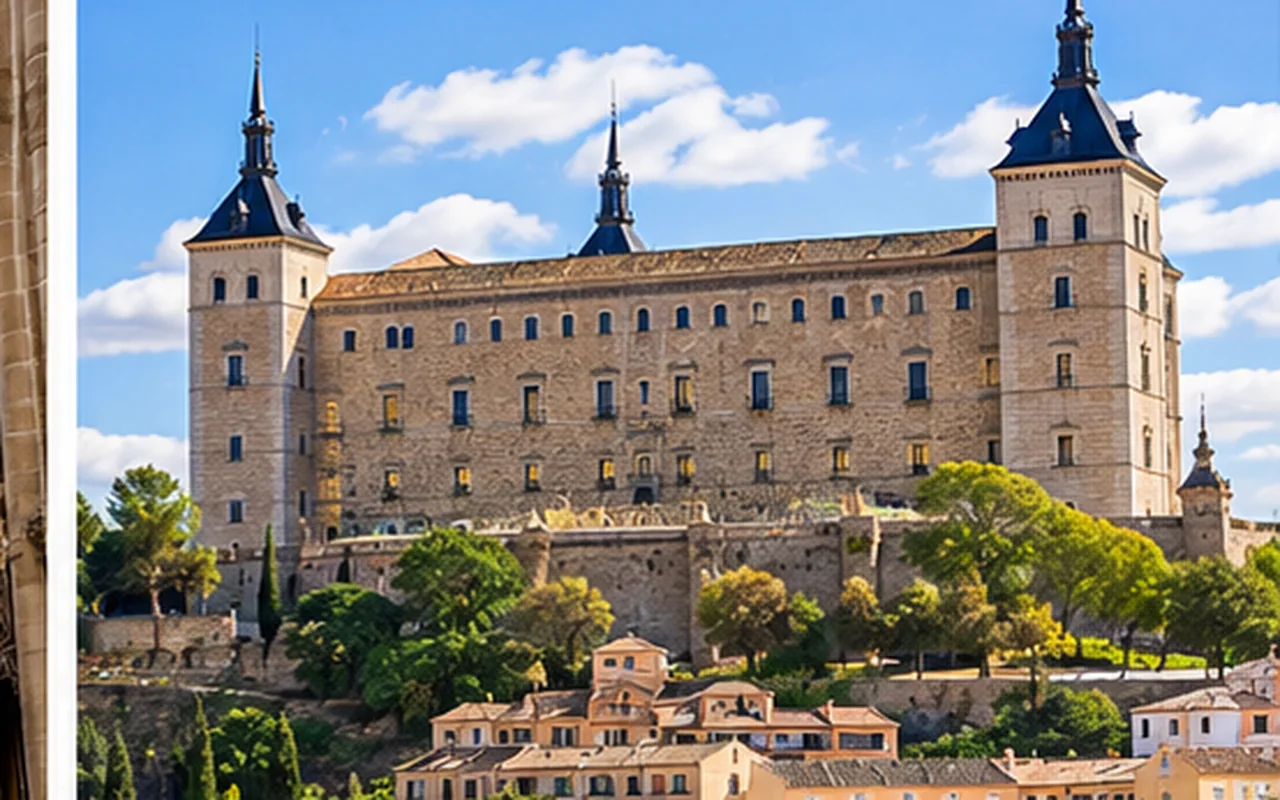
Understanding the visit
The Alcázar occupies the highest commanding ground in the city's historic center. Its site served successive rulers, and its present massive, symmetrical form is associated with early modern royal rebuilding. Seen from the Tagus valley, it dominates the skyline; from inside, the visitor enters a museum with a historical narrative much broader than Toledo alone.
The Army Museum comprises the Alcázar and an adjoining modern structure that provides visitor access. That arrangement matters when you arrive: a tourist photograph of the fortress is not necessarily a reliable guide to the museum entrance.
Practical visitor information
Checked November 2026 against the linked operator or public institution; recheck the date of your visit.
What the museum actually covers
The permanent displays document the armed forces and military history of Spain through weapons, uniforms, flags, models, decorative objects and historical collections. The official museum describes its purpose as presenting Spanish history and the military's scientific, technical and cultural contributions, in addition to its battlefield roles.
For someone expecting mainly medieval armor, the breadth can be surprising. Military institutions changed considerably between the Habsburg court, later imperial forces and the modern Spanish state. The different historical periods deserve attention separately rather than being folded into a single story of heroic battles.
The 1936 siege: part of the history, not a slogan
The Alcázar became internationally known during the Spanish Civil War, when Nationalist forces held the building under siege in 1936. The episode became a potent symbol in Francoist propaganda and remains politically and historically sensitive.
Visitors should distinguish what happened at the site from the political uses made of the story afterward. The fortress was heavily damaged and later reconstructed; it is not an untouched medieval survival. The museum's displays and surviving spaces can therefore be read as a combination of original fabric, reconstruction and curated interpretation.
How tickets and opening hours work
The Toledo municipal tourism listing gives a regular price of €5 and lists Wednesdays as free-admission days. The Army Museum's own English site states ordinary opening from 10:00 to 17:00, with admission closing thirty minutes beforehand, and Monday closure except for specified exceptional dates. The city listing describes the public visiting period as ending at 16:30, which may correspond to the final ticket-entry cutoff. Check the museum's current calendar rather than treating both times as interchangeable.
The national museum also identifies some spaces with free access — including designated temporary-exhibition areas, gardens and parts of the archaeological remains. Do not assume that free access to those spaces includes every permanent collection.
Most importantly, the €14 Toledo Monumental wristband does not include the Army Museum. The seven sites on that pass are religious and historic monuments managed through another ticketing system.
Architecture worth noticing before entering
Look at the building's relationship to the city rather than seeing it only as a museum container. The monumental square mass, corner towers and elevated position are part of the reason it became such a durable emblem of Toledo. Its historical function depended on visibility and control as much as thick walls.
Approaching from Zocodover, you can compare the exposed skyline with the tightly packed streets below. From a distant viewpoint across the river, the Alcázar and the Cathedral form two distinct landmarks: royal-military authority and ecclesiastical authority, shaping Toledo from different sides of the same hill.
Which Toledo itinerary makes the visit worthwhile
If you enjoy material culture and historical museums, set aside a substantial block of the morning. If you have only a few hours in Toledo and mainly want ecclesiastical art, the Cathedral is a more focused choice. Trying to combine both indoor attractions with several synagogues and the wristband circuit is unnecessarily rushed.
For travelers with limited mobility, the museum lists accessible facilities and adapted visitor information. The difficult part may be reaching the hilltop museum through Toledo's uneven streets; use the city transport and escalator information when planning.
Reading a museum notice in Spanish
Horario means opening hours; entrada gratuita means free admission; cerrado los lunes means closed on Mondays. A practical question is ¿Está abierto el museo hoy? — “Is the museum open today?”
Here, está abierto describes a current state. It connects with the use of estar in the Spanish grammar guide.
Guided visits and admission
Not every commercial “Alcázar tour” includes museum admission. Some city tours merely pass the exterior or include a panoramic stop. Confirm the itinerary and interior access in writing before booking, particularly if your priority is the Army Museum collections.
Compare Toledo fortress and historical toursGetYourGuide affiliate link: MundoDELE may earn a commission. Confirm precise tour inclusion, meeting point, cancellations and availability with the operator.