
Reflexive Verbs in Spanish: Me, Te, Se, Nos and Os
Learn how Spanish reflexive verbs work with reflexive pronouns — from me levanto and te llamas to se ducha, nos acostamos and quieren sentarse.
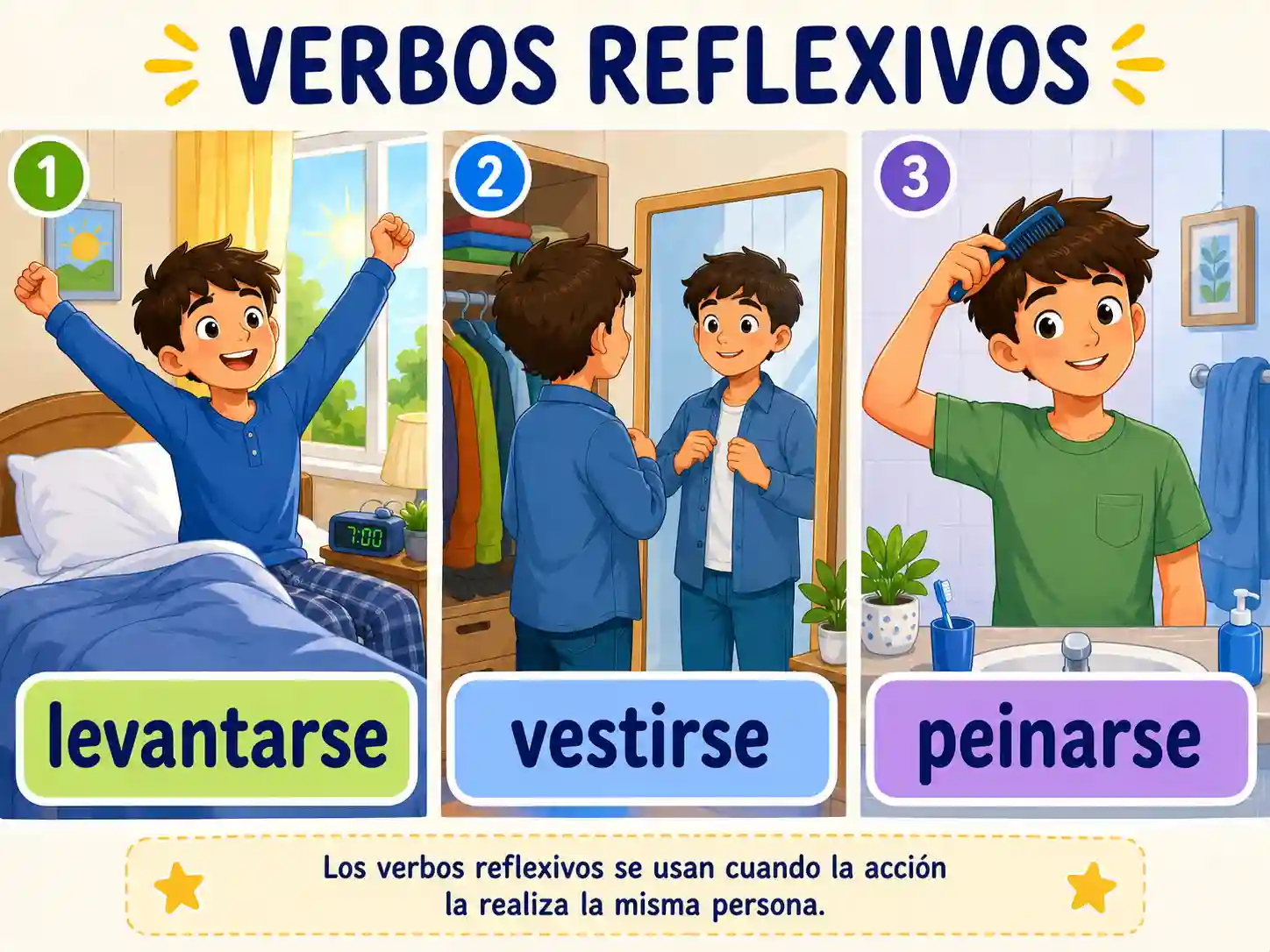
Why reflexive verbs matter
Reflexive verbs are essential for daily routines, personal information, movement, emotions and many common expressions. They also show how Spanish connects verbs with pronouns. Learning them early helps with sentences such as me llamo, me despierto, me siento bien and voy a acostarme.
How to use this page
Use this page after the general Spanish verbs overview. First learn the reflexive pronouns, then practise daily routine verbs, and finally study pronoun position with infinitives, gerunds and commands.
Dictionary forms often end in -se: levantarse, ducharse, acostarse.
Use me with yo, te with tú, se with él/ella/usted, and so on.
Say me levanto, but also voy a levantarme, estoy levantándome and levántate.
The core system: subject, verb and reflexive pronoun
Subject acts on itself
The subject and object refer to the same person or thing.
Me lavo. · Te duchas. · Se mira en el espejo.
Pronoun matches the subject
The reflexive pronoun changes with the subject.
me levanto · te levantas · se levanta
Pronoun position matters
The pronoun usually comes before a conjugated verb, but can attach to some verb forms.
me quiero levantar · quiero levantarme
Spanish reflexive pronouns
Reflexive verbs need a reflexive pronoun. The pronoun must match the subject of the verb. This is why learners should study reflexive verbs as full patterns, not only as isolated infinitives.
| Subject | Reflexive pronoun | Example with levantarse | English meaning |
|---|---|---|---|
| yo | me | Me levanto. | I get up. |
| tú | te | Te levantas. | You get up. |
| él/ella/usted | se | Se levanta. | He / she / you get up. |
| nosotros | nos | Nos levantamos. | We get up. |
| vosotros | os | Os levantáis. | You all get up. |
| ellos/ellas/ustedes | se | Se levantan. | They / you all get up. |
Why reflexive verbs end in -se
In dictionaries and grammar lists, reflexive verbs often appear with -se attached to the infinitive: levantarse, ducharse, acostarse. The -se shows that the verb is reflexive, but it changes when the verb is used with a subject.
levantarse → me levanto, te levantas, se levanta
ducharse → me ducho, te duchas, se ducha
acostarse → me acuesto, te acuestas, se acuesta
Common Spanish reflexive verbs
Many reflexive verbs describe daily routines, body care, movement, personal states or emotional reactions.
| Infinitive | Meaning | Example | Grammar note |
|---|---|---|---|
| llamarse | to be called / to be named | Me llamo Ana. | Used for names. |
| levantarse | to get up | Me levanto a las siete. | Daily routine. |
| ducharse | to shower | Se ducha por la mañana. | Body care. |
| lavarse | to wash oneself | Me lavo las manos. | Often used with body parts. |
| vestirse | to get dressed | Nos vestimos rápido. | Stem-changing verb. |
| acostarse | to go to bed | Me acuesto tarde. | Stem-changing verb. |
| sentarse | to sit down | Siéntate, por favor. | Common in commands. |
| sentirse | to feel | Me siento bien. | State or emotion. |
| quedarse | to stay | Nos quedamos en casa. | Often not literally reflexive in English. |
| irse | to leave / go away | Me voy ahora. | Highly common everyday verb. |
Position of reflexive pronouns
Reflexive pronouns usually come before a conjugated verb. With infinitives, gerunds and affirmative commands, the pronoun can be attached to the verb form.
| Structure | Pronoun position | Example | Meaning |
|---|---|---|---|
| Conjugated verb | before the verb | Me levanto temprano. | I get up early. |
| Modal verb + infinitive | before the conjugated verb or attached to the infinitive | Me quiero levantar. · Quiero levantarme. | I want to get up. |
| Ir a + infinitive | before ir or attached to the infinitive | Me voy a duchar. · Voy a ducharme. | I am going to shower. |
| Estar + gerund | before estar or attached to the gerund | Me estoy duchando. · Estoy duchándome. | I am showering. |
| Affirmative command | attached to the command | Levántate. | Get up. |
| Negative command | before the verb | No te levantes. | Do not get up. |
Reflexive vs non-reflexive verbs
Some Spanish verbs can be used reflexively or non-reflexively. The meaning changes depending on whether the action affects the subject or someone or something else.
Lavo el coche. — I wash the car.
Me lavo. — I wash myself.
Levanto la caja. — I lift the box.
Me levanto. — I get up.
Llamo a Marta. — I call Marta.
Me llamo Ana. — My name is Ana.
This is why reflexive verbs should be learned with full sentence examples, not only as vocabulary items.
Reflexive verbs for daily routines
Reflexive verbs are very common when describing daily routines. Many beginner-level Spanish texts use them to describe morning and evening habits.
Me despierto a las siete.
Me levanto y me ducho.
Me visto rápidamente.
Me peino antes de salir.
Me acuesto a las once.
When to use Spanish reflexive verbs
Actions you do to yourself
Use reflexive verbs for many routine actions.
me levanto · me ducho · me acuesto
Names and identity phrases
Use llamarse to say someone’s name.
Me llamo Ana. · ¿Cómo te llamas?
How someone feels
Use reflexive verbs such as sentirse for states and emotions.
Me siento bien. · Se siente cansado.
Related grammar topics
Reflexive Pronouns
Learn me, te, se, nos, os and se in detail.
Pronoun Position
Understand where pronouns go with conjugated verbs, infinitives, gerunds and commands.
Spanish Infinitive
Review forms such as levantarse, ducharse and acostarse.
Spanish Gerund
Practise forms such as me estoy duchando and estoy duchándome.
Spanish Imperative
Learn command forms such as siéntate, levántate and no te preocupes.
Stem-changing Verbs
Connect reflexive verbs such as acostarse, sentarse and vestirse with stem changes.
Typical mistakes with Spanish reflexive verbs
- Forgetting the reflexive pronoun: say me levanto, not only levanto when you mean “I get up”.
- Using the wrong pronoun: say me llamo for “my name is”, but se llama for “his/her name is”.
- Keeping se for every subject: levantarse becomes me levanto, te levantas, se levanta.
- Putting the pronoun in the wrong place: say quiero levantarme or me quiero levantar, not quiero me levantar.
- Missing stem changes: say me acuesto, te sientas, se viste.
Where to go next
After reflexive verbs, continue with reflexive pronouns, pronoun position and the imperative. These topics explain how reflexive forms behave in more complex sentences.
Want personal guidance?
If reflexive verbs feel confusing, individual guidance can help you practise daily routines, reflexive pronouns, pronoun position and real sentence patterns clearly.
FAQ: Reflexive verbs in Spanish
What are reflexive verbs in Spanish?
Spanish reflexive verbs are verbs where the subject and object refer to the same person or thing. They use reflexive pronouns such as me, te, se, nos, os and se.
What are the Spanish reflexive pronouns?
The Spanish reflexive pronouns are me, te, se, nos, os and se.
Why do some Spanish verbs end in se?
The -se ending in dictionary forms such as levantarse shows that the verb is reflexive. In real sentences, se changes to match the subject: me levanto, te levantas, se levanta.
Where do reflexive pronouns go in Spanish?
Reflexive pronouns usually come before a conjugated verb: me levanto. They can attach to infinitives, gerunds and affirmative commands: levantarme, levantándome, levántate.
What are common Spanish reflexive verbs?
Common Spanish reflexive verbs include llamarse, levantarse, ducharse, lavarse, vestirse, acostarse, sentarse, sentirse, quedarse and irse.
Is every reflexive Spanish verb reflexive in English?
No. Some Spanish reflexive verbs do not translate literally as reflexive verbs in English. For example, me llamo means “my name is” and me voy can mean “I am leaving”.

MundoDele – Spanish learning for education, work and intercultural understanding
MundoDele connects online Spanish courses, DELE preparation, Business Spanish and cultural context into a personal Spanish learning platform.
Grammar pages are designed to explain Spanish clearly, with practical examples, real sentence logic and connected learning paths.